
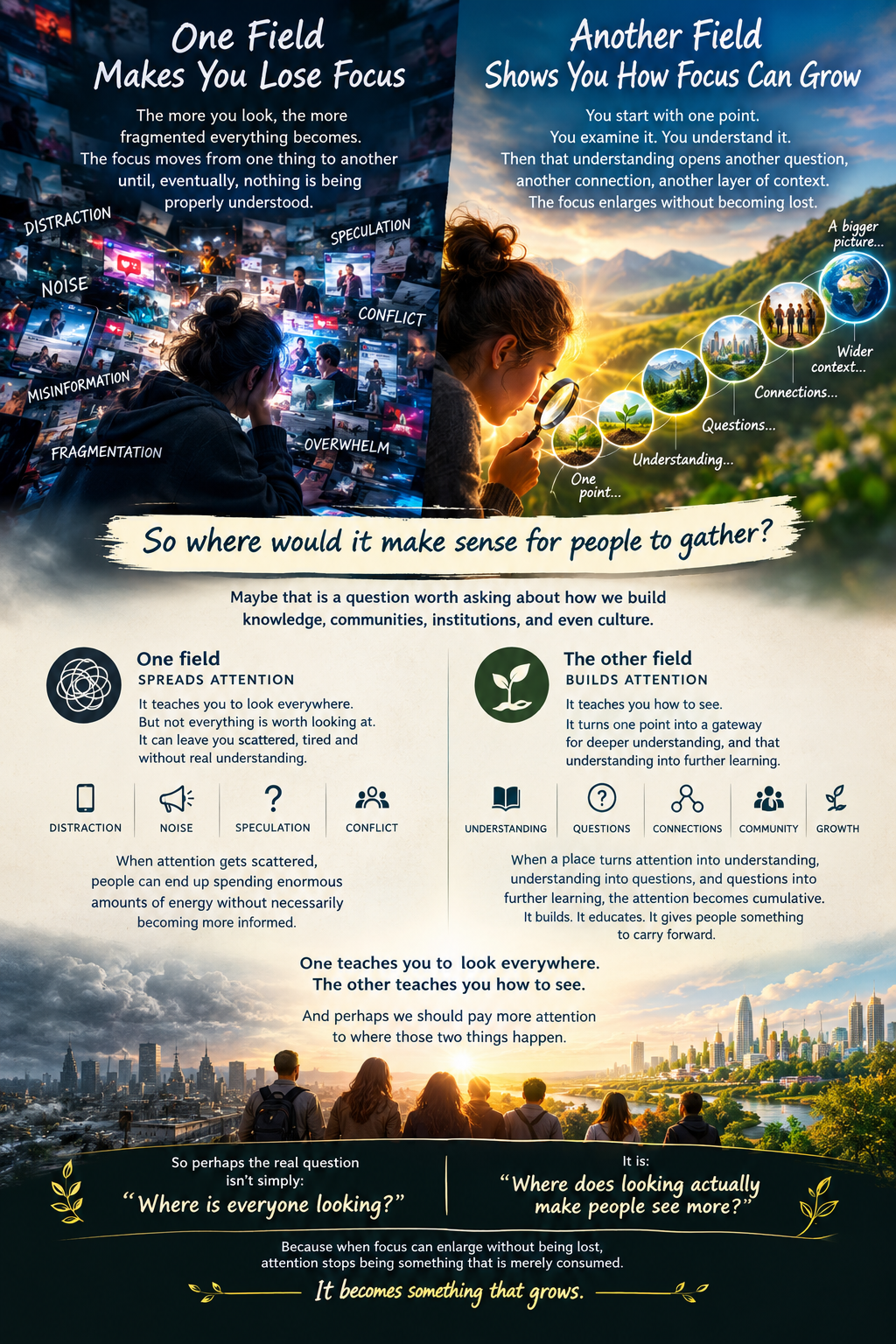
Maybe that is a question worth asking about how we build knowledge, communities, institutions, and even culture.
There are environments where attention gets scattered. The more you look, the more fragmented everything becomes. The focus moves from one thing to another until, eventually, nothing is being properly understood.
And then there are environments where attention does the opposite.
You start with one point.
You examine it.
You understand it.
Then that understanding opens another question, another connection, another layer of context.
The focus enlarges without becoming lost.
That is a very different kind of growth.
It isn’t about narrowing attention so much that nothing else exists. It is about developing enough depth in one point that the depth itself reveals a wider field.
One teaches you to look everywhere.
The other teaches you how to see.
And perhaps we should pay more attention to where those two things happen.
Because when a place consistently turns attention into confusion, distraction, speculation, or noise, people can end up spending enormous amounts of energy without necessarily becoming more informed.
Whereas when a place turns attention into understanding, understanding into questions, and questions into further learning, the attention becomes cumulative.
It builds.
It educates.
It gives people something to carry forward.
So perhaps the real question isn’t simply:
“Where is everyone looking?”
It is:
“Where does looking actually make people see more?”
Because when focus can enlarge without being lost, attention stops being something that is merely consumed.
It becomes something that grows.





Leave a Reply