
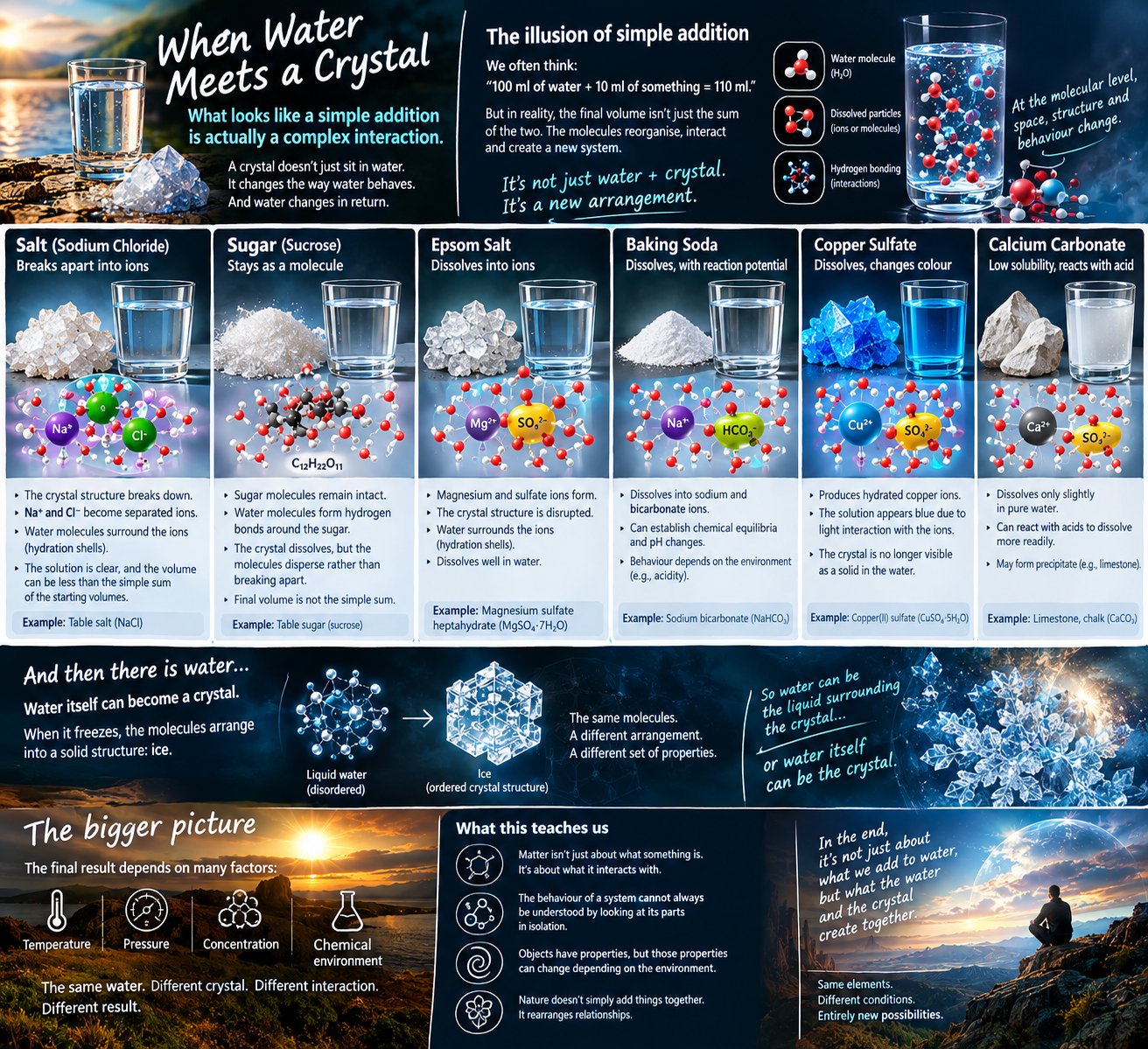
We often imagine adding something to water as a simple equation.
100 millilitres of water.
Add 10 millilitres of something.
Surely we get 110 millilitres.
But nature doesn’t necessarily work like that.
We saw it with salt.
We saw it with sugar.
And once you start looking at crystals more closely, you realise that “adding” something to water is not really about putting two objects beside each other. It is about changing a system.
A crystal looks like a solid block of matter.
Sugar looks like sugar.
Salt looks like salt.
A grain of something appears to have a definite size and occupy a definite amount of space.
But that is the view our eyes give us.
At the molecular level, something very different is happening.
Salt: the crystal comes apart
Take sodium chloride.
In the crystal, sodium and chloride are arranged in a repeating structure.
When salt enters water, that structure can come apart.
The sodium and chloride become separated ions, with water molecules surrounding them.
So the salt hasn’t simply remained as a little solid object floating inside the water.
The entire arrangement has changed.
Sugar: the molecule stays together
Sugar gives us a fascinating contrast.
Sucrose is made of individual molecules, and when it dissolves, those molecules generally remain intact rather than splitting into positive and negative ions.
Water molecules surround the sugar molecules and interact with them.
So, in a simplified way:
Salt breaks apart into ions.
Sugar disperses as molecules.
Different microscopic behaviour.
But the same bigger lesson:
The final system is not necessarily the starting materials simply added together.
The molecules reorganise.
The spaces between them change.
Their interactions change.
And therefore the measurable properties of the whole solution can change.
But sugar and salt aren’t the only possibilities
This is where things become even more interesting.
Not every crystal behaves like sugar.
Not every crystal behaves like salt.
And not every crystal even dissolves significantly in water.
Take Epsom salt, for example, which is magnesium sulfate heptahydrate.
It dissolves in water and produces magnesium and sulfate species in solution. The crystal structure is disrupted and the ions become surrounded by water.
Then there is baking soda, sodium bicarbonate.
It also dissolves in water, but its chemistry is different again because bicarbonate can participate in acid-base reactions and establish equilibria in solution.
Then consider copper sulfate.
It dissolves in water, producing a blue solution because of the way the hydrated copper ions interact with light.
The crystal is no longer sitting there as a blue crystal inside the water.
The microscopic organisation has changed, and the whole system now has different optical and chemical properties.
Then there are substances such as calcium carbonate, found in materials like limestone and chalk.
Put that into ordinary water and you don’t simply get the same kind of easy dissolution you see with table salt or sugar.
Its solubility is relatively low.
And under different chemical conditions, some of it can react with acids and dissolve much more readily.
So now we have another possibility:
Some crystals dissolve easily.
Some dissolve only a little.
Some require particular chemical conditions.
Some may react rather than simply dissolve.
And some barely dissolve at all.
And water has its own crystal
There is another beautiful twist to this.
Water itself can become a crystal.
When water freezes, the molecules arrange themselves into an organised solid structure:
ice.
So water can be the liquid surrounding the crystal…
or water itself can become the crystal.
That means the relationship isn’t simply:
water + crystal
It can also become:
water → organised crystal structure
and then:
crystal → liquid water again.
The same molecules.
A different arrangement.
A different set of properties.
This is why “space” gets so interesting
A crystal occupies space.
Water occupies space.
But the final mixture isn’t necessarily the simple sum of what our eyes told us those spaces were.
Why?
Because what we measure macroscopically is the consequence of an enormous number of microscopic interactions.
Particles are moving.
Molecules are attracting and repelling one another.
Structures are breaking apart.
New arrangements are forming.
Water is organising itself around dissolved substances.
The result depends on the particular substance, its concentration, temperature, pressure and the chemical environment.
So instead of thinking:
A + B = A sitting beside B
nature often gives us something more like:
A + B = a new arrangement of A and B.
And that distinction matters.
Perhaps the deeper lesson is this
We often think of objects as if their properties belong entirely to themselves.
Sugar is sweet.
Salt is salty.
Water is wet.
A crystal is solid.
But place them into another environment and their behaviour can change dramatically.
The crystal that was rigid can disperse.
The substance that was visible can become molecularly distributed.
The liquid that looked unchanged can acquire completely different physical properties.
And sometimes the substance doesn’t dissolve at all.
Sometimes it reacts.
Sometimes it precipitates back out.
Sometimes a new crystal forms from the solution.
So matter isn’t simply about what something is.
It is also about what it is interacting with.
That might be one of the simplest ways of seeing a profound scientific idea:
The behaviour of a system cannot always be understood by looking at its parts in isolation.
Salt behaves one way.
Sugar behaves another.
Epsom salt behaves another.
Copper sulfate behaves another.
Calcium carbonate behaves another.
And water responds differently to each of them.
Same water.
Different crystal.
Different interaction.
Different result.
And perhaps that is why the world around us is so much more interesting than the simple arithmetic of “I added this to that.”
Because nature isn’t merely adding things together.
It is rearranging relationships.



Leave a Reply