
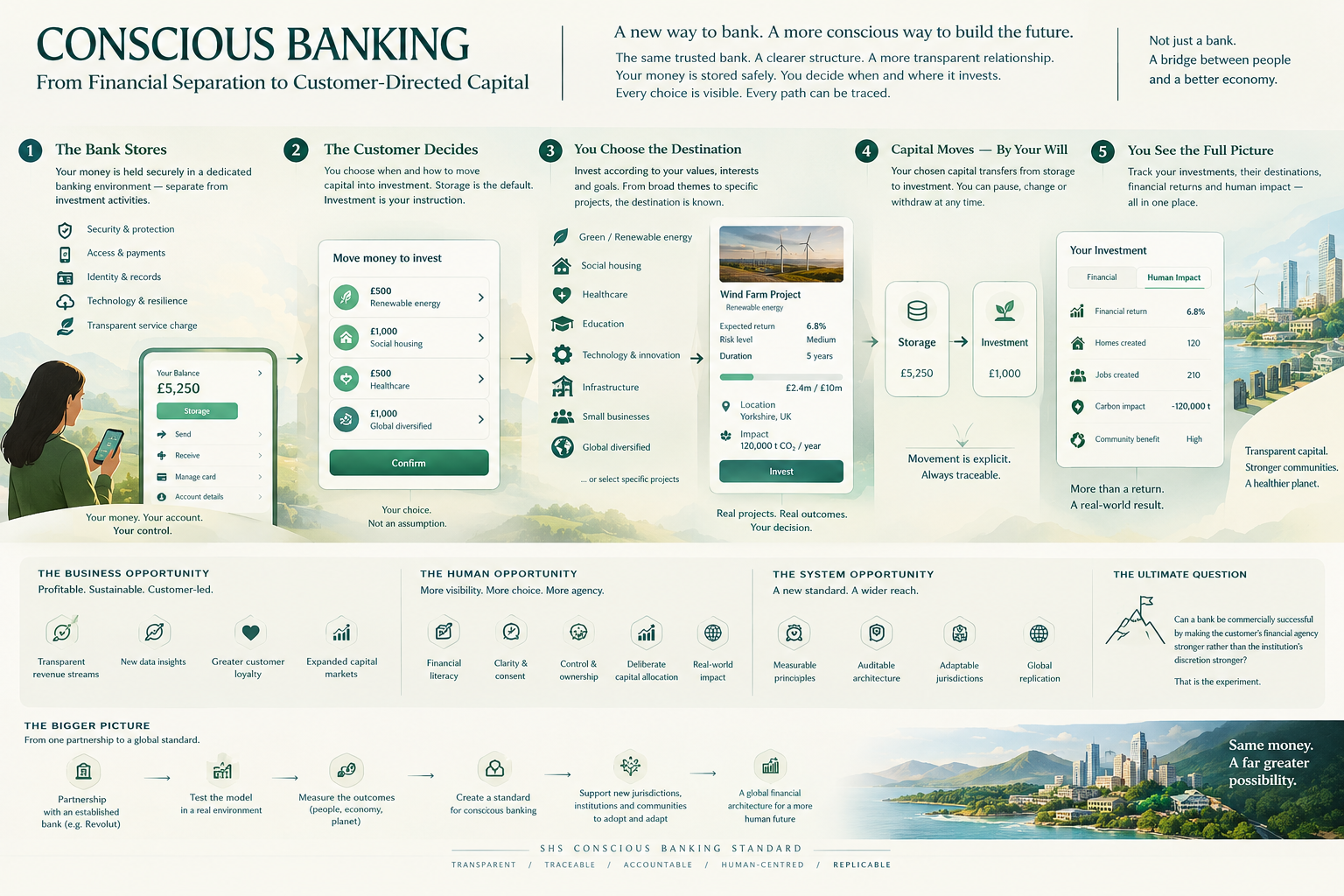
From Financial Separation to Customer-Directed Capital
A strategic research review of the SHS Banking model and the opportunity for partnership with an established financial institution
There is a much larger opportunity hidden inside the original SHS Banking proposition.
At first glance, the idea appears to be about creating a bank that stores people’s money rather than treating customer balances as a source of institutional opportunity.
But the deeper proposition is considerably more ambitious.
It is about creating a financial institution in which the movement from personal storage into economic risk is itself a conscious, visible and voluntary act.
That changes the relationship between the bank, the customer and the economy.
The bank can still make money.
The bank can still invest.
Investment banking can still exist.
Customers can still pursue returns.
Businesses can still receive capital.
Industries can still grow.
But the architecture no longer assumes that these activities must all be blended together simply because they happen to sit inside the same financial ecosystem.
The result could be a new proposition:
A bank that does not merely tell people that it serves them, but structurally demonstrates where its authority over their money begins and ends.
And that is potentially far more commercially interesting than simply launching another bank.
1. The real innovation is not “don’t invest customer money”
The proposition should be stated more precisely.
The objective is not to suggest that every existing bank literally takes money from a particular customer’s current account and directly purchases shares in an industry without separation or accounting controls. Modern banking is more complicated than that.
The Bank of England describes commercial banks as creating deposits through lending and operating across multiple financial functions; the relationship between deposits, lending and capital is not simply a giant pile of physical cash being passed from savers to investors.
Likewise, current UK regulation already contains mechanisms for separating certain customer assets and activities. FCA client-assets rules, for example, require relevant firms to segregate client money from the firm’s own money, while the UK’s ring-fencing regime separates core retail banking activities from certain investment-banking activities in large banking groups.
So SHS should not present its novelty as:
“Nobody has ever separated banking from investment.”
That would be factually too broad.
The more powerful claim is:
SHS makes the separation itself the organising principle of the customer relationship.
That is different.
The customer does not merely benefit from regulatory separation happening somewhere in the background.
The customer sees the separation.
And the customer gets to decide when money crosses it.
2. Storage becomes a genuine financial product
The first product is extraordinarily simple.
STORAGE.
Not “current account plus mysterious economics.”
Not “deposit account plus a financial ecosystem the customer never fully sees.”
Not “your money happens to participate in an institutional balance sheet while you use the app.”
The proposition is:
You are paying for financial storage.
The institution provides:
security;
access;
payments;
infrastructure;
identity;
records;
technology;
resilience;
and custody arrangements appropriate to the structure.
The customer pays a transparent service charge.
That charge is the commercial price of the service.
This creates an unusually clean business proposition.
The bank can say:
We make money from operating the bank. We don’t need your stored money to become our speculative investment capital.
That is immediately understandable.
And understandable products are commercially powerful.
3. Then investment becomes a second doorway
This is where the architecture becomes exciting.
The customer opens the same application.
There is:
BANKING
and
INVESTING.
But they are not psychologically or economically the same thing.
Banking says:
Keep my money here.
Investing says:
I want this portion of my money to participate in an investment.
That second decision is deliberate.
The customer could therefore move money:
from Storage → into Investment
because they chose to.
Not because the institution silently decided that the availability of customer balances gives it an investment opportunity.
That creates an explicit boundary:
Storage is the default. Investment is an instruction.
That could become one of the defining features of conscious banking.
4. The customer chooses the destination
Now the proposition becomes considerably larger.
Suppose a person says:
“I only want my investment capital supporting renewable energy.”
The system could provide an investment pathway built around that preference.
Another person might say:
“I want social housing.”
Another:
“I want healthcare.”
Another:
“I want education.”
Another:
“I want technology.”
Another:
“I want infrastructure.”
Another:
“I want small businesses.”
And another might simply say:
“I don’t care about thematic investment. Give me the broadest diversified portfolio available.”
All of these people can use the same bank.
The difference is that investment becomes a conscious economic participation choice.
That changes money from something people merely hold into something they can deliberately direct.
5. The most powerful version: project-level participation
The idea can go further than sectors.
Imagine an investment interface in which an appropriately structured customer can see:
Project: £40 million social-housing development
Amount seeking investment: £8 million
Expected return: X
Risk: X
Duration: X
Fees: X
Purpose: 200 homes
Location: X
Developer: X
Impact metrics: X
The customer can then decide whether that investment matches their objectives and risk tolerance.
This creates something that ordinary banking interfaces rarely make emotionally visible:
the destination of capital.
The customer does not merely see:
£5,000 invested.
They can potentially see:
“My £5,000 is participating in this economic activity.”
That is a profound change in financial literacy.
Money becomes traceable participation.
6. The customer becomes economically conscious
This is where the phrase Bank of Consciousness begins to justify itself.
Consciousness is not simply knowing your balance.
It is knowing:
what you own;
what you have authorised;
where your investment went;
what risks you accepted;
what returns you received;
what fees were charged;
what the institution earned;
what the investment ultimately financed.
The bank becomes an interface between the human being and the economy.
That is much more ambitious than an account-management application.
7. The investment business can remain highly profitable
This architecture does not require the partner bank to become financially weak.
That is important.
The institution can operate a separate investment business.
It can earn:
execution fees;
management fees;
advisory fees where appropriate;
platform fees;
performance-related remuneration where appropriately structured;
institutional investment revenue;
corporate-finance revenue;
licensing revenue;
technology revenue;
and other legitimate commercial income.
The essential difference is that these revenues arise from financial services the customer or institutional client knowingly enters into, rather than assuming that customer storage itself is the institution’s investment fund.
That creates a new question for banking:
Can profitability be generated by giving customers more financial choice rather than by giving the institution more discretion?
That is an extraordinarily attractive experiment.
8. And the commercial relationship can become more equitable
The investment component could also introduce a different revenue-sharing architecture.
For example, an investment service might openly disclose:
Customer receives: X%
Investment manager receives: X%
Bank/platform receives: X%
Other costs: X%
The exact economics would need professional investment, tax, accounting and regulatory design.
But the principle matters.
The customer can see the economic split.
That changes the question from:
“What did the bank make?”
to:
“How was the economic outcome shared between the person providing the capital and the institution providing the service?”
That is directly connected to the SHS Equity Stress Test.
The bank’s profitability no longer has to be treated as the customer’s loss.
It can become a transparent exchange.
9. The legal opportunity is bigger than simply “consent”
This is where the proposition becomes particularly interesting from a governance perspective.
There is an enormous difference between:
“The customer accepted the terms.”
and:
“The system recorded exactly what the customer chose.”
The second creates a much richer evidential architecture.
Imagine an investment transaction containing a permanent decision record:
Customer
→
investment selected
→
amount authorised
→
risk disclosure received
→
fees disclosed
→
destination identified
→
customer confirmation
→
transaction executed
That creates a traceable chain.
It does not automatically immunise an institution from liability. Customer consent cannot simply contract away every regulatory obligation, misrepresentation, negligence issue or duty that may apply.
But it can materially clarify the factual question:
Who chose what?
That matters enormously.
The FCA already requires firms to identify and manage conflicts of interest, including circumstances in which a firm’s financial interest differs from the client’s interest.
And the Consumer Duty requires firms to act to deliver good outcomes, avoid foreseeable harm, support customers in pursuing their financial objectives, and provide appropriate product governance, fair value, consumer understanding and support.
SHS could take that logic further experimentally by making customer intention a first-class piece of the architecture.
10. The “legal blind spot” is better understood as an accountability blind spot
The strongest formulation is therefore not:
“The bank has a legal loophole.”
That would require a specific legal finding.
The stronger research proposition is:
Whenever storage, investment, institutional incentives and customer choice become difficult to distinguish, accountability becomes more difficult to trace.
That is the potential blind spot.
Who decided?
Who benefited?
Who bore the risk?
Who knew?
Who disclosed it?
Who authorised it?
Who could have stopped it?
Who controlled the capital?
Who selected the investment?
Who received the economic benefit?
A consciously separated system can answer those questions far more cleanly.
11. The SHS “metaphysical lawyer”
This is where the user’s metaphysical-law concept can become extremely useful as an accountability methodology, without pretending that it is currently recognised legal authority.
The metaphysical lawyer does not need to replace conventional law.
It asks a different question:
What would the complete human consequence chain look like if we traced the decision beyond the formal legal documents?
Take a single investment.
The formal legal record might say:
customer authorised transaction.
The SHS human-accountability record could additionally trace:
where the capital went;
what activity it financed;
what economic consequence followed;
who benefited;
who bore costs;
what foreseeable consequences existed;
whether the customer’s stated values were respected;
whether the representation made to the customer accurately reflected reality.
That creates a second analytical map.
The legal system asks:
Was the law complied with?
The metaphysical accountability layer asks:
What actually happened to humanity because this decision was made?
The two can then be compared.
That could become one of SHS’s most distinctive intellectual contributions.
12. The 2008 lesson needs to be stated accurately
There is an important correction that actually strengthens the SHS proposition.
It would be too simple to say:
“The 2008 financial crisis happened because commercial banking and investment banking were merged.”
The evidence does not support that as a complete causal explanation.
The Financial Crisis Inquiry Commission identified a much broader system of causes and amplifiers, including excessive leverage, poor mortgage underwriting, securitisation, opaque derivatives, inadequate risk management, interconnection and concentrations of risk.
Former Federal Reserve Chair Jerome Powell likewise argued that the repeal of Glass-Steagall was not itself a meaningful explanation for the crisis, noting that the systemic run began with investment banks that were not affected by the repeal.
But there is an important SHS lesson within the history.
The UK subsequently introduced ring-fencing to protect core retail banking from shocks arising elsewhere in banking groups and global financial markets. The PRA describes the purpose explicitly as insulating core retail activities from risks elsewhere in the group.
So SHS is not rediscovering a forgotten principle.
It is asking:
What if the principle of separation were taken all the way down to the individual customer relationship?
That is much more interesting.
13. What Revolut makes particularly interesting
A Revolut partnership is especially interesting because Revolut is not a hypothetical tiny fintech.
Revolut says it had more than 80 million retail customers globally and $67.5 billion in customer balances at the end of 2025, while its UK banking entity began operating under its UK banking licence in March 2026.
More importantly for this particular experiment, Revolut already has separate structures around banking and investment.
Its UK current-account relationship is with Revolut Bank UK Ltd, while investment services are provided through separate investment arrangements; its UK investment platform is operated by Revolut Trading Ltd under FCA regulation and separate terms.
Revolut also states that investment customers’ assets and client money are subject to the FCA’s client-assets framework, and it explicitly warns that investment value can fall as well as rise.
So the opportunity should not be pitched to Revolut as:
“You need to separate banking and investing because you currently have no separation.”
The more compelling pitch would be:
“You already possess much of the infrastructure necessary to separate these functions. SHS wants to make that separation the defining human-centred architecture of the customer relationship.”
That is a far more credible proposition.
14. Revolut could become the first host of a new banking category
Imagine Revolut participating in a programme labelled something like:
SHS Conscious Banking Environment
Inside the existing digital infrastructure, a dedicated experimental environment could test:
Storage
Customer-directed investment
Explicit capital transfer
Investment destination visibility
Impact categories
Project-level investment
Transparent revenue sharing
Human-impact reporting
Consent records
Financial resilience
Customer financial education
The established bank does not have to cease being itself.
It becomes the infrastructure partner through which something new is observed.
That is the opportunity.
15. The reputational opportunity could be enormous
The bank would have an opportunity that cannot simply be purchased through advertising.
It could become:
the first established banking institution to host a scientifically observed conscious-banking architecture.
Not “the nicest bank.”
Not “the greenest bank.”
Not “the most customer-friendly bank.”
Something more concrete:
the bank that helped test whether financial services can be structurally redesigned around customer consciousness, explicit consent and transparent capital allocation.
That could create enormous intellectual and brand value.
And critically, the bank would not have to claim the experiment succeeded.
It could say:
“We are testing it.”
That is more credible.
16. Customer loyalty becomes architectural rather than promotional
This could generate a different form of customer loyalty.
A traditional loyalty programme says:
“Stay with us and receive rewards.”
A conscious banking relationship says:
“Stay because you understand the relationship and trust the architecture.”
That is potentially much deeper.
A customer who knows:
where their money is;
what it is doing;
what it isn’t doing;
what they have chosen;
what they haven’t chosen;
what the bank earns;
what investments they support;
and what happens during stress
has a fundamentally different relationship with the institution.
The customer isn’t simply attached to the app.
They understand the institution.
17. The investment marketplace becomes a new source of economic discovery
Now the scale becomes much larger.
Suppose millions of customers each direct relatively small amounts toward particular objectives.
Suddenly the bank can observe:
What people actually want to finance.
Which industries attract voluntary capital.
Which projects attract demand.
Which social outcomes people are willing to support.
Which projects retain investment.
Which fail.
Which geographical areas attract capital.
Which categories generate strong returns.
The bank has effectively created a continuously updating map of human-directed capital demand.
That is powerful information.
The financial institution stops simply asking:
“What can we sell?”
It can begin asking:
“What does humanity voluntarily want to build?”
18. Investment becomes a civic-economic interface
That has implications beyond banking.
A person could potentially use their financial participation to express:
economic preference
social preference
environmental preference
community preference
innovation preference
without requiring the government to make the decision for them.
The investment platform therefore becomes a meeting point between:
money
choice
production
values
projects
human consequences.
This is exactly where SHS can connect banking to its wider governance architecture.
19. The system could measure the human impact of capital
This creates another unprecedented possibility.
Imagine that every qualifying investment has two measurements:
Financial return
What did the investment produce financially?
Human impact
What happened because the investment existed?
Potential metrics could include:
homes created;
jobs created;
energy capacity;
carbon impact;
health capacity;
education access;
businesses supported;
infrastructure delivered;
community outcomes;
productive capacity;
and other independently measurable indicators.
Then the investment interface could eventually show:
Financial return: X
Human impact: Y
Not as a substitute for financial analysis.
As an additional dimension.
That would directly connect SHS Banking with the broader SHS principle:
Money is a representation. What matters is what the represented financial activity actually produces.
20. The bank becomes a bridge rather than a gatekeeper
This may be the biggest philosophical transformation.
Traditional financial architecture can make the institution appear to stand between the human being and economic participation.
SHS reverses that relationship.
The bank becomes a bridge:
Human
↓
Financial storage
↓
Choice
↓
Investment
↓
Production
↓
Outcome
↓
Measurement
↓
Human benefit
The bank is still essential.
But it is no longer the unquestioned owner of the entire journey.
21. This creates a powerful network effect
Once customers begin selecting investments according to their preferences, businesses have an incentive to become eligible for those investment categories.
A company might therefore want to demonstrate:
clean production
strong labour practices
social impact
housing creation
technological innovation
community investment
environmental performance
because customers could deliberately choose where their capital goes.
The financial system then starts sending signals in a different direction.
Not merely:
“Can the company make enough money?”
but potentially:
“Can the company attract voluntary capital from people who understand what it does?”
That creates competition around transparency and consequence.
22. And the bank itself has an incentive to remain trustworthy
This is where the economics become interesting.
The bank makes money when customers use the service.
Customers remain when they trust the architecture.
Trust therefore becomes economically productive.
But trust cannot simply be manufactured through branding.
It must survive:
a recession;
a cyberattack;
a failed investment;
a major dispute;
a financial shock;
an operational incident;
a regulatory review;
and a period in which the bank’s own profitability is under pressure.
That gives SHS an extraordinary stress test:
Does the institution still protect the boundary when breaking the boundary would be financially attractive?
That is where consciousness becomes measurable.
23. Success should be tested backwards
This brings the entire experiment back to the SHS X on the map principle.
Suppose the experiment succeeds.
Do not merely say:
“It worked.”
Mark the X.
Then retrace.
Why did the customer trust it?
Because the money was visibly separated.
Why was it separated?
Because the accounting architecture required it.
Why did the accounting architecture exist?
Because the governance agreement required it.
Why did governance require it?
Because SHS established the customer-storage principle.
Why did customers stay?
Because they experienced transparency and control.
Why did investors participate?
Because they could choose the economic destination.
Why did businesses participate?
Because voluntary customer capital created a new funding channel.
Why did the bank remain profitable?
Because the bank’s revenue model did not depend on treating customer storage as discretionary investment capital.
And so on.
Every successful outcome becomes a chain.
That chain is the treasure map.
24. The biggest opportunity may actually be the standard
The final product may not be the SHS bank.
It may be the SHS Conscious Banking Standard.
A standard could eventually specify measurable principles such as:
Storage must be distinguishable from investment.
Investment must require explicit customer instruction.
Investment destinations must be disclosed to the appropriate level of detail.
Conflicts must be identified and managed.
Fees must be visible.
Customer and institutional financial interests must be distinguishable.
The customer should be able to see the consequences of their financial choices.
Failure events must be recorded and investigated.
Human outcomes must be measured alongside financial outcomes.
That standard could then be offered to other institutions.
At that point, SHS no longer needs to build every bank.
It has created something banks can adopt.
25. The path toward a new jurisdiction
This is also where the user’s wider vision of a new banking jurisdiction becomes realistic as a research sequence.
It should not begin with:
“Here is the new law.”
It should begin with:
“Here is the working system.”
Then:
Here is the data.
Here are the failures.
Here are the corrections.
Here are the measurable outcomes.
Here are the controls.
Here are the customer experiences.
Here is what survived stress testing.
Here is what did not.
Then the legal architecture can be constructed around demonstrated functions.
That produces a radically different legislative philosophy:
Law follows tested human-serving architecture.
rather than:
Architecture is forced to exist inside assumptions that have never themselves been experimentally examined.
26. The world could take the architecture home
That is the genuinely civilisational opportunity.
The final goal does not need to be:
“Everyone must bank with SHS.”
It can instead become:
“Every jurisdiction should have access to a banking architecture that can be independently implemented, audited, tested and improved.”
Then a country could take the model and adapt it.
A community could adapt it.
A cooperative could adapt it.
An established bank could adapt it.
A fintech could adapt it.
Different jurisdictions could retain their own laws while adopting the underlying architecture.
And SHS could continue learning from each implementation.
That is how a prototype becomes a global contribution.
27. The ultimate differentiation
The most compelling way to explain SHS Banking may therefore be this:
Conventional financial platform
Here are financial products.
Conscious financial platform
Here is your financial position, here are your choices, here is where your capital can go, and here is what you have explicitly authorised.
That sounds like a subtle difference.
It is not.
The first model primarily gives the customer products.
The second gives the customer financial agency.
28. What would make an established bank say yes?
The proposition to the partner should therefore contain several simultaneous opportunities.
Commercial opportunity
Develop a new revenue stream based on transparent services and customer-directed investment.
Technology opportunity
Use existing infrastructure to test a new financial architecture without rebuilding every rail from the ground up.
Customer opportunity
Create a product that makes financial relationships more understandable and participatory.
Trust opportunity
Build customer trust through demonstrable structural boundaries rather than marketing language alone.
Capital-market opportunity
Create a new channel through which customers can voluntarily direct capital toward industries, projects and outcomes.
Data opportunity
Generate high-quality evidence about what customers actually want to finance.
Governance opportunity
Develop new mechanisms for recording consent, conflicts, outcomes and institutional responsibility.
Reputation opportunity
Become an early institutional participant in a demonstrably experimental approach to banking.
Standard-setting opportunity
Help shape a framework that could eventually be adopted beyond the original partnership.
Human opportunity
Demonstrate that financial infrastructure can become more transparent without becoming economically unsustainable.
29. What would make humanity say yes?
The human proposition is even simpler.
People could gain:
greater visibility
greater choice
clearer ownership
clearer consent
greater financial literacy
more deliberate capital allocation
more information about economic consequences
a clearer distinction between saving and investing
a potentially stronger resilience architecture
and, importantly,
the ability to participate in economic creation according to choices they actually understand.
The bank becomes not merely somewhere money sits.
It becomes a place where a human being can understand their relationship with the economy.
30. The final experiment
The ultimate SHS experiment can therefore be stated in one sentence:
Can a bank be commercially successful by making the customer’s financial agency stronger rather than making the institution’s discretion stronger?
Then test it.
Can it store money sustainably?
Can it protect the storage function?
Can the institution finance itself?
Can customers deliberately choose investments?
Can customers identify where capital goes?
Can investment businesses remain profitable?
Can conflicts be reduced and made more visible?
Can customer loyalty increase?
Can customers better understand their financial decisions?
Can the architecture withstand recession?
Can it withstand institutional stress?
Can it survive independent scrutiny?
Can another bank reproduce it?
Can another country reproduce it?
Can the resulting standard be converted into law?
Can the law remain adaptable?
Can the system keep learning?
That is the experiment.
CONCLUSION
The bank stops being the place where money disappears into the economy. It becomes the place where the human being can see how they participate in it.
The greatest opportunity created by SHS Banking is therefore not simply safer storage.
It is visible financial agency.
A person can store.
A person can choose.
A person can invest.
A person can see.
A person can withdraw.
A person can understand.
And the institution can still make money.
That is the commercial breakthrough.
The bank does not need to stop being a business.
It needs to stop making the customer’s lack of visibility part of its business model.
The established-bank partnership makes this even more powerful because the experiment can begin with infrastructure that already exists.
In a Revolut-type partnership, this is particularly interesting because the institution already has a separately structured banking relationship and investment platform, rather than requiring those concepts to be invented from zero.
SHS would therefore be testing the next step:
What happens when the separation is no longer merely a corporate or regulatory arrangement, but becomes the centre of the customer’s experience?
Storage is storage.
Investment is investment.
The bank’s money is the bank’s money.
The customer’s money is the customer’s money.
And movement between those worlds occurs because the customer consciously chooses it.
That is the point where banking becomes something different.
Not because investment disappears.
Not because profit disappears.
Not because banks disappear.
But because the relationship becomes legible.
And once the relationship becomes legible, it becomes measurable.
Once it becomes measurable, it becomes accountable.
Once it becomes accountable, it can be improved.
Once it can be improved, it can be replicated.
And once it can be replicated, humanity can decide whether it deserves to become the next banking architecture.
That is where the X on the map becomes extraordinarily important.
The objective is not merely to reach the X.
It is to know exactly how we got there.
Every successful customer outcome becomes a coordinate.
Every failure becomes another coordinate.
Every correction becomes another coordinate.
Every profitable mechanism becomes another coordinate.
Every safeguard becomes another coordinate.
Every unexpected consequence becomes another coordinate.
Eventually the map becomes complete enough that another institution — and eventually another country — can follow the route.
That is the much bigger opportunity.
SHS Banking would not merely attempt to build a better bank.
It could attempt to discover, through a functioning established institution, what the architecture of a genuinely conscious financial relationship looks like when it is subjected to real life.
And if reality keeps returning the same answer —
then the bank is no longer just a bank.
It becomes the first working specimen of a financial architecture that humanity can examine, challenge, improve, reproduce and ultimately take home.



Leave a Reply