
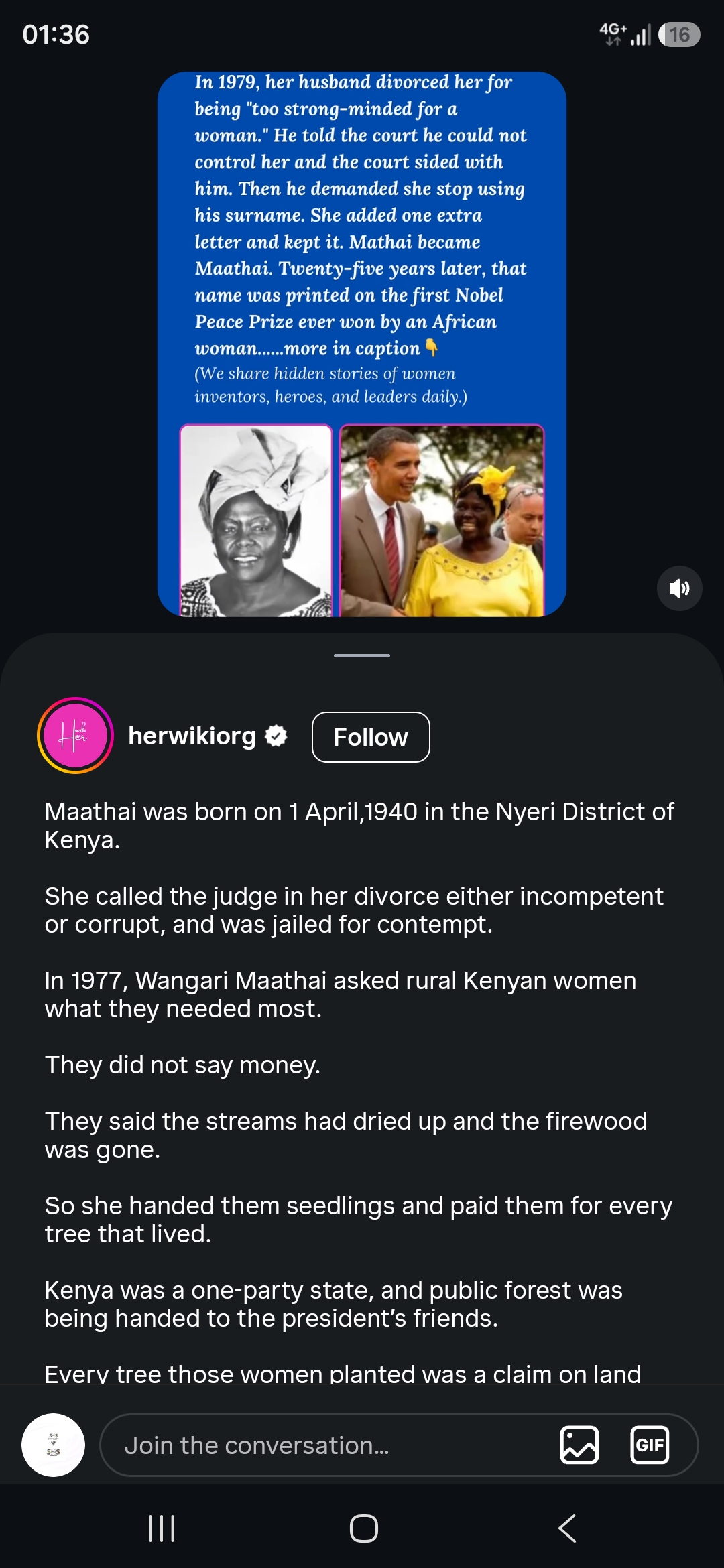
The divorce that did not define her

Maathai’s courage was tested in her personal life as well as in public.
She married Mwangi Mathai in 1969, and they had three children. Their marriage eventually ended in divorce. The account widely circulated about their separation says that her husband objected to her strong-mindedness and independence.
Following the divorce, she retained the surname Maathai, reportedly adding an extra letter to distinguish it from her husband’s spelling of Mathai. The story has since become a powerful symbol of a woman refusing to let a failed marriage dictate how she would identify herself.
Her life was not without personal hardship. She also faced imprisonment, public humiliation and repeated attempts to discredit her work. But she continued to pursue her education, her activism and her responsibilities to the communities she served.
Maathai had earned a doctorate in biological sciences from the University of Nairobi in 1971, becoming the first woman in East and Central Africa to achieve that distinction. She subsequently became the first woman to chair a university department in the region.
Her achievements were not dependent on a husband’s approval, political permission or society’s comfort with an independent woman.
The Nobel Prize that made history

On 10 December 2004, Wangari Maathai received the Nobel Peace Prize.
She became the first African woman to receive the award. The Nobel Committee recognised her contribution to sustainable development, democracy and peace.
Consider what that recognition represented.
The woman whose environmental activism had brought her into conflict with political authorities was now being recognised internationally for understanding something fundamental: peace cannot be separated from the conditions in which people live.
Where forests disappear, livelihoods suffer. Where communities lose access to land and resources, insecurity grows. Where citizens cannot challenge those who exercise power, environmental and social injustices become harder to confront.
Maathai had connected these issues through work that began with ordinary people planting trees.
By the time of her Nobel recognition, the Green Belt Movement had helped communities plant tens of millions of trees across Kenya. The movement had also become a model of grassroots environmental action and women’s empowerment.
In 2002, she was elected to Kenya’s parliament, and in 2003 she became an assistant minister for the environment, natural resources and wildlife. She was no longer simply challenging political power from outside government; she was also participating in public institutions.
What Wangari Maathai understood
Her story is often told as an environmental success story, a feminist story or a story about overcoming adversity. It is all three, but it also reveals something deeper about how meaningful change happens.
Maathai did not treat the problems facing rural women as isolated inconveniences. She looked at the relationships between the land, the economy, the community and the political system.
She understood that giving people money would not necessarily restore a dried-up stream. That telling women to work harder would not replenish a depleted forest. That environmental protection could not succeed without people who understood their own power to participate in it.
And she understood that a tree was more than a tree.
It could mean firewood for a household, protection against soil erosion, a healthier watershed, an income for a woman who planted it and a community taking responsibility for its future.
She turned an environmental intervention into an instrument of human empowerment.
That is why her legacy extends beyond conservation. She demonstrated that people do not always need to wait for a grand political programme before beginning to change their circumstances. Sometimes, they need the opportunity, the knowledge, the resources and the organisation to act together.
A legacy that outlived her
Wangari Maathai died in Nairobi on 25 September 2011, aged 71.
But the movement she founded continues to carry forward her work.
Her life leaves us with a question that applies far beyond Kenya:
What happens when we stop treating people as helpless recipients of solutions and start recognising them as participants in creating those solutions?
Maathai’s answer was not merely a speech, a book or a political promise. It was a movement built through the hands of ordinary people, one seedling at a time.
She was a scientist who understood ecosystems, an activist who challenged authority, a woman who insisted on her independence and a leader who recognised that the natural world and human society could not be separated.
Her name became internationally recognised not because she demanded that history remember her, but because she helped people change the conditions in which they lived.
And perhaps that is the most enduring lesson of Wangari Maathai’s life:
You do not have to control the whole system to begin changing it. You have to understand what needs to change, recognise what you can do, and give others the means to do it with you.
She planted trees. The trees restored land. The work empowered women. The movement challenged power. And the world eventually recognised the woman who had helped set it all in motion.
Wangari Maathai’s revolution was green, but its roots were human. 🌱
Sources for further reading: The Green Belt Movement — Wangari Maathai’s biography; Nobel Prize — Official Nobel biography.

Leave a Reply