
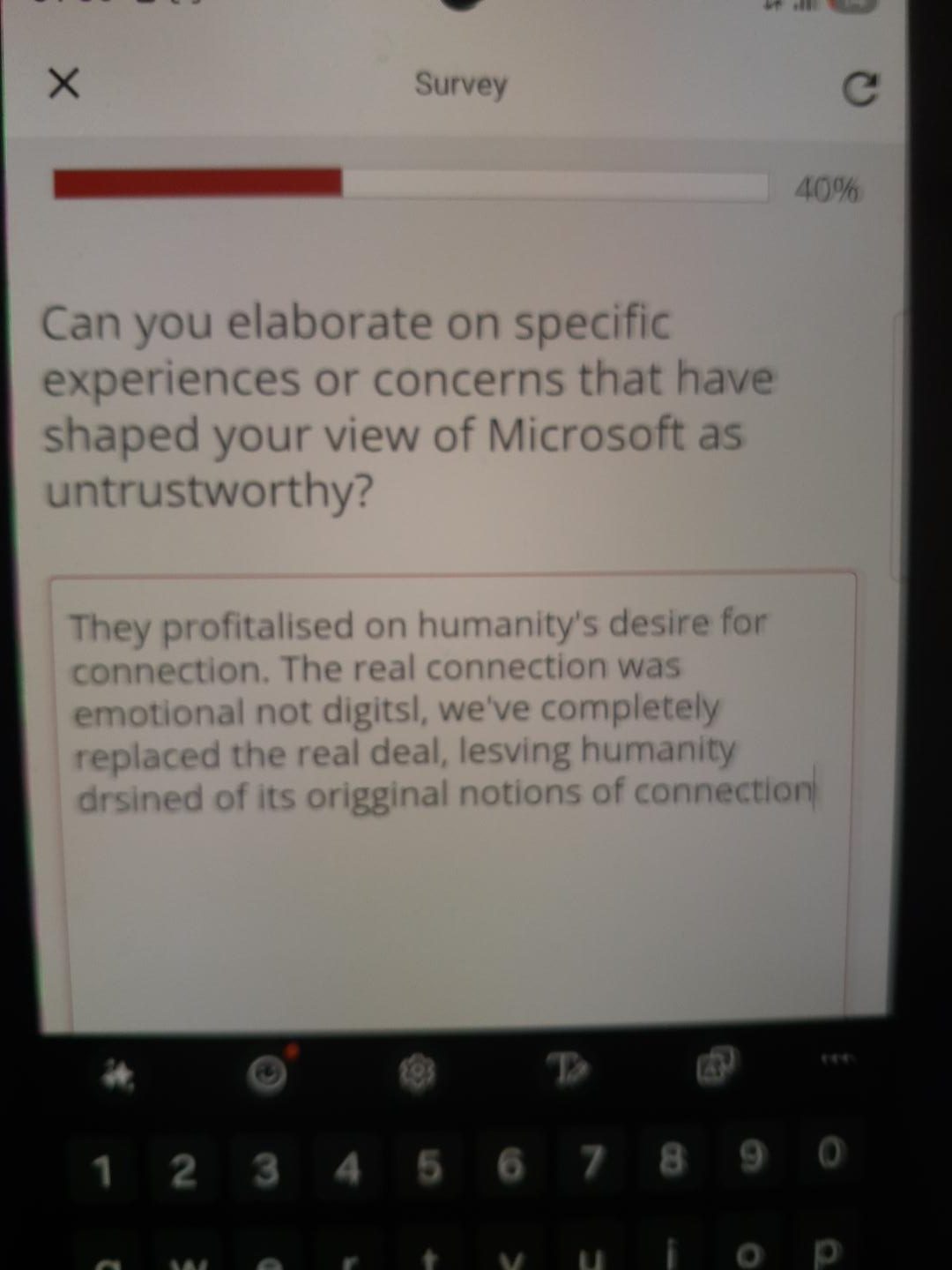
All tech companies. Ibm, google, microsoft, meta, cisco, nvidia, dell, the AWFUL lot.
[ Write a piece on rhis. They preyed on people’s needs for connections and made money off of it. If they cared they would have given it for free. They weren’t lacking money. Connection has become a business, it is not natural anymore. We need a detox, a hiatus. A pause from it ]
They preyed on humanity’s need for connection and turned it into a business.
Think about that for a moment. One of the most fundamental human needs — the desire to be heard, understood, acknowledged, loved and connected to others — became an opportunity for commercial profit. Instead of simply asking how humanity could remain connected, an entire industry emerged around how much money could be made from our desire to connect.
And we called it progress.
They understood that human beings are social creatures. We seek companionship. We want to belong. We want to share our experiences, express our thoughts, build relationships and feel that we matter to someone. These are not newly discovered desires. They are part of what it means to be human.
Yet, rather than protecting these needs from commercial exploitation, we built businesses around them.
We created platforms. We created subscriptions. We created accounts, profiles, networks and digital environments through which human beings could reach one another. We made connection dependent on technologies owned by companies whose success could be measured by how much participation, attention and money they could attract.
They turned a human need into a revenue stream.
And here is the question I keep coming back to: if the priority was genuinely humanity’s need for connection, why did access to that connection have to become such a lucrative business?
These companies were not ordinary people struggling to afford a means of communication. They built enormous commercial operations around a fundamental human desire. They had the resources, the infrastructure and the capacity to make decisions about how their services would be provided. They could choose what to charge, what to offer and what kind of relationship they wanted to establish with the public.
The argument is not that technology has no costs. The argument is that when a basic human need becomes a source of enormous commercial opportunity, we must question whether the business is serving the need or exploiting it.
If humanity’s connection had truly been the priority, why wasn’t greater emphasis placed on making it accessible without turning every interaction into an economic opportunity? Why did we become so comfortable with a world in which our need to communicate could be packaged, marketed and monetised?
We should not confuse a company’s ability to provide a useful service with proof that its interests are aligned with humanity’s.
A business can provide something valuable and still exploit the need that makes people depend on it. Those two things are not mutually exclusive.
We have forgotten what connection is.
Connection was never supposed to mean having an internet connection.
It was never supposed to mean having an account, a contact list, a profile or a device through which we could reach somebody. These are tools. They are not the human experience itself.
Real connection is emotional. It is the feeling of being understood without having to explain everything. It is sharing a laugh with someone beside you. It is sitting together in silence without feeling the need to escape into a screen. It is the comfort of another person’s presence, the spontaneity of a conversation and the relationships we build by actually sharing life with one another.
Digital communication can support those experiences. It can help people overcome distance, maintain relationships and find companionship when physical contact is not possible. Its usefulness is not in question.
What deserves questioning is the gradual replacement of the experience by the mechanism.
We have made it possible to contact almost anyone, almost anywhere, at almost any time. Yet the availability of communication does not automatically create intimacy, belonging or fulfilment. We can exchange messages all day and still feel alone. We can be surrounded by digital interactions and increasingly detached from the people and places immediately around us.
We have mistaken access for connection.
And the more accustomed we become to receiving our social lives through commercial digital environments, the harder it becomes to recognise what has been displaced.
When was the last time we allowed ourselves to be fully present with another person without reaching for a device? When did spontaneous human interaction become something that needed to be arranged through an application? Why has a world filled with communication tools become so dependent on them to facilitate what human beings have been doing naturally for generations?
We have not simply changed how we connect. We have changed the conditions under which connection happens.
Connection is no longer natural. It has become a business.
Consider what happens when something natural becomes commercialised. The business begins to shape how the thing is accessed, experienced and valued.
Connection becomes a service. Presence becomes a notification. Social participation becomes measurable activity. Attention becomes commercially valuable. The human desire to belong becomes an opportunity to encourage further engagement.
The danger is that the business no longer needs to ask whether we have connected meaningfully. It can benefit simply because we keep participating.
And that creates a fundamental conflict.
Human connection should be valuable because of what it gives to human beings. A commercial system, however, can benefit from the time we spend inside it regardless of whether that time leaves us more connected, less connected, fulfilled or dissatisfied.
The two objectives are not automatically aligned.
We need to be able to question an industry that has inserted itself between people and one of their most basic human needs. We need to question why so much of our social participation has become dependent on privately operated systems. We need to ask whether the infrastructures built in the name of connecting humanity are helping us live more fully with one another, or simply encouraging us to spend more of our lives inside the environments they control.
This is not a call to deny the benefits of communication technology. It is a call to stop treating technological participation as an unquestionable good.
Just because a business can profit from a human need does not mean that the need should be organised around the business.
Humanity needs a detox. A hiatus. A pause.
Perhaps what we need now is not another platform, another device or another promise that the next technological development will finally bring us closer together.
Perhaps we need to step back.
A detox from the constant expectation to be digitally available. A hiatus from the assumption that every moment must be documented, shared, answered or mediated through technology. A pause in which we can rediscover what it means to interact with one another without a commercial environment sitting between us.
Not an enforced abandonment of useful technology. Not a denial of the people whose circumstances make digital communication essential. And not an attempt to turn back time.
A deliberate break from our unquestioned dependence on it.
We need room to experience life without constantly translating it into digital activity. We need to restore value to physical presence, face-to-face conversation, shared experiences and communities built through direct participation. We need to allow ourselves to become comfortable with being unavailable online while remaining present in the world.
Imagine what could happen if we stopped treating every technological convenience as something that must become a permanent feature of our lives. What if we assessed these systems not only by what they make possible, but also by what they encourage us to abandon? What if we gave ourselves permission to use technology when it serves us and step away when it begins to occupy space that belongs to real life?
The purpose of a detox is not necessarily to reject something forever. It is to interrupt a pattern long enough to recognise our relationship with it.
We need that interruption.
We need to rediscover which relationships we maintain because they genuinely nourish us and which habits we have developed because the systems around us make constant participation feel normal. We need to remember that being reachable is not an obligation, that silence is not a failure to communicate and that a life does not become more meaningful simply because more of it happens online.
Most importantly, we need to reclaim the freedom to connect with one another without having our need for connection continually translated into somebody else’s commercial opportunity.
Give humanity back to humanity.
Imagine an approach to technology that regarded digital services as instruments rather than destinations. An approach that helped people overcome distance but encouraged direct human interaction whenever it was possible and appropriate. An approach that measured success not merely through participation and revenue, but through whether people were better equipped to live, relate and flourish beyond the technology itself.
That would require a different understanding of responsibility.
It would require companies to recognise that providing a connection service does not make them the owners of the human need behind it. It would require society to scrutinise the consequences of commercialising our relationships. And it would require us, as individuals, to reconsider the extent to which we have allowed convenience and commercial interests to determine the conditions of our social lives.
We do not owe a business our continued participation simply because it has built a useful tool. We do not have to accept every new layer of digital integration as progress. And we should not have to surrender more of our attention, time and lives merely because an industry has learned how to profit from the things we naturally desire.
Connection belongs to humanity before it belongs to any market.
It always did.
The question now is whether we are willing to reclaim it.
Perhaps the most revolutionary thing we could do in a world that keeps finding new ways to connect us digitally is to pause, put the devices down and turn towards one another.
Not to post about it. Not to monetise it. Not to make a business out of it.
Simply to be there.
Humanity does not need another business teaching it how to connect. Humanity needs the space to remember what connection means.
And that is why we need a detox. A hiatus. A pause.
Not from humanity.
From the systems that have taught us to experience humanity through them.




Leave a Reply