
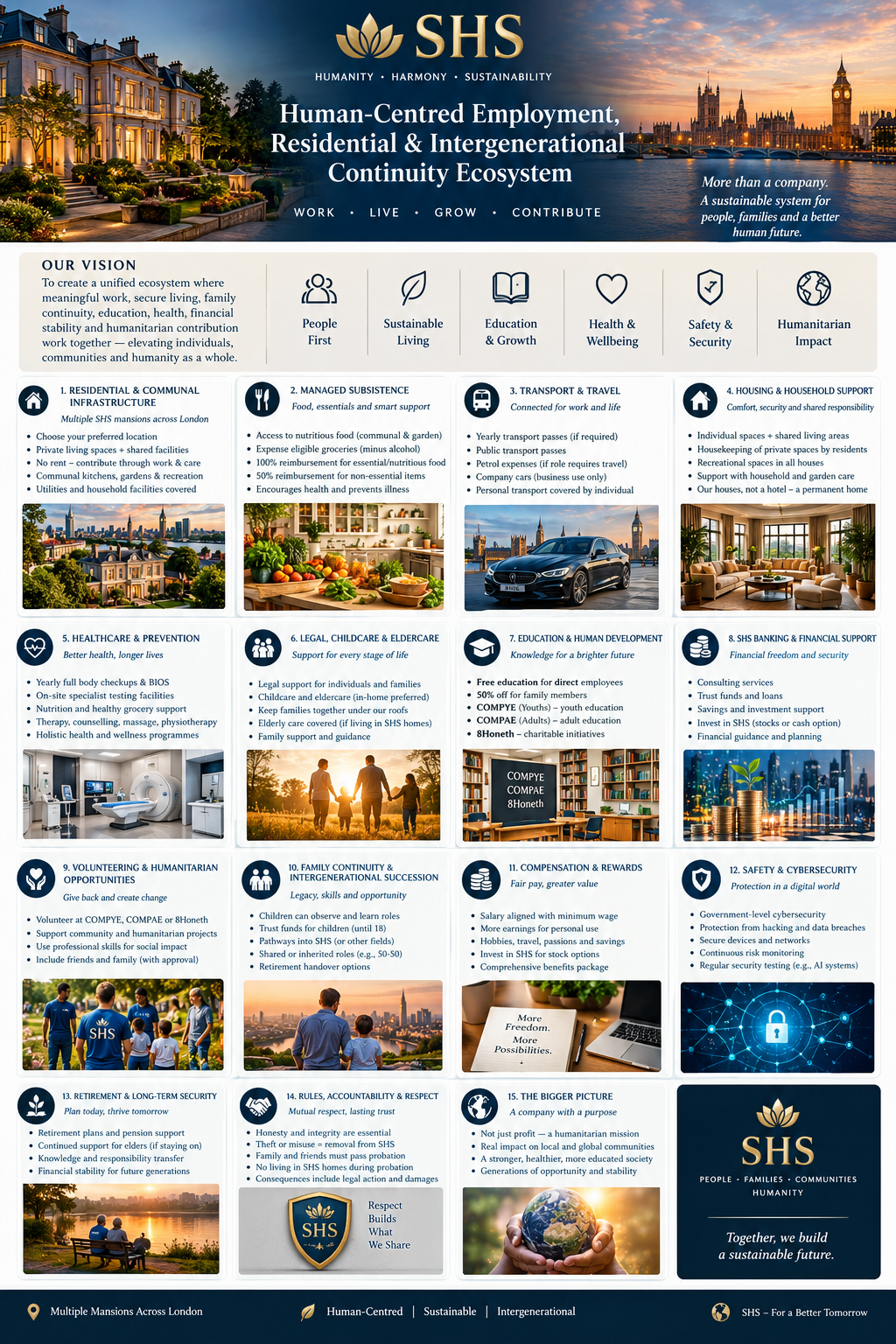
[ Why aren’t billionaires offering this? ]
Imagine a company where your job provides more than an income. Imagine having a home, food, healthcare, education, financial support, access to recreation, responsobility intergenerational succession, assistance with family responsibilities and opportunities to develop throughout your life—all within one interconnected system designed to contribute to the betterment of humanity.
What if employment didn’t mean spending most of your life earning money simply to afford the conditions that allow you to keep working?
What if a company recognised that its employees are not just workers, but human beings with bodies to care for, families to support, interests to pursue, futures to prepare for and lives to live?
This is the thinking behind SHS.
SHS proposes a different relationship between employment, money, housing, family life and human development. Rather than paying people a salary and leaving them to manage every expense and responsibility independently, SHS would coordinate a substantial part of their living conditions directly.
The intention is not simply to offer generous employee benefits. It is to redesign the relationship between the organisation and the people who contribute to it.
Because if a company exists to improve the state of humanity, why should that improvement begin only outside its doors?
Why shouldn’t it begin with the people who make the company possible?
1. The SHS mansion system: Housing becomes part of employment
Imagine working for SHS and being offered the opportunity to live in one of several SHS mansions across London.
You could choose the location that suits you best, subject to availability and the practical requirements of the residential community. Whether you work in estate care, law, finance, administration, education, security or another SHS department, you could potentially live within the same wider residential system.
The houses would not be hotels. They would not be temporary accommodation where people arrive, sleep and leave.
They would be homes.
Residents would have their own individual living spaces, while communal kitchens, gardens, recreational facilities and other shared areas would form part of everyday life.
Utilities would be covered by SHS, alongside the household provisions defined within the residential arrangement. Residents would be responsible for keeping their own personal spaces clean, while everyone would be encouraged to contribute towards maintaining the communal environment.
The principle is straightforward: if everyone benefits from the house, everyone should have a reason to care for it.
These would be SHS properties, owned or operated for the purposes of the organisation. Yet the culture within them would be one of shared responsibility.
The distinction is important. Ownership establishes who holds the property and carries the legal responsibilities. Shared stewardship establishes how the people living there treat the environment they depend upon.
The intention is to create residential communities in which people are not merely accommodated, but have a genuine stake in maintaining the quality of their surroundings.
No rent: contribution through participation
Under the proposed model, residents would not pay conventional rent for their SHS accommodation. Instead, their contribution would form part of their working relationship with SHS, including their professional responsibilities and their agreed participation in maintaining shared spaces.
This is what makes the model different from ordinary rental accommodation.
Rather than receiving a salary, paying rent to a separate landlord and then paying again for utilities, SHS would coordinate these elements within one system.
The resident contributes to SHS; SHS provides the agreed living infrastructure.
However, the arrangement would need clear boundaries between employment duties, voluntary communal contributions and private life. Looking after one’s own space and participating reasonably in shared living should not become an excuse for unlimited unpaid work or permanent availability outside working hours.
The objective is to create stability, not to turn a home into an extension of the workplace where a person never gets to switch off.
2. Food and subsistence: Why should everyone have to manage the same necessities separately?
One of the most significant aspects of the SHS model is its approach to subsistence.
Food is a necessity. Yet individuals and families must repeatedly organise their own shopping, budgeting, storage, cooking and household provisions.
SHS proposes to coordinate part of this process collectively.
Communal kitchens would be stocked with a variety of ingredients that residents could prepare themselves. Gardens could provide fresh produce while offering opportunities for recreation, practical learning and participation in the upkeep of the houses.
SHS could also employ specialist grocery shoppers responsible for sourcing nutritious, high-quality food and coordinating supplies.
The objective would be to make good food more accessible while reducing unnecessary duplication and waste.
A nutritional reimbursement system
Residents who purchase groceries for communal kitchens could expense eligible purchases back to SHS.
The proposed reimbursement structure could distinguish between different categories of expenditure:
- Essential nutritional groceries: eligible purchases reimbursed at 100%.
- Discretionary food purchases: certain items, such as chocolates, potentially reimbursed at 50%.
- Alcohol: excluded from the proposed reimbursement arrangement.
The intention is to encourage preventive investment in health rather than treating every purchase as an interchangeable expense.
SHS would be investing in access to nutritious food because wellbeing matters to the individual and to the wider organisation.
However, nutritional policies would need to be transparent, flexible and respectful of different dietary requirements, cultural preferences and medical needs. The purpose would be to encourage healthier choices, not to shame residents or dictate every aspect of their private lives.
The wider economic principle
The same communal kitchen can serve several purposes simultaneously.
It provides access to food. It creates opportunities for shared responsibility. It can reduce duplicated household purchases. It can support social interaction. And it can help make daily living more predictable.
This is the type of resource coordination SHS wants to explore: infrastructure that contributes to several aspects of human life instead of treating every need as a separate transaction.
3. Preventive healthcare: Invest in people before problems become crises
SHS would place preventive healthcare among its core employee-support provisions.
The underlying thinking is that people should have opportunities to understand and care for their health before problems become more difficult to manage.
The proposed support could include annual health assessments, access to qualified specialists, counselling, therapy, physiotherapy, massage where appropriate and other suitable forms of healthcare.
SHS could arrange for specialists to visit designated facilities, allowing employees to access certain assessments without having to organise every appointment independently.
The aim would be to make preventive care easier to access and to give people a clearer understanding of their health.
SHS could also coordinate nutritional support through its grocery provisions, connecting food access with the broader objective of prevention.
Rather than viewing healthcare solely as something to turn to when an employee becomes unwell, SHS would seek to make maintaining health an integral part of its operating philosophy.
Of course, prevention cannot eliminate illness, and no employee should be treated as having failed because they become sick. Medical information would need to remain confidential, with clinical decisions made by qualified professionals and health assessments offered with informed consent.
The principle is that a person’s wellbeing should matter before their ability to work is affected, not only afterwards.
4. Legal, financial and practical support: Life does not stop at work
A person’s life continues outside their professional responsibilities.
They may face legal questions, financial difficulties, family disputes, childcare challenges, eldercare responsibilities or administrative problems that consume time and energy.
SHS proposes to coordinate support across these areas rather than expecting every employee to navigate them alone.
Depending on the resources available and the employee’s needs, the support network could include:
- Access to qualified legal professionals and legal guidance.
- Financial consultations and budgeting support.
- Childcare assistance and information.
- Eldercare coordination.
- Counselling and therapeutic support.
- Retirement planning.
- Practical assistance navigating services and appointments.
The idea is to create a form of professional support that recognises the interconnectedness of life.
Someone dealing with a complicated legal or family matter may struggle to concentrate on their work. Someone experiencing financial uncertainty may find it difficult to plan their future. Someone caring for an older relative may need help coordinating services.
SHS would aim to reduce some of those pressures by making appropriate assistance available through an organised support system.
This would not mean that SHS controls every decision or assumes responsibility for every private circumstance. It would mean that employees have a clearer route to help when they need it.
5. Transport: The company covers the cost when the work requires it
SHS would distinguish between personal transport and work-related travel.
Where a role requires regular travel, eligible employees could receive annual public-transport passes, reimbursement for business journeys or reimbursement for petrol when using their own vehicle for approved work purposes.
Where using a car is more suitable, SHS could make designated business vehicles available according to operational need.
Not every vehicle owned by the founder would be available for employee use. Personal vehicles would remain separate from the business fleet.
This distinction allows SHS to provide practical mobility without treating every company asset as an unrestricted personal benefit.
The principle is that employees should not have to absorb necessary business expenses simply because they are the ones physically travelling to complete the work.
6. Education: COMPYE, COMPAE and 8Honeth
SHS’s humanitarian purpose extends beyond the workplace and into education, development and social participation.
The two proposed schools are:
- COMPYE (Youths) — education and development for young people.
- COMPAE (Adults) — education and development for adults.
Alongside these sits 8Honeth, focused on helping people who have been excluded from ordinary routes of social participation regain access to stability, development and community, including people experiencing homelessness.
These initiatives form part of the wider SHS vision: improving the conditions under which people can learn, develop and participate in society.
Employees would have access to relevant SHS educational opportunities, with the possibility of discounted education for their families—for example, a proposed 50% reduction, subject to the programme’s design and available resources.
Education would not be limited to learning the skills required for a particular job. It could also help people understand the systems around them, explore their interests, develop practical capabilities and identify opportunities for their future.
Employees contributing beyond their job titles
Imagine an employee working in SHS’s legal department who wants to volunteer for a day at 8Honeth.
They could contribute their time and appropriate skills to support people rebuilding their lives.
Someone in finance might assist with financial education. Someone with practical skills might help with a relevant educational activity. Others could contribute through mentoring, administration or community support.
The same possibility could extend to friends and family through organised volunteering opportunities.
SHS would provide the organisational infrastructure supporting these initiatives, while COMPYE, COMPAE and 8Honeth would need appropriate charitable governance, financial controls and safeguarding.
The important distinction is that participation should be meaningful and properly arranged. Charitable support must not become conditional on working for SHS, and volunteering should not be used to replace paid employment.
The wider objective is to connect professional capability with humanitarian contribution.
7. Family life: Employees are not isolated individuals
One of the strongest elements of the SHS concept is its recognition that people live within family and care relationships.
A parent may need childcare. An adult may have an elderly relative who requires support. Partners may share responsibilities. Children may need access to education, stability and opportunities to discover what they want to do.
A system that ignores these realities can create instability for both individuals and organisations.
SHS therefore proposes support for childcare and eldercare, with a particular emphasis on enabling families to remain together where practical.
Where an older relative lives within an SHS residential property, the organisation could help coordinate appropriate eldercare support.
The proposal places greater emphasis on care within the shared residential environment than on automatically funding arrangements elsewhere. However, that distinction would need to allow for circumstances in which an older person requires specialist accommodation or medical care that a shared house cannot safely provide.
Family unity should be encouraged, not imposed at the expense of someone’s safety or dignity.
A contribution-based household model
The proposal also considers an indicative ratio of one SHS worker for every four household members.
The thinking is that a household receiving extensive resources should have a sustainable relationship with the organisation providing them.
Larger households would require more careful planning because their costs and support requirements may differ.
However, such a ratio would need to be tested against actual costs, capacity and fairness. It should not mean that children, dependent relatives or people unable to work must justify their existence through employment.
The purpose is to establish a sustainable relationship between provision and contribution—not to make family size a punishment.
8. Intergenerational succession: What if a family could grow with the organisation?
The term for passing responsibilities from one generation to another is intergenerational succession.
SHS proposes to explore a system in which children can learn about their parents’ work, develop their interests and potentially take on responsibilities within the organisation when they become adults.
Consider a gardener working at one of the SHS mansions.
Their child grows up around the gardens, observes the work and becomes familiar with growing food, maintaining plants and caring for the property.
As the child approaches adulthood, SHS could provide opportunities to learn more formally about the role. If the young adult is interested, suitably trained and selected for the position, they could eventually enter that field.
SHS could also establish a trust or savings arrangement intended to support the child’s future, subject to clearly defined funding, eligibility and administration rules.
Now consider another family.
One parent works as a finance coordinator. When their child reaches adulthood, they could have an opportunity to observe appropriate aspects of the role, learn about financial operations and decide whether the work interests them.
If they discover that finance is not for them, they could explore another SHS role or pursue a different direction.
The aim is to offer exposure, learning and opportunity—not to dictate a child’s future.
The role can be shared before it is transferred
The model also considers situations in which a parent and adult child share responsibilities during a transition.
For example, an established employee might earn £40,000 annually. If the role can genuinely be divided, a possible arrangement could involve the experienced employee receiving £25,000 while the adult child receives £15,000 for their respective responsibilities.
These figures are illustrative, not a fixed formula.
Actual pay would depend on duties, working hours, skills, responsibility and applicable employment requirements. The organisation would also need to ensure that splitting a role does not simply create two people doing the work of one without proper compensation or a sensible workload.
When the established employee eventually retires, a trained successor could assume the relevant responsibilities.
This creates a route for transferring knowledge gradually rather than losing it all when someone leaves.
Why continuity matters
Every time an experienced person leaves an organisation, they can take valuable knowledge with them.
They may understand the history of a process, know how to resolve unusual problems, maintain important working relationships or recognise details that are not recorded in manuals.
A succession system gives the organisation an opportunity to preserve that knowledge.
Family connections could help create continuity, but a role should not automatically become an inheritance. Children must remain free to choose their own futures, and SHS must select people on the basis of suitability, competence and fairness.
Family-based succession should be one pathway among several, alongside apprenticeships, open recruitment and external talent.
The intended outcome is a more stable organisation in which experience is transferred deliberately and people can develop over time.
9. SHS Banking: More of an employee’s earnings can serve their personal life
If SHS covers agreed essentials such as housing, utilities and some food expenses, employees may have less need to use their salaries for those particular costs.
That could leave more of their earnings available for personal choices.
They might use their money for clothing, hobbies, holidays, savings, investments or other acquisitions they value.
SHS Banking could complement this structure through financial consultations, budgeting support and appropriately governed savings, loan or trust arrangements.
The proposal also considers giving employees the option of investing part of their earnings in SHS and receiving shares instead of that portion in cash, where a lawful and properly structured arrangement permits it.
Participation would need to be voluntary, with clear information about investment risk, valuation, liquidity and the possibility of financial loss.
Reallocating expenditure rather than merely reducing wages
The central economic argument is that SHS would coordinate some of the costs that employees ordinarily manage separately.
A conventional arrangement generally looks like this:
- The company pays the employee.
- The employee pays rent, food, utilities and other necessities.
- The employee independently manages the financial consequences of those expenses.
The proposed SHS arrangement would look different:
- SHS provides agreed accommodation and household provisions.
- SHS coordinates selected living expenses and support services.
- Employees contribute through their work and agreed responsibilities.
- Employees retain personal earnings for discretionary spending and financial planning.
The organisation would therefore be attempting to reorganise the use of resources rather than simply remove expenditure.
However, this approach would only work if the full cost of providing those services were understood. Housing, maintenance, food, healthcare, insurance, staffing and administration still require funding.
Likewise, providing accommodation or other benefits does not automatically permit an employer to pay below applicable UK minimum-wage requirements. Compensation and benefits would need to be structured lawfully and fairly.
The goal is to make resources work more coherently—not to make employees surrender their financial independence.
10. Retirement: A future that does not depend on working forever
SHS proposes to incorporate retirement planning into its employee-support structure.
This could include access to pension information, financial education, retirement preparation and opportunities to transfer responsibilities gradually.
Instead of treating retirement as an abrupt end to a person’s contribution, SHS could plan for the transition in advance.
An experienced employee could document their processes, mentor colleagues, train a successor or reduce their responsibilities over an agreed period.
Where an adult child is interested and qualified, they might be considered as a successor. Where that is not appropriate, another suitable candidate could take over.
The objective is continuity without forcing anyone to remain in a position indefinitely.
Housing arrangements for retirees would also need to be defined clearly. If accommodation is linked to active employment, the organisation would need fair transition arrangements. If retirement housing is intended as a long-term benefit, it would require dedicated financial planning.
A human-first system should allow people to plan for the end of their working life, not leave them uncertain about what happens when they can no longer contribute in the same way.
11. Security and cybersecurity: Protecting an interconnected system
SHS would bring together people, properties, devices, financial arrangements, family information and professional services.
That interconnectedness creates opportunities, but it also creates responsibilities.
A compromised account or device could potentially expose information or provide a route into other systems. A security weakness in one department could affect the wider organisation.
SHS would therefore need a serious cybersecurity programme, supported by appropriate technical expertise and proportionate controls.
This could include:
- Multi-factor authentication and secure devices.
- Encryption and protected backups.
- Restricted access to sensitive information.
- Regular security assessments and staff training.
- Supplier security checks.
- Incident reporting and recovery plans.
- Separate protection for health, financial, family and employment records.
Physical security would matter just as much within the mansions. Fire safety, maintenance, safeguarding, emergency procedures, visitor arrangements and clear reporting channels would be necessary.
The objective would be to develop a high-assurance security environment suited to the organisation’s risks and responsibilities.
At the same time, security cannot become an excuse for indiscriminate surveillance. Employees need privacy in their homes, control over their personal accounts and clarity about what information SHS collects and why.
Trust requires both protection and boundaries.
12. Mutual accountability: Generosity must be matched by responsibility
The SHS proposal involves a substantial commitment to employees and their families.
Housing, food, utilities, education, healthcare support, professional services and other provisions would require resources, planning and ongoing maintenance.
In return, SHS expects people to take their responsibilities seriously.
That includes honesty, respect for shared property, appropriate use of company resources and a commitment not to undermine the system on which other people rely.
Deliberate theft, fraud or serious misuse of trust would need a firm response.
Depending on the evidence and circumstances, consequences could include a formal investigation, proportionate disciplinary action, termination where lawful, referral to relevant authorities or legal action to recover proven losses.
The purpose would be to protect the organisation and the people who depend on it.
Why accountability must be consistent
A breach of trust can affect more than the immediate financial loss.
It may create additional security work, interrupt operations, damage relationships and require the organisation to review processes or access permissions.
However, accountability must be evidence-based and proportionate. Friends and relatives should not automatically be treated as responsible for another person’s actions.
If someone previously associated with SHS has committed misconduct, any enhanced assessment of a new applicant connected to them should be individually justified, lawful and fair.
The same standards should apply to everyone, regardless of seniority, family connection or personal relationship with the founder.
The underlying principle is mutual respect: SHS takes its commitments to people seriously and expects people to take their commitments to SHS seriously.
A human-first organisation still needs rules. The difference is that those rules should protect the integrity of the system without sacrificing the dignity of the people within it.
13. Why family continuity could benefit humanity beyond SHS
The family dimension is not merely about keeping employees close to the company.
It is about recognising that knowledge, care and responsibility often develop through relationships that last longer than a single employment contract.
When people have a stable environment in which to learn, share experiences and develop their abilities, they may be better positioned to contribute over time.
An experienced gardener can teach a younger colleague. A finance coordinator can explain how a process works. An older resident can share practical knowledge. A retiring employee can pass on years of experience rather than leaving it undocumented.
The same principle can apply outside families.
SHS could build a wider culture of mentorship, apprenticeships and knowledge transfer in which employees support one another and help newer members understand the organisation.
The result could be greater stability, reduced disruption and a stronger sense of shared responsibility.
However, continuity should never become a closed system in which opportunities are reserved for existing families or personal connections. SHS would need to remain open to new people, ideas and skills.
The goal is to preserve valuable knowledge while continuing to develop.
14. SHS is not just about employee benefits
Taken individually, each part of this proposal might resemble something that already exists.
Some companies provide accommodation. Others offer meals, healthcare, pensions, transport, education or family assistance.
What makes the SHS concept distinctive is the attempt to coordinate these provisions as parts of a single system.
Housing connects to subsistence. Subsistence connects to health. Health connects to wellbeing and work continuity. Education connects to development. Family support connects to stability. Financial coordination connects to personal choice. Succession connects to organisational memory.
Each part can reinforce the others.
The mansions are not simply places to sleep. They are proposed residential environments connected to work, shared facilities and community responsibility.
The food system is not simply a catering benefit. It is part of an approach to subsistence and preventive investment.
Education is not simply a qualification service. It connects individual development to the wider humanitarian mission through COMPYE, COMPAE and 8Honeth.
Family succession is not simply inheritance. It is an attempt to preserve skills and experience while allowing individuals to choose their own futures.
And accountability is not simply punishment. It is intended to protect the resources, relationships and continuity on which the entire system depends.
This is why SHS must be understood as an organisational model rather than a list of perks.
15. The difficult question: Can SHS make this sustainable?
A vision of this scale needs more than good intentions.
Multiple residential properties, food provision, specialist services, healthcare, transport, education, financial support and retirement arrangements would require substantial and continuing funding.
SHS would need to understand the actual cost of each provision, determine what it can reliably deliver and expand according to its financial capacity.
The model would also need professional guidance on UK employment law, minimum-wage obligations, tax, housing arrangements, healthcare provision, data protection, regulated financial services, pensions and charitable governance.
Employee autonomy would be particularly important because SHS would potentially occupy several roles in a person’s life at once: employer, accommodation provider, source of support and financial-services provider.
That concentration of responsibility makes independent safeguards essential.
Employees should have clear agreements, confidential complaint channels, fair disciplinary procedures and the ability to leave without being trapped by housing arrangements or financial obligations.
The company should measure whether the model genuinely improves stability, wellbeing, retention and financial sustainability.
A phased pilot could establish what works in practice before the system expands across multiple properties and departments.
The ambition should remain extensive. The implementation should be deliberate.
16. What would success look like?
Success would not simply mean that SHS owns several mansions or offers a long list of benefits.
It would mean that the arrangements produce meaningful results.
Employees would have more predictable living conditions and a clear understanding of their rights.
People would be able to access appropriate preventive care without surrendering medical privacy.
Families would have practical support while retaining the freedom to make their own decisions.
Employees would have opportunities to learn, save, develop interests and prepare for retirement.
Knowledge would be transferred effectively when people change roles or leave.
The residential environment would remain safe, well maintained and respectful of privacy.
COMPYE, COMPAE and 8Honeth would be able to pursue their educational and humanitarian purposes with appropriate safeguards.
And the organisation would be financially sustainable enough to continue delivering what it promises.
These outcomes would need to be measured rather than assumed. Generosity is meaningful when it can be sustained and when the people receiving it can genuinely benefit.
17. The central argument behind WHY SHS
Human life is interconnected.
Housing affects health. Health affects work. Money affects choices. Family responsibilities affect time. Education affects opportunity. Trust affects security. Financial uncertainty can influence almost every other area of a person’s life.
Yet many conventional arrangements separate these realities into individual expenses and responsibilities.
The employee receives a salary, and the rest is largely left to them.
SHS proposes a different approach: coordinate selected conditions of life so that people can contribute within a more stable environment while retaining their independence and dignity.
This does not mean that everything should be provided without limits or that every person should depend entirely on one organisation.
It means asking whether resources could be organised more intelligently, whether unnecessary insecurity could be reduced and whether a company could make its humanitarian purpose visible in its internal structure.
The mansions, communal kitchens, gardens, healthcare support, financial services, education and succession arrangements are different expressions of that same question.
What if a company took responsibility not only for the work it needs people to perform, but also for designing a better relationship between work and the lives people lead?
What if the organisation invested in the conditions that allow its members to develop, remain stable and contribute over time?
And what if that investment also strengthened the company’s ability to serve a wider humanitarian purpose?
That is the thinking behind SHS.
WHY SHS: A company designed around human continuity
Imagine an employee who does not have to spend most of their earnings simply securing the basics.
They have a stable home, access to food, opportunities for learning, support when family responsibilities arise and a clearer route to preventive healthcare.
They can contribute to a shared environment, develop their own interests, prepare for retirement and make plans for their future.
Imagine their family can grow and learn without being forced into a predetermined path. Imagine an experienced employee can transfer knowledge to a willing successor. Imagine professional skills can support both the organisation and its humanitarian initiatives.
And imagine that the organisation measures its success not only through financial results, but also through the quality of the conditions it creates for people.
That is the ambition behind SHS: to coordinate employment, living, resources, family continuity and humanitarian betterment within one interconnected system.
The company would still need financial discipline, clear policies, fair compensation, privacy protections and mutual accountability. Its resources would not be limitless, and its promises would need to be matched by what it can sustainably deliver.
But its starting point would be different.
Instead of asking only how much an employee costs, SHS would ask how resources can be organised to support both the organisation and the human being.
Instead of treating every necessity as an isolated expense, SHS would explore how shared infrastructure can serve several purposes.
Instead of viewing family responsibilities as external complications, SHS would consider how stability, care and intergenerational learning can contribute to continuity.
And instead of reserving humanitarian betterment for public-facing projects, SHS would seek to embody that purpose in the way it operates.
Why SHS? Because if humanity is the purpose, the organisation itself should be designed to reflect that purpose.
Why aren’t billionaires offering this?
Leave a Reply