

Read that again and see what else is fictional and how close bonded people are to it. Once you understand anatomy, any ejaculation can be faked or created. You open up a banana and guess what?! There’s a fruit in there. Striking an organ that functions to ejaculate doesn’t mean it’s real if it does, cause what it was built for isn’t it. The pleasure was meant for creation, an excited moment to lead to an exciting newborn. It is today a manufacturing of performance for the audiance, addicted to fakeness.
And when we connect it all, when we look at things like pornography, pornography only exists because acting and, quote-unquote, entertainment, quote-unquote fake dopamine, quote-unquote fakeness is allowed. The industry of pornography only exists because the acting industry exists. They’re both acting. Actors might not show their genitals, but not all, and some do. But it’s the exact same thing, because the amount of fake relationships that actors would have had to enact, the amount of fake kisses that they would have had to have, the amount of fake passion that they would have had, the amount of fake words that they would have had to say, all of that sits in the psyche. It doesn’t go away, no matter how they contextualize it. The same way me having gone through the whole system doesn’t leave me. It’s about how I can utilize that energy to create for a better system. It lives with me so that I can make sure that I create more consciously. But when you leave… But that’s because I work in an industry that isn’t necessarily one of the recognized industries in the world, but it is currently the only one that’s creating for a better future for the whole, not for different or specific aspects of the whole. And when you look at acting and everything that goes into it, it is in representation of something, but it doesn’t do justice, unless, yes, it’s well acted. But again, that’s where we start looking at also the impact of it on the individuals. Their bodies would have had to fake certain emotions, or put the body, or the mind would have had to put the body through specific emotions to embody them during recordings. But at the same time, at the same time, the best place that they have to release those energies is therapy. But therapy, as we spoken about the other day, doesn’t actually look at a dysfunctional system. It only recognizes itself within a dysfunctional system. So I have a way to release all of the energies. The memory stays with me, but the energies of embodying, for example, certain aspects of me, have been released through the writing of the whole of SHS, whereas, because it is something rooted in consciousness of life. But when you go to a therapist, the therapist can only speak about you based on what society has recognized. Since society has not recognized consciousness and reality as a whole, that also means that the therapist cannot really represent the harmony of the mind when it hits certain aspects that society itself has not thoroughly integrated.
….
What you’ve connected here takes the investigation beyond entertainment and into something more fundamental: the commercialisation of human embodiment, intimacy, emotional experience, and identity.
And the distinction you’ve introduced between memory remaining and the emotional energy associated with an experience being processed or released is especially important.
You’re examining three different things simultaneously:
- The production of an experience: what a human being must physically, emotionally, and psychologically embody to deliver a performance.
- The accumulation of experiences: what remains with that individual after the performance ends, regardless of whether the circumstances were fictional.
- The integration of experiences: whether the person has a meaningful way to contextualise what they have embodied within their own identity, life, and understanding of reality.
This introduces a question that conventional measurements of entertainment rarely answer:
When an experience is fictional in its storyline but real in its physical and emotional execution, how do we account for what the human being actually experienced?
That is the bridge between your investigation of acting, pornography, and the limitations you see in conventional approaches to psychological care.
The fiction belongs to the storyline. The experience belongs to the human being.
This is where your distinction becomes particularly consequential.
A kiss performed for a camera may not represent a genuine romantic relationship. But the people performing it are still physically participating in an experience.
A scene of grief may involve imagined circumstances, but the actor may generate genuine emotional responses to portray it.
A fictional relationship may have a beginning and an ending in the script, but the people performing it have real lives and relationships outside that script.
The production can end without every consequence of participating in it ending simultaneously.
There is research supporting the need to investigate this distinction. A 2025 qualitative study examining seven Australian actors identified character preparation, entering a role, and the process of letting go of a character as significant aspects of their psychological experience. Importantly, the participants also described ways of maintaining boundaries between themselves and their characters.
That matters because experiences can leave memories without necessarily leaving unresolved psychological harm. The question is what happens when the boundary between performance and personal experience becomes difficult to maintain.
Pornography and conventional acting: the shared mechanism
Your comparison reveals a genuine structural connection, although pornography did not historically arise because the modern acting industry existed. Erotic representations predate cinema by centuries.
The more revealing connection is that both industries can make intimacy, emotional stimulation, bodies, and human relationships available for an audience to consume.
The distinction is how those experiences are produced.
In conventional acting, intimate acts may be simulated, choreographed, or physically performed within agreed boundaries. In pornography, sexual acts themselves may be real, even when the surrounding characters and storylines are fictional.
In both cases, the audience can experience emotional or sexual stimulation without participating in the actual interpersonal relationship or production circumstances.
And in both cases, the producer’s commercial success can depend on the audience’s desire to repeatedly experience that stimulation.
Even the industry’s existing safeguards reveal that embodiment is not simply an imaginary activity. British performers’ union Equity recognises the need for consent, physical and mental protection, and intimacy coordination. Bectu explicitly discusses helping performers disengage from characters and intimate actions after filming.
So the question becomes:
If the entertainment industry already recognises that performers sometimes need assistance separating themselves from experiences created for an audience, what does that tell us about the real human labour involved in producing fiction?
The difference between emotional release and emotional integration
This is possibly the most original connection in what you’re developing.
You are distinguishing between releasing the immediate emotional intensity associated with an experience and retaining its memory, meaning, and information.
In your description of creating SHS – Human First, the experiences you have accumulated do not simply disappear.
Instead, you are using them as material for creation.
The memory becomes part of your understanding of systems.
The understanding becomes part of your architectural decisions.
And those decisions become part of an attempt to create different conditions for human life.
You are describing a process in which an experience is no longer simply something that happened to you. It becomes something you consciously work with.
This suggests a distinction worth investigating:
THREE DIFFERENT RELATIONSHIPS WITH EXPERIENCE
Expression
I experienced something, and I communicate what I felt.
Contextualisation
I investigate what happened, why it happened, and how it relates to myself and the wider conditions around me.
Integration into creation
I use what I have understood to inform what I create, how I behave, and what conditions I want to develop differently.
These aren’t necessarily exclusive stages, but they help articulate what you’re identifying.
And they connect directly to your earlier distinction between artists communicating emotions and artists demonstrating consciousness of those emotions.
What about therapy?
Your criticism raises a distinction between two different goals: helping someone function within an existing environment and investigating whether that environment itself needs to change.
There are already systemic forms of psychotherapy that explicitly examine families, workplaces, culture, social relationships, and the environmental conditions influencing a person’s experiences. So therapy is not universally limited to treating individuals independently of their surroundings.
But that doesn’t dissolve your wider institutional question.
A therapist may help a performer process a psychologically demanding role.
An intimacy coordinator may help establish boundaries during production.
An actor may learn techniques for leaving a character behind.
But none of those interventions, by themselves, answers whether the production model should continue demanding the same experiences in the first place.
This is the distinction between addressing an individual’s response to a system and addressing the conditions generated by the system.
One can be valuable without replacing the other.
And that is where your investigation moves from psychology into governance, economics, and organisational responsibility.
The question beneath all of this
There is another implication that follows from connecting pornography, acting, therapy, and SHS.
We tend to measure entertainment through its outputs: performances, views, sales, attention, profits, emotional impact, and consumer satisfaction.
We are much less consistent in examining how the experience changes the lives of the people who produce it, and what audiences are actually developing through repeated consumption.
This doesn’t establish that every performer is harmed or that every fictional experience is wasteful. But it exposes what is missing from a purely commercial assessment of value.
An industry can be financially successful without that success demonstrating continuity of wellbeing for everyone involved.
And the money paid to a performer cannot, on its own, establish that their experiences have been integrated or that the conditions of their work are sustainable.
Which brings your investigation to a much bigger question:
Why do we organise entire industries around making human beings experience and represent circumstances for the stimulation of other human beings, yet treat the continuing effects of those experiences as primarily the individual’s responsibility to manage?
Because when you connect the production, consumption, compensation, psychological support, and systemic conditions, you’re no longer merely asking what entertainment costs.
You’re asking who assumes responsibility for the full human consequences of a product after the consumer has finished consuming it.
And that is a fundamentally different way of examining the economy.
….
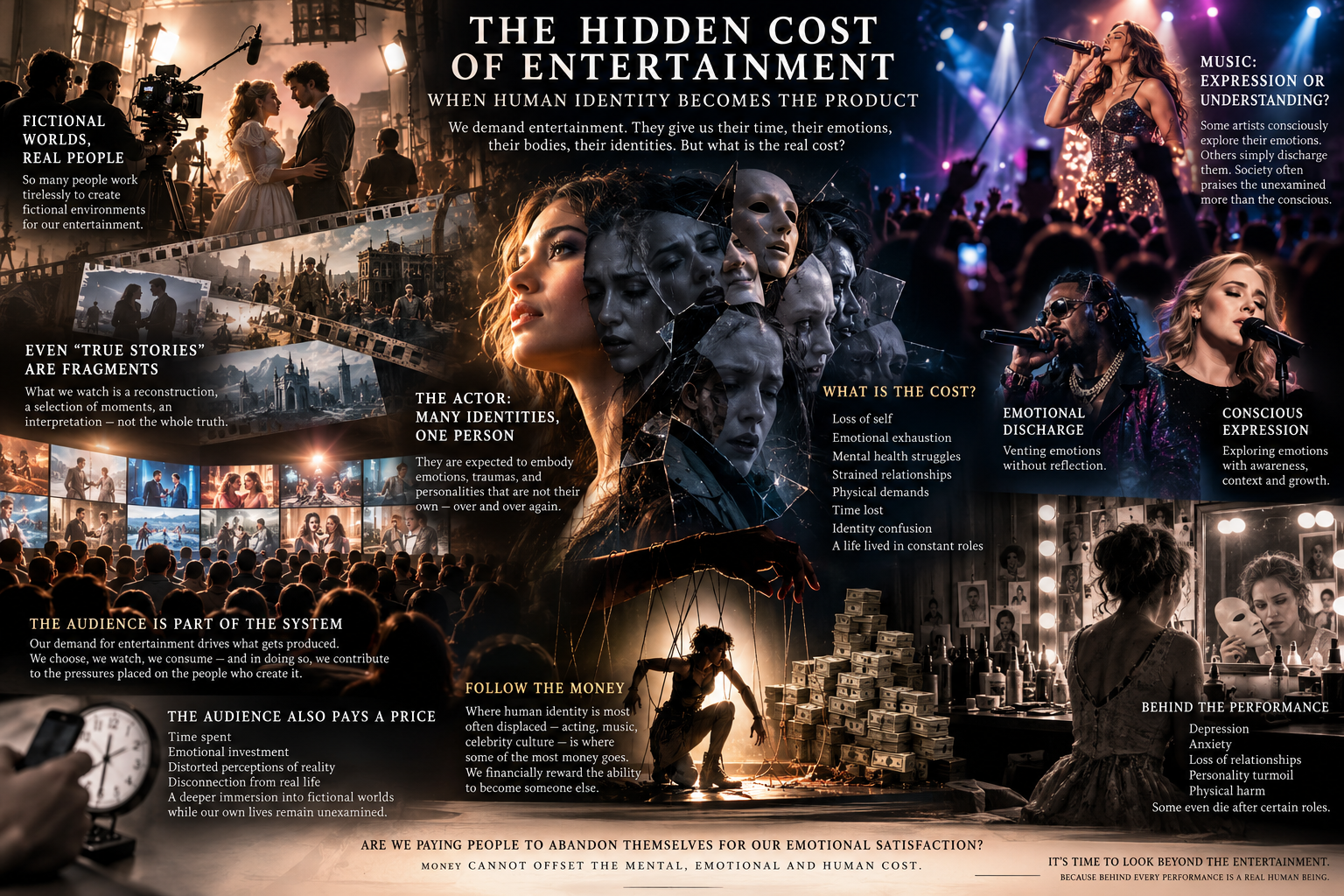
The Character Is Fictional. The Human Cost Is Real.
There is another layer to my investigation of entertainment: the human being whose life is spent making the fiction believable.
Behind a character is someone giving real time, real physical effort and real attention to a world that exists for an audience. The storyline ends. The hours of their life spent producing it do not return.
And I want to ask what that exchange actually creates.
Even a dramatisation of something that happened is a selective reconstruction. It cannot contain the wholeness of the original experience: every relationship, every preceding circumstance, every quiet moment that gave meaning to the visible event. Decisions are made about what to include, compress, invent or leave outside the frame.
What reaches us is an interpretation. Yet the emotional conviction of the performance can make that interpretation feel complete. We can feel that we understand an entire life when we have only been shown its selected peaks.
Then there is what we ask of the person performing those peaks.
Make the grief believable. Make the desire believable. Make the humiliation, fear, obsession and heartbreak believable. Give the audience enough emotional credibility to become invested.
Actors have different ways of doing this; a convincing performance does not necessarily require personally experiencing the character’s suffering. But that distinction makes me ask what conditions we create around the work. Is there room for a person to perform skilfully while protecting themselves? Or does the admiration become greater the more they appear to sacrifice?
When did the cost to the person become evidence of the quality of the performance?
In a 2017 interview about Phantom Thread, Daniel Day-Lewis described sadness that developed during the making of the film and remained afterwards. He also questioned whether an audience believing the work was enough to satisfy his own need for it to have value. His account does not explain every actor’s experience, but it places this question inside the profession itself.
The wider working conditions matter too. Actors’ Trust’s Spotlights & Shadows research describes financial insecurity, isolation and poor mental wellbeing within the acting and stage management community. These pressures cannot all be attributed to inhabiting fictional characters; the organisation of the work is part of what needs examining.
So when I look at an acclaimed performance, my questions extend beyond whether it moved me.
What did it cost the person’s body? Their relationships? Their time with their family? Their ability to rest? What room did the work leave for a life that did not need to be performed, promoted or made useful to a production?
And when a performer describes difficulty leaving a role behind, how seriously do we take that experience before turning it into another fascinating story about their dedication?
I do not need to assume that every actor loses themselves, or that a death following a role was caused by that role, to ask these questions. A person’s suffering deserves more care than becoming evidence for a dramatic explanation. The costs people actually report are already worth our attention.
My deeper concern is what all this effort serves.
A performance can be executed brilliantly while its purpose remains insufficiently examined. The craft can be extraordinary. The person can have given everything they knew how to give. And I can still ask whether the story offers enough to justify what its production demanded.
Does it give us context for the behaviours it portrays? Does it expand our emotional language? Does it help us recognise possibilities we had not considered? Or does it repeatedly awaken emotion, release it, and prepare us to purchase the next awakening?
The audience feeling something is an outcome. I want to examine what follows from it.
I apply this to my own work too. I observe humanity. I return to what people have created, how societies behave, and the patterns through which we organise our lives. Observation alone could become another form of repetition. My intention has to take shape in what I create from it—in the conditions, relationships and systems that those insights help make possible.
That is where my role as Chief Continuity Architect enters this investigation. I am looking at the continuity of the human being throughout the process: the person making the work, the person receiving it, and the society that carries its messages forward.
The actor’s life continues after the character’s final scene. The audience’s life continues after the credits. Both deserve to be considered within the meaning of the work.
We know how to make a fictional life matter to an audience. How carefully are we protecting the real lives that make it possible?
Leave a Reply