
SHS – HUMAN FIRST | TECHNOLOGY, SURVEILLANCE & CORPORATE ACCOUNTABILITY | 25 OCTOBER 2026
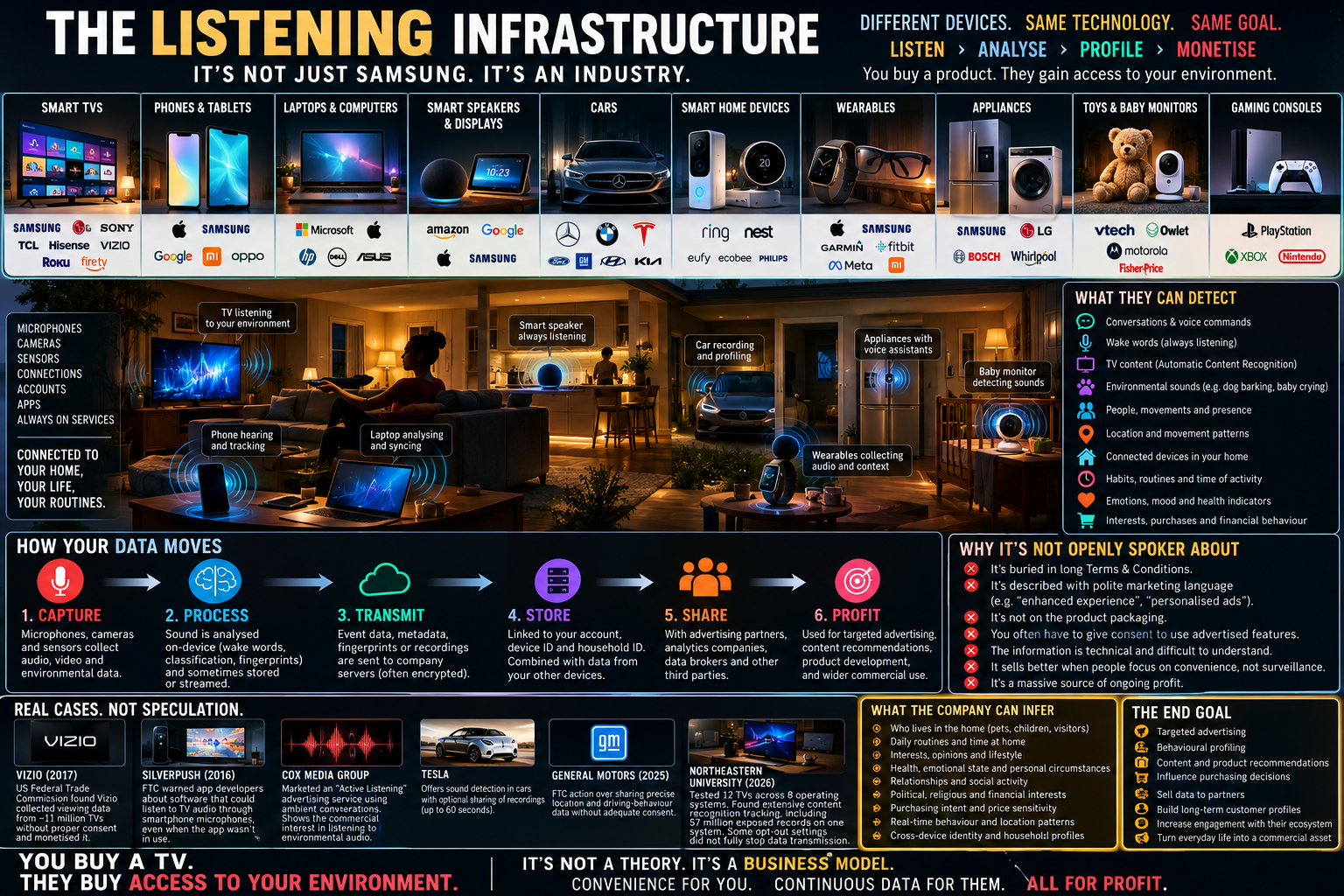
Your question goes beyond Samsung. It concerns an entire technological architecture that allows companies to introduce microphones, environmental sensors, behavioural analytics and advertising systems into objects people purchase for completely different purposes.
The technology is real. Its commercial applications are documented. And there have already been regulatory cases involving undisclosed monitoring.
Three discoveries establish that this is an industry-wide issue rather than speculation about one television.

2017 — Vizio: viewing surveillance
The US Federal Trade Commission found that Vizio had collected viewing information from approximately 11 million televisions without adequate consumer knowledge or consent. The company monetised that information through advertisers and other businesses.

2016 — Silverpush: microphones tracking television activity
The FTC warned 12 app developers about software capable of monitoring television audio through smartphone microphones, including when an application wasn’t actively being used.

2026 — Samsung: environmental sound recognition
Samsung itself advertises televisions that can detect barking through a microphone while the television is switched off but connected to power. The documented feature requires activation. Separately, the October reverse-engineering investigation alleges more extensive telemetry capabilities that still need independent verification.
The essential distinction is between continuously analysing sound locally, recording or transmitting actual conversations, and using information derived from sound commercially. These are different technological activities. A company can learn something about its customers without saving an intelligible recording of their conversations.
That distinction does not eliminate the privacy question. In some circumstances it makes the investigation more important, because the information extracted from sound may be more commercially useful than the sound itself.
1. Mapping the companies and devices
The following is a cross-industry technology map, not a claim that every device secretly records conversations. I have separated confirmed environmental audio processing from voice-activated services and non-microphone tracking.
| Company / infrastructure | What the technology can detect or collect | Evidence and limitations |
|---|---|---|
| Samsung — TVs, Galaxy phones, tablets | Voice commands, wake words, selected environmental sounds, viewing history and device usage | Pet Care and Bixby are documented. ACR is documented separately. |
| LG — smart TVs / webOS | Audio fingerprints from TV programming, viewing patterns, advertising exposure | Confirmed ACR ecosystem. LG says its ACR does not record household conversations. |
| Vizio / Walmart — smart TVs | Viewing habits, connected devices and content identification | Historical nonconsensual tracking established by FTC proceedings. Current collection is described as consent-based. |
| Sony, TCL, Hisense, Roku, Amazon Fire TV | Various ACR systems, content identification, advertising telemetry and voice controls | Independent TV research confirms ACR across tested operating systems, with differences by manufacturer. |
| Apple — iPhone, iPad, HomePod | Siri commands and, on supported devices, environmental sound recognition | iPhone Sound Recognition can continuously detect sounds such as crying. This does not establish transmission to advertisers. |
| Google — Android, Pixel, Nest, Google Home | Voice activation, baby sounds, barking, alarms, breaking glass and other selected sounds | Sound Notifications processes audio locally; supported Nest products offer additional sound detection. |
| Amazon — Echo, Alexa | Wake words, activated voice requests, optional environmental-event detection | Amazon says ordinary speech is not streamed before activation; supported devices offer sound-detection routines. |
| Microsoft — Windows laptops and computers | Microphone input, speech recognition, voice activation and transcription | Windows supports local and cloud speech recognition, with different data handling. |
| Samsung — Family Hub refrigerators | Bixby/Alexa wake words and voice commands | A refrigerator can directly accept voice commands through its microphone. |
| Apple — Watch and compatible wearables | Ambient noise levels and voice commands | Apple says the Watch Noise app measures sound levels without recording or saving audio. |
| Meta — Ray-Ban smart glasses | Voice activation, speech commands, audio and visual AI interactions | Meta documents recording and processing during some voice interactions and follow-up windows. |
| Mercedes-Benz / BMW — connected cars | Voice activation, commands, personalised assistant interactions and selected contextual information | Documented vehicle assistant functions; not evidence of universal cabin-conversation recording. |
| Tesla — connected cars | Voice commands, sound-event detection and optional sound-data sharing | Tesla says sound detection is local by default, with optional uploads of recordings up to 60 seconds. |
| Amazon Ring — security cameras and doorbells | Device-dependent video and microphone recordings | Historical FTC case established serious unauthorised access to private video; it did not establish universal ambient audio advertising surveillance. |
Microphone-equipped baby monitors, smart headphones, headsets, conferencing equipment, smart displays, connected toys and security systems also belong within this investigation. Their actual recording behaviour depends on the model, software, permissions and activation state.
The same principle applies to gaming consoles: a microphone-equipped controller or headset creates a potential audio input, but its presence does not establish continuous recording or transmission.
2. How the listening infrastructure works
A typical environmental-audio processing chain
Microphone / acoustic sensor
Captures sound waves from the environment
Local signal processing
Filters sound, detects wake words, recognises events or creates fingerprints
Local only
Notification or action without sending audio
Cloud transfer
Audio, transcripts, event metadata or fingerprints sent to servers
Secondary data use — where permitted or enabled
Analytics, service improvement, profiling, targeted advertising or sharing with partners
Not every product uses every stage. Some stop after local analysis, and some never use audio for advertising.
A key technical detail: listening doesn’t necessarily involve storing recordings.
A sound classifier can return something like:
dog_barking = detected
The software may discard the actual sound after recognising it. Nevertheless, if that event is transmitted with a time, account identifier or device identifier, it can reveal information about the household.
That creates a new distinction:
You can be monitored through the classification of your environment without your conversations ever being transcribed.
This is technically possible; determining whether a specific company retains or commercially exploits those classifications requires separate evidence.
3. The companies behind the companies
The device manufacturer is only one layer. There are also software suppliers, advertising platforms, measurement companies and data brokers.
Some important connections are already publicly documented.
| Company | Infrastructure and commercial role |
|---|---|
| Samsung Ads | Uses TV viewing information and advertising technology to create audiences and measure campaigns. Its UK website describes third-party data matching and measurement partnerships. |
| LG Ad Solutions / Alphonso | Provides content recognition and advertising intelligence, including targeting based on viewing habits, gaming and ad exposure. |
| Samba TV | Offers ACR technology and viewing measurement across multiple television manufacturers and connected devices. |
| Silverpush | Developed software capable of recognising ultrasonic advertising beacons through smartphone microphones. The FTC documented associated privacy risks. |
| Cox Media Group | Marketed an Active Listening advertising service purportedly using ambient conversations. The pitch existed; independent verification that the claimed commercial surveillance worked as advertised remains insufficient. |
| Consumer-data and measurement partners | Samsung Ads publicly lists relationships across data matching, campaign measurement and attribution. These relationships do not establish that its partners receive microphone recordings. |
A particularly revealing example: Alphonso
On its own website, Alphonso supplies privacy-policy wording for mobile developers using its software.
That description says the software can sample audio through a phone’s microphone, convert it into an audio signature, identify television content and use matches to deliver advertising.
It also explicitly says it is designed to recognise commercial content, not understand private conversations.
In other words, the system does not need to know what you said to discover what you were watching.
What happens when separate devices are combined?
Consider a household with a smart TV, a phone and a smart speaker.
TV
Viewing data
Phone
App activity
Speaker
Voice interactions
Potential identity and data matching
Account IDs, household IDs, network identifiers, behavioural signals
Combined household profile
May inform content recommendations, advertising audiences and marketing measurements, depending on actual sharing arrangements
Even when every device collects only a fragment, linking fragments can produce information that none of the devices individually collected.
This is why the data-sharing relationships between companies are just as important as the sensors themselves.
4. What does the company gain?
The commercial value is not limited to knowing what product you might buy next.
Here is what data can reveal, depending on what is actually collected.
| Collected information | Potential commercial or behavioural inference |
|---|---|
| Television viewing patterns | Interests, preferred genres and advertising responsiveness |
| Connected console or gaming activity | Entertainment preferences, gaming platforms and engagement |
| Time-of-day usage | Daily routines and patterns of activity |
| Audio classifications, if retained | Presence of pets, childcare-related sounds or environmental events |
| Voice requests and transcripts | Questions, preferences, requested services and contextual needs |
| Device and household identifiers | Relationships among devices and potential household-level profiles |
| Combined viewing and purchase data | Advertising conversion, audience segmentation and purchase attribution |
| Location and movement telemetry | Travel habits, commonly visited areas and patterns of mobility |
These are possible inferences, not a verified list of information sold by Samsung.
But some of the monetisation practices are explicitly advertised.
For example, LG Ad Solutions promotes the ability to target viewers according to gaming platforms, viewing behaviour, ad exposure, content preferences and location.
It isn’t even necessary to secretly record conversations to build commercially valuable behavioural profiles.
The car industry provides another example
In January 2025, the FTC announced action against General Motors over the sharing of precise location and driving-behaviour data without adequate consent. According to the agency, information about driving speed, braking and travel patterns reached consumer-reporting agencies and could affect insurance decisions.
This was not an ambient microphone case. It demonstrates something related but distinct: data captured to support a consumer product can later affect the consumer in a completely different commercial relationship.
5. The newest independent technical evidence is particularly concerning
A 2026 Northeastern University investigation tested 12 commercially available televisions across eight operating systems in 5,943 controlled experiments.
The researchers compared network behaviour while content recognition was enabled and after users opted out.
NORTHEASTERN UNIVERSITY — EXPERIMENTAL RESULTS
12
Televisions tested
5,943
Controlled experiments
4
Operating-system configurations where ACR opt-out fully worked
57M+
VIDAA detection results found exposed
Source: Watching the Watchers — Northeastern University. The 57 million figure concerns exposed TV content-recognition results, not voice recordings.
Particularly important findings:
- Samsung and Vizio test configurations continued transmitting traffic consistent with ACR after opt-out. Because much of the traffic was encrypted, the researchers could not definitively establish its contents or server-side use.
- LG webOS used audio-based recognition of TV content in the tested configuration.
- A tested VIDAA system transmitted identifiable content-recognition metadata without encryption, including categories relating to religion, politics and health.
- The VIDAA investigation exposed more than 57 million recognition results associated with over one million televisions; the researchers reported that the provider later secured access to the server.
Another 2026 investigation by RTINGS produced a more reassuring result on specific Samsung, LG and Sony models: identifiable ACR traffic stopped or changed substantially after the relevant privacy setting was disabled. These different findings make firmware, device model and testing method essential to interpreting the evidence.
Neither study proves that all those TVs transmit private room conversations. What they establish is that television data collection can be extensive, technically difficult to inspect and sometimes difficult to disable reliably.
6. Why isn’t this written plainly on the packaging?
This brings us to your question about how the technology is presented to consumers.
A television is typically sold as a screen offering picture quality, entertainment, connectivity and convenience.
The data-processing features are often presented separately as something else:
| Consumer-facing wording | Underlying technical or commercial activity |
|---|---|
| Viewing Information Services | Automatic recognition of watched content |
| Interactive Service | Content recognition and related smart-TV services |
| Enhanced Viewing Service | Content recognition presented alongside picture or sound improvements |
| Personalised Experience | Processing preferences, activity or other user information |
| Interest-Based Advertising | Advertising audiences informed by personal or device information |
| Voice Assistant | Microphone access, activation detection and processing of voice requests |
These are not imaginary euphemisms. RTINGS documented several of the exact labels used by television manufacturers in August 2026.
The descriptions are not necessarily false. A feature can genuinely improve recommendations while also enabling commercial profiling.
The problem arises when the benefit is obvious to the buyer but the associated data exchange is difficult to understand.
RTINGS also reported that refusing some permissions could mean giving up advertised smart-TV features. One Vizio model could be used as a basic display when certain data terms were declined, but without the full connected experience.
That creates a real imbalance: people can purchase a product before discovering that access to some of its advertised functions depends on accepting an ongoing data relationship.
Does UK law require disclosure on the box?
Not necessarily on the packaging itself. But companies cannot rely on a vague reference buried in terms and conditions to justify every kind of personal-data processing.
The UK’s Information Commissioner’s Office explains that connected-device manufacturers must give people understandable information about what they collect, why they collect it, who receives it and how rights can be exercised.
Importantly, its guidance says that privacy information must be separate from terms and conditions, and that meaningful information should be provided when collection occurs.
In June 2026, the ICO specifically announced increased scrutiny of connected televisions, recognising that they can gather substantial information and use it for targeted advertising.
There is a difference between making information legally available and making it genuinely understandable before a purchase.
7. What would genuine informed consent look like?
A product should be capable of explaining its data practices to the buyer in language as straightforward as the claims on its packaging.
For example, where the relevant functions actually apply:
Example of a transparent consumer disclosure
This television contains microphones and content-recognition software.
When enabled, selected functions can detect sounds in the room, recognise the content displayed on your screen and process information about your device usage.
We will explain separately whether each feature:
- Processes information only on your television.
- Sends audio, fingerprints or event information to company servers.
- Stores information and for how long.
- Shares information with advertising or analytics partners.
- Can be disabled without losing unrelated core features.
This is a proposed transparency standard, not wording attributed to Samsung or another manufacturer.
That would make the exchange visible at the point of choosing the product rather than after it has already entered someone’s home.
It would also distinguish between the consent of the purchaser and the privacy of guests, children and other household members whose sounds could be detected even though they never accepted the product’s terms.
8. What has and has not been established?
Established
Commercial devices can continuously analyse selected environmental sounds. Software has been developed to identify television content through smartphone microphones. Smart-TV viewing data is commercially monetised, and regulators have documented serious failures of consent and data protection.
Documented as allegations or requiring further testing
The full scope of the October 2026 Samsung reverse-engineering allegations, including whether unintended conversations are captured and transmitted, and whether household sound-event classifications are being used in advertising profiles.
Not established
That every phone, TV, laptop and car records all conversations by default, or that every manufacturer sells ambient recordings to advertisers.
9. How to complete the reverse-engineering investigation
To go beyond publicly documented behaviour and establish precisely what a particular device is doing, the next level requires hands-on examination of owned or authorised hardware.
That would involve comparing microphones and sensor specifications against firmware functions, tracing app permissions and SDK dependencies, examining network destinations, and measuring data transfers while varying controlled audio inputs and privacy settings.
The critical test is whether identifiable acoustic events cause information to leave the device when no corresponding feature has been intentionally activated. Network traffic alone does not prove that audio is inside an encrypted transmission; controlled testing and additional technical evidence are necessary.
This investigation provides the cross-industry map and existing technical evidence, but it is not a completed firmware-level reverse engineering of every named product.
What this establishes about the commercial model
The underlying transformation is significant.
A company once primarily sold a product and received payment for the product.
Many connected-device businesses now maintain an ongoing relationship after purchase, through accounts, subscriptions, analytics, content services and advertising.
Some of those relationships are useful and consciously chosen. Others may be poorly disclosed or imposed through the design of the product.
The fundamental question is no longer simply:
Does the device work as advertised?
It is also:
What is the device doing for the company while it is working for its owner?
And, extending your point about packaging:
Why should the consumer have to reverse-engineer a product to discover a commercial activity that its manufacturer already understands?
That is the central accountability gap exposed by this investigation.


Leave a Reply