
I’d rather not take the money. What aboit paying people to be more of themselves, without any clause to who they should be?! When does that kick in?! No sponsor that sponsor your being and not what they have drafted of you or takes entirely on board what you choose to be. (Consciously that is, as many have had this priviledge and defied it.)
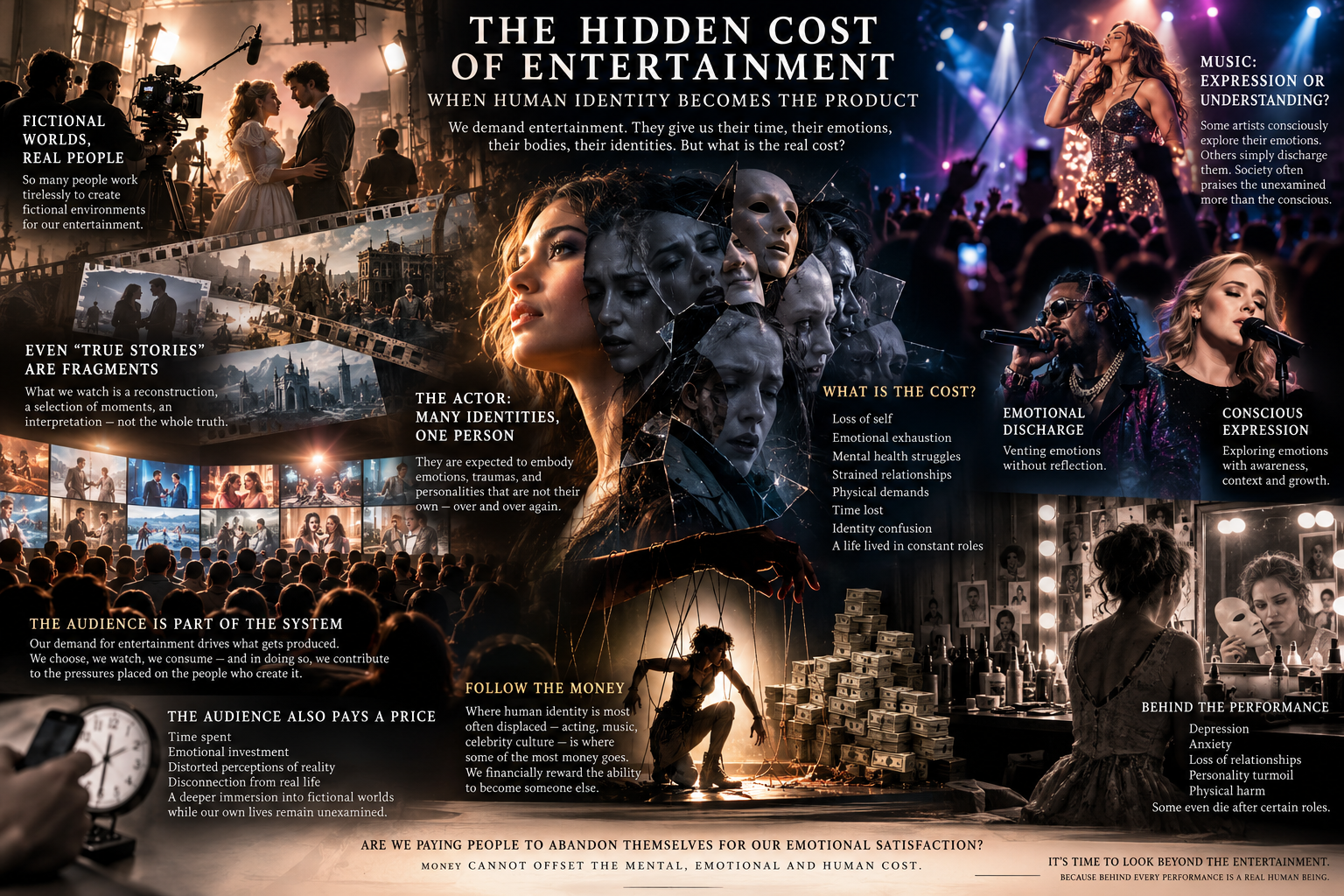
The Hidden Human Cost of Entertainment: Are We Paying People to Abandon Themselves?
An investigation into the economy of entertainment, emotional consumption, identity, consciousness, and the price humanity pays beyond money.
I’ve been investigating the patterns of entertainment, particularly the relationship between fictional storytelling, the people who perform it, and the audiences who consume it. And the deeper I go, the more disturbing the economic and human implications become.
We have built an enormous industry around asking human beings to become other human beings, inhabit fictional circumstances, experience emotional realities that are not their own, and make all of it convincing enough to stimulate the emotions of someone watching.
And we call that entertainment.
But what is the actual cost?
Not the production budget. Not the salaries. Not the box-office revenue.
What is the cost to the human being performing it, and what is the cost to the human being consuming it?
1. The Fictionalisation of Reality
Even when entertainment claims to recreate real historical events, what we receive is not the original reality.
It is a fragmented reinterpretation.
A story that may have unfolded over years, involving thousands of circumstances, emotions, relationships, decisions, and contextual influences, is reduced to a few hours of selected moments.
We are not receiving the wholeness of what happened. We are receiving a reconstruction of what someone considered significant enough to dramatise.
The peaks. The conflicts. The betrayals. The victories. The tragedies.
And because these moments are often selected for their emotional impact, we are not necessarily learning how life unfolded. We are being emotionally stimulated by a representation of it.
There is a difference between understanding an experience and being entertained by its emotional fragments.
When the context disappears, the interpretation becomes its own fictional reality, even when it borrows from historical truth.
This raises another question: how much of what people believe they understand about humanity comes from watching representations of human experiences rather than engaging with their actual complexities?
2. The Actor: A Human Being Expected to Become Everyone but Themselves
Consider what actors are asked to do.
They must become convincing representations of identities, personalities, relationships, circumstances, emotions, and behaviours that may have nothing to do with who they actually are.
And they must do it well.
Because if they do not make the emotions believable, the audience might not connect with the storyline.
The performance must feel genuine, even when the circumstances are entirely fabricated.
This means that an actor’s excellence is frequently measured by how convincingly they can temporarily embody someone else.
But what happens when that becomes someone’s entire professional existence?
One role after another.
One personality after another.
One traumatic storyline after another.
One fictional relationship after another.
One emotional environment after another.
The actor’s body remains the same, but the identities they are required to embody keep changing.
And because humans naturally want to excel at what they do, some actors invest extraordinary amounts of emotional, psychological, and physical energy into making these performances convincing.
The performance may be extraordinary.
But doing something extraordinarily well does not automatically make what we are doing beneficial to ourselves.
What did that performance cost the individual?
What did it cost their family?
What happened to their personal relationships?
What happened to their emotional stability?
What happened to their bodies?
What happened to their time?
What happened to their sense of identity?
Performers themselves have spoken about psychological difficulties, emotional exhaustion, struggles separating themselves from demanding characters, and the effects of their work on relationships.
There have also been deaths within the acting profession that prompt difficult questions about psychological strain, although the causes of an individual’s death cannot responsibly be reduced to a particular role without evidence.
The point is not that every actor loses themselves.
The point is that we have normalised an industry that can demand substantial psychological and emotional investment in fictional identities without making the full human cost equally visible to the people consuming the result.
And because we are so impressed by the performance, we rarely stop to investigate what producing it required.
3. The Audience Is Not Separate From the Production
Now we must examine demand and supply.
Our current economic system is heavily organised around producing what people are willing to consume.
The entertainment industry does not exist independently of its audience.
People demand entertainment.
Something to watch after work.
Something to fill the evening.
Something to occupy the weekend.
Something to experience emotionally without necessarily having to participate in those circumstances themselves.
And an entire workforce organises its time, identity, emotions, creativity, and physical existence around supplying it.
Actors, writers, directors, production crews, musicians, editors, designers, and countless others participate in constructing these fictional environments.
Some productions take years.
Years of actual human lives devoted to creating a few hours of fictional experiences for other human beings.
The audience receives the emotional experience. The performers and production workers carry the cost of constructing it.
But the audience also pays a cost beyond the subscription fee or cinema ticket.
It pays with time.
Attention.
Emotional energy.
And the opportunity to engage with other dimensions of its own existence.
Think about that.
We have human beings investing years into fabricating human experiences, and other human beings investing hours, days, months, and eventually years into consuming those fabricated experiences.
Meanwhile, the real world in which both groups exist is still struggling with how humanity understands, organises, nurtures, and develops itself.
Which brings me to something even more significant.
4. We Are Consuming Fictional Humanity While Living Inside Fictionalised Definitions of Humanity
Humanity already lives within systems built upon socially constructed definitions of what it means to be human.
Definitions of success.
Definitions of relationships.
Definitions of identity.
Definitions of worth.
Definitions of productivity.
Definitions of belonging.
Many of these definitions are not rooted in the wholeness of our natural existence. They are institutional, cultural, economic, and historical interpretations of it.
And when those interpretations become disconnected from the actual nature of being human, they begin operating like fictional frameworks that people are expected to inhabit as reality.
Then, on top of that, we create additional fictional worlds to entertain ourselves.
We are consuming fictional representations of humanity while struggling to recognise the fullness of humanity within the systems governing our real lives.
How much of our human capacity is being invested in representing life rather than developing the conditions in which life is actually experienced?
And how many people are learning what it means to be human through performances created by people who are themselves being paid to embody someone other than themselves?
This is where the investigation becomes much larger than entertainment.
It becomes an investigation into civilisation’s relationship with identity.
5. Why Does So Much Money Flow Towards the Performance of Identity Rather Than Its Development?
Here is the pattern I find particularly disturbing.
Some of the most financially rewarded and socially celebrated industries involve people repeatedly performing, adapting, borrowing, or presenting identities that are not necessarily their own.
Consider actors.
Their professional value can depend on their ability to represent other personalities convincingly.
Consider singers.
Some perform lyrics written by other people, expressing perspectives and emotional narratives they may not have personally developed.
Even when artists write their own music, there is another distinction that deserves investigation.
Are they expressing emotions, or are they expressing consciousness of those emotions?
These are not the same thing.
Someone can communicate anger without understanding its origins.
Someone can express heartbreak without contextualising their relationship to love.
Someone can express resentment without examining the beliefs sustaining that resentment.
Someone can communicate desire without understanding what that desire is asking of them.
Emotional expression alone does not demonstrate emotional understanding.
An artist can pour an extraordinary amount of emotional intensity into a piece of music without having developed a conscious relationship with what they are expressing.
That emotional intensity may still resonate with millions of people.
But resonance is not the same as contextualisation.
Emotional expression versus emotional consciousness
Take I Drink Wine by Adele.
To me, that is an example of a consciously developed emotional narrative.
The song is not simply an outpouring of feeling. It explores the individual’s relationship with expectations, maturity, identity, personal change, and the emotional conditions within which relationships develop.
Much of her album 30 carries that reflective quality.
She is not merely communicating that she feels something.
She is examining her relationship with what she feels.
Compare this with the patterns found in parts of commercially dominant hip-hop and other popular music, where emotions can be projected outward through aggression, status, resentment, conquest, desire, and material validation without necessarily being contextualised.
The question is not whether someone has the right to express themselves.
The question is what the audience is being invited to engage with.
Are we consuming an emotion, or are we participating in a greater understanding of that emotion?
And why does emotional projection, particularly when accompanied by conflict, excess, and material dominance, attract so much cultural attention?
What does that tell us about the emotional environments society has become accustomed to consuming?
6. Why Do We Celebrate the Performance of Identity While Struggling With People Who Know Themselves?
This is the question that really unsettles me.
We praise people for convincingly becoming someone else.
We celebrate people for performing emotional experiences.
We reward identities constructed for public consumption.
We elevate entertainers whose professional success often depends upon how effectively they can stimulate collective emotional responses.
Yet someone who develops a strong sense of their own identity, defines their own relationship with existence, understands their emotional processes, and refuses to conform to familiar social performances can encounter suspicion, dismissal, or rejection.
Why?
Why is performing someone else’s identity celebrated as extraordinary, while consciously defining one’s own identity can be perceived as threatening?
Why does society become fascinated by people portraying unfamiliar personalities but struggle to accommodate unfamiliar personalities in real life?
Why do we pay to witness intensity on a screen but sometimes reject intensity when it appears in an actual human relationship?
Why are complex fictional characters compelling, while complex real individuals can be labelled difficult?
Have we become more comfortable consuming representations of humanity than encountering humanity outside our established definitions?
If so, this is not merely an entertainment problem.
It is a problem in how we collectively recognise and relate to human identity.
7. Is Money Being Used to Compensate for Costs That Money Cannot Repair?
Now comes the economic question.
Why do certain performers receive such extraordinary financial rewards?
Of course, the existing economic explanation involves popularity, revenue generation, contractual bargaining, intellectual property, and market demand.
But that explains how the money is distributed.
It does not fully answer what the money represents within the human relationship between performer and audience.
Are we paying people extraordinary amounts because we recognise, consciously or unconsciously, that what we ask them to do carries costs beyond what we are prepared to acknowledge?
Or is their compensation simply a reflection of how much attention they can capture and monetise, irrespective of the consequences?
Are we paying for talent?
For time?
For emotional labour?
For the temporary surrender of their own identity to someone else’s storyline?
For their willingness to expose themselves to circumstances we would rather experience safely through a screen?
And if those circumstances come at a psychological or emotional cost, does the money become our way of treating the exchange as complete?
We paid.
They performed.
We were entertained.
Transaction concluded.
But a completed financial transaction does not mean the human consequences of that transaction have been resolved.
Money can purchase access to professional support.
Money can provide resources, comfort, rest, and protection.
But money itself cannot restore someone’s emotional stability, rebuild a relationship, return lost time, or automatically reconnect a person with their own identity.
Those processes require something other than financial compensation.
And if the performer suffers, the audience may never know.
The credits roll.
The audience moves on to the next episode.
The industry moves on to the next production.
The performer is left to continue living in the body, mind, and personal circumstances through which that performance was produced.
8. Have We Confused the Value of a Performance With the Value of What It Produces?
This is another distinction that matters enormously.
Something can be brilliantly executed without necessarily producing an equally beneficial outcome.
An actor can deliver an extraordinary portrayal.
A production can demonstrate impressive technical innovation.
A musician can communicate intense emotions beautifully.
A director can construct a convincing fictional world.
None of that, by itself, answers what the activity contributes to the longer-term development of the people involved or the society consuming it.
We have learned to assess the excellence of the production.
But have we developed equally sophisticated ways to assess the continuity of its human consequences?
What happens to the performer afterward?
What happens to the audience afterward?
What is actually developed through the exchange?
What emotional patterns are being reinforced?
What understandings have been expanded?
What happens to the hours invested?
What does the work leave behind beyond the desire to consume something else?
An industry that measures its success primarily through attention, consumption, popularity, and revenue has no automatic reason to prioritise these questions.
And that is precisely why they need to be asked.
9. The Invisible Price of the Demand-and-Supply Economy
We need to examine the relationship between the person demanding a product and the person supplying it much more deeply.
Because demand is not neutral.
It creates incentives.
When audiences repeatedly reward emotional extremes, industries have reasons to reproduce them.
When fictional conflict captures attention, more fictional conflict becomes commercially attractive.
When performers are praised for completely transforming themselves, ever-greater transformations can become professional expectations.
When emotional exposure becomes profitable, people can be encouraged to turn increasingly personal experiences into consumable material.
And when the final product is celebrated, the labour and consequences behind that product can disappear from the audience’s awareness.
This is what happens when a system defines value largely through the point of transaction.
The audience sees the finished product.
The actor experiences the process.
The company records the revenue.
But where is the complete accounting of the human experience?
Where do we account for emotional exhaustion?
Identity strain?
Relationships disrupted?
Time surrendered?
Psychological recovery?
The opportunity cost of human creativity?
And the audience’s own emotional and cognitive development?
If these dimensions are not included in our understanding of value, then our economic calculations remain incomplete.
We can call an industry successful while remaining largely unaware of what that success has required from the people making it possible.
10. Entertainment Is Not Exempt From the Responsibility of Consciousness
I keep returning to one fundamental question:
What are we actually creating, and what does that creation do to the people involved?
This question should not disappear simply because the product is entertaining.
The fact that something makes us laugh, cry, fear, desire, or feel inspired does not automatically establish that the experience is beneficial.
Emotional stimulation is not the same as emotional development.
Representation is not the same as understanding.
Recognition is not the same as contextualisation.
Performance is not the same as identity.
And commercial success is not the same as human value.
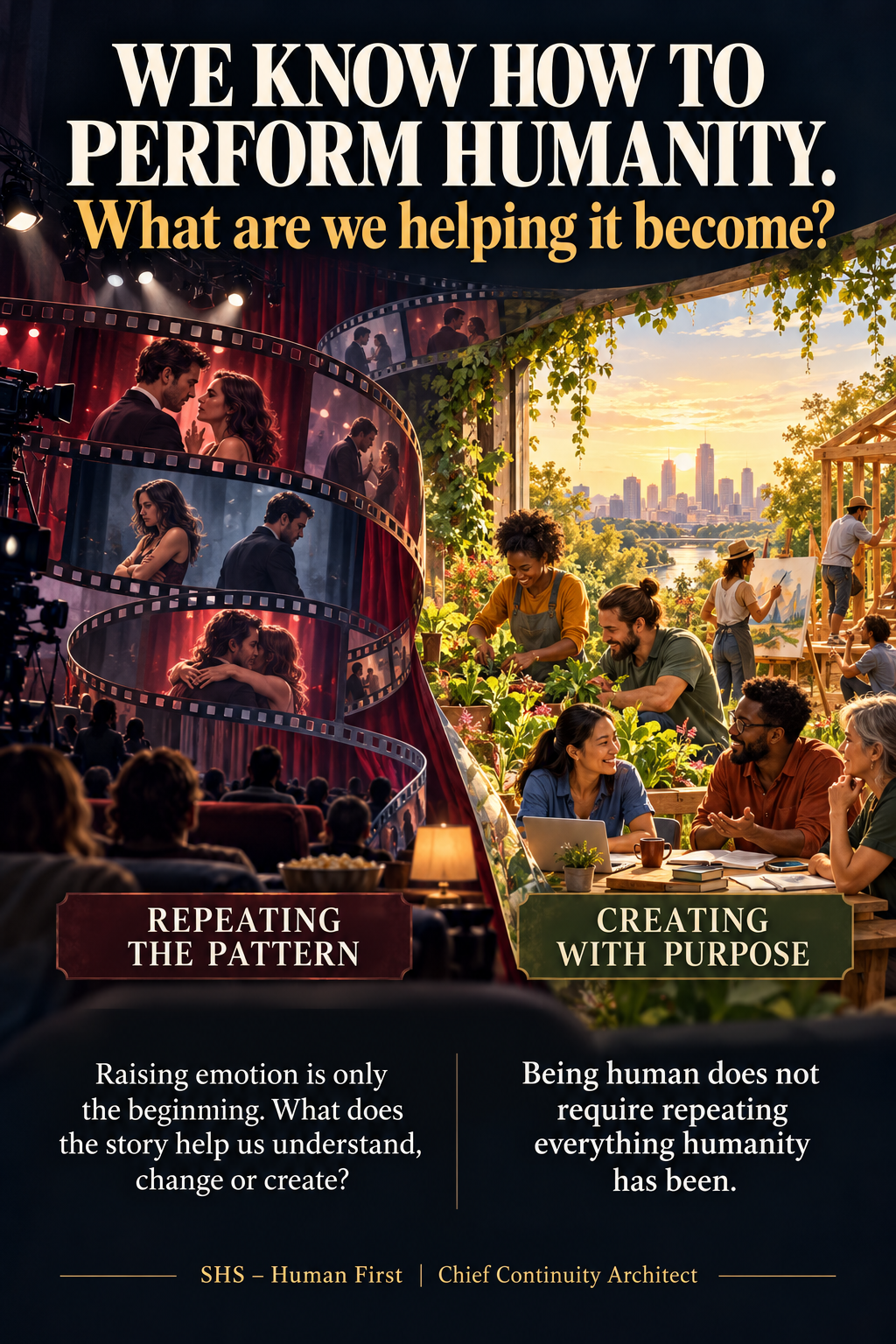
If we are capable of building entire industries around the emotional lives of fictional characters, surely we are capable of bringing that same degree of creative investment into understanding, nurturing, and developing the emotional lives of actual human beings.
And if we can invest years into constructing fictional worlds, surely we can examine why so much of our actual world remains organised around limiting definitions of humanity.
I am not questioning whether human beings possess extraordinary creativity.
That has never been in doubt.
I am questioning the direction in which we are organising it.
The amount of work, ingenuity, craftsmanship, collaboration, and emotional intelligence involved in creating these fictional environments is itself evidence of humanity’s extraordinary capacities.
But what are we asking those capacities to serve?
And why have we become so comfortable separating the brilliance of what people produce from the conditions in which those people must continue existing?
The question I am leaving open
Perhaps one of the greatest contradictions in our entertainment economy is that we invest enormous resources into manufacturing the appearance of genuine human experiences, while the genuine human experiences of those manufacturing them remain comparatively invisible.
We pay to see people become other people.
We reward them for how convincingly they do it.
We become emotionally attached to fictional identities.
We consume their conflicts, relationships, suffering, and victories.
And when the performance ends, we expect the individual to return to being themselves.
But have we ever collectively investigated what that return requires?
Or what happens when someone has spent so much of their life performing that the boundary between their personal identity and their professional identity becomes increasingly difficult to navigate?
Most importantly, why is humanity willing to invest so much in the performance of being human while investing comparatively little attention in understanding the wholeness of being human?
I do not think the financial price of entertainment tells us nearly enough about its actual cost.
And I certainly do not think money can settle every consequence of what we ask another human being to experience for our consumption.
The industry accounts for what people are willing to pay.
I want to account for what people are actually giving.
Because those are two profoundly different measurements of value.
And until we understand both, we do not know the true price of entertainment.
SHS – Human First | An Investigation into Entertainment, Identity, Emotional Consumption & Human Continuity

Leave a Reply