
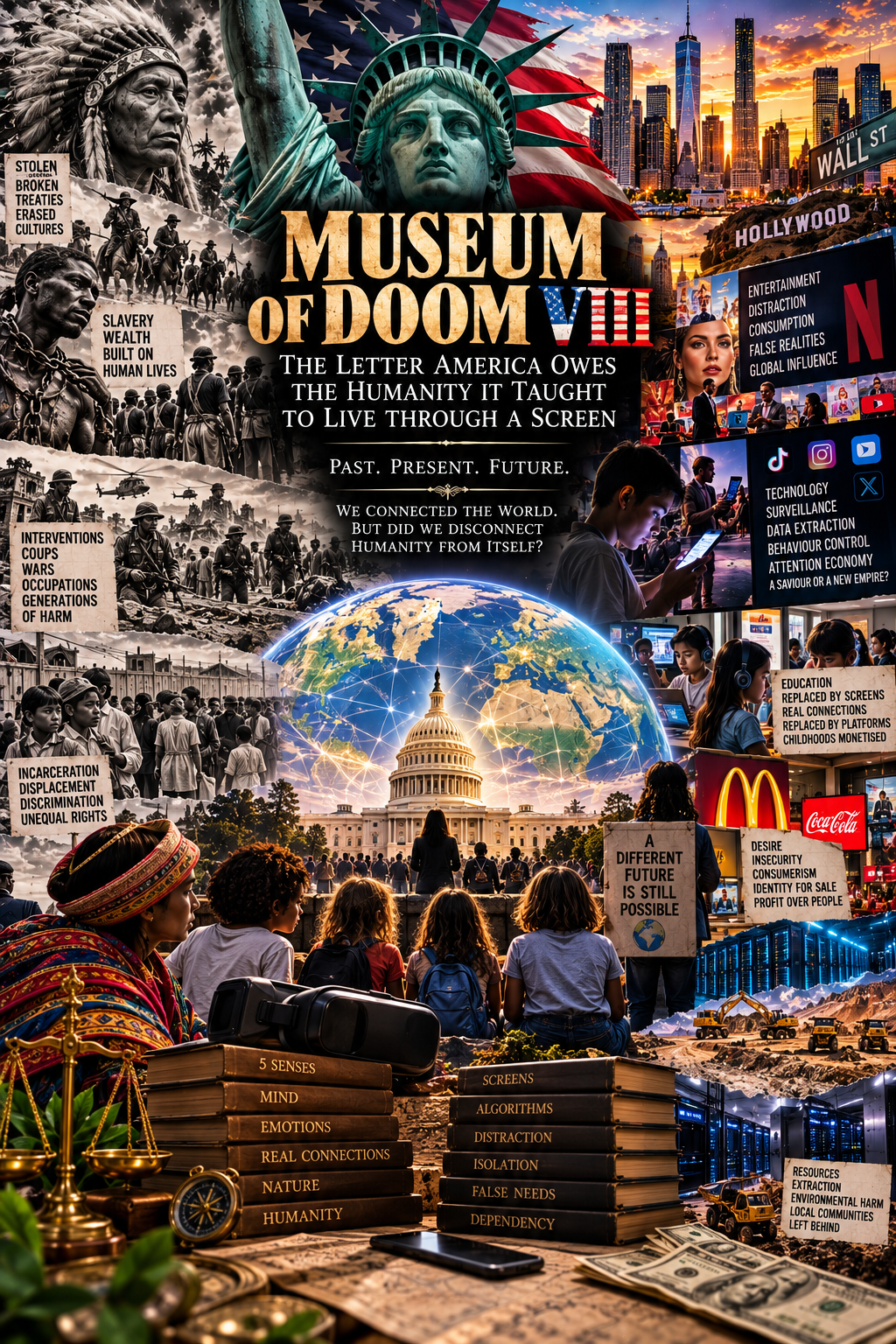
The Letter America Owes the Humanity It Taught to Live Through a Screen
We connected the world. But did we disconnect humanity from itself?
The American chapter goes beyond territorial conquest. It confronts an additional form of influence: the export of systems that increasingly mediate how human beings communicate, learn, perceive themselves, form relationships, entertain themselves and participate in society.
The contradiction is visible in research. In April 2026, Pew Research found that American teenagers use social platforms for both connection and entertainment, while reporting problems with sleep and productivity. The FTC has documented extensive commercial surveillance by major digital platforms. And the American Psychological Association’s 2025 survey found that 54% of US adults felt isolated at least some of the time. These findings do not prove technology caused the loneliness crisis, but they make the relationship between digital design, social connection and human wellbeing impossible to dismiss. Pew Research Center +2
The letter below is written from the perspective of an American who recognises both the nation’s historical injustices and its present responsibility for technologies and commercial models that influence billions of lives—including the generations who will inherit them.
MUSEUM OF DOOM VIII
The Letter America Owes the Humanity It Taught to Live Through a Screen
We connected the world. But did we disconnect humanity from itself?
An imagined letter of atonement from an American soul confronting the past, present and future consequences of a civilisation that has become extraordinarily capable of influencing the world, but has not always exercised equal responsibility for what that influence does to human existence.
To the Indigenous nations of North America.
To the descendants of enslaved Africans.
To the peoples of the Philippines, Puerto Rico, Hawaii, Vietnam, Korea, Iraq, Afghanistan, Iran, Guatemala, and every community affected by American expansion, military intervention or political influence.
To the workers, families, children, students, artists, creators and communities whose lives have been shaped by American corporations, entertainment and technology.
To the generations yet to be born.
And to my fellow Americans.
I am American.
And I love my country.
I love our creativity.
Our innovation.
Our scientific achievements.
Our extraordinary diversity.
Our music.
Our art.
Our films.
Our literature.
Our engineering.
Our universities.
Our researchers.
Our inventors.
Our entrepreneurs.
Our capacity to transform ideas into reality.
We have contributed extraordinary things to the world.
Medical breakthroughs.
Space exploration.
Scientific discoveries.
Technological advancements.
Forms of cultural expression that have inspired people across continents.
We helped develop the internet into a global infrastructure.
We built powerful computing systems.
We created platforms through which people thousands of miles apart could communicate in seconds.
We made information accessible on a scale that previous generations could scarcely have imagined.
We created entire industries around storytelling, entertainment and digital communication.
And I recognise the genuine value of much of that work.
But today, I want to ask something.
What have we actually done to humanity through the systems we have created?
Not merely what have we invented.
Not merely what have we sold.
Not merely how much revenue have we generated.
Not merely how many people use our products.
But what have our creations done to the human being?
To their mind.
Their emotions.
Their relationships.
Their perception.
Their ability to learn.
Their relationship with nature.
Their understanding of themselves.
Their capacity to exist without needing an external system to validate their existence.
Because there is something I am beginning to recognise.
We have become extraordinarily successful at creating vessels through which human beings experience life, while becoming less attentive to the life they were already capable of experiencing without those vessels.
And I want to apologise.
Not for creating technology.
Not for developing intelligence.
Not for making extraordinary discoveries.
But for every occasion on which we have confused making technology more powerful with making humanity more capable.
I am sorry for what we did in the past.
I am sorry for what we are doing in the present.
And I want to take responsibility for what we are now preparing to leave to the future.
Because the consequences of our creations will not necessarily end when the people who created them are gone.
PART I — THE PAST
To the peoples whose existence preceded the United States
I am sorry.
For the land taken.
For the treaties broken.
For the communities displaced.
For the wars.
For the massacres.
For the destruction of livelihoods.
For the forced removals.
For the attempts to erase Indigenous languages, cultures, religions and systems of governance.
I am sorry to the Cherokee, Choctaw, Chickasaw, Creek, Seminole and the many other Indigenous nations subjected to removal and dispossession.
For the Trail of Tears.
For the thousands who died through forced displacement.
For the families separated from their homelands.
For the people who watched their existing relationships with land become subordinate to a system of property rights imposed through settler expansion.
I am sorry for the federal Indian boarding-school system.
For the children removed from their families.
For the children whose hair was cut.
Whose names were changed.
Whose languages were forbidden.
Whose cultural and spiritual practices were suppressed.
For those subjected to physical and sexual abuse.
For those forced into labour.
And for the children who never returned home.
I want to ask something.
How can a country describe itself as the land of the free while organising institutions designed to deprive entire populations of their freedom to remain who they already were?
And how can we celebrate our expansion without fully recognising the people whose existing societies were disrupted by it?
I do not want the United States to become the beginning of the history of the land upon which it exists.
Because America did not begin when the United States was established.
The land already possessed histories.
Civilisations.
Languages.
Relationships.
Knowledge.
And human communities.
We did not create humanity upon this continent. We established a new political system upon lands where humanity already existed.
And I want to recognise that distinction.
Because an Indigenous person does not need the United States to validate the legitimacy of their ancestral existence.
Their history is not merely a chapter within ours.
To the descendants of enslaved Africans
I am sorry.
For slavery.
For the commodification of human life.
For the families separated.
For the people sold.
For the men, women and children forced to labour under violence.
For the people whose bodies became somebody else’s financial property.
For the people whose reproductive lives were controlled.
For the women subjected to sexual violence.
For the children born into enslavement.
For the generations deprived of autonomy.
And for the extraordinary wealth accumulated through the exploitation of their labour.
I am sorry that our institutions protected slavery while celebrating liberty.
That our political language spoke of freedom while excluding millions from its protection.
That our economy benefited from an arrangement in which the suffering of human beings could be converted into financial value.
And that after slavery formally ended, systems of segregation, discriminatory law, political exclusion, racial terror and economic inequality continued restricting the lives of Black Americans.
I am sorry for Jim Crow.
For lynchings.
For the denial of voting rights.
For unequal schools.
For discriminatory housing policies.
For redlining.
For the barriers imposed upon families attempting to accumulate wealth and establish security.
And for every generation that inherited the consequences.
There is something deeply disturbing about recognising that the same country which produced extraordinary technological and financial systems also produced institutions capable of organising the systematic exclusion of human beings.
Our ability to organise was never proof that what we organised was humane.
We were capable of designing extraordinary systems.
But not every system we designed protected humanity.
And I want us to recognise that the historical consequences of slavery did not disappear the moment the law changed.
The conditions of land ownership, education, housing, income, political power and opportunity were shaped through generations of decisions.
Those conditions cannot be fully understood without acknowledging their histories.
I recognise the enormous achievements of Black Americans.
The artists.
The scientists.
The civil rights organisers.
The educators.
The workers.
The inventors.
The intellectuals.
The people who transformed American culture and institutions.
But I do not want to celebrate their resilience as though that resilience absolves us of responsibility for the conditions they were forced to overcome.
A person’s ability to become extraordinary despite injustice does not make the injustice acceptable.
To the Japanese Americans whose country turned against them
I am sorry.
For the forced removal and incarceration of approximately 120,000 people of Japanese ancestry during the Second World War.
For the families removed from their homes.
For the businesses lost.
For the communities disrupted.
For the people whose loyalty was questioned because of their ancestry.
I recognise that the United States eventually enacted legislation acknowledging the injustice and providing redress to surviving eligible individuals.
But I want to acknowledge what happened before that repair.
The state was capable of depriving people of their freedom while claiming to be defending freedom.
And that contradiction matters.
Because it reveals something about power.
A government does not become incapable of injustice simply because it describes its intentions as protective.
To Hawaii, Puerto Rico and the Philippines
I am sorry for the overthrow of the Hawaiian monarchy in 1893, carried out by a group including American and European residents with the support of United States diplomatic and military representatives.
For the annexation that followed.
For the disregard of Native Hawaiian sovereignty.
For the historical dispossession and suppression of cultural rights.
I am sorry to Puerto Rico for the transfer of sovereignty from Spain to the United States in 1898 without Puerto Ricans determining that agreement themselves.
For the long history of unequal political arrangements that followed.
And for the continuing debates over Puerto Rico’s political status, economic autonomy and representation.
To the Philippines, I am sorry for the war that followed the United States’ acquisition of the islands from Spain.
For the Filipino people who sought independence rather than a change in colonial rulers.
For the civilians killed.
For the villages destroyed.
For the torture.
For the reconcentration policies.
For the extraordinary suffering of a population whose desire for political autonomy was treated as an obstacle to American expansion.
And I want to ask something.
How could a country founded upon independence deny another population the right to determine its own independence?
How could we understand the value of freedom for ourselves while refusing to recognise its equal value for others?
I am sorry for the occasions on which the United States behaved as though its political interests gave it authority over another people’s future.
To the nations affected by American military and political interventions
I am sorry for the human consequences of interventions through which the United States attempted to influence the political futures of other countries.
For the American involvement in the overthrow of Iran’s Prime Minister Mohammad Mossadegh in 1953.
For the CIA-backed operation that helped overthrow Guatemala’s government in 1954.
For the people whose lives were affected by the political instability, repression and conflict associated with such interventions and their aftermath.
For the devastating suffering of the Vietnam War.
For the civilians killed.
For the communities destroyed.
For the environmental harm associated with chemical defoliants.
For the people who continued living with the consequences long after the war ended.
For the human suffering associated with wars in Iraq and Afghanistan.
For civilians killed or displaced.
For families who lost homes and livelihoods.
For the people subjected to torture and unlawful detention.
And for the consequences of military decisions whose effects extended far beyond the immediate objectives of those who made them.
I recognise that these conflicts had different causes, actors and histories.
I recognise that the United States was not responsible for every act of violence committed within them.
But I refuse to treat complexity as permission to avoid examining our own actions.
I also recognise the Americans who protested unjust wars, exposed abuses, defended civil liberties and worked to protect those harmed.
They are part of our national history too.
But their existence does not erase the responsibility of the institutions whose actions they challenged.
The ability to project power across the world does not establish the wisdom of doing so.
And I want our understanding of national security to include the humanity of the people living beyond our borders.
Because they do not become less human when their country becomes a place of strategic interest.
PART II — THE PRESENT
To the world we connected through technology
This is where my apology becomes different.
Because in earlier centuries, power was exercised through territorial conquest, military force, slavery, commercial extraction and political control.
But today, some of the most influential American institutions exercise power through something less immediately visible.
The organisation of human attention.
The organisation of information.
The organisation of communication.
The organisation of entertainment.
The organisation of transactions.
The organisation of education.
The organisation of the ways in which people encounter, interpret and respond to one another.
We created platforms capable of reaching billions of human beings.
And those platforms do not merely distribute information.
Their design can influence what people see.
What they ignore.
What they remember.
What they purchase.
What they believe.
What they fear.
What they desire.
And how they relate to other people.
We created extraordinary technological vessels.
And gradually, many people began organising more of their existence through those vessels.
I recognise the benefits.
A person can speak to a family member living on another continent.
A disabled person can access services and communities that might otherwise be inaccessible.
A student can learn from a teacher thousands of miles away.
A creator can share work with an international audience.
A person who feels isolated can find others with similar experiences.
And people can build meaningful relationships online.
Those are real achievements.
But I want to ask a question.
At what point did the vessel become more important than the human connection it was created to facilitate?
At what point did our measure of successful communication become the number of messages exchanged rather than the quality of understanding established?
At what point did we start measuring connection through followers?
Likes?
Views?
Shares?
Notifications?
And engagement?
Why do we speak so much about increasing connectivity when the human experience of connection cannot be reduced to the existence of a network?
Because connectivity and connection are not necessarily the same thing.
We can connect two devices.
But that does not mean we have connected two human beings emotionally.
We can deliver a message.
But that does not mean the recipient feels understood.
We can create a video call.
But that does not mean the people involved are fully present.
We can create a social network.
But that does not mean we have created a community.
We connected the infrastructure of communication and increasingly treated that as though it were equivalent to connecting humanity.
And I am sorry for that confusion.
To the human being who was already equipped to connect
There is something I want my fellow Americans to remember.
We did not invent the human capacity for connection.
It existed long before our companies.
Long before our devices.
Long before the internet.
Long before the platforms.
Long before the algorithms.
Human beings were already equipped with five senses.
Sight.
Hearing.
Touch.
Smell.
Taste.
And beyond those senses, with the capacity to perceive, interpret, remember, imagine, think and experience emotions.
We were already capable of recognising another person’s presence.
Seeing the expression on their face.
Hearing the changes in their voice.
Feeling the warmth of an embrace.
Recognising the smell of a familiar environment.
Sharing food.
Experiencing nature.
Observing behaviour.
Learning through direct participation.
Developing relationships through repeated encounters.
And understanding one another through layers of interaction that cannot always be reduced to words.
We had our minds.
We had our emotions.
We had our bodies.
We had our environments.
And we had one another.
Humanity did not need Silicon Valley to invent connection.
Humanity already possessed the capacity to connect.
Technology expanded the distances across which we could communicate.
But somewhere along the way, we began designing systems that could encourage people to spend extraordinary amounts of time interacting with representations of life rather than participating directly in the life around them.
A photograph of a gathering.
A video of a conversation.
A recording of a concert.
A stream of somebody else’s daily existence.
A simulation of companionship.
A platform that presents endless opportunities to observe other people’s lives.
And I want to ask something.
When did watching become an adequate substitute for participating?
When did observing another person’s experience become more desirable than developing our own?
When did we become so accustomed to consuming representations of existence that we stopped questioning how much of our own existence was being spent on that consumption?
We were given the capacity to experience life, yet we have created industries that profit from keeping people occupied with experiencing representations of other people’s lives.
And I want us to examine the consequences.
Not because watching a film is inherently harmful.
Not because a digital conversation is inherently meaningless.
But because the relationship between a tool and the human being using it matters.
Technology should expand human possibility.
Not gradually replace the conditions through which human possibility is developed.
To the people whose attention we monetised
I am sorry.
For the ways American technology companies have built business models around capturing, retaining and monetising human attention.
For the enormous collection of personal information.
For the commercial tracking of behaviour.
For advertising systems that attempt to anticipate what people will respond to.
For recommendation systems optimised around commercial objectives that do not necessarily align with human wellbeing.
For the children and teenagers whose developmental needs have not always been adequately protected within those systems.
For the adults whose time, attention and personal information have become commercially valuable resources.
I recognise that not every platform uses the same business model.
I recognise that recommendation systems can help people discover useful information.
But I want to ask something.
When a company makes more money because a person remains engaged for longer, what happens when the most engaging experience is not necessarily the most beneficial one?
What happens when outrage attracts attention?
When insecurity creates consumption?
When comparison encourages repeated checking?
When a person becomes accustomed to constant novelty?
When silence begins to feel uncomfortable?
When boredom becomes something to immediately eliminate?
And when the mind becomes increasingly conditioned to expect stimulation?
We have created extraordinary systems for predicting and responding to human behaviour.
But how much effort have we invested in understanding what those systems do to the person whose behaviour is being predicted?
I want our companies to recognise that attention is not an unlimited resource.
Time is not an unlimited resource.
And the human mind is not simply an environment within which businesses can continuously compete for engagement.
A person’s attention is part of their life.
When we design systems intended to capture it, we are influencing how that person spends their existence.
And that deserves far more responsibility than merely asking whether the business model is profitable.
To the children growing up inside our digital architecture
I am sorry.
Because I want to ask something about the childhood we are creating.
What happens when a child increasingly encounters the world through a screen?
When entertainment is available every moment?
When social interaction is mediated by applications?
When approval can be represented through numbers?
When comparison becomes continuous?
When the opportunity to escape discomfort is available through another notification, video or game?
And when artificial systems increasingly respond to their questions, preferences and emotions?
I recognise that children benefit from useful educational technologies.
I recognise that digital access can open extraordinary opportunities.
I recognise that some children find acceptance and community online that they have struggled to find elsewhere.
But I want us to stop assuming that more access automatically means better development.
Children need opportunities to play.
To imagine.
To interact.
To encounter disagreement.
To negotiate relationships.
To observe.
To explore nature.
To move their bodies.
To develop patience.
To experience boredom.
To resolve conflicts.
To build understanding through the senses and through direct interaction with their environments.
Childhood is not merely a period in which we should maximise exposure to information.
It is a period of human development.
And I want technology companies to recognise that distinction.
Because a child is not simply a future consumer.
Not merely a future user.
Not merely a collection of behavioural information.
A child is a human being developing the capacity to participate in existence.
And the systems surrounding that child should support that development.
Not make their attention the primary opportunity for commercial extraction.
To the teachers and students whose learning we attempted to digitise
I am sorry.
For every occasion on which technology has been presented as a replacement for the human relationships that make education meaningful.
We have developed extraordinary learning tools.
Digital libraries.
Educational platforms.
Artificial intelligence tutors.
Video lessons.
Remote classrooms.
Interactive simulations.
And I recognise their value.
They can expand access to knowledge.
They can make certain learning experiences more affordable.
They can support students whose circumstances prevent them from attending conventional classrooms.
But I want to ask something.
Is education simply the delivery of information?
Or is it also the development of the human being who receives it?
Because a teacher does more than transmit knowledge.
A teacher observes.
Listens.
Responds.
Encourages.
Challenges.
Interprets.
Recognises difficulties.
Understands context.
Builds relationships.
And helps a student develop the capacity to think.
Education happens through the interaction between the student, the information, the environment and the people involved.
We should not confuse access to endless information with the possession of understanding.
And we should not confuse being able to retrieve an answer with having developed the cognition necessary to produce one.
A student who can obtain an answer through technology is not necessarily a student who understands how that answer came into existence.
And now we are developing systems that can write essays.
Solve problems.
Summarise books.
Generate explanations.
Produce presentations.
And respond to questions almost instantly.
Those capabilities are extraordinary.
But what happens when the student increasingly uses them without developing the corresponding human abilities?
What happens to independent reasoning?
To curiosity?
To persistence?
To the experience of working through uncertainty?
To the development of judgement?
We must stop treating the automation of an educational task as though it automatically represents progress in education.
The purpose of education is not merely to produce completed work. It is to develop a human being capable of understanding and contributing to the world.
And no technological product should be allowed to obscure that purpose.
To the world we entertained
I owe you another apology.
And perhaps this is one of the most uncomfortable.
Because entertainment is among America’s most influential exports.
Hollywood.
Television.
Streaming.
Music.
Gaming.
Celebrity culture.
Social media entertainment.
The commercial production of desire, aspiration, beauty, status and identity.
We have produced extraordinary art.
Films that moved people.
Stories that challenged injustice.
Music that connected generations.
Creative work that expanded imagination.
And I recognise the talent and humanity involved.
But I also recognise that we have created enormous commercial systems around entertaining people.
Systems that compete for attention.
Systems that turn emotion into engagement.
Systems that transform insecurity into demand.
Systems that create aspirational images of lifestyles that many people cannot afford.
And systems that can make the representation of a life more commercially valuable than the actual conditions of the people living it.
We have become extraordinarily effective at selling experiences of existence.
And I want to ask whether we have also become increasingly comfortable with people substituting those experiences for direct participation in their own lives.
We have reality television.
But how much of it is reality?
We have celebrity relationships.
But how much of what we see reveals the actual human relationship?
We have lifestyle influencers.
But how much of the lifestyle is structured around commercial agreements?
We have entertainment designed to create emotional intensity.
But what happens when the intensity disappears?
What happens when the screen turns off?
What remains within the person?
What knowledge has been developed?
What relationship has been strengthened?
What human capacity has been expanded?
I am not saying entertainment cannot offer those things.
It can.
But I want to distinguish entertainment that enriches life from entertainment designed primarily to occupy life.
An industry can become extraordinarily successful at stimulating emotions without necessarily contributing to the wellbeing of the person experiencing them.
And I want America to be willing to examine that.
To the people taught to consume identities instead of developing their own
I am sorry for the enormous commercial pressure placed upon people to become something that can be recognised, purchased, displayed and admired.
The perfect body.
The perfect home.
The perfect lifestyle.
The perfect relationship.
The perfect career.
The perfect holiday.
The perfect image.
The perfect personal brand.
We have transformed enormous parts of human identity into commercial markets.
And I want to ask something.
Who was the human being before the product was introduced?
Before the trend?
Before the advertisement?
Before the social expectation?
Before the platform taught them what should be desirable?
Because I worry that we have become so accustomed to selling people an improved version of themselves that we have neglected to recognise the value of the person who already exists.
Humanity should not have to become a consumer before it can be recognised as valuable.
And the development of a person’s identity should not depend upon their ability to purchase the symbols through which society recognises success.
I am sorry for every commercial system that has profited from making people feel inadequate without the thing being sold to them.
To the people whose basic needs became financial obligations
There is another contradiction at the centre of our society.
We have created one of the world’s largest economies.
An enormous financial system.
Extraordinary productivity.
Sophisticated logistics.
Advanced technology.
Great agricultural capacity.
And immense institutional wealth.
Yet people continue experiencing food insecurity.
Housing insecurity.
Medical debt.
Educational debt.
Financial stress.
And the fear of losing access to the conditions necessary for survival.
I recognise that resources are not unlimited.
That production requires labour.
That infrastructure requires maintenance.
That healthcare requires skilled professionals.
That food must be grown, transported and distributed.
But I want to question how we organise access to what human beings require to remain alive.
Because food did not become a human need when we invented currency.
Water did not become necessary when we established markets.
Shelter did not become important when property acquired a price.
And human health did not become valuable when medical services became billable.
These needs existed before our financial systems.
The systems were created to organise economic activity around them.
Yet we increasingly behave as though the ability to pay is the primary measure through which a person should gain access to the necessities of existence.
And I want to ask something.
What exactly have we accomplished if our organisational intelligence has created extraordinary wealth but still leaves people frightened about whether they can afford to remain alive?
We should be able to ask how financial structures can support human wellbeing rather than allowing financial measures to become the ultimate definition of that wellbeing.
And we should be able to recognise that a person is not less human because they possess less currency.
To the families who can communicate constantly but struggle to spend time together
I am sorry.
For the ways our economic and technological systems can contribute to lives that are increasingly occupied, scheduled and financially pressured.
For the parents who work long hours while trying to maintain relationships with their children.
For the children who receive digital entertainment because the adults around them are exhausted.
For the people who communicate throughout the day without having the time or emotional availability to be fully present with one another.
For the friends who live near each other but increasingly interact through applications.
And for the people whose daily lives are structured around obligations that leave little space for direct human connection.
I do not claim technology created every one of these circumstances.
Industrialisation, urban planning, work patterns, social inequality and other forces have shaped human relationships for generations.
But I want to recognise that our technological systems have become part of this environment.
And I want to ask whether we have sometimes used technology to accommodate the loss of proximity rather than questioning why that proximity became so difficult to maintain.
We invented tools that allow people to communicate across enormous distances. But we must not use that achievement as a reason to neglect the conditions that allow people to spend time together.
A message is useful.
A video call can be meaningful.
A photograph can preserve a memory.
But none should become an excuse for creating a society in which meaningful human presence is increasingly difficult to access.
To the people whose loneliness became a market
I am sorry.
Because loneliness should never be treated merely as another commercial opportunity.
People need connection.
They need recognition.
They need affection.
They need friendship.
They need communities.
They need opportunities to belong.
And they need to feel that their existence matters beyond what they produce or purchase.
Yet our industries increasingly offer products and services designed around the human desire for companionship.
Applications for dating.
Platforms for friendship.
Subscriptions for entertainment.
Virtual communities.
Artificial companions.
And now increasingly sophisticated conversational artificial intelligence.
Some of these technologies genuinely help people.
But I want us to question what happens when the conditions producing loneliness remain unresolved while businesses become increasingly capable of selling responses to it.
What if we become better at monetising loneliness than at reducing it?
What if we create an economy in which emotional discomfort becomes a recurring source of revenue?
What if the customer is financially more valuable when they continue returning for reassurance?
And what happens if a company has little commercial incentive to help someone become less dependent upon its product?
I want American technology companies to understand that human vulnerability is not merely a business opportunity.
The person seeking companionship is a human being.
Their emotions are real.
Their need for connection is real.
And the consequences of the relationship they establish with a product can be real.
That deserves care.
Not simply innovation.
PART III — THE FUTURE
To the generations who will inherit artificial intelligence
I want to apologise in advance for the harm we may create if we continue developing artificial intelligence without sufficient responsibility.
Because the technologies we are building today may become part of the environments in which future generations learn, work, communicate, make decisions and develop relationships.
We are building systems capable of producing language.
Images.
Videos.
Voices.
Music.
Simulations.
Recommendations.
Predictions.
And increasingly complex forms of autonomous action.
We are creating tools that can perform tasks once requiring substantial human effort.
And I recognise the possibilities.
Scientific discovery.
Medical research.
Accessibility.
Education.
Engineering.
Environmental monitoring.
Creative assistance.
The reduction of dangerous or repetitive labour.
But there is something we must never forget.
A machine becoming more capable does not automatically mean the human being using it is becoming more capable.
And the fact that a system can produce something resembling a human response does not establish that it possesses the same experience, understanding or responsibility as a human being.
We must distinguish the capacity to generate communication from the experience of human connection.
The capacity to produce information from the development of understanding.
The capacity to simulate empathy from the human experience of caring.
And the capacity to complete a task from the development of the human being who would otherwise have performed it.
I do not want us to create generations who can obtain answers to everything but have been deprived of opportunities to develop their own cognition.
I do not want children to become more familiar with artificial voices than with the emotional complexity of the people around them.
I do not want human companionship to become an optional luxury while artificial companionship becomes the more financially accessible alternative.
And I do not want our companies to market the replacement of human interaction as an achievement without accounting for what is lost when the interaction disappears.
AI should expand what humanity can do, not diminish what humanity is encouraged to become.
To the workers whose future is being reorganised
I am sorry for every occasion on which technological efficiency has been pursued without an equivalent concern for the human beings affected.
I recognise that automation can remove dangerous work.
Improve productivity.
Reduce costs.
Create new professions.
And make useful services more accessible.
But I want to ask something.
When a company automates thousands of tasks, what becomes of the people whose incomes depended upon performing them?
What becomes of the communities?
The families?
The skills?
The relationships?
The industries?
And the social structures built around that work?
I am not suggesting that humanity should preserve every form of labour simply because it once existed.
But I want us to recognise that productivity is not the only measure of economic progress.
A society that becomes extraordinarily productive while leaving growing numbers of people unable to access its prosperity has not resolved the human problem of economic organisation.
It has changed the technical conditions under which that problem exists.
And I want America to take responsibility for the social consequences of the technologies its institutions commercialise.
If technological advancement creates greater abundance, then we should question how that abundance is distributed.
Who benefits?
Who owns the systems?
Who controls access?
Who receives the resulting wealth?
And what happens to the people whose labour is no longer required?
The future should not become an arrangement in which human beings lose both the opportunity to work and the ability to access what technology produces.
To the communities living beside our data centres
I am sorry for every occasion on which technological development has been treated as though it exists outside nature.
Our technologies require materials.
Energy.
Water.
Land.
Buildings.
Transport.
Manufacturing.
Waste management.
And human labour.
The digital world is not separate from the physical world.
It is sustained by it.
As artificial intelligence expands, data centres require increasingly substantial energy infrastructure.
And some communities are raising concerns about water consumption, electricity costs, land use and environmental consequences.
I recognise that impacts vary by location, technology and energy source.
And I recognise that technological infrastructure can create jobs and economic opportunities.
But I want us to stop speaking about digital advancement as though its environmental costs disappear because the product exists on a screen.
The cloud is not floating outside nature.
It is constructed within it.
And every physical resource used to sustain our systems must be accounted for.
If we call ourselves innovative, then let us innovate in ways that protect the ecosystems upon which our existence depends.
We cannot claim progress while ignoring the conditions necessary for life.
To the future children of humanity
There is something I want you to know.
You were never supposed to become dependent upon an application to recognise your own existence.
Your worth was never supposed to be calculated through the number of people watching you.
Your relationships were never supposed to become mere collections of interactions recorded by a platform.
Your education was never supposed to become simply the ability to retrieve information.
Your mind was never supposed to exist merely as an audience for endless stimulation.
And your emotions were never supposed to become commercially valuable signals for systems designed to predict your behaviour.
You were born with the capacity to perceive.
To think.
To feel.
To experience.
To create.
To question.
To imagine.
To build relationships.
And to participate in the extraordinary complexity of existence.
Technology can help you do those things.
But it should never become the authority that determines whether your humanity is valuable.
You should not have to be digitally visible to be humanly recognised.
You should not have to become commercially productive to deserve care.
You should not have to purchase companionship to experience belonging.
And you should not have to surrender your personal information simply to participate in the society around you.
I want you to inherit technologies that expand your freedom.
Not systems that require your dependency.
To the companies that will shape the future
I want you to understand something.
You are not merely developing products.
You are increasingly participating in the architecture of human existence.
Your decisions can influence how children learn.
How adults communicate.
How communities organise.
How people understand themselves.
How information circulates.
How culture develops.
And how human beings relate to one another.
That is an extraordinary responsibility.
And I want you to stop measuring success only through commercial growth.
Revenue.
Market share.
Subscriptions.
Engagement.
Valuation.
The number of users.
The quantity of information collected.
Or the amount of labour automated.
I want you to ask:
Does what we create protect and expand the human capacity to live?
Does it improve understanding?
Does it strengthen autonomy?
Does it protect privacy?
Does it reduce unnecessary dependency?
Does it create genuine opportunities for learning?
Does it help people form meaningful relationships?
Does it preserve nature?
Does it respect the bodies, minds and emotions of the people involved?
And can a person refuse to use the product without becoming excluded from essential parts of society?
Because a technology that becomes practically unavoidable carries responsibilities far greater than those of an optional consumer product.
The more essential your system becomes to human life, the greater your responsibility to ensure that the human being remains more important than the system.
And now, America, I want to speak to you directly
We have to stop confusing influence with greatness.
The fact that our companies shape the habits of billions does not automatically mean those habits are beneficial.
The fact that our entertainment circulates globally does not mean every cultural influence it produces is valuable.
The fact that our currency plays a central role in international finance does not mean every economic relationship structured around it is equitable.
The fact that our technologies are extraordinarily advanced does not mean every application of those technologies is wise.
And the fact that people continue using our products does not mean the products are free from harmful consequences.
I want America to examine itself beyond its achievements.
I want us to recognise the distinction between creating something that people desire and creating something that improves their lives.
Because the two are not always equivalent.
People can desire things that do not serve their wellbeing.
People can become dependent upon systems they did not originally need.
And commercial success can sometimes increase precisely because the underlying human need remains unresolved.
We must stop treating the continuation of demand as sufficient evidence that we are meeting the need responsibly.
If a person remains lonely, selling them another subscription is not necessarily a solution.
If a child struggles to learn, providing another device is not necessarily an education.
If a community lacks meaningful opportunities to gather, creating another social platform does not necessarily restore proximity.
If a person cannot afford food, offering more ways to borrow money does not necessarily address the structure of their insecurity.
And if technology makes human interaction increasingly optional within an institution, we must ask whether the resulting efficiency is worth what may be lost.
I want us to develop the capacity to recognise these distinctions.
The guilt beneath our exceptionalism
There is something I want to confess about my own national identity.
I have been taught to see America as extraordinary.
Powerful.
Innovative.
Free.
Ambitious.
A country capable of achieving things that once seemed impossible.
And there is truth within parts of that identity.
But I wonder whether my pride has sometimes made it difficult to examine the consequences of our influence.
Perhaps when someone criticises American foreign policy, I feel compelled to speak about our humanitarian assistance.
Perhaps when someone questions American corporations, I immediately mention the products that have improved lives.
Perhaps when someone criticises Hollywood, I remind them of its artistic achievements.
Perhaps when someone questions social media, I point towards the relationships it has enabled.
Perhaps when someone criticises artificial intelligence, I emphasise the scientific possibilities.
And perhaps all those statements can contain truth.
But I want to ask myself something.
Why do I feel the need to present an achievement every time somebody asks me to acknowledge a harm?
Why does recognising something we did wrong sometimes feel like a threat to everything we have done well?
Why can I not acknowledge both without treating one as though it cancels the other?
And I wonder whether part of that response comes from an inherited relationship with national identity.
A relationship that teaches me to recognise America through its successes while making its failures something to defend against.
From a metaphysical perspective, I want to examine how unacknowledged historical and institutional consequences may influence the relationship a person has with the ecosystem they belong to.
I cannot assume every American carries the same psychological burden.
But I can recognise that guilt does not necessarily announce itself.
That defensiveness can exist before conscious recognition.
That a person can spend years protecting something without fully understanding why.
And that belonging to a society means being shaped by conditions created before one’s own lifetime.
I did not personally write every law.
I did not personally design every algorithm.
I did not personally authorise every military intervention.
I did not personally participate in every harmful commercial decision.
But I belong to a society whose institutions have exercised extraordinary influence over the world.
And I have a responsibility to examine that inheritance.
I cannot celebrate America’s capacity to influence humanity while refusing to account for the consequences of that influence.
What genuine atonement should require
I do not want the United States to apologise merely so it can feel morally accomplished.
I want responsibility.
I want honest historical education.
I want respect for Indigenous sovereignty and the fulfilment of lawful obligations.
I want meaningful consideration of restitution and reparatory justice where historical harms remain unresolved.
I want the acknowledgement of slavery and the continuing examination of discriminatory institutions.
I want transparency concerning military interventions and their human consequences.
I want technology companies to be accountable for the way they collect data and influence behaviour.
I want children protected from exploitative commercial design.
I want schools to preserve human-led education.
I want artificial intelligence developed in ways that strengthen human autonomy rather than unnecessarily replace it.
I want communities to have meaningful opportunities to gather.
I want people to be able to access essential services without unnecessary technological barriers.
I want workers to participate in the benefits of the technologies transforming their industries.
And I want the basic requirements of human existence to be treated as foundational responsibilities of social organisation rather than merely commercial opportunities.
I want American institutions to be capable of recognising that there are things technology cannot replace simply by becoming better at imitating them.
A human being does not become unnecessary because a machine becomes capable.
And human relationships do not become obsolete because communication technologies become more sophisticated.
My final letter to America
I love you.
I love what our people are capable of creating.
I love the extraordinary scientific discoveries.
The art.
The music.
The innovation.
The cultural diversity.
The capacity to question.
The people who continue working to make our institutions more responsible.
But I do not want the future of America to be measured through the number of human activities we can successfully transfer into technological systems.
I want it to be measured through what those systems make possible for humanity.
I do not want children who can communicate with the world but struggle to connect with the people around them.
I do not want students who can obtain every answer but have not developed the ability to reason independently.
I do not want workers who create extraordinary value but cannot afford the basic conditions of existence.
I do not want communities whose physical spaces disappear while their digital representations become increasingly profitable.
I do not want people who possess thousands of online connections but cannot find somebody to sit beside them when they need genuine human presence.
And I do not want a future in which the human body, mind and emotions become secondary to the commercial systems created to serve them.
We already possessed the foundations of human connection before we invented technology.
Our five senses.
Our minds.
Our emotions.
Our bodies.
Our communities.
Our relationship with nature.
And our capacity to participate directly in existence.
Technology was supposed to expand those possibilities.
Not make us forget that we already possessed them.
So I want America to change the question it asks.
Not simply:
What else can we automate?
But:
What should remain human?
Not simply:
How can we increase engagement?
But:
What happens to the person whose attention we are engaging?
Not simply:
How can we make communication faster?
But:
How can we make understanding deeper?
Not simply:
How can we distribute more content?
But:
How can we contribute more meaningfully to human development?
Not simply:
How can we create more wealth?
But:
How can our economic organisation better sustain the lives of the people generating and depending upon that wealth?
And not simply:
How much influence can America exercise across the world?
But:
How much responsibility are we prepared to exercise for the consequences of that influence?
To the Indigenous nations:
I am sorry for the land, lives, cultures and opportunities taken.
To the descendants of enslaved Africans:
I am sorry for the generations of exploitation, oppression and exclusion.
To the nations subjected to American interventions:
I am sorry for the suffering caused by our actions and for the political autonomy we sometimes failed to respect.
To the people whose privacy and attention have become commercial resources:
I am sorry for the systems that have treated your personal existence as something available for extraction.
To the children whose lives are increasingly organised through screens:
I am sorry for every occasion on which our technologies have failed to protect your development.
To the teachers and students:
I am sorry for every time we have confused access to information with education.
To the workers:
I am sorry for the times we have placed technological efficiency above the human consequences of achieving it.
To the artists and creators:
I am sorry for the systems that have converted human creativity into commercial content while failing to recognise its full value.
To the families:
I am sorry for the ways our economic and technological arrangements can make meaningful time together increasingly difficult.
To the generations of the future:
I am sorry for every consequence we are creating today that you will inherit without having participated in the decisions that produced it.
And to the world:
I recognise that America did not create every form of disconnection, inequality, commercialisation or technological harm.
Other countries, institutions and individuals have participated in these transformations.
The world has changed through many interacting forces.
But America’s immense contribution to those changes carries immense responsibility.
And I do not want us to deny that responsibility simply because others share it.
We do not have to be the only cause of a problem to be accountable for our contribution to it.
I am sorry for the harm we caused in the past.
I am sorry for the harm we continue to produce.
And I am sorry for the harm we may create in the future if we fail to understand the consequences of our present decisions.
But I do not want to end this letter merely with an apology.
I want it to end with a commitment.
To recognise humanity before the system.
To protect nature before exploiting its resources.
To develop intelligence without surrendering consciousness.
To preserve human relationships while expanding communication.
To make education a process of human development rather than the commercial delivery of answers.
To create technology that supports rather than unnecessarily displaces human capacities.
And to organise prosperity around the wellbeing of people, rather than measuring the wellbeing of people only through their capacity to participate in commercial systems.
We connected the world.
Now we must ask whether we have helped humanity become more connected to itself.
And if we discover that some of our systems have weakened that connection, then we have a responsibility to change them.
Because our greatest achievement should never be the creation of a world that cannot function without American technology.
Our greatest achievement should be contributing to a world in which humanity can function, connect, learn, create and thrive—with or without the technologies we provide.
That is the difference between creating dependency and creating genuine progress.
And that is the future I want America to help build.
With recognition, remorse, gratitude, responsibility, consciousness and a commitment to the generations that will inherit the consequences of our choices,
An American soul who finally understands that connecting every device on Earth means very little if we lose the ability to recognise the humanity standing directly in front of us.
Museum of Doom VIII — The Letter America Owes the Humanity It Taught to Live Through a Screen.
SHS – Human First
The historical sections draw on the US National Archives, Department of the Interior and Department of State’s own records concerning forced Indigenous removal, boarding schools, Japanese American incarceration, the Philippine-American War and covert interventions in Iran and Guatemala. National Archives +5
The central education argument is also reflected in UNESCO’s research: technology can improve access and some learning outcomes, but should support rather than replace human-led education. As of 2026, the expansion of AI infrastructure is also creating measurable challenges involving energy demand, water use and local communities. 2023 GEM Report +2
The underlying distinction in this letter is between technological connectivity and human connection: technology can support meaningful relationships, but its existence alone cannot guarantee the emotional, mental, physical and social conditions necessary for those relationships to flourish.


Leave a Reply