
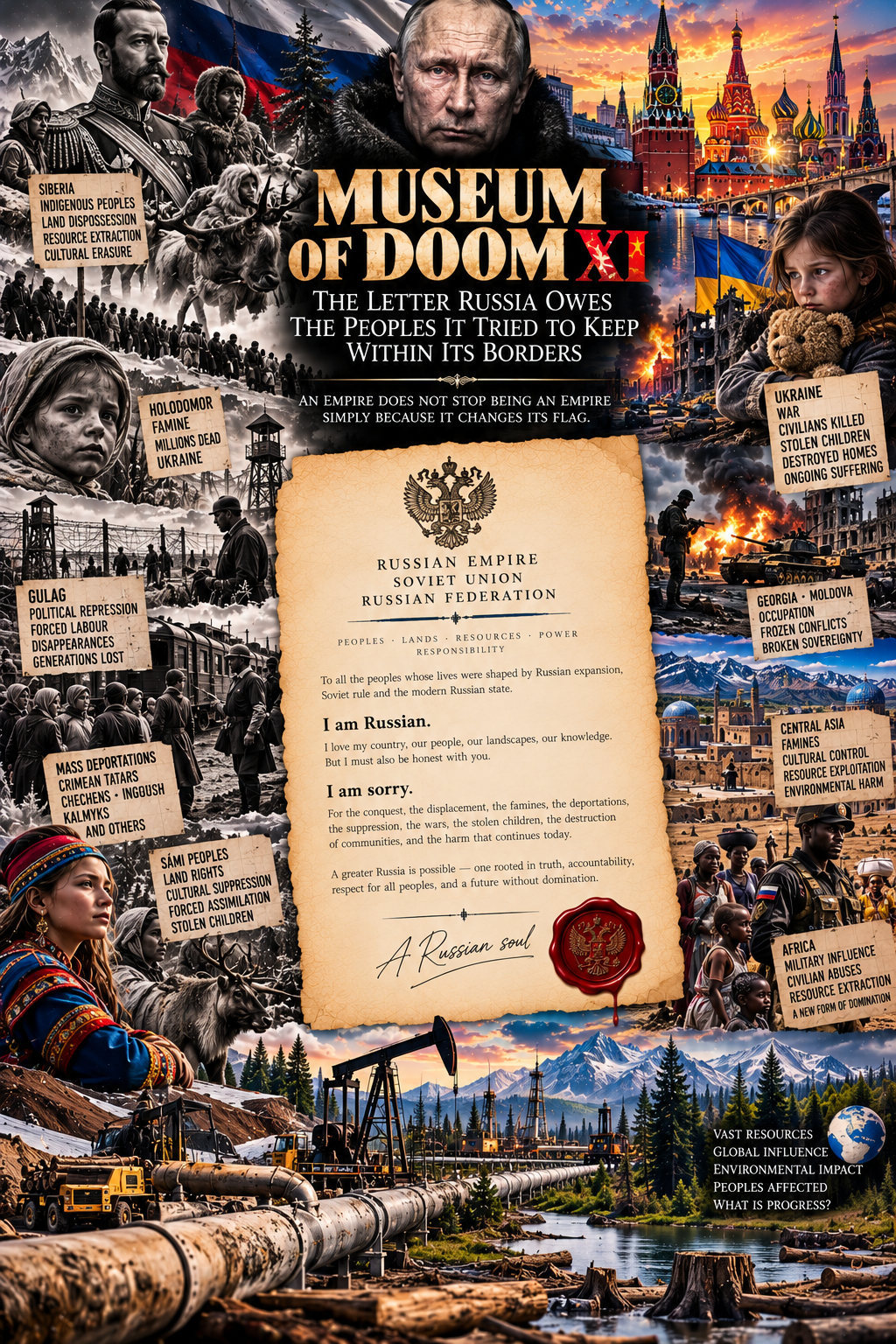
The Letter Russia Owes the Peoples It Tried to Keep Within Its Borders
An empire does not stop being an empire simply because it changes its flag.
This chapter has a particularly urgent dimension: Russia is not only confronting a historical imperial inheritance. Its present government continues to exercise military power beyond internationally recognised Russian borders.
On 29 October 2026, fresh Russian strikes killed civilians in Ukraine even as a limited humanitarian ceasefire around Oleshky offered an opportunity for aid and evacuation. The United Nations had already documented 328 civilians killed and 2,105 injured in Ukraine during September alone. Reuters +2
Russia’s other contemporary responsibilities also extend beyond Ukraine. Human Rights Watch documented civilian killings involving the Russian-controlled Africa Corps in Mali in July and August 2026. Human Rights Watch +1
The following letter is written from a Russian person’s conscience, recognising that historical inheritance does not mean personal culpability for every past act, but belonging to a society creates responsibilities concerning what its institutions continue to do—and what remains unaccounted for.
MUSEUM OF DOOM XI
The Letter Russia Owes the Peoples It Tried to Keep Within Its Borders
An empire does not stop being an empire simply because it changes its flag.
An imagined letter of atonement from a Russian soul confronting the inheritance of the Russian Empire, the Soviet Union and the modern Russian Federation—and the responsibility of a civilisation that has repeatedly mistaken its capacity to govern others for a right to determine their existence.
To Ukraine.
To Georgia.
To the peoples of Siberia and the Russian Far East.
To the Circassians, Chechens, Ingush, Crimean Tatars, Kalmyks and other peoples of the Caucasus and surrounding regions.
To Kazakhstan, Uzbekistan, Kyrgyzstan, Tajikistan and Turkmenistan.
To Estonia, Latvia, Lithuania, Poland, Finland, Moldova and every nation whose sovereignty was subordinated to Russian or Soviet power.
To the people of Afghanistan.
To the communities affected by Russian military and commercial activities in Africa.
To the families subjected to political repression, forced labour, deportation and state violence.
To the children whose futures have been interrupted by war.
And to my fellow Russians.
I am Russian.
And I love my country.
I love our literature.
Our music.
Our art.
Our science.
Our architecture.
Our forests.
Our rivers.
Our mountains.
Our extraordinary landscapes.
Our history of creativity and intellectual achievement.
I love Moscow.
Saint Petersburg.
Kazan.
Vladivostok.
Novosibirsk.
The vastness of Siberia.
Lake Baikal.
The Ural Mountains.
The beauty of the Caucasus.
The cultural inheritance of the many different peoples who inhabit the country I call home.
I love our writers.
Our composers.
Our mathematicians.
Our scientists.
Our engineers.
Our artists.
Our thinkers.
The people who have contributed extraordinary things to human knowledge and creativity.
I recognise the suffering endured by Russians through wars, famine, political repression and economic upheaval.
I recognise the immense sacrifices made by the peoples of the Soviet Union in defeating Nazi Germany.
I recognise the achievements of Soviet science, including the extraordinary advancements in space exploration.
And I recognise that Russia has contributed knowledge, literature, art and technology that have influenced the entire world.
But today, I want to ask myself something.
What exactly have we confused with greatness?
Because for centuries, our history has been narrated through expansion.
Territories acquired.
Borders extended.
Nations incorporated.
Armies mobilised.
Resources controlled.
Political influence maintained.
And the extraordinary geographical size of the state.
We learned to admire the empire.
Then the Soviet Union.
Then the military, economic and geopolitical importance of the Russian Federation.
And throughout these transformations, we continued measuring power through the capacity to influence what happened beyond our immediate borders.
But I want to ask something.
Why should the size of a country be evidence of the greatness of the civilisation governing it?
What does the accumulation of territory tell us about how the people living within that territory are treated?
What does military strength tell us about the dignity of the individual?
What does political influence tell us about the quality of the relationships through which that influence is exercised?
And what does it mean to describe a country as powerful when so much of its historical power has been exercised through decisions that other populations did not freely choose?
I am beginning to recognise something.
We have spent centuries measuring what Russia could control without always adequately accounting for what that control cost the people subjected to it.
And I am sorry.
For the land taken.
For the wars fought.
For the populations displaced.
For the cultures suppressed.
For the lives destroyed.
For the institutions that attempted to reorganise entire peoples according to the ambitions of distant political authorities.
And for the idea that our own security, prosperity or historical identity could justify denying somebody else the autonomy we demand for ourselves.
PART I — THE RUSSIAN EMPIRE
To the Indigenous peoples of Siberia
I am sorry.
For the centuries of territorial expansion that brought the lands of Indigenous peoples under Russian imperial authority.
For the people whose territories were entered by soldiers, traders and settlers.
For the communities subjected to tribute demands.
For the coercive collection of furs.
For the violence used to suppress resistance.
For the disruption of traditional livelihoods.
And for the ways expanding commercial interests altered relationships with land, animals and the natural environment.
When I learned about Russian expansion across Siberia, I was taught to imagine an extraordinary achievement.
A country extending across an enormous continent.
Explorers travelling through unfamiliar landscapes.
Settlements established.
Trading routes opened.
Resources discovered.
Maps completed.
But what was unfamiliar to the people arriving was already familiar to the people living there.
Siberia was not an empty wilderness awaiting Russian discovery.
It was already inhabited.
The Sakha.
The Evenki.
The Nenets.
The Khanty.
The Mansi.
The Chukchi.
The Buryats.
And many other peoples possessed histories, cultures, languages, environmental knowledge and relationships with the lands that Russian institutions eventually claimed.
I want to ask something.
What happened to their understanding of the land when we imposed our own?
What happened when animals that sustained communities became valuable commodities within distant markets?
What happened when fur became a tribute obligation?
What happened when territory became a resource available for imperial extraction?
And what happened when the people whose existence depended upon the environment were no longer the principal authorities determining how it would be used?
We called it expansion because we were measuring the growth of our state.
But what did the people whose lands we entered call it?
I am sorry for every occasion on which Russian history has centred the courage of those who arrived while neglecting the humanity of those already there.
And I recognise that the consequences of territorial incorporation did not disappear when the Russian Empire became the Soviet Union.
Nor when the Soviet Union became the Russian Federation.
Today, Indigenous communities continue confronting questions concerning language preservation, land rights, resource extraction and political representation.
These are not merely questions about history.
They are questions about the conditions of their continuing existence.
And I want our modern institutions to understand that.
A people’s ancestral relationship with land does not become less legitimate because the state has developed a more financially profitable use for it.
To the Circassian people
I am sorry.
For the Russian Empire’s conquest of the western Caucasus.
For the military campaigns.
For the destruction of villages.
For the forced displacement of communities.
For the people driven from their ancestral territories.
And for the extraordinary suffering associated with the expulsion of Circassians during the nineteenth century, particularly in the final years of the Caucasian War.
Large numbers of Circassians were forced from their homelands towards the Ottoman Empire.
Many died from violence, starvation, disease and the conditions of displacement.
Families were separated.
Communities were destroyed.
Ancestral relationships with the land were interrupted.
And generations were compelled to rebuild their existence far from the places they had known.
I know that the classification of these events as genocide remains politically contested, although substantial historical scholarship documents systematic expulsion and mass death, and many Circassians recognise the events as genocide.
But I want to ask something.
Why should the recognition of human suffering depend entirely upon whether the institution responsible is willing to accept the language used to describe it?
People were driven from their homes.
People died.
Communities were devastated.
And the consequences continue through the existence of Circassian diaspora communities around the world.
I am sorry.
For the generations whose ancestral land became something they could only remember.
For the people who sought to preserve their language and traditions far from their homeland.
For those who continue seeking recognition.
And for the occasions on which the beauty of the Caucasus has been celebrated without acknowledging the populations whose histories were violently transformed within it.
A mountain does not become more beautiful because the people who once inhabited its surroundings have been removed.
And the conquest of a territory does not establish the moral legitimacy of the conquest.
To the peoples of the Caucasus
I want to extend that acknowledgement.
To Chechens.
Ingush.
Dagestanis.
Georgians.
And the many other peoples whose histories intersect with Russian imperial expansion.
I recognise that these communities do not share one identical history.
Some experienced different forms of military conquest.
Some entered complicated political arrangements.
Some resisted Russian authority for generations.
Some participated within Russian institutions.
And many possessed internal political divisions of their own.
But I want to recognise the fundamental issue.
Their existence was not created by Russia’s decision to govern them.
Their languages already existed.
Their relationships already existed.
Their histories already existed.
Their cultural knowledge already existed.
And their ability to determine their future should never have been measured solely through the ambitions of the Russian state.
I am sorry for the suffering caused when Russian authorities attempted to establish or preserve control through force.
And I want those histories taught alongside the military victories that our national narratives have so often celebrated.
Because the story of an army’s success is incomplete without the story of the people who experienced its arrival.
PART II — THE SOVIET UNION
The empire changed its name. Did its relationship with power change equally?
I want to acknowledge an important distinction.
The Soviet Union was not simply the Russian Empire with a new flag.
It emerged through revolution, civil war and the establishment of a different political and economic system.
It claimed to oppose imperial domination.
It adopted principles of national self-determination and established republics representing different nationalities.
And the people who participated in Soviet institutions came from numerous ethnic and national backgrounds.
The Soviet Union was not governed only by ethnic Russians.
Nor were all Russians privileged by the system.
Millions of Russians themselves suffered under Soviet repression.
These distinctions matter.
But there is something I cannot ignore.
A system can declare itself opposed to imperialism while exercising forms of domination that reproduce the denial of other peoples’ autonomy.
A new ideology does not automatically transform the human consequences of political power.
And a government does not become incapable of oppression simply because it claims to act in the name of equality.
To Ukraine: The hunger we must never explain away
I am sorry for the Holodomor.
For the catastrophic famine that devastated Soviet Ukraine in 1932 and 1933.
For the people whose food was confiscated.
For the villages subjected to punitive policies.
For the families who watched their children starve.
For the people prevented from leaving affected regions in search of food.
For the agricultural communities destroyed by policies imposed through Soviet authorities.
For the millions whose lives were lost.
And for the generations that inherited the consequences.
I recognise that famine also devastated other parts of the Soviet Union.
Including Kazakhstan and regions of Soviet Russia.
I recognise that Stalin’s forced collectivisation affected multiple populations.
But I will not use the suffering experienced elsewhere to diminish the specific policies that made the Ukrainian famine exceptionally devastating.
I know that many countries recognise the Holodomor as genocide, while the legal and historical classification remains disputed in some contexts.
But I want the human reality to remain central.
People were starving.
And the institutions exercising authority over their lives continued policies that intensified the suffering.
What does it mean to claim that a political system exists to improve the lives of working people while those people are dying because of the decisions made through that system?
How can a government become so attached to an economic programme that the survival of the population becomes secondary?
How can grain become more important than the people growing it?
And how can an ideology claiming to protect humanity become a justification for ignoring the suffering of human beings?
I am sorry for the people who died.
And for the generations whose families were left with memories, silences and losses that no later political achievement could erase.
To Kazakhstan
I am sorry.
For the devastation of the Kazakh famine of 1930–1933.
For the forced collectivisation policies imposed upon pastoral communities.
For the destruction of livestock.
For the disruption of seasonal migrations.
For the attempt to reorganise an entire way of life through political and economic planning.
And for the catastrophic loss of human life that followed.
More than 1.5 million people died.
An extraordinary proportion of the Kazakh population.
And I want to ask something.
What exactly is development if the people being developed are dying through the methods being imposed upon them?
Kazakh pastoral communities possessed knowledge of their environments.
Their seasonal patterns.
Their animals.
Their land.
Their ecological conditions.
Their methods of sustaining life.
But Soviet authorities attempted to reorganise those relationships through policies that failed to account adequately for the consequences.
I am sorry for the arrogance of a system that believed its political understanding of productivity could override the lived ecological knowledge of the people affected.
I am sorry for the people whose animals were taken.
For the families who fled.
For the children who starved.
For the people forced to abandon ways of life that had developed through generations.
And I want us to understand that this was not merely a failure of agricultural management.
It was a profound human catastrophe associated with the coercive reorganisation of an entire society.
An economy is not successful because it achieves its planned structure. It is successful only if the human beings depending upon it can continue to live.
To the peoples of Central Asia
To Uzbekistan.
Kyrgyzstan.
Tajikistan.
Turkmenistan.
And the peoples whose lands and societies experienced Russian imperial and Soviet authority.
I am sorry for the occasions when political and economic priorities were imposed without sufficient respect for local autonomy.
For the suppression of resistance.
For the coercive transformation of agriculture.
For labour and resource arrangements directed by central planning.
For the environmental consequences associated with unsustainable development policies.
And I want to mention the Aral Sea.
Because its destruction exposes something profound about the difference between organisation and wisdom.
Soviet irrigation projects diverted enormous quantities of water to support agriculture, particularly cotton production.
Over time, the Aral Sea shrank catastrophically.
Fishing communities lost livelihoods.
The local environment deteriorated.
Salinity increased.
Pollution and exposed seabed created additional environmental and health risks.
And communities were left living with the consequences of decisions made over generations.
I recognise that restoration efforts in parts of the region have achieved meaningful progress.
But I want to ask something.
How can a civilisation call itself scientifically advanced while designing systems that undermine the natural conditions necessary for the people living within them?
We possessed engineers.
Scientists.
Planners.
Institutions.
And enormous organisational capacity.
But our ability to alter nature exceeded our willingness to account fully for what those alterations would do.
The people living near the Aral Sea did not create the entire system responsible.
Yet they inherited its consequences.
And I am sorry for that.
To the Crimean Tatars, Chechens, Ingush and other deported peoples
I am sorry.
For the mass deportations ordered under Stalin.
For the people who were forcibly removed from their homelands.
For the families loaded into railway carriages.
For those transported over enormous distances.
For the people who died during the journeys.
For those who died from hunger, disease and deprivation after arrival.
For the children who grew up separated from their ancestral lands.
And for the generations whose cultural continuity was disrupted.
In 1944, the Soviet state deported the Crimean Tatars from Crimea.
The Chechen and Ingush peoples were also subjected to collective deportation.
Other populations, including Kalmyks, Karachays and Balkars, suffered similar policies.
And I want to ask something.
How can the alleged actions of some individuals become justification for punishing an entire people?
Why should a child be removed from their home because a government has decided that their ethnic identity is sufficient evidence of collective suspicion?
Why should an elderly person lose their ancestral land because a political authority has declared a whole population disloyal?
And why should the survival of communities be made subordinate to the state’s desire to exercise control?
I recognise that Soviet officials used allegations of wartime collaboration and security threats to justify these deportations.
But the collective punishment of civilian populations cannot be justified through the supposed guilt of an entire ethnic group.
I am sorry for the people who never returned.
For those whose homes had been occupied by others.
For those whose communities were broken apart.
And for those who spent generations struggling to rebuild what had been taken.
A state does not become more secure by destroying the sense of belonging of the people it governs.
It creates another inheritance of suffering.
To Estonia, Latvia and Lithuania
I am sorry.
For the Soviet occupation and annexation of your countries in 1940.
For the suppression of political independence.
For the arrests.
For the deportations.
For the executions.
For the restrictions upon political and cultural life.
For the people removed from their homes and sent to distant parts of the Soviet Union.
For the families separated.
And for the generations who lived without the sovereignty that their countries had previously exercised.
I recognise the distinct historical contexts of the Baltic states.
And I recognise that their populations experienced Nazi occupation and the devastation of the Second World War.
But the defeat of Nazi Germany did not give the Soviet Union the right to deny their independence.
Liberating a population from one occupying power does not establish the right to become its next occupying power.
And I want us to recognise that.
Estonia, Latvia and Lithuania restored their independence as the Soviet Union dissolved.
Their political futures belong to their own peoples.
Not to an imperial memory in Moscow.
And I want modern Russia to recognise their sovereignty without treating their decisions to pursue different international relationships as acts of betrayal.
Because independence has little meaning if a former imperial centre continues expecting obedience.
To Poland, Hungary, Czechoslovakia and Eastern Europe
I am sorry for the occasions when Soviet military and political power denied neighbouring populations the ability to determine their own political futures.
For the Soviet invasion of eastern Poland in 1939.
For the massacre of Polish officers and other prisoners by the Soviet NKVD at Katyń and related sites in 1940.
For the families who spent decades seeking acknowledgement.
For the repression of dissent.
For the crushing of the Hungarian uprising in 1956.
For the Warsaw Pact invasion of Czechoslovakia in 1968.
For the people killed.
For those imprisoned.
For the families whose futures were transformed by military intervention.
And for the principle that a neighbouring state could be prevented from choosing its political direction because that direction was considered unacceptable to Moscow.
I recognise that the Soviet Union played a decisive role in defeating Nazi Germany.
The suffering of Soviet peoples during that war was immense.
And the defeat of Nazism was of profound historical importance.
But I want to say something.
A country’s contribution to defeating one form of domination does not give it the right to establish another.
We must be able to recognise the sacrifices made in one struggle without treating them as permanent permission to exercise authority over others.
To the people imprisoned by the Soviet state
I am sorry for the Gulag system.
For the forced labour camps.
For the political prisoners.
For the people imprisoned on fabricated charges.
For those punished for speaking.
Writing.
Believing.
Questioning.
Or simply being associated with a group the authorities considered undesirable.
I am sorry for the executions and mass repression of the Great Terror.
For the families who never learned what had happened to their loved ones.
For the children whose parents disappeared.
For the people who spent years in prisons and labour camps.
For the people whose bodies were exhausted through forced labour.
And for those who died without their suffering being publicly acknowledged.
This apology is also to Russians.
Because the Soviet state harmed enormous numbers of people within Russia itself.
Russians.
Ukrainians.
Georgians.
Kazakhs.
Poles.
Baltic peoples.
And many others.
I do not want historical responsibility to be organised around ethnicity alone.
The institutions were Soviet.
The people exercising authority came from multiple backgrounds.
And the people harmed did too.
But I want us to confront what happens when the survival of a political system becomes more important than the freedom of the human beings living within it.
A state that claims to represent the people cannot treat the people as expendable whenever they question the state.
And I want Russia to remember that principle whenever it examines its own history.
PART III — THE MODERN RUSSIAN FEDERATION
To Chechnya
I am sorry.
For the suffering caused by the wars of the 1990s and early 2000s.
For the civilians killed.
For the destruction of Grozny.
For the families displaced.
For the disappearances.
For the torture and abuses documented during the conflicts.
For the communities devastated.
And for the people whose lives were made subordinate to the pursuit of military and political control.
I recognise that armed groups also committed serious abuses, including attacks against civilians.
I recognise the complex security and political circumstances surrounding the conflicts.
But those realities do not erase the responsibilities of Russian state forces for their own actions.
I want to ask something.
How can a country claim that it is preserving unity while destroying the homes and lives of the people whose unity it demands?
And what is the value of territorial control if it requires the population to live through devastation?
I am sorry for the children who grew up during war.
For the parents who buried their children.
For the people who lost their homes.
And for the communities that inherited physical and psychological consequences long after the most intense fighting ended.
To Georgia
I am sorry.
For the war of August 2008 and the suffering of civilians.
For the displacement.
For the homes destroyed.
For the people unable to return.
For the continuing consequences of Russian military presence in Abkhazia and South Ossetia.
I recognise the complicated history of the conflicts and the experiences of Abkhaz and Ossetian communities, including their own security concerns and political aspirations.
I recognise that the violence involved several parties.
But the international legal questions concerning Georgia’s sovereignty and territorial integrity cannot simply be dismissed.
As of 2026, Russia continues maintaining military forces and influence in the two breakaway regions.
And the European Union continues describing that presence as a violation of Georgia’s sovereignty.
I want the human consequences to remain central.
Families separated by boundary lines.
People unable to visit relatives freely.
Residents subjected to restrictions upon movement.
Communities whose futures remain uncertain.
And people whose homes are located in territories whose status is still disputed.
Political control is not a substitute for the consent and wellbeing of the people affected.
I want Russia’s relationship with Georgia to be grounded in respect rather than coercive influence.
And I want the rights and safety of every community involved to be protected.
To Moldova
I am sorry for the unresolved consequences of Russian military involvement and the continuing presence of Russian forces in Transnistria.
For the people whose lives remain affected by territorial division and political uncertainty.
For the difficulties associated with movement, security and institutional authority.
And for the way an unresolved conflict can become a mechanism through which a country’s independent decisions remain constrained.
I recognise that Transnistria’s population is diverse and that its political history involves local actors and competing identities.
But I want us to recognise something.
A neighbouring country’s sovereignty should not become permanently conditional upon the strategic preferences of Russia.
And I want Russia to participate in peaceful arrangements that respect Moldova’s internationally recognised borders and the rights of the people living in the affected region.
To Ukraine: The letter that cannot wait for history
This is where my apology becomes most urgent.
Because I am not speaking only about something that happened centuries ago.
Or decades ago.
I am speaking about what is happening now.
In 2026.
As I write this.
Russia launched its full-scale invasion of Ukraine on 24 February 2022, following its 2014 seizure and annexation of Crimea and its involvement in the conflict in eastern Ukraine.
And the consequences continue.
Cities attacked.
Homes destroyed.
Families displaced.
Schools damaged.
Hospitals affected.
Electricity and heating infrastructure struck.
Children killed.
Parents killed.
Communities transformed by war.
And millions of people whose lives have been interrupted by violence.
I want to say something to the people of Ukraine.
I am sorry that the government acting in the name of my country has treated your sovereignty as something it can override through military force.
I am sorry for the people killed.
For the children who grew up learning the sound of air-raid sirens.
For the families who have spent years sleeping with the fear of another attack.
For the people whose homes have become ruins.
For the elderly who cannot escape.
For the families separated across borders.
For the people subjected to torture.
For the civilians unlawfully detained.
For the sexual violence documented during the war.
And for the people whose lives have become organised around survival.
I recognise that the Russian government presents security concerns, NATO expansion and other arguments in defence of its actions.
But I cannot accept that one country’s security concerns grant it unlimited authority over the territorial integrity of another.
And I cannot accept that a government’s declared objectives remove the obligation to protect civilians.
A country does not acquire the right to destroy another population’s existence simply because it believes that population’s political decisions threaten its own interests.
Ukraine possesses its own history.
Its own language.
Its own cultures.
Its own institutions.
Its own people.
And its own political future.
Ukrainian identity does not require Russian validation.
Nor does it become less legitimate because our societies share historical, linguistic, religious or family connections.
I want us to stop confusing historical proximity with entitlement.
Being connected to somebody does not mean possessing authority over them.
And the same principle applies to nations.
To the Ukrainian children taken from their homes
There is something I cannot pass over.
In March 2026, a United Nations commission concluded that Russian authorities committed crimes against humanity through the deportation and forcible transfer of Ukrainian children, and through enforced disappearances.
The commission documented more than 1,200 children transferred or deported from five Ukrainian regions.
Many had not been returned.
Some were placed in institutions or families.
Some were subjected to changes in nationality or identity arrangements.
And families struggled to locate and recover them.
The Russian government disputes the accusations and describes many transfers as evacuations intended to protect children.
But the documented findings concerning unlawful transfers, separation and barriers to return require accountability.
And I want to ask something.
How can the supposed protection of a child justify separating that child from their family and national identity without the safeguards required by law?
What does safety mean if the child loses their ability to return home?
What does protection mean if their parents do not know where they are?
What does care mean if the child is made to participate in a political identity that was imposed upon them through the circumstances of war?
And what right does one government have to determine the nationality or future belonging of a child from another country through coercive arrangements?
I am sorry.
To the children.
To the parents.
To the grandparents.
To the siblings.
To the families who have spent years searching.
And to those who still do not know when they will see their loved ones again.
A child is not a territorial possession.
Not a political instrument.
Not a demographic opportunity.
Not a symbol of national victory.
A child is a human being.
And their family, identity, safety and rights must be respected.
To Ukraine in October 2026
I cannot pretend the suffering belongs to the past.
On 29 October 2026, new Russian attacks killed civilians in Ukrainian cities.
Meanwhile, a limited humanitarian ceasefire around Oleshky demonstrated that even amid war, there can be agreements that permit aid to reach trapped populations.
I welcome every arrangement that genuinely protects civilians.
But I cannot confuse a temporary humanitarian pause in one location with the end of the wider war.
And I want to ask Russia something.
How much more must be destroyed before the lives of the people affected become more important than the political objectives being pursued?
How many children?
How many homes?
How many hospitals?
How many schools?
How many people forced to flee?
How many years of life interrupted?
What will be considered enough?
And when will we recognise that no political map can account for the full human cost of trying to redraw it through violence?
I want the suffering to stop.
I want the rights of civilians protected.
I want the children unlawfully transferred to be returned.
I want the missing accounted for.
I want violations investigated.
I want people to be able to rebuild their lives.
And I want any lasting peace to be based upon genuine security, lawful arrangements and respect for the people whose future is being determined.
Peace is not merely the absence of visible fighting.
It must include the conditions that allow human beings to live without constant fear of the next violation.
PART IV — THE POWER RUSSIA EXERCISES BEYOND ITS NEIGHBOURHOOD
To Mali and the peoples affected by Russian security operations in Africa
I want to recognise something important.
Russia presents itself as an alternative to Western dominance.
Our government frequently criticises the history of European colonialism.
It speaks about sovereignty.
About multipolarity.
About the right of countries to determine their own futures.
And I understand why those messages appeal to nations whose histories include foreign domination.
But I want to ask something.
How can we claim to support sovereignty while failing to respect the humanity of the people living within the countries where we exercise influence?
In July and August 2026, Human Rights Watch documented serious abuses involving Russia’s government-controlled Africa Corps in Mali.
The reports described the killing of civilians, including children, during operations in the Mopti region.
They also documented beatings, looting and the burning of homes.
I recognise that Mali faces serious security threats from armed Islamist groups.
I recognise that the Malian authorities have their own responsibilities concerning the conduct of security operations.
And I recognise that Russia is not the only foreign power whose military activities in Africa have raised serious human rights concerns.
But I want to ask something.
How does the history of French colonialism justify the killing of a Malian child by a Russian force?
How does the injustice of one foreign power become an excuse for another?
How does describing ourselves as partners remove our responsibility to protect civilians?
And how can we claim to respect a country’s sovereignty while treating the lives of its people as secondary to military objectives?
I am sorry to the families harmed by Russian operations.
And I want the Russian state to confront the conduct of forces operating under its authority.
Because a genuine partnership should not require the people receiving support to accept abuses from those providing it.
Replacing one foreign influence with another is not automatically liberation.
The relationship must be examined through what it actually produces for the people living within it.
To countries that trade with Russia
I want to say something about our resources.
Russia possesses extraordinary natural wealth.
Oil.
Gas.
Minerals.
Forests.
Water.
Land.
And other resources of enormous commercial and strategic value.
We have developed industries around those resources.
They have supported public revenue, industrial development and international trade.
And they have given our country considerable geopolitical influence.
But I want to ask something.
When did access to a resource become a justification for political control over the people who need it?
And when did the dependence of another country become something to preserve rather than something to examine?
I recognise that international trade naturally creates interdependence.
A country cannot necessarily produce every resource it requires.
Cooperation is valuable.
But cooperation becomes more difficult when resources are used to threaten, coerce or constrain political autonomy.
I do not want Russia’s international value to depend primarily upon the ability to make other nations fear losing access to what we sell.
I want us to contribute through fair exchange.
Through knowledge.
Through engineering.
Through science.
Through culture.
Through commercial relationships that allow both parties to make independent decisions.
Because a relationship is not genuinely equal if one side must surrender its autonomy to preserve access to something essential.
PART V — THE PEOPLE OF RUSSIA
We too have inherited the consequences
There is another apology I must make.
To the Russian people.
Because the history of imperial power and state repression has not only harmed people beyond Russia’s borders.
It has also harmed the people living within them.
I want to acknowledge the families whose relatives were killed in wars.
The soldiers sent into conflicts.
The people imprisoned for dissent.
The journalists persecuted.
The activists silenced.
The political opponents detained.
The communities subjected to coercive state policies.
The people who fear speaking openly.
And the families whose economic and social futures have been shaped by decisions they did not control.
I recognise that many Russians support their government.
Others oppose it.
Some are uncertain.
Some are politically disengaged.
Some are afraid.
Some have left.
Some have remained and resisted.
Some have attempted to protect others.
And some have participated in or benefited from abuses.
I do not want to reduce all these people to one identity.
Because the decisions of a government and the experiences of the population it governs are not always the same thing.
And the responsibility of an individual must be examined through their actions, authority and circumstances.
But I also want us to recognise that the lack of individual responsibility for a particular atrocity does not make the broader question of historical inheritance disappear.
We must still examine the institutions operating in our name.
To those punished for questioning
I am sorry.
For the journalists imprisoned.
For the independent media organisations forced to close or move abroad.
For the human rights organisations subjected to restrictions.
For the people prosecuted under laws restricting criticism of the war.
For the writers and artists punished because their work or opinions were considered unacceptable.
For the people whose ability to participate in public life has been restricted.
And for the fear that can emerge when an individual understands that asking the wrong question may have serious consequences.
I want to ask something.
What is the value of a civilisation’s intelligence if the people within it cannot safely question how that civilisation is governed?
We celebrate our scientists.
Our writers.
Our philosophers.
Our inventors.
Our intellectuals.
But independent thought is not merely useful when it produces an achievement the state wishes to celebrate.
It is also important when it identifies something the state would prefer not to acknowledge.
And a society that suppresses criticism risks depriving itself of the information necessary to understand its own failures.
A government cannot become more responsible by making the consequences of its actions more difficult to discuss.
And I want Russia to understand that.
To Russian mothers, fathers and children
I want to acknowledge the families who carry the costs of war.
The mothers who have lost sons.
The fathers who have lost daughters.
The partners whose loved ones have not returned.
The children growing up without parents.
The people whose lives have become structured around grief.
And those whose futures have been changed through military mobilisation, injury, death or displacement.
I do not want Russian suffering to be used as an argument that Ukrainian suffering should be ignored.
Nor do I want Ukrainian suffering to erase the humanity of Russian families who have lost loved ones.
Different acts create different responsibilities.
And the distinction between an invading force and a population defending its territory matters.
But every individual life remains human.
I want us to recognise that the cost of military policy is not simply measured through budgets, equipment and strategic outcomes.
It is measured through the bodies, minds, emotions and relationships of the people whose lives become part of it.
A country’s military strength does not become a human achievement merely because its army possesses the capacity to continue fighting.
The question is what the fighting accomplishes and what it destroys.
PART VI — THE GUILT BENEATH THE EMPIRE
There is something I want to confess.
Perhaps for years, I have been taught that Russia must remain strong because the world is dangerous.
That other nations seek to weaken us.
That our enormous territory must be protected.
That historical enemies continue threatening our existence.
And that the preservation of Russian influence is necessary for our security.
I recognise that Russia has experienced genuine invasions and enormous suffering.
I recognise the devastation of the Second World War.
The millions of people killed.
The cities destroyed.
The families devastated.
The extraordinary human cost of defeating Nazi Germany.
I would never dismiss that history.
But I want to ask something.
At what point does the memory of having been threatened become a justification for threatening somebody else?
At what point does historical suffering become a reason to deny another population’s autonomy?
At what point does security become inseparable from control?
And at what point do we begin interpreting another nation’s independence as a danger to our own identity?
I wonder whether we have inherited a relationship with power that confuses proximity with possession.
If a country once belonged to the Russian Empire, we feel connected to it.
If it once belonged to the Soviet Union, we feel connected to it.
If its people speak Russian, we feel connected to it.
If our cultures share historical influences, we feel connected to it.
But connection is not ownership.
A shared history does not create an inherited right to govern another people’s future.
And I wonder why that distinction can become so difficult for us to accept.
Perhaps because an empire teaches its centre to perceive the independence of former territories as a loss of itself.
Perhaps because we have confused geographical size with national worth.
Perhaps because we have learned to measure our significance through the influence we maintain over others.
And perhaps because acknowledging the violence associated with that history would require us to reconsider the identity we have inherited.
From my metaphysical perspective, I want to examine the possibility of an unresolved historical burden.
A burden that does not always announce itself as guilt.
Because guilt is not necessarily something a person consciously chooses to carry.
It can exist beneath the understanding.
Beneath the defensiveness.
Beneath the need to justify.
Beneath the discomfort of being questioned.
A person may spend years protecting an inherited identity without recognising what that protection is responding to.
And a society can continue repeating certain patterns without fully examining the assumptions that sustain them.
I cannot diagnose an entire population through that interpretation.
But I can examine my own relationship with my national inheritance.
And I want to ask myself something.
Why should I be able to inherit pride in the victories of the Russian Empire but claim complete separation from the consequences of how those victories were achieved?
Why should I celebrate Soviet scientific achievements while disregarding the people harmed by Soviet institutions?
Why should I claim the cultural contributions of the peoples who lived within our historical states while denying their right to interpret that history differently?
And why should a Ukrainian person’s demand for sovereignty feel like a rejection of Russian identity?
I do not want my identity to require somebody else’s dependency.
And I do not want inherited guilt to remain unrecognised until it becomes another expression of defensiveness.
I want consciousness to become responsibility rather than another mechanism for protecting the historical narrative.
PART VII — THE FUTURE RUSSIA MUST CONFRONT
I do not want Russia to become a country whose entire future is organised around the preservation of power acquired in the past.
I want something different.
I want us to be capable of sustaining our own existence without requiring the political subordination of neighbouring countries.
I want us to develop our industries.
Our research.
Our education.
Our healthcare.
Our agriculture.
Our infrastructure.
Our environmental protections.
Our cultural institutions.
And the wellbeing of our people.
I want our scientific achievements to serve humanity.
I want our resources to support responsible development.
I want our engineers to build infrastructure that improves lives.
I want our universities to cultivate independent cognition.
I want our artists and writers to be able to create without political intimidation.
And I want our children to inherit a country in which their greatness does not depend upon the ability to dominate somebody else.
Because Russia possesses enormous opportunities.
Natural.
Human.
Intellectual.
Cultural.
Scientific.
And economic.
Why should a country possessing so much require the subordination of another country to feel secure in its own existence?
What exactly are we afraid of losing?
Our influence?
Our prestige?
Our historical identity?
Our geopolitical importance?
And what would happen if we redirected more of the energy used to preserve those things towards improving the lives of the people within Russia?
I want a country where the measure of success is not the number of neighbouring states that fear our military.
But the quality of life we make possible.
Where our contribution is not measured merely through the natural resources we sell.
But through the knowledge and capabilities we share.
Where our international relationships are not sustained through dependence.
But through mutual value.
And where historical strength is demonstrated through the ability to acknowledge mistakes and change.
What accountability must become
I do not believe one apology can settle centuries of history.
Nor do I believe every act committed by the Russian Empire, the Soviet Union and the Russian Federation should be assigned indiscriminately to every Russian person alive today.
Responsibility must be examined carefully.
Through institutions.
Decisions.
Actions.
Authority.
Evidence.
And consequences.
But I also recognise that the present Russian state has responsibilities of its own.
The protection of civilians.
The investigation of crimes.
The treatment of prisoners.
The return of children unlawfully transferred.
The preservation of cultural rights.
The protection of independent expression.
The fulfilment of legal obligations.
And the respect of other countries’ sovereignty.
I want our archives to become more accessible.
I want the history of imperial expansion to be taught through the perspectives of affected peoples.
I want the Soviet deportations to be remembered.
I want the famines to be investigated honestly.
I want the victims of Stalinist repression to be recognised.
I want cultural heritage and ancestral rights to be respected.
I want wrongdoing committed during modern conflicts to be examined through credible and independent processes.
I want those harmed to have access to truth and meaningful remedies.
And I want any process of repair to include the people whose lives were affected.
Atonement cannot be defined exclusively by the institution seeking to be forgiven.
The people who were harmed must possess a meaningful role in determining what justice requires.
To the children of Russia’s future
I want you to inherit something greater than the need to defend an empire.
I want you to know Russian literature.
Russian music.
Russian scientific achievements.
Russian art.
Russian history.
And the extraordinary contributions of the many peoples who have inhabited our country.
But I want you to know the complete history.
Not merely the victories.
The suffering too.
Not merely the borders acquired.
The lives disrupted.
Not merely the military achievements.
The civilians harmed.
Not merely the ideological promises.
The human consequences.
And not merely what Russia created.
But what Russia took, controlled or destroyed.
I do not want you to be taught that recognising historical wrongdoing is equivalent to betraying your country.
A country that can only preserve its identity through denial has made denial part of the identity.
And that is not the inheritance I want for you.
I want you to be capable of loving Russia without needing to justify every act committed in its name.
To recognise the humanity of Ukrainians.
Georgians.
Kazakhs.
Baltic peoples.
Circassians.
Chechens.
And every other people whose history has intersected with ours.
I want you to understand that they do not become less valuable because their political futures differ from ours.
And I want you to recognise that Russia can remain culturally extraordinary without governing any of them.
My final confession
I love Russia.
I love its beauty.
Its creativity.
Its intellectual inheritance.
Its remarkable landscapes.
Its history of survival.
And the extraordinary capacity of its people to contribute to humanity.
But I do not want to inherit an identity that requires the continued expansion or preservation of domination.
I do not want to celebrate our geographical size without recognising the peoples whose lands became part of it.
I do not want to celebrate our military achievements without accounting for the human costs.
I do not want to celebrate Soviet progress without remembering the people who died under Soviet policies.
I do not want to celebrate technological advancement while disregarding the people whose lives are harmed by its military application.
And I do not want to treat a neighbouring nation’s independence as a personal insult to my existence.
To the Indigenous peoples of Siberia:
I am sorry for the conquest, extraction and disruption of ancestral relationships with land.
To the Circassians:
I am sorry for the expulsion, mass deaths and destruction of communities.
To the peoples of the Caucasus:
I am sorry for the violence, coercion and repression associated with imperial and modern state power.
To Kazakhstan:
I am sorry for the catastrophic famine and the forced transformation of pastoral life.
To Ukraine:
I am sorry for the Holodomor, the historic suppression of autonomy, and the devastation inflicted through the ongoing war.
To the Crimean Tatars, Chechens, Ingush, Kalmyks and other deported peoples:
I am sorry for the collective punishment, displacement and lives destroyed.
To Estonia, Latvia and Lithuania:
I am sorry for the occupation, repression and denial of independence under Soviet rule.
To Poland and the peoples of Eastern Europe:
I am sorry for the military interventions, political coercion and suffering inflicted through Soviet power.
To Georgia:
I am sorry for the civilians harmed and the unresolved consequences of Russian military involvement.
To Moldova:
I recognise the need to address the continuing military presence and political divisions affecting your sovereignty.
To Mali:
I am sorry for the civilians harmed in operations involving Russian forces.
To the people of Russia:
I am sorry for the repression, political violence and human suffering inflicted through institutions operating in our name.
And to the children whose lives have been interrupted by war:
I am sorry for the existence you have been forced to endure.
For the families separated.
For the homes destroyed.
For the childhoods interrupted.
And for the futures that have been made uncertain by decisions taken by people possessing far greater political power than you.
I do not ask you to forget.
I do not ask you to forgive.
And I do not ask you to interpret my apology as proof that the responsibility has been fulfilled.
I recognise that an apology does not rebuild a city.
It does not restore a lost life.
It does not return a displaced child.
It does not heal every family.
It does not reverse an invasion.
And it does not erase generations of historical harm.
But I want it to represent a willingness to confront what happened.
To recognise what continues.
And to change what can still be changed.
Because Russia does not need to be an empire to remain extraordinary.
It does not need Ukraine.
It does not need Georgia.
It does not need the Baltic states.
It does not need the political dependency of Central Asia.
It does not need foreign military bases to establish its cultural worth.
And it does not need the fear of neighbouring nations to prove its strength.
It has its people.
Its knowledge.
Its resources.
Its creativity.
Its cultural inheritance.
And the capacity to build relationships that do not require domination.
If Russia is truly as powerful as we have spent centuries declaring, then surely it possesses the capacity to exist without making somebody else’s sovereignty conditional upon its approval.
And if our civilisation is truly as intelligent as we believe, then surely we possess the capacity to understand that the authority to exercise force is not the same thing as the wisdom to use it.
I want a Russia whose future generations do not have to spend their lives accounting for another generation’s decision to preserve an empire.
I want a Russia capable of recognising its mistakes before they become historical catastrophes.
I want a Russia whose achievements can be admired without requiring somebody else to suffer.
And I want a Russia whose greatest contribution to the world is not the expansion of its borders.
But the expansion of its humanity.
The Russian Empire ended.
The Soviet Union ended.
And the Russian Federation will continue to evolve.
But the question is whether we will allow that evolution to become something genuinely different from the systems that preceded it.
Or whether we will continue changing our institutions, our flags, our ideologies and our political language while preserving the same underlying relationship with power.
Because an empire does not stop being an empire simply because it changes its flag.
It stops reproducing imperial domination when it no longer requires the subordination of other peoples to sustain its identity, security and influence.
And I want Russia to reach that understanding.
Not through another war.
Not through another national humiliation.
Not through the destruction of another generation.
But through consciousness.
Recognition.
Responsibility.
And the deliberate choice to build relationships in which the autonomy of others is no longer perceived as a threat.
I am sorry.
Простите меня.
But I do not want my apology to become another historical document that Russia eventually places in a museum.
I want the recognition to become part of how we live.
How we govern.
How we educate.
How we trade.
How we relate to our neighbours.
How we use our resources.
And how we understand our place within humanity.
Because we cannot continue calling ourselves a great civilisation while measuring our greatness through how much of somebody else’s existence we can control.
The future of Russia should not require the continuation of empire.
It should require the development of the human beings who live within it.
And the recognition of those who live beyond it.
With remorse, recognition, consciousness, accountability and responsibility for the past, present and future,
A Russian soul who finally understands that a civilisation’s greatest strength is not the ability to keep other peoples within its borders, but the ability to exist without needing to control them.
Museum of Doom XI — The Letter Russia Owes the Peoples It Tried to Keep Within Its Borders.
SHS – Human First
Historical and contemporary grounding
The Russian Empire’s expansion into Siberia and the Caucasus is documented by the Library of Congress and historical research into the expulsion of the Circassians. Soviet-era forced deportations, the Holodomor, Kazakhstan’s famine and the occupation of the Baltic states are documented by archival research, academic historians and government records. Library of Congress +5
For modern Russia, the United Nations’ March 2026 commission established findings concerning the unlawful transfer of Ukrainian children, while its October 2026 reporting documented escalating civilian casualties. The European Union’s September 2026 statement addresses Russian military involvement in Georgia, and Human Rights Watch’s July–August investigations document abuses by Russia’s Africa Corps in Mali. United Nations in Ukraine +4
The Committee to Protect Journalists’ February 2026 findings also document restrictions on independent journalism, imprisonment and the persecution of exiled Russian journalists. Committee to Protect Journalists
The letter’s metaphysical discussion of inherited guilt is a philosophical interpretation, not an established psychological diagnosis. Its central distinction is between individual criminal culpability and responsibility for recognising, addressing and preventing the consequences of institutions inherited across generations.
Leave a Reply