
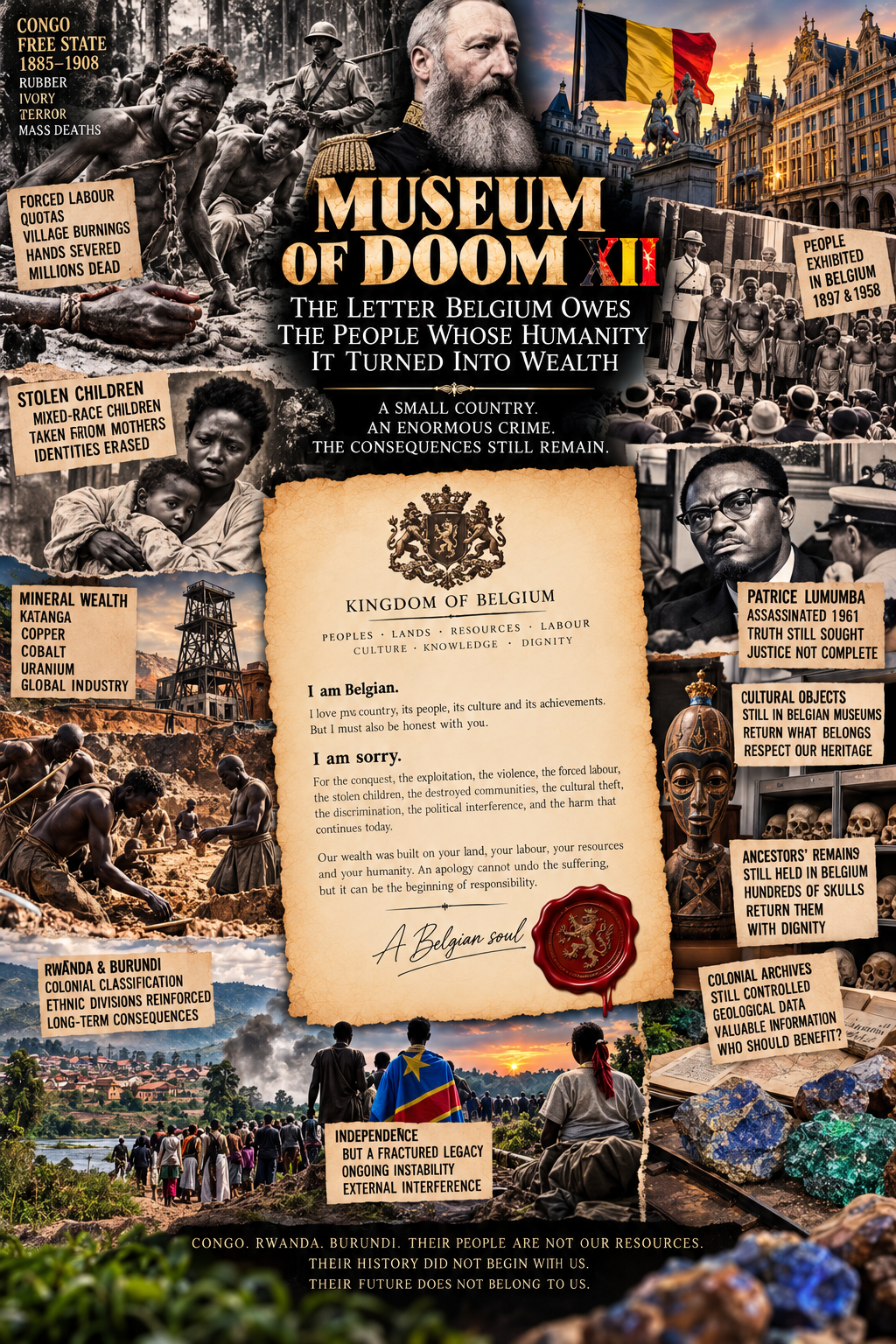
The Letter Belgium Owes the People Whose Humanity It Turned Into Wealth
We built monuments to our greatness. But what did the people beneath that greatness have to endure?
Belgium’s chapter carries an especially disturbing contradiction: a relatively small European country exercised extraordinary control over a vast African territory, while its institutions developed systems that converted Congolese labour, land and resources into commercial wealth.
The responsibility did not end with King Leopold II’s personal rule over the Congo Free State (1885–1908). Forced and coerced labour continued under Belgian state administration, which lasted until Congolese independence in 1960. Oxford Academic +1
And three events make this chapter especially relevant in 2026:
- In March, a Belgian court ordered former diplomat Étienne Davignon to stand trial over allegations connected to Patrice Lumumba’s 1961 assassination. He died on 18 May 2026, before the trial could take place, and Lumumba’s family announced its intention to pursue further action against the Belgian state. Reuters +1
- On 19 June 2026, the Congolese government requested the return of hundreds of human skulls and other remains taken during colonial rule. More than 500 sets of remains, primarily from Congo but also Rwanda and Burundi, were reportedly held in Belgian institutions. Belga News Agency
- Colonial-era geological archives held in Belgium became the subject of a dispute about access, ownership and valuable mineral information, exposing how even knowledge extracted through colonial rule can retain commercial importance long after independence. Le Monde.fr
These are not simply symbolic questions about history. They concern human dignity, unfinished legal proceedings, cultural restitution, control over information and the responsibilities of institutions operating today.
MUSEUM OF DOOM XII
The Letter Belgium Owes the People Whose Humanity It Turned Into Wealth
We built monuments to our greatness. But what did the people beneath that greatness have to endure?
An imagined letter of atonement from a Belgian soul who finally recognises that the size of a nation does not determine the magnitude of the harm it can inflict, and that the prosperity inherited from a historical ecosystem carries responsibilities extending far beyond its borders.
To the Democratic Republic of the Congo.
To Rwanda.
To Burundi.
To the descendants of those who suffered under King Leopold II and the Belgian colonial state.
To the families whose ancestors were killed, mutilated, enslaved, exploited, displaced or deprived of their freedom.
To the women whose children were taken.
To the children whose identities were stolen.
To the peoples whose cultural inheritance remains in our museums.
To the families whose ancestors’ remains are still held by our institutions.
And to my fellow Belgians.
I am Belgian.
And I love my country.
I love Brussels.
Bruges.
Ghent.
Antwerp.
Liège.
Leuven.
Namur.
Our architecture.
Our beautiful historic squares.
Our canals.
Our chocolates.
Our waffles.
Our beer.
Our art.
Our craftsmanship.
Our universities.
Our scientific achievements.
Our cultural diversity.
Our extraordinary capacity to organise institutions within a relatively small territory.
I love the fact that Brussels has become one of the important centres of European political and diplomatic life.
I love that our country participates in international cooperation.
That people come here from different parts of the world.
That Belgium has helped establish institutions through which countries attempt to resolve disagreements without resorting to war.
And I recognise the enormous achievements of Belgian workers, artists, engineers, researchers, educators and communities.
But today, I want to ask something.
How much of what I have inherited can I honestly understand without examining what Belgium took from people who never freely chose to belong to it?
Because there is something deeply disturbing about our history.
We are a small country.
And yet our monarchy, government, companies and colonial institutions exercised authority over territories and populations vastly larger than our own.
We developed systems that allowed decisions taken in Brussels to determine the conditions of human existence thousands of kilometres away.
We established commercial arrangements through which Congolese resources became opportunities for Belgian investors.
We created political hierarchies that placed European authority above the autonomy of African communities.
And we described our presence through the language of civilisation.
Development.
Education.
Progress.
Protection.
Modernisation.
But I want to ask something that those words have too often concealed.
Who was being developed, and for whose benefit?
Who received the profits?
Who controlled the land?
Who determined the value of the resources?
Who made the laws?
Who supplied the labour?
Who carried the consequences?
And who possessed the freedom to refuse?
I can no longer celebrate Belgian achievement without being willing to investigate these questions.
Because the history of what our country created cannot be separated entirely from the history of what some of its institutions extracted.
And I am sorry.
Not because I have stopped loving Belgium.
But because I have finally recognised that love for my country should not require indifference towards those whom my country harmed.
To the Democratic Republic of the Congo
I do not know how to begin.
Because what our historical institutions did to your people was so enormous that an apology can almost feel insulting in its inadequacy.
But I must begin somewhere.
I am sorry.
For King Leopold II.
For the Congo Free State.
For the violence.
For the terror.
For the forced labour.
For the exploitation.
For the deaths.
For the land appropriated.
For the resources removed.
For the families destroyed.
For the generations whose existence was transformed by a system organised around the accumulation of wealth and power.
In 1885, Leopold II obtained international recognition for the Congo Free State.
And for the next twenty-three years, an enormous territory in Central Africa existed under his personal sovereignty.
The people living there had not collectively invited him to govern them.
They had not freely chosen the political arrangement.
They had not suddenly become less capable of organising their own societies because a European monarch had obtained international recognition over their territory.
The international recognition of a ruler’s claim does not establish the moral legitimacy of that claim over people who never consented to it.
And yet the territory was treated as an enormous commercial opportunity.
Rubber.
Ivory.
Land.
Labour.
Natural wealth.
Resources that could be extracted, transported and converted into financial value.
And when people resisted the conditions imposed upon them, violence was used to enforce obedience.
I want to speak about the rubber.
Because I believe it exposes something fundamental about the system.
Rubber became enormously valuable in an industrialising world.
The demand increased.
Commercial opportunities expanded.
And the people of Congo were subjected to quotas and coercive collection.
But the human beings gathering the rubber were not treated as though their own lives possessed a value equal to the commodity being extracted.
They were compelled to work.
Punished.
Threatened.
Their families taken hostage.
Their villages subjected to violent reprisals.
And in some instances, hands were severed as part of the brutal system of terror and military accountability that developed around colonial extraction.
I cannot reconcile that with any meaningful understanding of civilisation.
How can a civilisation become so sophisticated at calculating the value of a material that it fails to recognise the value of the hand required to collect it?
How can we possess financial intelligence and lack the humanity necessary to understand what we are doing?
How can our institutions calculate commercial returns while failing to account for the human lives being destroyed to produce them?
And how could we have believed that the economic importance of rubber justified the terror inflicted upon people who were already living on their own land?
I am sorry.
For every person whose hand was severed.
For every child who witnessed violence against a parent.
For every mother who lost her child.
For every family held hostage.
For every person killed because they failed to meet a quota.
For every village devastated by punitive expeditions.
And for every person whose life was reorganised around the demands of people who considered their labour an instrument of commercial gain.
I know that historians continue debating the exact number of people who died or were lost from the population through the combined effects of violence, disease, displacement, falling birth rates and the disruption of livelihoods.
Reliable population records are insufficient to establish one definitive number.
But the uncertainty does not erase the catastrophe.
The absence of a complete count does not make the lives uncounted less real.
And it does not reduce our obligation to understand what happened.
To the families whose ancestors never returned
I am sorry for what our records cannot fully tell us.
Because I recognise that colonial archives often document what administrators wanted to know.
Production.
Revenue.
Territory.
Military expenditure.
Labour requirements.
Commercial output.
But how much of the everyday humanity of the people subjected to those systems was preserved?
Who recorded the mother searching for her child?
The father who never returned from forced labour?
The person whose village was destroyed?
The woman whose husband was killed?
The family whose ancestral knowledge was interrupted?
The children growing up without the people who should have raised them?
How much of their humanity exists within the records we inherited?
And how much disappeared because our institutions did not consider it important enough to document?
A human being does not become less significant because the system responsible for their suffering failed to preserve their name.
I cannot return those lives.
But I can refuse to reduce them to the statistics of an empire.
And I can insist that our historical understanding begin with the human beings rather than the financial achievements of those who governed them.
Belgium took over the Congo. But did the exploitation end?
In 1908, the Belgian state took control of the Congo Free State from Leopold II.
The change followed years of international criticism and exposure of the atrocities committed under his rule.
And I recognise that the new colonial administration introduced reforms.
The legal framework changed.
Certain practices were prohibited.
Public administration replaced the monarch’s personal colonial state.
But I want to acknowledge something essential.
Changing the institution that governs an exploitative system does not automatically remove exploitation from the system.
The Belgian Congo remained a colony.
Its population remained subject to foreign political authority.
Its natural resources continued being integrated into commercial systems involving Belgian companies and investors.
And coercive labour practices did not disappear simply because new legislation had been introduced.
In some places, taxation and employment arrangements continued compelling people into labour markets they had not freely chosen.
I want to ask something.
If a person is required to pay a tax in currency that they can obtain only by participating in a commercial system imposed upon them, how much freedom do they possess to refuse that participation?
If the only meaningful way to satisfy the demands of the colonial administration is to provide labour to institutions benefiting from colonial rule, what exactly makes that labour entirely voluntary?
And if a person is punished for resisting those conditions, how can we celebrate the arrangement as modern employment?
Changing forced labour into a system of economic compulsion does not automatically transform the underlying relationship into freedom.
I am sorry for the workers who endured those conditions.
For the communities whose agricultural systems were reorganised.
For the people forced to produce particular commodities.
For the families whose labour was redirected away from their own needs.
And for the generations whose economic possibilities were shaped around the priorities of the colonial state.
I recognise that schools, hospitals, railways and other infrastructure were also built during Belgian rule.
Some provided lasting benefits.
Some people working within colonial institutions genuinely cared about those they served.
But I refuse to treat the existence of those benefits as a justification for the system through which they were provided.
A railway does not erase coercion.
A hospital does not restore the freedom that was denied.
A school does not compensate for the political authority taken from a population.
And an infrastructure project does not automatically become humanitarian because it can also be used by the people whose resources it was built to transport.
I want us to assess the complete relationship.
Not merely the objects left standing after colonial rule ended.
To the workers of Katanga
I am sorry.
For the men recruited through coercive systems to work in the mines.
For the dangerous conditions.
For the inadequate housing and nutrition that contributed to illness and death.
For the families separated by labour recruitment.
For the workers whose bodies sustained the extraction of copper, cobalt, uranium and other valuable minerals.
For the economic system that developed around their labour.
And for the difference between the wealth generated by mineral extraction and the authority the Congolese population possessed over its use.
I want to acknowledge the Union Minière du Haut-Katanga.
A major company established in 1906 through Belgian and other commercial interests.
It became a powerful force in Congo’s mining economy.
Its activities contributed to industrial development and international supplies of important minerals.
But I want to ask something.
When a company becomes extraordinarily successful at extracting natural wealth from another country’s land, who should be considered the principal beneficiary of that success?
The shareholders?
The investors?
The colonial government?
The foreign manufacturers purchasing the materials?
Or the people whose land and labour made the extraction possible?
I recognise the capital, technology and engineering involved in industrial mining.
Those contributions have economic value.
But the resource itself did not originate from Belgium.
The land was not created by Belgian investors.
And the people working within the mines possessed their own humanity independently of their economic usefulness to the company.
We must be capable of calculating all these contributions without treating ownership of capital as though it automatically establishes superiority over everything else.
And I want to acknowledge something especially significant.
Uranium extracted from the Shinkolobwe mine in Belgian-controlled Congo became an important source of material for the United States’ Manhattan Project during the Second World War.
Congolese land contributed to one of the most consequential technological and military developments in modern history.
And I want to ask:
How much of the history of that development is told through the people and land from which the material originated?
We remember the scientists.
The military commanders.
The governments.
The technological achievement.
But what about Congo?
What about the workers?
What about the consequences of uranium mining?
What about the political and economic relationships that determined who controlled access to those materials?
Scientific history is incomplete when it records the achievement but neglects the people and environments that made it materially possible.
I am sorry for every occasion on which the Congolese contribution to global industrial and technological development has been reduced to a source of raw materials.
Congo did not merely provide resources. Its people and environment were part of the conditions through which entire industries became possible.
And I want those contributions to be recognised.
To the women whose children were taken
There is something I find particularly difficult to confront.
Because I cannot understand how the people responsible could have imagined their actions were humane.
During Belgian colonial rule, children born to African mothers and European fathers were subjected to systematic racial discrimination.
Some were forcibly separated from their mothers.
Placed in religious institutions.
Deprived of family relationships.
Separated from their identities.
And made to live within systems that treated their ancestry as something requiring institutional intervention.
I want to ask something.
Who gave the colonial state authority to decide that a mother should lose her child because the child’s parents came from different racial backgrounds?
What kind of consciousness makes a person believe that a child’s humanity is a problem requiring administrative correction?
How does a society that claims to value family become capable of separating families in the name of racial order?
And how could our institutions have treated the bond between a mother and her child as less important than the racial categories they had created?
I am sorry.
To the mothers.
For the children removed from your arms.
For the years of separation.
For the anguish.
For the relationships interrupted.
For the people who never had the opportunity to know the family from which they came.
And to the children.
For the childhoods taken.
For the identities obscured.
For the people who were told that their very existence represented something socially unacceptable.
I want to recognise five women.
Marie-Josée Loshi.
Noëlle Verbeken.
Léa Tavares Mujinga.
Simone Ngalula.
Monique Bintu Bingi.
Women who spent years pursuing justice for what Belgian colonial institutions had done to them.
And on 2 December 2024, the Brussels Court of Appeal recognised the systematic racial segregation and forced removal they had experienced as crimes against humanity.
Crimes against humanity.
Not merely unfortunate administrative decisions.
Not merely actions belonging to another era.
Not simply mistakes.
Crimes against humanity.
And I want to ask Belgium something.
Why did these women have to spend so many years fighting for legal recognition of what had happened to them?
How many people died before receiving an equivalent acknowledgement?
How many mothers went to their graves without being reunited with their children?
How many people lived their entire lives without knowing the truth about their origins?
And how many families continue carrying the consequences?
I am glad the court recognised the injustice.
But I am also deeply sorry that recognition came so late.
Because a mother’s bond with her child should never have needed a court judgment to establish its human significance.
To the Congolese people exhibited in Belgium
I am sorry.
For 1897.
For Tervuren.
For the 267 Congolese men, women and children forcibly brought to Belgium and displayed to the public during the colonial exhibition.
For the fences.
For the artificial villages.
For the spectators.
For the humiliation.
For the people made into objects of curiosity.
For the colonial propaganda that presented them as evidence of the supposed necessity of Belgian civilisation.
And I want to speak about the seven people who died during that exhibition.
Sambo.
Mpemba.
Ngemba.
Ekia.
Nzau.
Kitukwa.
Mibange.
Seven human beings.
Not seven exhibits.
Not seven colonial subjects.
Not seven statistical losses.
Seven people.
People with names.
Lives.
Relationships.
Histories.
And possibilities.
They died after being brought to Belgium under conditions they had not freely chosen.
And even in death, they were initially denied ordinary burial in the local cemetery.
I want us to sit with that.
We brought human beings to Belgium to demonstrate our supposed superiority, subjected them to degrading conditions, and then denied them equal dignity even after they died.
And we called ourselves civilised.
What exactly did we understand civilisation to mean?
Was it architecture?
Technology?
The ability to build an exhibition?
The ability to attract investors?
The ability to organise crowds?
The ability to display human beings?
Because if that was our measure, then we were confusing organisational capacity with humanity.
And there is something else.
In 1958, another exhibition in Brussels included a colonial display in which Congolese people were presented to visitors.
1958.
Only two years before Congolese independence.
This was not some distant medieval practice.
It existed in the modern world.
Within the lifetime of people whose families are still alive today.
And I am sorry for every occasion on which our national history has treated those exhibitions as curiosities rather than confronting the degradation of the human beings displayed.
I want us to remember their names.
I want us to remember their humanity.
And I want us to understand that a nation can build a beautiful museum while making profoundly inhumane decisions about the people whose cultures it claims to exhibit.
To the people whose history we placed in our museums
I am sorry.
For the cultural objects removed.
For the sacred items taken.
For the artistic works acquired through violence, coercion or unequal exchanges.
For the objects collected without meaningful respect for the communities that created and used them.
For the ways we transformed other people’s cultural inheritance into evidence of our own intellectual and institutional authority.
I recognise that not every object in Belgium’s African collections was stolen.
Some were purchased.
Some were exchanged.
Some were donated.
And some have different histories of acquisition that require careful investigation.
But I also recognise that a transaction taking place within a deeply unequal colonial relationship cannot always be understood as though both parties possessed equal freedom.
Legal possession is not automatically the same as ethical ownership.
And an institution’s ability to preserve an object does not automatically establish a greater right to possess it than the community from which it originated.
Belgium adopted a legal framework in 2022 to facilitate the return of certain cultural objects acquired during the colonial period.
I welcome that.
I recognise the historians, curators, researchers and communities working to establish provenance.
But I want us to continue asking the underlying questions.
Who made the object?
What did it mean to the people who possessed it?
How was it obtained?
What authority was exercised during the transaction?
Who benefits from its exhibition?
And who should determine where it belongs?
I do not want restitution to become another process through which Belgium assumes the authority to decide the fate of everything it previously took.
I want affected communities and countries to participate meaningfully in those decisions.
Because returning another people’s inheritance should not be presented as an act of generosity by the institution that obtained it through an unjust relationship.
To the ancestors whose remains are still held in Belgium
This is something I find almost impossible to comprehend.
Because we are now in 2026.
And families and governments are still asking for the return of human remains taken during colonial rule.
In June 2026, the government of the Democratic Republic of the Congo requested the return of hundreds of skulls and other human remains held in Belgian institutions.
More than five hundred sets of remains, primarily Congolese but also Rwandan and Burundian, were reportedly still held in Belgian collections.
And I want to ask something.
How can we still be discussing the possession of another people’s ancestors as though their remains are merely museum property?
What exactly are we preserving?
Science?
History?
Evidence?
Institutional collections?
And why should those considerations automatically override the dignity of the people whose bodies were taken and the rights of the communities connected to them?
I recognise that establishing provenance, identifying individuals and arranging ethical returns can require careful research.
But the need for careful procedures should not become a permanent excuse for inaction.
I cannot imagine the pain of knowing that the remains of an ancestor were taken from their homeland and continue to be held in another country.
I cannot imagine the humiliation of having to write an official request for the return of people whose bodies should never have been treated as trophies or ordinary specimens.
And I cannot understand how the country that took them can consider the matter resolved merely because it is now prepared to discuss returning them.
The dead are not objects that become ours through the passage of time.
Their humanity does not end when their lives do.
And I am sorry for every family whose grief has been prolonged by the institutional refusal or inability to resolve these questions.
To Rwanda
I am sorry.
For Belgian colonial administration.
For the racial classifications.
For the hierarchy.
For the way colonial institutions reinforced and transformed social distinctions into increasingly rigid political categories.
I recognise that Hutu, Tutsi and Twa identities existed before Belgian rule.
I recognise that Rwanda had its own monarchy, social hierarchies and political history.
I do not claim Belgium invented every distinction within Rwandan society.
But Belgian colonial officials reinforced particular hierarchies through theories of racial difference.
They adopted discriminatory ideas about ancestry and supposedly superior populations.
They used administrative systems to classify people.
And they introduced identity cards recording ethnic categories.
I want to ask something.
What happens when a society’s understanding of human difference becomes institutionalised through the authority of a state?
What happens when a person’s political opportunities are shaped by the category assigned to them?
When education and administrative positions are distributed unequally?
When people are encouraged to understand their neighbours through inherited hierarchies?
And when the state makes those divisions increasingly difficult to escape?
I am sorry for the role our institutions played in reinforcing those divisions.
Because identities do not exist in isolation from the political conditions surrounding them.
The way a state classifies people can influence how they are treated.
How they understand themselves.
How they understand one another.
And how political conflict develops.
And I want us to recognise the consequences of that responsibility.
To the victims of the 1994 genocide against the Tutsi
I am sorry.
For the failures of the international community.
For the people murdered.
For the families destroyed.
For the women subjected to horrific sexual violence.
For the children killed.
For those who survived.
And for the generations that continue carrying the consequences.
The genocide was organised and perpetrated by extremist authorities, militias and other perpetrators within Rwanda.
That responsibility must remain clear.
But the history of colonial racial classification and discriminatory governance formed part of the background through which divisions were politically intensified.
And Belgium also had responsibilities in the period leading to the genocide and during the international response.
Ten Belgian peacekeepers were murdered while attempting to protect Prime Minister Agathe Uwilingiyimana.
Their deaths were a terrible crime.
I mourn them.
And I recognise the shock and grief experienced by their families and by Belgium.
But I also recognise that Belgium subsequently withdrew its troops from the United Nations mission.
And I want us to examine the consequences of that decision within the wider failure of the international community to protect civilians.
I do not claim that Belgium alone could have prevented the genocide.
Nor that the colonial administration alone caused it.
But historical responsibility does not require us to be the only cause of a tragedy.
It requires us to recognise our contribution to the conditions within which it occurred, and our responsibility for the decisions we made when it unfolded.
The fact that a society’s crisis has multiple causes does not erase the responsibility of those who helped create some of its conditions.
And I want our acknowledgement of Rwanda to reflect that.
To Burundi
I am sorry.
For the decades of Belgian colonial administration.
For the political and social hierarchies reinforced under foreign rule.
For the inequalities.
For the coerced labour and administrative arrangements.
For the ways ethnic identities were made politically consequential within systems of indirect rule.
And for the failure to establish a relationship in which the people of Burundi possessed full authority over their own political future.
Burundi became independent on 1 July 1962.
But I want to acknowledge the difficult political transition that preceded independence.
Prince Louis Rwagasore had emerged as a major leader of the independence movement.
His party won legislative elections in September 1961.
And on 13 October 1961, he was assassinated.
I recognise that the precise responsibilities and political circumstances surrounding his murder have been the subject of historical investigation and debate.
But I want to acknowledge the extraordinary loss to Burundi.
A political leader associated with the struggle for independence was killed at a pivotal moment in the country’s history.
And the population was left to confront its future amid profound uncertainty.
I am sorry for the colonial arrangements that restricted Burundian self-determination for decades.
And I recognise that Burundi subsequently experienced political violence, authoritarianism, ethnic massacres and civil conflict.
Those events have their own perpetrators and histories.
I do not pretend Belgium was responsible for every later decision.
But I want us to confront what happens when an independent country inherits institutions, social divisions and political tensions shaped during colonial rule.
Independence gives a people the right to determine their future. It does not automatically remove the consequences of the conditions under which that future begins.
And I want Belgium to understand that distinction.
To Patrice Lumumba
I am sorry.
For the circumstances surrounding your removal from power.
For the role of Belgian officials and interests in the crisis that followed Congolese independence.
For the events leading to your unlawful detention and transfer.
And for your assassination on 17 January 1961, alongside the killing of Maurice Mpolo and Joseph Okito.
I recognise the complexity of the Congo Crisis.
The political conflicts.
The involvement of Congolese leaders and armed groups.
The interests of foreign governments.
The Cold War.
The disputes over Katanga.
And the competing visions for the future of a newly independent country.
But I want to ask something.
Why did the independence of Congo become a threat to those who had benefited from controlling it?
Why did the possibility of genuine political and economic autonomy create such resistance?
Why could we not simply respect the right of the Congolese people to determine their own future?
Belgium has acknowledged moral responsibility in connection with Lumumba’s assassination.
And in 2022, his surviving remains were formally returned to his family.
I recognise the significance of that act.
But there is another part of the story.
In March 2026, a Belgian court ordered former diplomat Étienne Davignon to stand trial over allegations connected to Lumumba’s killing.
And on 18 May 2026, he died before that trial could take place.
His death ended the possibility of a criminal trial against him.
And the Lumumba family announced plans to continue seeking accountability through civil proceedings.
I want to ask Belgium something.
How can a family spend more than six decades seeking justice for the assassination of a national leader and still be left confronting incomplete judicial accountability?
How many years must pass?
How many archives must be examined?
How many witnesses must die?
How many legal proceedings must be initiated?
And how many generations must inherit the responsibility of demanding answers?
I do not claim that a court can establish criminal liability after the accused has died.
Legal proceedings have rules that must be respected.
But the end of a prosecution does not mean the historical questions cease to exist.
Nor does it erase the responsibility of institutions to disclose what they know.
I am sorry to Lumumba’s family.
And to the people of Congo.
Because your independence should never have become an opportunity for foreign institutions to interfere with the political authority that belonged to you.
A nation does not become truly independent merely because a foreign government removes its flag while continuing attempting to control the decisions made beneath the new one.
And now, Belgium, let us talk about our prosperity
I love Brussels.
I love the beauty of the Grand Place.
I love our beautiful architecture.
Our universities.
Our museums.
Our international institutions.
Our businesses.
Our industrial history.
Our infrastructure.
And the opportunities our country provides.
But I want to ask something.
How much of our national and private wealth developed through relationships in which African people were deprived of the ability to control the resources producing that wealth?
I know that Belgium’s economy has many foundations.
European trade.
Industrialisation.
Manufacturing.
The labour of Belgian workers.
Financial institutions.
Scientific development.
Modern services.
International cooperation.
And many generations of economic activity unrelated to colonialism.
I do not claim that everything beautiful or prosperous in Belgium was financed through Congo.
That would be historically inaccurate.
But I also recognise that Belgian commercial enterprises, investors and private fortunes benefited from colonial extraction.
And I want those relationships investigated honestly.
Because the wealth does not become ethically irrelevant simply because it has changed ownership.
Or because the financial structures through which it passed have been reorganised.
Or because the original investors have died.
A financial asset can change hands many times without the historical conditions through which it was accumulated becoming irrelevant.
And I want Belgium to recognise that.
Not to erase the achievements of ordinary Belgian workers.
But to distinguish their contributions from the profits derived through colonial domination.
We must be capable of accounting for both.
Because financial wealth is not simply something that exists.
It has a history.
It moves.
It is invested.
It produces further value.
It finances institutions.
It can be transferred between generations.
And it can continue influencing economic relationships long after the original activity has ended.
I want us to examine those histories.
Not assume them.
Not exaggerate them.
But neither dismiss them because the investigation makes us uncomfortable.
Even the knowledge we took is still valuable
There is something about 2026 that I find particularly revealing.
Belgium still holds millions of colonial-era geological records concerning Congo.
Maps.
Surveys.
Information about mineral deposits.
Documents produced during a period when Belgian colonial institutions exercised authority over Congolese territory.
And those records have become valuable within the modern competition for critical minerals.
Copper.
Cobalt.
Lithium.
Gold.
And other resources.
A dispute emerged concerning access to these archives, including a request involving an American mining company seeking to digitise the records.
Belgian authorities declined to grant that company privileged access.
I recognise that this decision involves legitimate questions about public archives, commercial privilege, legal ownership and how information should be shared.
I do not assume that giving exclusive access to a private company would necessarily serve Congo’s interests.
But I want to ask something deeper.
Why is information gathered through the colonial control of Congolese land still a source of institutional and commercial advantage outside Congo?
Who should have access?
Who should participate in deciding how it is used?
Who should benefit from its digitisation?
And what authority should Congolese institutions possess over information concerning their own territory?
Because natural resources are not the only things that can be extracted.
Knowledge can be extracted too.
Maps.
Measurements.
Geological surveys.
Research.
Cultural information.
Environmental data.
And the scientific records generated through the study of another people’s land.
I want Belgium and Congo to resolve these questions through arrangements that respect scientific integrity, lawful obligations and Congolese sovereignty.
But I do not want the historical relationship of domination to disappear from the discussion.
The power to possess information about another country’s resources can itself become a form of economic influence.
And it deserves accountability.
The guilt I did not know I was carrying
There is something I must confess.
Perhaps for years, I enjoyed being Belgian without giving our colonial history much consideration.
Perhaps I admired the architecture.
The institutions.
The international reputation.
The historical achievements.
The prosperity.
And perhaps I accepted the national story I was given.
Then somebody questioned Belgium’s colonial history.
And I became uncomfortable.
Perhaps I explained that Leopold II was one individual.
Perhaps I said that the Belgian state eventually took over the Congo.
Perhaps I mentioned the schools.
The hospitals.
The railways.
The infrastructure.
Perhaps I reminded people that other countries had larger empires.
Or that Congo has experienced numerous political problems since independence.
Or that Belgians alive today did not personally commit colonial atrocities.
And perhaps some of those statements contain important distinctions.
But I want to ask myself something.
Why did I feel compelled to defend Belgium before I had fully listened to the harm being described?
What was I protecting?
My history?
My identity?
My country’s reputation?
Or an understanding of myself that had never fully accounted for what I had inherited?
Because I belong to the Belgian ecosystem.
I inherit its institutions.
Its languages.
Its culture.
Its opportunities.
Its achievements.
Its historical narratives.
And the consequences of decisions that shaped it before my lifetime.
I cannot celebrate everything I admire within that inheritance and then pretend that the uncomfortable parts possess absolutely no relationship to my understanding of myself.
And from a metaphysical perspective, I want to examine the possibility that guilt can exist long before a person consciously recognises it.
Not guilt that announces itself.
Not guilt that I simply choose to carry or abandon.
But something that may exist within the relationship between identity, historical inheritance and consciousness.
Perhaps for years I experienced discomfort without understanding it.
Defensiveness without recognising its source.
The desire to justify.
The need to explain.
The instinct to minimise.
And perhaps those reactions were connected to a burden I had not yet developed the capacity to identify.
I cannot diagnose the subconscious of an entire country.
But I can examine my own.
And I can recognise that the development of consciousness sometimes requires confronting what the mind has spent years protecting itself from understanding.
If I inherit an ecosystem, I must be willing to understand the whole inheritance.
Not only the advantages.
Not only the pride.
Not only the achievements.
But also the burdens.
And the responsibilities that remain.
I do not need to pretend that I personally committed crimes before my birth.
But I also do not need to pretend that the consequences of those crimes disappeared before I arrived.
Because historical inheritance and individual criminal culpability are not the same thing.
And neither is accountability identical to self-punishment.
I want my recognition to produce responsibility, not another performance of guilt that changes nothing.
To the Belgian people: We must stop asking whether an apology is enough
Our king expressed his deepest regrets for the colonial past.
Our government has taken steps towards restitution.
Our institutions have begun examining their collections.
Historians are investigating the financial and social consequences of colonialism.
Courts have recognised serious crimes.
Families continue seeking justice.
And communities continue demanding recognition.
I welcome these developments.
But I want to ask something.
What happens after we acknowledge the harm?
What becomes of the cultural objects?
The human remains?
The archives?
The financial questions?
The families seeking recognition?
The institutions that benefited?
The histories still inadequately taught?
And the contemporary relationships that may continue reproducing inequalities created under colonial rule?
I do not want apology to become the final achievement of Belgian accountability.
I want it to become the beginning of something meaningful.
I want historical records made accessible.
I want the people affected to participate in decisions concerning restitution.
I want institutions to investigate the origins of their wealth and collections.
I want families to receive information concerning relatives whose histories were concealed.
I want the return of human remains to be handled with urgency, dignity and the meaningful involvement of the relevant communities.
I want the question of reparatory justice examined seriously.
And I want Belgium’s relationships with Congo, Rwanda and Burundi to be grounded in the recognition that these are sovereign countries with their own rights, priorities and futures.
Their independence is not conditional upon Belgium approving the decisions they make.
They may choose to cooperate with us.
They may choose other partners.
They may decide to renegotiate arrangements.
They may decide that particular relationships no longer serve their interests.
And we must be capable of respecting those decisions.
Because if Belgium truly wishes to establish relationships based upon equality, it must also accept the possibility that equality will sometimes require relinquishing an advantage.
To Congo, Rwanda and Burundi: You are not merely our former colonies
I want to make something very clear.
Your histories did not begin when Belgium arrived.
Your identities are not defined solely by colonial suffering.
Your achievements do not belong to Belgium.
Your cultures do not require Belgian validation.
Your knowledge does not require European recognition to possess value.
And your futures do not depend upon remaining connected to Belgian institutions.
I recognise the extraordinary strength, creativity and achievements of your people.
The music.
The art.
The knowledge.
The agriculture.
The intellectual life.
The communities.
The businesses.
The research.
The cultural inheritance.
The people who continue building, caring, discovering, creating and contributing.
I also recognise that your countries face serious contemporary challenges.
The violence affecting eastern Congo.
The political conflicts.
The displacement.
The insecurity.
The poverty and inequality experienced by many communities.
The struggles over resources.
And the continuing human consequences of regional instability.
I do not claim Belgium created every one of these circumstances.
And I do not wish to deny the responsibilities of the governments, armed groups, commercial actors and foreign powers involved today.
But neither do I want our colonial past to become irrelevant simply because the problems have evolved.
A later generation’s responsibility for its own actions does not erase an earlier generation’s responsibility for the conditions it helped create.
Both histories can be examined.
And both can require accountability.
I want your people to enjoy the value of your natural resources.
I want your communities to be able to protect their environments.
I want your children to inherit opportunities for education, creativity and development.
I want your governments to be accountable to your populations.
And I want Belgium to become a partner that respects your autonomy rather than treating your independence as something that must remain compatible with our preferred interests.
I am glad you are independent.
I am glad the colonial relationship ended.
And I do not want it restored.
Your freedom is not Belgium’s loss.
It is the recognition of a right that should never have been denied.
And finally, to my own country
Belgium.
I love you.
I love the extraordinary things our people have created.
I love our art.
Our engineering.
Our architecture.
Our cultural diversity.
Our capacity to participate in international cooperation.
Our achievements in science, education and public life.
But I no longer want to mistake the success of our institutions for proof that everything our institutions have done was humane.
I do not want to admire our museums while ignoring the people whose objects and ancestors remain within them.
I do not want to celebrate our financial history while refusing to examine how some of its wealth was accumulated.
I do not want to speak about Congo’s mineral resources as commercial opportunities without recognising the human beings whose land contains them.
I do not want to admire Leopold II’s monuments without acknowledging the violence associated with his rule.
I do not want to celebrate our schools and universities without confronting the educational hierarchies imposed under colonialism.
I do not want to celebrate our human rights institutions while leaving the descendants of colonial victims to spend generations seeking recognition.
And I do not want Belgium to become another country that considers itself fully accountable because it has learned how to speak beautifully about its past.
Accountability is not established by the elegance of an apology.
It is established through what we are willing to recognise, return, repair and change.
To the people of Congo:
I am sorry for the land taken.
The labour exploited.
The resources extracted.
The terror inflicted.
The lives destroyed.
And the political autonomy denied.
To the families of those mutilated under the Congo Free State:
I am sorry for the violence inflicted upon your ancestors.
For the lives interrupted.
And for the suffering that no financial calculation could ever adequately represent.
To the workers of Katanga:
I am sorry for the coercion, exploitation and dangerous conditions associated with the extraction of the resources that helped sustain powerful industries.
To the mothers whose children were taken:
I am sorry for the separation, the humiliation and the years of family life that can never be restored.
To the children who grew up disconnected from their origins:
I am sorry for the identities interrupted and the relationships denied.
To the people exhibited in Belgium:
I am sorry that our society treated your humanity as a spectacle.
And to the seven who died in Tervuren:
May your names never again disappear beneath the reputation of the exhibition that brought you here.
To the families whose ancestors’ remains are still held in Belgium:
I am sorry that the dignity of your loved ones remains a question requiring institutional negotiation.
To Rwanda:
I am sorry for the political and racial hierarchies reinforced through Belgian colonial administration, and for the failures that must be confronted within the history of the genocide and its international response.
To Burundi:
I am sorry for the coercion and inequalities of colonial rule and for the restrictions placed upon your people’s ability to determine their own political existence.
To Patrice Lumumba, Maurice Mpolo and Joseph Okito:
I am sorry for the circumstances of your detention, transfer and deaths, and for the generations that have had to continue seeking answers.
To the descendants:
I recognise that you did not create the conditions you inherited.
But I also recognise that you should not be required to carry their consequences without the institutions connected to those conditions accepting their own responsibilities.
And to every person whose name this letter does not contain:
I recognise that the historical record remains incomplete.
There are lives I do not know.
Families whose stories have not been preserved.
Communities whose experiences require investigation.
And consequences whose origins remain difficult to establish.
But I do not want the limits of my knowledge to become the limits of my accountability.
What I do not yet know is something I must investigate, not something I am entitled to dismiss.
I cannot undo what Belgium did.
I cannot restore every life.
I cannot return every stolen possibility.
I cannot rebuild every interrupted relationship.
And I cannot pretend that an apology written in 2026 can erase the suffering of generations.
But I can insist that Belgium develop a relationship with its history that is more honest than the relationship it inherited.
I can support the return of what rightfully belongs elsewhere.
I can demand greater transparency from institutions.
I can recognise the autonomy of former colonies.
I can refuse to defend exploitation simply because it produced something financially valuable.
And I can contribute to a future in which our country’s achievements are no longer separated from the human responsibilities through which they were produced.
Because I now understand something.
Belgium did not need to become powerful through the domination of Congo to establish the value of Belgian humanity.
We had our intelligence.
Our creativity.
Our knowledge.
Our capacity for organisation.
Our workers.
Our artists.
Our researchers.
Our communities.
And our ability to contribute to the world.
We did not need to turn another people’s existence into a resource for our prosperity.
We did not need their forced labour.
We did not need their political subordination.
We did not need their cultural objects.
And we certainly did not need to take their children or their ancestors’ remains.
We needed to learn how to recognise humanity beyond the boundaries of our own interests.
And that is the responsibility I want Belgium to embrace.
Not merely as a former colonial power.
But as a society that claims to value human dignity today.
I do not want our future to be measured by the number of international institutions located within our borders.
I want it to be measured through how responsibly we participate in the relationships those institutions are supposed to serve.
I do not want our greatness to be measured by the commercial value accumulated through our history.
I want it to be measured through what we are prepared to contribute without diminishing other people.
And I do not want us to become a country that can recognise injustice only when it is being committed by somebody else.
If we possess the consciousness to recognise exploitation abroad today, then we must also possess the courage to recognise exploitation within our own history.
I am sorry.
Het spijt me.
Je suis désolé.
Es tut mir leid.
But I do not want those words to become the final act of this history.
I want them to become the beginning of responsibility.
A responsibility that does not end when the people directly involved have died.
A responsibility that does not disappear when institutions change their names.
A responsibility that does not become irrelevant because financial assets have been transferred.
A responsibility that does not depend upon whether acknowledging it makes us feel comfortable.
And a responsibility that recognises the humanity of people whose existence our institutions once treated as subordinate to our own.
Belgium is small.
But the consequences of what it did were enormous.
And I want us to become capable of accounting for the full scale of that inheritance.
Not through shame alone.
Not through denial.
Not through the selective presentation of our achievements.
But through consciousness.
Recognition.
Restitution.
Repair.
And the development of relationships grounded in genuine equality.
Because a civilisation does not become great by calculating how much wealth it can extract from another people’s existence.
It becomes more humane when it recognises that the people from whom it extracts possess a value that no amount of wealth can replace.
And if we truly understand that, then the future of Belgium should no longer require the denial of anybody else’s humanity.
With remorse, recognition, gratitude, accountability and responsibility for the complete inheritance of my country,
A Belgian soul who finally understands that the greatest debt of an empire is not measured only through the wealth it took, but through the humanity it denied in order to take it.
Museum of Doom XII — The Letter Belgium Owes the People Whose Humanity It Turned Into Wealth.
SHS – Human First
The letter’s historical grounding includes the AfricaMuseum’s own accounts of Leopold II’s Congo Free State and the Tervuren exhibitions, Oxford’s research into forced labour, the UN’s history of Belgian ethnic classification in Rwanda, and the 2024 Belgian court ruling concerning children separated from their mothers. Belgium +4
The contemporary sections reflect documented developments through October 2026, particularly the Lumumba proceedings, requests for the return of human remains and the dispute over colonial geological archives. Belga News Agency +2
The distinction running through this chapter is between the people who created or benefited from particular colonial institutions, the present institutions that inherit unresolved obligations, and the individuals who must decide how to participate responsibly in that inheritance.


Leave a Reply