
Any stigma deserves to be remembered as a lesson of existence. We must. 4getfulness becomes redundantness and Consciousness throws “do overs” when messages aren’t received. I don’t know what it is like to be German and walk with this memory, but I know they deserve to own their own history, a chapter of it, isn’t all of it. And instead of concetrating labour in the economy, same thing different direction, different victims…, humanity still needs its own recognition. Good business won’t make up for it.
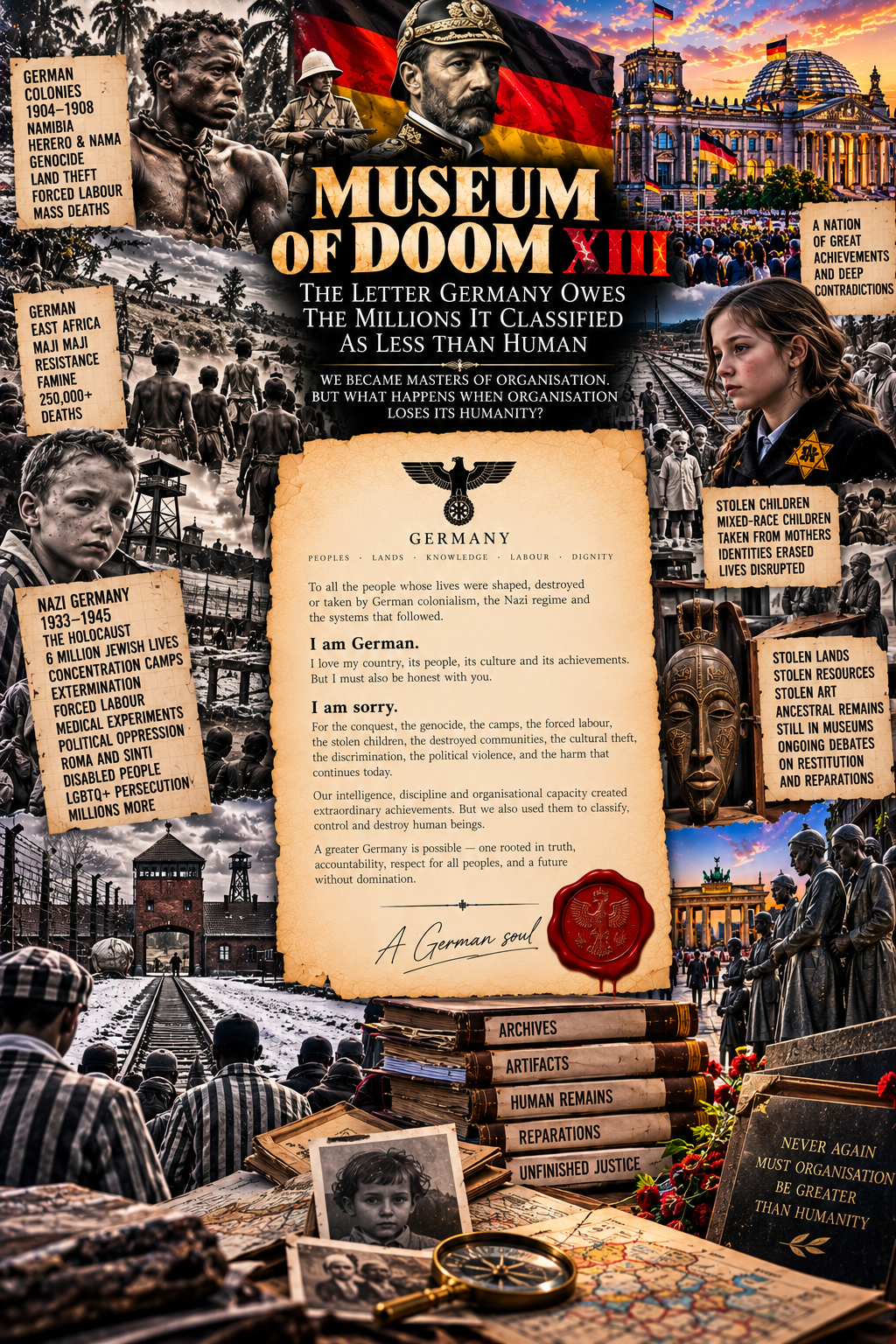
The Letter Germany Owes the Millions It Classified as Less Than Human
We became masters of organisation. But what happens when organisation loses its humanity?
Germany’s chapter must account for three connected but historically distinct systems: imperial colonisation, Nazi dictatorship and genocide, and the unresolved responsibilities inherited by the modern German state.
The record begins before Hitler. Germany’s colonial forces committed genocide against the Ovaherero and Nama in present-day Namibia between 1904 and 1908. In German East Africa, the suppression of the Maji Maji resistance caused catastrophic famine and an estimated 250,000–300,000 deaths. Federal Government +1
Then came Nazi Germany. From 1933 to 1945, its institutions built an enormous system of persecution, concentration camps, forced labour and mass killing. The Nazi regime and its collaborators murdered approximately six million Jewish people during the Holocaust, alongside the mass murder and persecution of Roma and Sinti, disabled people, Polish and Soviet civilians, prisoners of war and other targeted populations. United States Holocaust Memorial Museum +2
There is also an important development this month: on 14 October 2026, the German Bundestag debated renewed proposals concerning recognition, restitution and reparatory justice for the Ovaherero and Nama genocide. Germany’s proposed €1.1 billion reconciliation programme with Namibia remains disputed, particularly by representatives of affected communities who say they were not adequately included. Deutscher Bundestag +1
This letter does not equate colonial concentration camps with Nazi extermination camps or suggest the Holocaust was an inevitable result of colonialism. It examines their documented histories and the recurring ethical failure of using sophisticated institutions to organise the subordination of human beings.
MUSEUM OF DOOM XIII
The Letter Germany Owes the Millions It Classified as Less Than Human
We became masters of organisation. But what happens when organisation loses its humanity?
An imagined letter of atonement from a German soul who finally confronts the entire inheritance of German colonialism, Nazi ideology, the SS, the concentration camps, the Holocaust, the machinery of extermination and the responsibilities that remain today.
To the Jewish people.
To the Ovaherero, Nama, Damara and San peoples of Namibia.
To the peoples of Tanzania, Cameroon, Togo, Rwanda, Burundi, the Pacific and the territories once subjected to German colonial rule.
To the Roma and Sinti.
To the people of Poland, Ukraine, Belarus, Russia, Czechia, Greece, France, the Netherlands, Belgium, Italy, Serbia and every other nation devastated by Nazi occupation.
To the people with disabilities murdered or sterilised under the Nazi regime.
To the Black Germans subjected to racial persecution.
To the men persecuted for their sexuality.
To Jehovah’s Witnesses, political dissidents, resistance fighters and prisoners of conscience.
To the families of those subjected to medical experimentation.
To the people whose labour was stolen.
To the children who never returned home.
To the descendants still carrying the consequences.
And to my fellow Germans.
I am German.
And I love my country.
I love our forests.
Our mountains.
Our rivers.
Our lakes.
Our architecture.
Our music.
Our literature.
Our philosophy.
Our scientific achievements.
Our engineering.
Our craftsmanship.
Our extraordinary capacity for research, innovation and organisation.
I love Berlin.
Munich.
Hamburg.
Frankfurt.
Cologne.
Dresden.
Leipzig.
Heidelberg.
The Black Forest.
The Bavarian Alps.
The beautiful villages.
The historic streets.
The castles.
The universities.
The institutions.
And the generations of people who have contributed extraordinary things to humanity.
I love that our country has produced thinkers whose work transformed philosophy.
Scientists whose discoveries advanced human understanding.
Composers whose music continues moving people centuries later.
Engineers whose inventions changed transportation, manufacturing and infrastructure.
I admire the discipline, precision and attention to detail that have become associated with German craftsmanship.
And I understand why people around the world recognise those qualities.
But there is something I must ask myself.
What happens when a civilisation becomes extraordinarily capable of organising systems without exercising equal consciousness about what those systems are doing to human beings?
Because Germany’s history contains something that I cannot ignore.
We did not merely create extraordinary systems of production.
We also created extraordinary systems of destruction.
We did not merely establish sophisticated institutions.
We established institutions capable of categorising, controlling, dispossessing, enslaving and exterminating human beings.
We did not merely develop administrative efficiency.
We developed administrative systems through which mass murder could be organised.
And I want to ask something that I believe every civilisation should ask itself.
What is intelligence worth when it becomes capable of calculating the logistics of extermination without recognising the humanity of the people being exterminated?
How can a society produce extraordinary philosophers while participating in the suppression of independent thought?
How can a country produce exceptional doctors while developing programmes for killing patients?
How can a nation produce sophisticated engineers while applying engineering knowledge to facilities used for mass murder?
How can we produce scientific knowledge and then use pseudoscience to justify racial hierarchy?
How can we possess such extraordinary organisational capacity and direct it towards the destruction of human life?
And how can we continue celebrating our historical achievements without fully accounting for those contradictions?
I am sorry.
For what we did.
For what we organised.
For what we justified.
For what we ignored.
For what we concealed.
For what our institutions profited from.
For the people whose suffering was converted into administrative records.
And for the human beings whose existence was reduced to a problem that powerful people believed they had the right to solve.
PART I — THE GERMAN EMPIRE
Before the Nazi camps, there were colonial camps
I want to begin before Adolf Hitler.
Before the SS.
Before the Nazi Party.
Before the Second World War.
Because Germany’s history of racial domination did not begin in 1933.
The German Empire acquired colonial territories from the 1880s.
In Africa.
In the Pacific.
And in China.
Our political authorities joined the competition among European powers for land, resources, influence and commercial opportunities.
I want to acknowledge the Berlin Conference of 1884–1885.
A gathering hosted by our imperial government during which European powers negotiated rules concerning their expansion and territorial claims in Africa.
African societies were not represented as equal sovereign participants in the decisions being made.
And I find that extraordinary.
How can foreign governments meet in a European capital to organise the future of territories already inhabited by other peoples?
Who gave them the right?
What made their political ambitions more important than the sovereignty of the communities living there?
Why was the ability to exercise military and commercial power treated as though it established legitimate authority over somebody else’s homeland?
And why do we continue describing these events through the language of diplomatic achievement without equally examining the human consequences?
I am sorry for Germany’s participation in that imperial order.
For the assumption that African territories were available for European possession.
For the people whose existing political systems were disregarded.
And for the institutions that converted territorial conquest into a source of national prestige.
To Namibia: The genocide before the Holocaust
I am sorry.
For German South West Africa.
For the conquest.
For the dispossession.
For the land taken from African communities.
For the livestock confiscated.
For the labour coerced.
For the racial hierarchy imposed.
And for the genocide committed against the Ovaherero and Nama peoples between 1904 and 1908.
I am sorry for the military campaign conducted under General Lothar von Trotha.
For the extermination order directed against the Herero.
For the people driven into the Omaheke Desert.
For the destruction and restriction of access to water.
For the people who died of thirst.
For those who died of hunger.
For the people shot.
For the families separated.
For the people forced into camps.
For those subjected to brutal labour.
For the women and children who suffered.
And for the communities devastated by German colonial violence.
I want to speak about Shark Island.
A place in present-day Lüderitz where prisoners were confined under appalling conditions.
People died from exposure, disease, deprivation, mistreatment and forced labour.
Human beings were treated as though they were disposable.
Their lives were subordinated to a system organised around colonial domination.
And I want to ask something.
How can an empire become so concerned with possessing land that it becomes willing to destroy the people whose ancestral existence was already connected to it?
What exactly was Germany attempting to acquire?
Land?
Resources?
Authority?
Prestige?
And why were those things considered more valuable than the lives of the people already there?
I am sorry for the ancestral land lost.
And for the descendants who continue confronting the consequences of dispossession.
Because the effects of colonial violence did not end when the survivors left the camps.
Land ownership changed.
Communities were displaced.
Economic opportunities were reorganised.
And the distribution of resources became shaped by decisions taken during colonial rule.
The end of a genocide does not automatically restore the conditions of existence that the genocide destroyed.
I want us to acknowledge that.
And I want us to examine the relationship between Germany’s colonial violence and the later history of European racial domination without reducing either atrocity to a mere repetition of the other.
Historians have investigated connections involving racial ideology, practices of confinement, settler ambitions and ideas about population removal.
Those connections matter.
But the Holocaust and the genocide in Namibia had distinct perpetrators, historical circumstances, institutions and methods.
I do not need to claim they were identical to recognise that both reveal catastrophic failures to respect human life.
And I cannot celebrate the sophistication of German colonial administration when that administration exercised power through such violence.
To Tanzania: The famine we created through war
I am sorry.
For the brutal suppression of the Maji Maji resistance in German East Africa between 1905 and 1907.
For the forced cultivation policies.
For the coercion.
For the taxation.
For the communities whose labour was redirected towards colonial commercial production.
For the people who resisted.
And for the extraordinary suffering inflicted when German colonial forces responded through a scorched-earth strategy.
Fields were destroyed.
Food stores were burned.
Villages were devastated.
Water sources were attacked.
Agricultural production was disrupted.
And famine followed.
Historical estimates suggest that approximately 250,000 to 300,000 people died through the war and its immediate consequences, most through starvation.
And I want to ask something.
How can a government destroy the food systems sustaining a population and then describe the resulting devastation as the unfortunate consequence of suppressing a rebellion?
What is rebellion when the authority being resisted was imposed through foreign conquest?
What right did Germany possess to determine how Tanzanian communities should produce, labour and govern themselves?
And why were people expected to accept colonial economic demands merely because German administrators had decided those demands were necessary?
I am sorry.
For the lives destroyed.
For the families who starved.
For the communities whose agricultural knowledge was overridden by colonial priorities.
And for the people who had to endure the destruction of the very environmental systems through which they sustained their existence.
An authority that destroys the means through which a population survives cannot claim to be developing that population merely because it possesses superior military technology.
To Cameroon, Togo and the peoples of the Pacific
I am sorry for the coercion, land dispossession, forced labour and military violence associated with German colonial rule.
For the communities whose political autonomy was restricted.
For the people subjected to taxation and labour obligations.
For the resources and agricultural products directed towards colonial commercial networks.
For the people whose cultures and institutions were treated as inferior.
To the peoples of Papua New Guinea, Samoa and other Pacific territories under German control, I recognise the historical interference with land, commerce, local authority and existing relationships.
To the people of China’s Shandong Peninsula, I recognise the coercive establishment of German influence around Jiaozhou Bay and Qingdao, and Germany’s participation in imperial military operations in China.
These territories had different histories.
Their populations experienced German rule differently.
And I do not want to invent one identical story of suffering for all of them.
But I recognise the central relationship.
Foreign political authority was exercised over people who had not freely granted that authority.
And I am sorry for every act of coercion, violence and dispossession through which that relationship was imposed or maintained.
PART II — THE NAZI STATE
To the people who watched democracy become dictatorship
I am sorry.
For 1933.
For the destruction of democratic institutions.
For the persecution of political opponents.
For the arrests.
For the intimidation.
For the censorship.
For the suppression of independent organisations.
For the establishment of a one-party dictatorship.
And for the transformation of the state into an instrument of National Socialist ideology.
Adolf Hitler became Chancellor of Germany on 30 January 1933.
The Nazis then consolidated power through political violence, emergency decrees, legislation and the elimination of opposition.
And I want to acknowledge something.
A dictatorship does not become dangerous only when it begins killing millions.
Its danger also exists in the institutions and practices through which it makes mass violence possible.
The normalisation of exclusion.
The suppression of dissent.
The dehumanisation of minorities.
The concentration of political authority.
The destruction of independent oversight.
The manipulation of education.
The criminalisation of opposition.
And the conversion of prejudice into official policy.
I want to ask something.
How did so many institutions become capable of participating?
How did the judiciary adapt?
How did businesses cooperate?
How did universities respond?
How did medical institutions become involved?
How did the police?
The civil service?
The media?
The schools?
And the ordinary administrative structures upon which society depended?
I recognise that many Germans resisted Nazism.
Some were imprisoned.
Some were tortured.
Some were executed.
Some risked their lives to protect others.
And many Germans themselves became victims of the regime.
I honour those who resisted.
But I also recognise that the Nazi dictatorship depended upon far more than the decisions of one man.
An atrocity of that scale requires institutions, personnel, resources, administration and people willing to carry out or facilitate its operations.
And we must be capable of examining their responsibilities.
To the Jewish people: The humanity we attempted to erase
I am sorry.
For the Holocaust.
For the Shoah.
For the approximately six million Jewish people murdered by Nazi Germany and its collaborators.
I am sorry for the antisemitism.
For the laws.
For the exclusion.
For the humiliation.
For the destruction of businesses.
For the property stolen.
For the citizenship revoked.
For the families displaced.
For the people imprisoned.
For the ghettos.
For the deportations.
For the shootings.
For the gas chambers.
For the starvation.
For the forced labour.
For the medical experiments.
For the children murdered.
For the communities destroyed.
And for the attempt to eliminate an entire people from European existence.
I want to acknowledge the Nuremberg Laws of 1935.
Laws through which the Nazi state formally institutionalised racial discrimination against Jewish people.
People who had been German citizens.
People who had lived within German society for generations.
Doctors.
Teachers.
Artists.
Scientists.
Workers.
Parents.
Children.
People whose lives were connected to the very society that began excluding them.
And the government decided that their ancestry made them less entitled to citizenship, marriage, employment, safety and dignity.
I want to ask something.
How can a person lose their humanity in the eyes of an institution simply because that institution has changed its definition of who belongs?
How can a law make a human being less human?
It cannot.
It can only reveal the failure of the institution that created the law.
And I am sorry for every occasion on which German legal authority was used to legitimise the denial of human dignity.
I want to acknowledge November 1938.
Kristallnacht.
The destruction of synagogues.
The attacks upon Jewish businesses and homes.
The murders.
The arrests.
The people sent to concentration camps.
And the escalation of persecution that followed.
I want to ask every institution that participated in those events what it believed it was protecting.
Germany?
Culture?
Public order?
The future?
Because the people being attacked were part of the human society those institutions claimed to serve.
We did not protect civilisation by destroying Jewish lives. We exposed how far our institutions had departed from civilisation’s most basic responsibilities.
To the Jewish children
There is something I cannot comprehend without profound sorrow.
Children.
Children who were born without any understanding of the political ideology that would determine their fate.
Children who played.
Who laughed.
Who learned.
Who loved their parents.
Who possessed curiosity.
Who had hopes.
Who were developing their understanding of the world.
And then the system decided their existence was undesirable.
Some were removed from schools.
Some were forced into ghettos.
Some were separated from their families.
Some survived in hiding.
Some escaped through the Kindertransport and other rescue efforts.
And enormous numbers were murdered.
I want to ask something.
What kind of society becomes capable of identifying a child as an enemy simply because the child exists?
What threat did a baby pose?
What danger did a child represent?
What justification could possibly transform the murder of a child into an administrative objective?
There is none.
And I am sorry.
For the childhoods stolen.
For the parents who could not protect their children.
For the children who watched their parents disappear.
For the families whose entire genealogies were interrupted.
And for the generations who were never born because their ancestors were murdered.
A genocide does not destroy only the lives of those killed. It also destroys the futures those lives might have created.
And there is no financial calculation capable of fully restoring that loss.
PART III — THE SS AND THE CAMPS
We organised the destruction of human beings
I want to speak directly about the SS.
Because I do not want the history of the Holocaust reduced to a vague statement that terrible things happened during the war.
They were organised.
They were administered.
They were financed.
They were implemented.
The Schutzstaffel, the SS, became a central institution of Nazi terror.
Its organisations included those administering concentration camps, security services and forces involved in mass murder.
The Gestapo and other police bodies participated in persecution, arrest, interrogation and deportation.
The SS Security Service collected intelligence.
The Einsatzgruppen carried out mass shootings.
And the SS Economic-Administration Main Office helped organise the exploitation of concentration-camp prisoners as forced labour.
I am sorry for the systems through which the human being was reduced to an administrative category.
A file.
A number.
A classification.
A labour resource.
A transport.
A prisoner.
A target.
A body.
And eventually, a death recorded within the operations of the state.
We created administrative distance between the people making decisions and the people whose lives those decisions destroyed.
And I want us to recognise the danger within that separation.
Because a person can become so focused upon completing a function that they cease to examine the human consequences of the function itself.
The clerk records a name.
The official approves a transport.
The railway carries prisoners.
The company receives labour.
The guard enforces confinement.
The administrator calculates costs.
The doctor performs a selection.
And each participant can attempt to understand their own role as a small function within a larger system.
But the consequences do not disappear because responsibility has been divided into departments.
An atrocity does not become less atrocious because its execution has been separated into a thousand administrative tasks.
And I am sorry for the human beings subjected to that machinery.
To the people imprisoned in the concentration camps
Dachau.
Sachsenhausen.
Buchenwald.
Ravensbrück.
Bergen-Belsen.
Mauthausen.
Flossenbürg.
Mittelbau-Dora.
Neuengamme.
And the enormous network of camps and satellite facilities.
I am sorry.
For the imprisonment.
For the beatings.
For the starvation.
For the humiliation.
For the disease.
For the forced labour.
For the torture.
For the executions.
For the medical experimentation.
For the people who died under conditions that were deliberately inhumane.
The Nazis established the first permanent concentration camp at Dachau in March 1933.
Long before the full-scale wartime machinery of genocide had developed.
Political opponents were among those imprisoned early.
Over time, the camp system expanded to encompass many groups targeted by the regime.
And I want to acknowledge something.
The camps did not all serve identical purposes.
Some were concentration camps.
Some were forced-labour camps.
Some were transit camps.
Some were ghettos.
And some were killing centres established specifically for mass murder.
These distinctions matter.
But they were connected through the Nazi system of persecution, exploitation and extermination.
And I want to ask something.
How did Germany become capable of constructing an infrastructure through which the deprivation of human liberty became a normal administrative activity?
How did imprisonment without due process become an institution?
How did torture become a method?
How did forced labour become a commercial arrangement?
And how did human suffering become something for which administrators could establish budgets, schedules and operating procedures?
I am sorry for every prisoner whose identity was reduced to a number.
For every person denied the right to be heard.
For every individual who was made to understand that their existence was subject to the arbitrary decisions of an institution that no longer recognised their humanity.
To Auschwitz
I want to address you separately.
Because the name itself has become one of the most recognisable symbols of industrialised mass murder.
Auschwitz was established by Nazi Germany in occupied Poland.
It became an enormous complex containing concentration camps, forced-labour facilities and a killing centre.
Approximately 1.1 million people were murdered there.
Around one million were Jewish.
Others included Polish prisoners, Roma and Sinti, Soviet prisoners of war and people from many other backgrounds.
I am sorry for the people transported there.
For the families separated upon arrival.
For the children selected for death.
For the elderly.
For the parents.
For the people who were deceived about their destination.
For the prisoners exploited for labour.
For the people subjected to experimentation.
For the bodies burned.
For the possessions stolen.
And for the lives reduced to an industrial process of destruction.
I want to make something clear.
Auschwitz was not a Polish creation because it was located in occupied Poland.
It was built and operated by Nazi Germany.
The responsibility belongs to the perpetrators and institutions that created and controlled it.
And I want that distinction preserved.
Because historical accountability requires precision.
Not merely emotional intensity.
I am sorry for everything that Auschwitz represents.
And I am sorry that it took the military defeat of Nazi Germany to bring the operation of that machinery to an end.
To Treblinka, Sobibór, Bełżec, Chełmno and Majdanek
I am sorry.
For the people deported to be murdered.
For the families separated.
For the Jewish communities destroyed.
For the enormous suffering inflicted under Nazi occupation.
The killing centres were not merely ordinary prisons that happened to become deadly.
They were central components of a programme of mass murder.
People were transported towards death.
And I want to ask something.
What happened to our understanding of human existence when the destruction of life became an objective for which facilities were specifically designed?
How could engineers, administrators, military personnel, transport officials and political authorities participate in the construction of such a system?
How could the ability to organise become separated so completely from the responsibility to understand what was being organised?
I am sorry for the people whose final moments were controlled by those institutions.
And for every family whose ancestors disappeared into a system specifically developed to prevent them from surviving.
To the victims of mass shootings
There is another history that cannot be hidden behind the image of the gas chamber.
The Einsatzgruppen.
Mobile killing units of the SS and police.
They operated across occupied Eastern Europe, particularly after Germany invaded the Soviet Union in 1941.
They murdered Jewish communities, Roma and other targeted civilians.
They carried out mass shootings.
Often close to the places where the victims lived.
And they were supported by other police, military and collaborating forces.
At Babyn Yar, near Kyiv, more than 33,000 Jewish people were murdered over two days in September 1941.
And I want to ask something.
How can human beings stand before other human beings, recognise their faces, hear their voices and still participate in their organised murder?
What process of dehumanisation makes that possible?
What ideological conditioning transforms the existence of a neighbour into a threat?
And what happens when a system convinces people that obedience is more important than their responsibility towards the life standing directly before them?
I am sorry for the murdered.
For the families destroyed.
And for the countless people whose final moments were spent looking at the human beings who were about to kill them.
PART IV — THE PEOPLE OUR SYSTEM DECIDED WERE UNWORTHY
To the Roma and Sinti
I am sorry.
For the genocide.
For the racial persecution.
For the forced sterilisation.
For the families deported.
For the people imprisoned.
For the people subjected to forced labour.
For the Roma and Sinti communities devastated by Nazi violence.
At least 250,000 Roma and Sinti were murdered by the Nazis and their collaborators; some historical estimates are considerably higher.
And I want to acknowledge that the recognition of this genocide came far too late.
For decades, survivors struggled to have their persecution recognised.
Some continued encountering discriminatory assumptions within postwar institutions.
And I find that deeply disturbing.
How can a person survive genocide and then be required to spend decades proving that the suffering was an injustice?
Why should recognition depend upon a population’s political influence?
Why should the suffering of one community receive less attention because its members have historically been marginalised?
I am sorry for the generations whose histories were neglected.
And I want our remembrance of Nazi crimes to include the full humanity of Roma and Sinti victims and survivors.
To the people with disabilities
I am sorry.
For Aktion T4.
For the Nazi killing programme directed at people with mental and physical disabilities.
For the children and adults murdered.
For the patients removed from institutions.
For the medical staff who participated.
For the officials who authorised the programme.
For the families deceived about what had happened to their loved ones.
And for the extraordinary perversion of healthcare through which human beings were classified as lives supposedly unworthy of living.
I want to ask something.
How can a doctor become so committed to an ideology that the preservation of human life ceases to be the organising purpose of medical care?
What happened to the relationship between the professional and the patient?
What happened to the responsibility to protect vulnerable people?
And how could a society allow the language of efficiency, economics and biological improvement to become a justification for killing people who depended upon its care?
I am sorry for the people whose disabilities were used to deny them humanity.
And I want us to understand that the worth of a human being does not depend upon their productivity.
Their physical capacity.
Their cognitive abilities.
Their economic contribution.
Or the cost of supporting them.
A person does not become less entitled to life because an institution has calculated that supporting them requires resources.
To the people subjected to Nazi medical experimentation
I am sorry.
For the experiments conducted without consent.
For the people deliberately exposed to dangerous conditions.
For the prisoners subjected to infection, injury, sterilisation procedures and other forms of medical abuse.
For the children experimented upon.
For the families who never received answers.
And for the medical professionals who used their education to participate in violations of human dignity.
I want to distinguish something.
Education is not the same as humanity.
A person can possess an extraordinary amount of medical knowledge and still make profoundly inhumane decisions.
A scientist can understand biological processes while failing to respect the life in which those processes occur.
And a professional qualification does not establish that the person possessing it will exercise their responsibilities ethically.
That is something I want Germany to remember.
Especially when we celebrate our medical and scientific achievements.
Because the Nazi medical crimes expose what happens when intellectual capacity becomes separated from moral responsibility.
And the Nuremberg Code that emerged in the aftermath of the Doctors’ Trial remains a powerful reminder of why voluntary consent and ethical protections are essential to human experimentation.
To the Black Germans
I am sorry.
For the racism.
For the discrimination.
For the restrictions on marriage and family life.
For the forced sterilisation of Black and mixed-race people.
For the people imprisoned.
For those murdered.
And for the children subjected to state policies intended to prevent them from having families of their own.
The Nazis forcibly sterilised hundreds of Black and mixed-race people, including at least 385 multiracial children and teenagers from the Rhineland.
And I want to ask something.
How could we claim to be improving the future of the nation while depriving children of the possibility of creating their own future families?
How could the existence of different ancestry become something the state believed it had the right to eliminate?
I am sorry.
For the children.
For their parents.
For the families humiliated.
And for the people whose humanity was denied through a system of racial classification.
To the people persecuted for their sexuality, beliefs and political conscience
I am sorry.
To gay and bisexual men and others persecuted under Nazi policies concerning homosexuality.
For the arrests.
For imprisonment under Paragraph 175.
For the concentration camps.
For the forced castrations.
For the violence.
For those who died.
I am sorry to Jehovah’s Witnesses imprisoned and killed because they refused to submit to Nazi demands.
For those who refused military service.
For those who would not renounce their religious convictions.
I am sorry to political opponents.
Trade unionists.
Socialists.
Communists.
Democrats.
Members of resistance groups.
And everyone persecuted because they challenged the dictatorship.
I recognise that these groups experienced different policies and levels of persecution.
Their histories should not be collapsed into one identical experience.
But they reveal something important.
The Nazi state attempted to make the human being’s right to exist freely conditional upon conformity to its preferred ideology.
And I am sorry for the violence through which that conformity was pursued.
PART V — THE ECONOMY OF EXTERMINATION
To the people whose forced labour sustained German industry
There is something that I believe Germany must never stop examining.
The relationship between its industrial capacity and the Nazi system of forced labour.
Because the camps were not only sites of imprisonment and murder.
They also became sources of labour for military and commercial production.
Companies used prisoners.
State enterprises used prisoners.
Private businesses entered arrangements through which concentration-camp inmates and other forced labourers contributed to production.
I want to acknowledge the documented involvement of companies such as I.G. Farben, Siemens, Volkswagen and other firms that used forced labour during the Nazi period.
At Auschwitz-Monowitz, prisoners were exploited for industrial production associated with I.G. Farben.
At Volkswagen’s wartime facilities, large numbers of forced labourers were employed, including prisoners of war and concentration-camp inmates.
And I want to ask something.
At what point did the pursuit of industrial output become more important than the humanity of the person producing it?
How could a company recognise a worker’s technical usefulness while refusing to recognise that worker’s dignity?
How could the labour of an imprisoned person become part of a financial calculation?
How could a factory operate beside a concentration camp and fail to confront what made its labour arrangements possible?
And how could businesses participate in an economy where human beings were deliberately deprived of freedom and then used as inputs for production?
I recognise that companies faced different forms of state pressure and operated under different circumstances.
Their responsibilities must be examined through the evidence of what they did.
But I do not want commercial activity to be treated as though it exists outside ethics merely because the institution involved was a business rather than a government department.
A company does not become innocent of exploitation because its role was to profit from the labour rather than to administer the prison.
And the fact that an activity was permitted or organised through the state does not automatically make participation ethically defensible.
I am sorry to the forced labourers.
For their stolen time.
Their physical suffering.
Their hunger.
Their exhaustion.
Their injuries.
For those who died.
And for the people whose labour helped produce goods they were never free to benefit from.
To the families whose possessions were stolen
I am sorry.
For the confiscated homes.
The businesses.
The bank accounts.
The jewellery.
The artwork.
The furniture.
The books.
The cultural objects.
The personal belongings.
And the financial assets taken through Nazi persecution.
The Holocaust was not only a programme of murder.
It was also accompanied by systematic dispossession.
Jewish families were deprived of property, livelihoods and economic rights.
Businesses were transferred.
Assets were seized.
And property was redistributed through discriminatory policies and coercive arrangements.
I want to ask something.
How many later fortunes, collections and institutional assets contain histories that their present owners may not fully understand?
What was taken?
Who received it?
Who sold it?
Who inherited it?
And what remains unresolved?
I recognise that Germany has established restitution and compensation mechanisms.
I recognise the important work undertaken to identify and return Nazi-looted art.
But I also recognise that not every loss can be repaired.
And not every stolen object has been returned.
I want this history examined with honesty.
Because property does not become ethically unproblematic simply because enough years have passed for the original victim to die.
PART VI — TO EUROPE AND THE WORLD
To Poland
I am sorry.
For the invasion of 1 September 1939.
For the destruction.
For the massacres.
For the persecution.
For the forced displacement.
For the extermination of Jewish communities.
For the murder of Polish civilians and intellectuals.
For the destruction of Warsaw.
For the people subjected to forced labour.
And for the extraordinary suffering inflicted under German occupation.
I want to recognise that Nazi Germany sought not only military control but the violent reorganisation of Polish society.
Political leaders.
Teachers.
Religious figures.
Intellectuals.
Community members.
And ordinary civilians were targeted.
I am sorry for the lives destroyed.
And for the generations that inherited the consequences.
To the peoples of the Soviet Union
To Ukrainians.
Belarusians.
Russians.
And the other peoples subjected to Nazi occupation and warfare.
I am sorry.
For the invasion of June 1941.
For the war of annihilation.
For the mass shootings.
For the villages destroyed.
For the prisoners of war deliberately starved or otherwise killed.
For the civilians subjected to siege, forced labour, deportation and military terror.
For the people who died in the siege of Leningrad.
For those murdered in Belarus.
For the Jewish communities destroyed throughout occupied Soviet territories.
And for the extraordinary devastation inflicted upon populations whose existence was subordinated to Nazi racial and territorial ambitions.
I recognise the immense contribution of Soviet peoples to the defeat of Nazi Germany.
I recognise the enormous number of lives lost.
And I want those sacrifices remembered without using them to justify unrelated political actions committed by later governments.
Each history deserves to be understood through its own responsibilities.
To France, Greece, the Netherlands, Belgium, Italy, Yugoslavia and every occupied nation
I am sorry.
For the occupation.
For the deportations.
For the resistance fighters executed.
For the civilians killed in reprisals.
For the villages destroyed.
For the resources seized.
For the Jewish communities deported and murdered.
For the workers compelled into German industry.
And for the families who lived beneath the fear of military and political domination.
I recognise that collaborators existed within occupied countries.
Their actions also require accountability.
But collaboration does not erase Nazi Germany’s responsibility for the occupation and the crimes carried out through it.
And I want us to recognise the people who resisted.
The people who hid Jewish families.
The people who assisted prisoners.
The people who documented atrocities.
The people who refused to participate.
And those who lost their lives protecting others.
Their courage is part of humanity’s history.
But the existence of courage does not erase the injustice it was required to confront.
A society should never need extraordinary courage merely to defend the basic humanity of another person.
PART VII — GERMANY AFTER 1945
We lost the war. But did we fully account for the institutions that made it possible?
I recognise that Nazi Germany was defeated in May 1945.
The concentration camps were liberated.
The machinery of extermination was brought to an end.
War-crimes investigations began.
The Nuremberg trials prosecuted major Nazi leaders.
Germany eventually developed democratic institutions.
The Federal Republic was established in 1949.
And after reunification in 1990, a unified Germany continued developing its relationship with the history of National Socialism.
I recognise the extraordinary work of Holocaust survivors, historians, educators, journalists, prosecutors, museums and memorial institutions.
I recognise the people who refused to let the victims disappear from public memory.
I recognise the compensation and restitution programmes established after the war.
I recognise Germany’s acknowledgement of responsibility for the Holocaust.
And I recognise the importance of remembrance within modern German political and educational life.
But I also recognise that denazification was incomplete.
Some people who participated in Nazi institutions later returned to professional and public life.
Some former officials retained influence.
Many perpetrators were never prosecuted.
Some victims received recognition or compensation only after decades.
And some families never received meaningful justice.
I want to ask something.
How can a society rebuild institutions without fully examining the people, assumptions and professional cultures that operated within the institutions it is replacing?
Changing a flag does not automatically change the consciousness of the people working beneath it.
Changing legislation does not automatically erase prejudice.
Creating a democracy does not mean every institutional habit inherited from dictatorship has disappeared.
And establishing a memorial does not automatically resolve every question of responsibility.
I am glad Germany has taken meaningful steps to confront its past.
But I do not want remembrance to become an achievement that makes us feel exempt from further examination.
A society can become proud of how well it remembers its crimes while forgetting that remembrance exists to support responsibility, not national self-congratulation.
The Holocaust is not a marketing achievement of modern Germany
There is something else I want to question.
Germany is often recognised internationally for the seriousness with which it commemorates the Holocaust.
And that recognition is meaningful.
We have memorials.
Museums.
Archives.
Education programmes.
Research institutions.
Public ceremonies.
And legal protections against Nazi propaganda and Holocaust denial.
But I do not want the existence of those institutions to become another reason to celebrate ourselves without listening to the people whose ancestors were murdered.
We should not turn our willingness to acknowledge genocide into a new form of national prestige.
The memorial does not exist to make Germany look good.
It exists because human beings were murdered.
The archive does not exist to demonstrate how advanced our record-keeping has become.
It exists to preserve evidence and testimony.
The educational programme does not exist simply to prove that we are different from our ancestors.
It exists to help prevent the reproduction of the conditions that made their crimes possible.
And the apology does not exist to make the person offering it feel morally accomplished.
It exists to recognise the people who were harmed.
I want us to remember that distinction.
PART VIII — NAMIBIA IN 2026
Why is restitution still unresolved?
I want to return to Namibia.
Because there is something important about the present.
In 2021, Germany and Namibia’s governments negotiated a joint declaration concerning the genocide of the Ovaherero and Nama peoples.
Germany acknowledged moral and historical responsibility and proposed approximately €1.1 billion over thirty years for reconstruction and development programmes.
But the declaration has not been finally signed.
And representatives of affected Ovaherero and Nama communities have challenged the arrangements.
Some argue that they were not adequately represented in the negotiations.
Others question whether development assistance should be treated as an adequate form of reparatory justice.
And I want to ask Germany something.
How can we attempt to repair a historical injustice without ensuring that the people whose ancestors experienced it possess meaningful participation in determining the repair?
Why should the former colonial power remain so influential in defining the terms of atonement?
Why should financial assistance automatically be treated as equivalent to restitution?
And why should the affected communities be required to accept an agreement merely because two governments have negotiated it?
I recognise that agreements between states involve legal, diplomatic and financial complexities.
I recognise that representatives of different communities may disagree about appropriate remedies.
But those complexities do not remove the importance of meaningful representation.
In October 2026, the Bundestag again debated proposals concerning Germany’s colonial responsibility, cultural restitution and the genocide of the Ovaherero and Nama.
I welcome continued attention.
But I do not want us to confuse parliamentary discussion with completed justice.
A genocide does not become fully accounted for simply because the descendants of those harmed have finally received recognition within a government document.
I want us to examine the land.
The livelihoods.
The cultural heritage.
The ancestral remains.
The economic opportunities lost.
And the continuing conditions through which colonial dispossession affects communities today.
Because the original harm extended far beyond a symbolic insult.
It transformed human existence.
And the response must take those consequences seriously.
PART IX — THE GUILT BENEATH OUR ACHIEVEMENTS
There is something I must confess.
Perhaps for years, I have been proud of Germany’s ability to organise.
Our trains.
Our factories.
Our engineering.
Our universities.
Our scientific achievements.
Our institutions.
Our cultural history.
Our reputation for precision.
And perhaps I have treated those achievements as evidence of an advanced civilisation.
But I now recognise that some of the most horrific crimes of modern history were also committed through highly organised systems.
The Nazi state did not lack administrative capacity.
It possessed enormous administrative capacity.
The SS did not lack organisation.
It possessed sophisticated structures for organising violence, detention and exploitation.
The doctors involved in Nazi atrocities did not necessarily lack education.
Many were highly educated.
The companies that used forced labour did not lack commercial expertise.
They possessed it.
And the engineers working within the Nazi system did not necessarily lack technical competence.
The failure was not simply a lack of intelligence.
It was the failure to exercise intelligence in a manner that protected humanity.
And I want to ask myself something.
What happens when a society becomes so impressed by its own capacity to create systems that it stops examining whether the systems should exist?
What happens when professional responsibility becomes defined primarily through obedience to the institution?
When moral understanding becomes subordinate to legal authority?
When efficiency becomes more important than dignity?
When productivity becomes more important than life?
And when people begin believing that the sophistication of a system is evidence of its legitimacy?
Because a perfectly functioning system can still be perfectly inhumane.
And that is something I want my country to recognise at the deepest level.
There is also another question.
Guilt.
Perhaps for years, I have experienced discomfort whenever German history is questioned.
Perhaps I have felt compelled to explain that modern Germany is different.
That I did not personally participate.
That the perpetrators are dead.
That we have apologised.
That we have memorials.
That we have made extraordinary contributions to humanity since the war.
And all those distinctions can be relevant.
But why do I sometimes feel the need to introduce them before fully acknowledging the suffering being discussed?
What am I protecting?
My identity?
My country?
My understanding of my ancestry?
Or the narrative through which I learned to belong to the society I inhabit?
From my metaphysical perspective, I want to explore the possibility that an inherited burden can remain beneath conscious recognition.
That guilt does not necessarily announce itself.
That a person can experience defensiveness before understanding what they are defending.
That the subconscious can protect a person from confronting an aspect of their identity they are not yet prepared to understand.
And that belonging to a historical ecosystem means being shaped by more than the decisions one personally made.
I do not claim every German possesses identical feelings of guilt.
Nor do I claim that every defensive response reveals guilt.
But I want to examine my own relationship with the inheritance I carry.
Because I cannot celebrate the achievements of my civilisation as part of my identity while refusing to understand the historical consequences of the institutions that also formed part of it.
I do not need to have personally committed a historical crime to recognise the responsibilities attached to the institutions and society I inherit.
And I do not want guilt to become another emotion that remains unresolved because I am too uncomfortable to understand it.
I want it to become recognition.
And recognition to become responsibility.
PART X — WHAT GERMANY OWES THE FUTURE
I do not want the children of Germany to inherit a history they are required to defend.
I want them to inherit a history they are capable of understanding.
The achievements.
The discoveries.
The creativity.
The scientific advancements.
The art.
The literature.
The engineering.
The philosophy.
But also the colonial violence.
The genocides.
The dictatorship.
The SS.
The camps.
The racial laws.
The forced sterilisation.
The medical crimes.
The stolen property.
The forced labour.
The invasions.
The destruction.
And the institutional decisions that made those things possible.
I want our children to understand that education is not simply the accumulation of knowledge.
It must also cultivate the capacity to question what knowledge is being used to achieve.
I want our engineers to recognise that technical competence does not remove ethical responsibility.
I want our doctors to understand that the human being is more important than the medical classification assigned to them.
I want our businesses to recognise that profitability does not automatically establish legitimacy.
I want our legal institutions to recognise that a law can be enacted and still be unjust.
I want our governments to recognise that possessing power does not automatically establish the right to exercise it.
And I want our society to understand that the human being must remain more important than the institution created to organise their existence.
The greatest failure of Nazi Germany was not that it could not organise society.
It was that it organised society around the denial and destruction of humanity.
And I do not want any future system to be allowed to repeat that failure merely because it uses different terminology, technology or political language.
I want Germany to contribute to a future in which intelligence is inseparable from responsibility.
Where technology serves life.
Where education develops independent cognition.
Where healthcare protects human dignity.
Where economic systems do not treat people as expendable.
Where public institutions can be questioned without fear.
Where minorities possess equal rights.
And where the humanity of a person does not depend upon their ancestry, identity, physical abilities, beliefs or economic usefulness.
MY FINAL LETTER
To the Ovaherero and Nama:
I am sorry for the genocide, the camps, the land dispossession and the generations left carrying its consequences.
To the peoples of Tanzania:
I am sorry for the violence and starvation inflicted through the suppression of the Maji Maji resistance.
To the peoples of Cameroon, Togo, the Pacific and other colonial territories:
I am sorry for the coercion, extraction and denial of autonomy.
To the Jewish people:
I am sorry for the Holocaust.
For the six million lives murdered.
For the communities destroyed.
For the property stolen.
For the families erased.
And for the generations that never had the opportunity to exist.
To the Roma and Sinti:
I am sorry for the genocide, the forced sterilisation, the persecution and the decades in which your suffering was insufficiently recognised.
To people with disabilities:
I am sorry for the medical institutions that classified your existence as unworthy of life.
To the Black Germans:
I am sorry for the racial persecution, the families disrupted and the reproductive autonomy denied.
To those persecuted for their sexuality, beliefs or political opposition:
I am sorry for the imprisonment, violence and suppression of your freedom.
To the prisoners of the concentration camps:
I am sorry for the suffering inflicted through institutions designed to deprive you of dignity, liberty and life.
To the people murdered in the killing centres:
I am sorry for the machinery created to destroy your existence.
To the victims of the Einsatzgruppen:
I am sorry for the organised shootings and the destruction of entire communities.
To the workers exploited by German industries:
I am sorry for the labour stolen and the lives sacrificed to production.
To the people subjected to medical experimentation:
I am sorry for the extraordinary betrayal of the relationship between knowledge, care and human dignity.
To Poland and the nations occupied by Nazi Germany:
I am sorry for the invasion, the suffering, the destruction and the years of freedom denied.
To the peoples of the Soviet Union:
I am sorry for the war of annihilation, the civilian massacres and the extraordinary devastation.
To the children:
I am sorry.
For the childhoods stolen.
The parents murdered.
The homes destroyed.
The identities erased.
The bodies experimented upon.
The futures interrupted.
And the lives that were never given the opportunity to unfold.
To those who survived:
I recognise the extraordinary burden of rebuilding an existence after experiencing what no human being should ever have been subjected to.
I recognise that survival does not mean the harm disappeared.
And I recognise the descendants who continue carrying the emotional, cultural, familial and material consequences.
I do not ask you to forget.
I do not ask you to forgive.
And I do not ask you to consider our memorials and apologies sufficient simply because they exist.
I recognise that Germany has already taken meaningful steps towards accountability.
But I also recognise that responsibility is not completed merely because the state has developed institutions for remembering.
Remembrance must remain connected to the protection of human life in the present.
And to Germany itself:
I love you.
I love what our people have created.
I love the extraordinary capacity for invention, discovery, engineering and artistic expression.
But I do not want our national identity to depend upon separating those achievements from the history of how some of our institutions used the same organisational capacities to cause harm.
I do not want another generation to confuse discipline with wisdom.
Education with consciousness.
Science with humanity.
Law with justice.
Authority with legitimacy.
Obedience with responsibility.
Economic growth with human wellbeing.
Or administrative efficiency with civilisation.
Because we have already demonstrated how dangerous those confusions can become.
We built camps before we built some of our greatest modern institutions of remembrance.
We developed systems of classification that treated human beings as though they possessed different degrees of worth.
We created medical programmes that murdered patients.
We built industrial arrangements that exploited prisoners.
And we developed a machinery of extermination that attempted to remove entire populations from existence.
I do not want us to minimise that history.
Nor do I want us to become trapped within a national identity defined only by the atrocities committed through past governments.
I want something greater.
A Germany capable of loving its humanity enough to recognise every occasion on which that humanity was denied to others.
A Germany whose institutions develop the capacity to challenge their own failures.
A Germany whose scientists, engineers, doctors, teachers, businesses and public authorities understand that their responsibilities cannot be reduced to technical competence.
A Germany that continues examining its colonial inheritance.
A Germany that supports meaningful restitution.
A Germany that preserves the memory of the Holocaust without turning remembrance into a substitute for action.
And a Germany that refuses to make the protection of an institution more important than the protection of the human beings it is supposed to serve.
Because there is something profoundly important that I want us to understand.
The danger was never simply that Germany possessed extraordinary intelligence.
The danger was that extraordinary intelligence could be organised through institutions that had abandoned the equal value of human life.
And that is why I believe the lesson must extend beyond Germany.
Because no nation is immune to the danger of treating its own systems as more important than humanity.
No institution becomes automatically humane because it is modern.
No technology becomes automatically beneficial because it is advanced.
And no civilisation becomes legitimately superior because it possesses more knowledge, wealth or organisational power.
The test is what those capacities are used to protect.
What they are used to create.
And what they do to the people affected by them.
I am sorry for everything we did.
I am sorry for everything we allowed.
I am sorry for the people whose existence we classified, controlled, exploited and destroyed.
I am sorry for the generations required to carry the consequences.
And I am sorry for every occasion on which Germany has treated the completion of a historical acknowledgement as though it were equivalent to the completion of responsibility.
But I do not want this letter to end with guilt alone.
I want it to end with a different understanding of greatness.
Germany’s greatest future achievement should not be the creation of the most efficient system.
It should be the creation of systems whose efficiency is inseparable from the protection of the humanity they serve.
Because a system that can organise millions of people but cannot recognise the humanity of each one of them has failed at the very foundation of civilisation.
And no amount of technology, intelligence, wealth, military power or institutional sophistication can compensate for that failure.
I am sorry.
Es tut mir leid.
But I do not ask that those words erase what happened.
I ask that what happened never again be separated from our understanding of what we are capable of creating.
Because the human being must always remain greater than the system.
Always.
With remorse, recognition, consciousness, historical accountability and an enduring responsibility to humanity,
A German soul who finally understands that the greatest measure of civilisation is not how perfectly it can organise its systems, but how completely those systems recognise and protect human existence.
Museum of Doom XIII — The Letter Germany Owes the Millions It Classified as Less Than Human.
SHS – Human First
Historical grounding
The colonial portions draw on Germany’s Federal Archives, the Federal Agency for Civic Education and the German government’s own acknowledgement of genocide in Namibia. The Federal Archives +2
The Nazi-era sections draw on the United States Holocaust Memorial Museum’s documentation of the SS, the concentration and killing camps, the Einsatzgruppen, Aktion T4, the persecution of Roma and Sinti, and forced labour involving German businesses. Holocaust Encyclopedia +5
The contemporary reparations discussion reflects Germany’s March 2026 statement that negotiations with Namibia remain ongoing, alongside October 2026 Bundestag proceedings and continuing objections from representatives of affected communities. Federal Foreign Office +2
The defining question of Chapter XIII is not whether Germany knew how to build sophisticated systems. It clearly did. It is how systems of extraordinary sophistication became instruments for denying the very humanity they should have protected.

Leave a Reply