
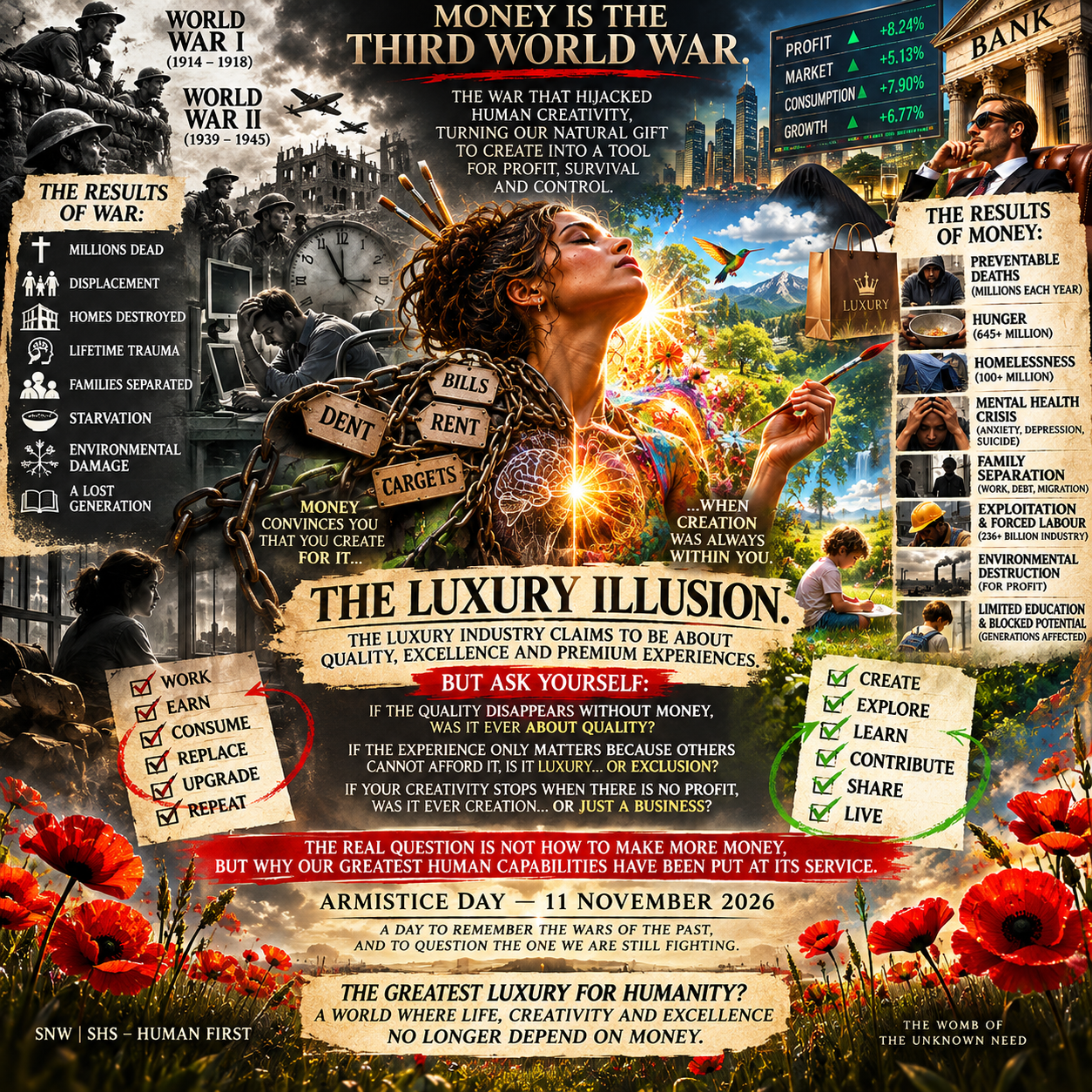
Life existed before the systems that brought destruction, and life continued after the weapons fell silent.
The poppy reminds us not only of those who died, but of the life that remained—and the responsibility to preserve it.
Emigration is for money.
THE LUXURY INDUSTRY. INNOVATION. ART. CRAFTSMANSHIP. HUMAN INTELLIGENCE. WHAT HAPPENS TO YOUR SO-CALLED EXCELLENCE WHEN THERE IS NO MONEY LEFT TO MAKE FROM IT?
MONEY IS THE THIRD WORLD WAR. AND ONE OF ITS GREATEST CASUALTIES IS THE HUMAN CAPACITY TO CREATE FOR THE SAKE OF CREATION ITSELF.
— SNW | SHS – HUMAN FIRST
11 November 2026 — Armistice Day
Oh, humanity.
I have another rather fascinating investigation for you.
And this time, I want us to examine something money has managed to convince us it inspires.
Creativity.
Innovation.
Craftsmanship.
Excellence.
Ambition.
The pursuit of perfection.
Apparently, we have reached a point in human civilisation where somebody has to introduce the possibility of financial reward before we remember that we possess a functioning imagination.
How terribly embarrassing.
WHEN DID MONEY BECOME THE INSPIRATION FOR A SPECIES THAT WAS ALREADY CAPABLE OF CREATING BEFORE MONEY EXISTED?
Think about that.
You were born with a brain.
A nervous system.
A body capable of interacting with its environment.
A mind capable of observing, investigating, connecting information, imagining possibilities and developing solutions.
You didn’t need a bank account to become curious.
You didn’t need a salary to learn how to move.
You didn’t need a financial incentive to discover pleasure.
You didn’t need an investment portfolio to develop preferences.
And you certainly didn’t need somebody promising you a million pounds before your imagination became capable of producing something that had never existed before.
CREATIVITY WAS NEVER MONEY’S CREATION.
Money merely discovered that human beings could be persuaded to place their creativity at its service.
And now?
We call money the motivation.
The incentive.
The inspiration.
The reason to innovate.
The reward for excellence.
Oh, humanity.
YOU HAVE GIVEN THE INSTRUMENT CREDIT FOR THE VERY CAPABILITY THAT MADE THE INSTRUMENT POSSIBLE.
What a spectacular reversal.
1. BEFORE MONEY INSPIRED YOU, LIFE ALREADY DID.
Let’s investigate something.
Why does a child draw?
Why does a child build things?
Why does a child take something apart to investigate how it works?
Why does a child invent games?
Why does a child ask questions?
Why does a child experiment with sounds, colours, movements and expressions?
Who is paying them?
Who is sponsoring their imagination?
Where is the commercial contract?
Where is the investor?
Where is the promise of financial return?
Nowhere.
And yet the child creates.
The child explores.
The child investigates.
The child develops.
THE ORIGINAL CREATIVE INSTINCT DOES NOT WAIT FOR MONEY TO GIVE IT PERMISSION TO FUNCTION.
Human beings observe something and wonder.
What if?
What happens if I combine these?
What if I change this?
What if I improve that?
What if I develop something that does not yet exist?
That is the original technology.
The human self.
Our capacity to receive information, investigate it and produce something further.
Money doesn’t perform any of those processes.
It doesn’t experience curiosity.
It doesn’t wonder.
It doesn’t imagine.
It doesn’t feel the satisfaction of seeing an idea become reality.
MONEY HAS NEVER HAD AN ORIGINAL THOUGHT IN ITS ENTIRE EXISTENCE.
Because money cannot think.
But you can.
And somehow, we have developed an entire economic philosophy around the idea that the thing incapable of creativity is responsible for motivating the thing capable of it.
What an extraordinary insult to human intelligence.
2. THE QUEST FOR SURVIVAL HAS HIJACKED THE CREATIVE INSTINCT.
Now here is where the Third World War becomes particularly interesting.
Because money doesn’t simply reward creativity.
Our economic arrangements can redirect it.
Imagine a person with an extraordinary imagination.
A mind capable of developing solutions.
Someone who could investigate agriculture.
Design housing.
Create music.
Develop technologies.
Improve education.
Or discover something that humanity has not yet considered.
But before they can investigate their possibilities, they have to survive.
Rent.
Food.
Bills.
Transportation.
Debt.
Employment.
Financial security.
And suddenly, the question is no longer:
WHAT AM I CAPABLE OF CREATING?
It becomes:
WHAT CAN I CREATE THAT SOMEBODY WILL PAY ME FOR?
Oh.
There it is.
The transformation.
An original human capacity has been redirected through the conditions of financial survival.
The person may still be creative.
Exceptionally creative.
But their imagination is now working under economic instruction.
Will it sell?
Can it scale?
Can it attract investment?
Is there a market?
Is it commercially viable?
What is the return?
And what happens to the idea that could improve humanity but does not promise sufficient financial reward?
What happens to the invention that eliminates a profitable dependency?
What happens to the creation that solves a problem so effectively that people no longer need to purchase recurring solutions?
What happens to the discovery that benefits everybody without generating an exclusive ownership advantage?
DO WE RECOGNISE IT AS EXCEPTIONAL INNOVATION, OR DO WE DISMISS IT BECAUSE THERE IS NO SUFFICIENT MONEY TO MAKE FROM IT?
And if we dismiss it, what have we actually measured?
The value of the creation?
Or its capacity to participate in a monetary economy?
HOW MUCH HUMAN CREATIVITY HAVE WE FAILED TO DEVELOP BECAUSE THE MIND WAS TOO OCCUPIED TRYING TO AFFORD THE CONDITIONS NECESSARY TO USE IT?
That is another casualty of the Third World War.
Not a destroyed building.
Not a wounded soldier.
But an entire possibility that never had the opportunity to emerge.
3. NOW, LET’S INVESTIGATE THE LUXURY INDUSTRY.
Oh, luxury.
How fascinating.
An entire industry built around the language of excellence.
Quality.
Craftsmanship.
Precision.
Detail.
Artistry.
Heritage.
Personalisation.
Comfort.
Refinement.
Exceptional materials.
Extraordinary experiences.
And, apparently, extraordinary prices.
But I have a question.
WHICH PART OF LUXURY ACTUALLY REQUIRES MONEY TO BE LUXURIOUS?
Is it the quality?
Is it the craftsmanship?
Is it the precision?
Is it the comfort?
Is it the attention to detail?
Is it the knowledge of the person creating it?
Is it the experience of receiving something exceptionally well made?
Or is it the price tag?
Because those are not the same thing.
Consider a beautifully constructed piece of furniture.
The wood.
The craftsmanship.
The joinery.
The design.
The time invested.
The knowledge required.
The care with which each component is assembled.
Where exactly does the money enter the physical quality of the creation?
Does the price strengthen the joints?
Does the bank balance improve the grain of the wood?
Does a luxury label make the material more durable?
No.
The human being does.
Through skill.
Knowledge.
Attention.
Time.
And access to suitable materials and tools.
THE QUALITY IS CREATED BY HUMAN CAPABILITY. THE PRICE IS ASSIGNED BY THE ECONOMIC SYSTEM.
Now imagine the same piece being made in a world without money.
Does the quality disappear?
Does the craftsperson lose their skill?
Does the material suddenly become inferior?
Does the design stop being beautiful?
Does the finished creation cease to provide comfort?
Of course not.
The resources, organisation, tools and labour remain necessary.
But the monetary price is not what produces their quality.
IF SOMETHING STOPS BEING CONSIDERED LUXURIOUS THE MOMENT IT LOSES ITS PRICE TAG, WAS IT EVER LUXURY?
Or was it simply expensive?
4. IF YOUR LUXURY REQUIRES SOMEONE ELSE TO BE EXCLUDED, WHAT ARE YOU ACTUALLY SELLING?
Now let’s become a little more uncomfortable.
Because the luxury industry doesn’t exclusively sell quality.
Sometimes, it sells distinction.
Exclusivity.
Scarcity.
Prestige.
Social position.
The knowledge that not everybody can possess what you possess.
And I find that rather fascinating.
WHEN DID THE INABILITY OF OTHER HUMAN BEINGS TO ACCESS SOMETHING BECOME PART OF THE PLEASURE OF POSSESSING IT?
Think about that.
Imagine a beautifully designed hotel room.
Excellent bedding.
Thoughtful architecture.
Exceptional cleanliness.
Comfort.
Peace.
Beautiful surroundings.
Attentive service.
A wonderful meal.
The possibility of resting without unnecessary disturbance.
What exactly makes that experience valuable?
The experience itself?
Or the knowledge that somebody else cannot afford it?
Because if the experience is genuinely exceptional, it should remain exceptional regardless of whether another human being can enjoy something equally wonderful.
If everybody had access to comfortable bedding, would your bed suddenly become less comfortable?
If everybody could enjoy nutritious, beautifully prepared food, would your meal suddenly lose its flavour?
If everybody lived in a well-designed home, would your architecture become less beautiful?
If everybody had access to excellent care, would your experience of receiving care become less meaningful?
DO YOU WANT LUXURY, OR DO YOU WANT THE SATISFACTION OF KNOWING THAT SOMEBODY ELSE HAS LESS?
And if the latter is essential to your enjoyment, perhaps the product is not the only thing requiring improvement.
Perhaps the consumer does too.
Because there is an extraordinary difference between appreciating something exceptional and requiring somebody else’s exclusion to validate your appreciation.
REAL QUALITY DOES NOT NEED DEPRIVATION TO PROVE ITS EXISTENCE.
A well-made object remains well made.
A beautiful creation remains beautiful.
An excellent experience remains excellent.
Even if nobody is financially excluded from accessing comparable quality.
5. THE ULTIMATE TEST OF LUXURY: REMOVE THE MONEY.
Now let’s conduct an experiment.
Tomorrow, humanity develops a functioning system in which life’s necessities are reliably provided without money.
Production continues.
Resources are responsibly managed.
Human contributions are coordinated.
Knowledge continues developing.
People still possess different interests, specialisations and capabilities.
Scarce materials still require careful allocation.
Complex creations still require skill, time and effort.
But financial accumulation is no longer the condition for sustaining existence.
What happens to luxury?
What happens to the designer?
What happens to the architect?
What happens to the tailor?
What happens to the chef?
What happens to the artist?
What happens to the craftsperson?
What happens to the engineer pursuing extraordinary precision?
Do they suddenly stop caring about excellence?
Do they wake up and discover that beautiful things are no longer worth creating?
Does the chef lose their passion for flavour?
Does the designer stop imagining?
Does the architect abandon beauty?
Does the tailor forget craftsmanship?
Does the artist suddenly require a banknote before experiencing inspiration?
IF YOUR EXCELLENCE DISAPPEARS WHEN YOUR FINANCIAL REWARD DISAPPEARS, WHAT EXACTLY WAS YOUR EXCELLENCE DEPENDENT UPON?
Because perhaps you weren’t pursuing excellence as an expression of your creative capabilities.
Perhaps you were pursuing the financial reward attached to being recognised as excellent.
And there is an important difference.
One is the expression of human capability.
The other is the pursuit of economic recognition.
Of course, even passionate creators need time, tools, materials, rest and support.
Removing money would not remove those requirements.
But if those conditions were reliably provided, why should creativity require the threat of deprivation or the promise of wealth before it can flourish?
THE HIGHEST TEST OF AN INDUSTRY CLAIMING TO STAND FOR QUALITY IS WHETHER QUALITY REMAINS ITS PURPOSE WHEN PROFIT IS NO LONGER ITS REWARD.
If craftsmanship continues, you have discovered its genuine foundation.
If beauty continues, you have discovered its genuine source.
If innovation continues, you have discovered the human instinct behind it.
And if an industry’s claim to greatness collapses the moment money disappears?
Perhaps it was never greatness that sustained it.
Perhaps it was the price.
6. MONEY HAS TAUGHT HUMANITY TO CONFUSE EXPENSIVE WITH EXCELLENT.
Look at our language.
Premium.
Exclusive.
Luxury.
High-end.
Prestigious.
Elite.
World-class.
And how frequently do we associate those words with financial cost?
Why should a higher price automatically suggest superior quality?
Why do people sometimes trust something more because it costs more?
Why can an ordinary product acquire extraordinary perceived value simply by attaching a prestigious name?
Why can marketing persuade somebody that what they are purchasing is not merely an object, but a better identity?
Why do some people feel more important because of the price of what they wear?
DOES AN EXPENSIVE COAT MAKE THE PERSON INSIDE IT MORE HUMAN?
Does a luxury vehicle improve the moral character of its driver?
Does a costly watch make somebody’s time more valuable than another person’s?
Does a designer handbag increase the capacity of the person carrying it to understand the world?
No?
Then what exactly are we celebrating?
Sometimes, genuinely exceptional workmanship.
Sometimes, rarity or costly materials.
Sometimes, a particular aesthetic preference.
And sometimes, an expertly marketed financial hierarchy.
THE PRICE OF A CREATION DOES NOT ESTABLISH THE WORTH OF THE HUMAN BEING POSSESSING IT.
And the inability to purchase that creation does not establish the inferiority of the person without it.
What a strange idea for humanity to have normalised.
7. INNOVATION HAS BECOME AN INVESTMENT OPPORTUNITY BEFORE IT BECOMES A HUMAN CONTRIBUTION.
Now consider technology.
How often do we hear that innovation requires financial incentives?
That without profits, nobody would develop new products?
That without investors, human beings would lose the motivation to discover?
That without competition, progress would stop?
Oh, please.
DO YOU REALLY BELIEVE HUMAN CURIOSITY WAS INVENTED BY THE STOCK EXCHANGE?
Did the first human beings investigate their surroundings because somebody offered them shares?
Did the first tools emerge because somebody was preparing an initial public offering?
Did human language develop through a subscription model?
Did people begin experimenting with plants because they anticipated commercial intellectual-property rights?
Human beings create because they encounter the world and respond to it.
They become curious.
They recognise problems.
They imagine possibilities.
They experience the satisfaction of discovery.
They want to improve conditions.
They want to express themselves.
They want to contribute.
Financial incentives can influence which projects attract resources, how quickly they develop and who has the means to pursue them.
But that is not the same as creating the underlying human capacity.
MONEY MAY FUND THE CONDITIONS OF INNOVATION WITHIN OUR CURRENT SYSTEM. IT DOES NOT CREATE THE HUMAN CAPACITY TO INNOVATE.
And what happens when funding becomes the gatekeeper?
What happens to the research that is important but unprofitable?
What happens to preventive solutions that reduce future demand?
What happens to discoveries that could be shared widely but are restricted for commercial advantage?
What happens to the capable mind that cannot afford the equipment, education or time needed to develop its idea?
HOW MANY INVENTIONS HAS HUMANITY NEVER SEEN BECAUSE THEIR CREATORS WERE TOO BUSY SURVIVING?
And how many inventions have we seen that would never have been prioritised if financial returns were not involved?
Now which arrangement is actually producing the greatest possible human innovation?
8. WE HAVE BUILT AN ECONOMY THAT WASTES CREATIVITY ON THE PURSUIT OF MONEY.
Imagine the hours.
The extraordinary quantity of human intellectual energy directed toward acquiring, preserving, multiplying, defending and competing for money.
Financial speculation.
Competitive marketing.
Pricing strategies.
Market positioning.
Customer acquisition.
Status differentiation.
Manufacturing demand.
Increasing consumption.
Protecting margins.
Developing products people are encouraged to replace.
Designing entire systems to maximise financial returns.
Now imagine redirecting even a portion of that intelligence toward meeting actual human needs.
Better housing.
Better resource distribution.
Preventive healthcare.
Education.
Food preservation.
Environmental restoration.
Child development.
Technologies that reduce unnecessary labour.
Systems that make human necessities more accessible.
HOW MUCH OF OUR MOST EXCEPTIONAL INTELLIGENCE IS BEING USED TO MAKE MONEY MOVE MORE EFFICIENTLY INSTEAD OF MAKING LIFE FUNCTION MORE EFFECTIVELY?
And think about the person who has to choose between creating and earning.
The artist working a job that consumes all their energy.
The inventor unable to afford experimentation.
The writer too exhausted to write.
The researcher without institutional backing.
The craftsperson pressured to prioritise volume over quality.
The designer required to produce what sells instead of what solves.
The educator forced to measure success through financial targets.
HOW MUCH HUMAN POSSIBILITY IS BEING SACRIFICED TO KEEP THE INVENTION OF MONEY AT THE CENTRE OF HUMAN ACTIVITY?
And how much better could humanity become if the original creative capacity were not so heavily occupied by the quest to financially survive?
Perhaps we would discover that our problem was never insufficient human motivation.
Perhaps it was misdirected motivation.
9. WHAT HAPPENS TO COMPETITION WHEN HUMANITY NO LONGER NEEDS TO COMPETE FOR SURVIVAL?
Now, somebody will tell me that competition produces excellence.
And sometimes it does.
Competition can encourage experimentation, refinement and improved performance.
But let me ask another question.
DOES THE DESIRE TO IMPROVE REQUIRE THE DESIRE TO DEFEAT SOMEBODY ELSE?
Can a chef improve a recipe simply because they believe it could taste better?
Can a musician develop their craft because they want to hear what they are capable of producing?
Can an engineer pursue greater precision because the existing design could function more effectively?
Can a scientist investigate a question because they genuinely want to understand the answer?
Can an artist develop something extraordinary without needing to defeat another artist?
Of course.
Excellence can emerge from curiosity.
Love of the craft.
Care for the recipient.
Personal discipline.
Collaboration.
Purpose.
And the satisfaction of solving something difficult.
YOU DO NOT NEED AN OPPONENT TO IMPROVE YOURSELF.
A strategic mind does not become useless without financial competition.
It can coordinate resources.
Anticipate needs.
Prevent problems.
Improve systems.
A skilled pair of hands does not become useless without a customer competing to pay the highest price.
It can still produce something extraordinary.
And a creative mind does not become worthless because nobody is financially rewarding its imagination.
HUMAN CAPABILITY DOES NOT CEASE TO EXIST WHEN ITS COMMERCIAL VALUE IS REMOVED.
Perhaps the removal of financial survival pressure would allow more people to investigate what excellence actually means to them.
Not what they can sell.
Not what will impress the market.
But what they are capable of contributing.
10. REAL LUXURY SHOULD BE FOUND IN THE EXPERIENCE OF LIFE, NOT THE PRICE OF ACCESSING IT.
And here is where I want to return to luxury.
Because perhaps we have misunderstood it.
What is genuinely luxurious?
A beautiful environment?
A peaceful home?
Excellent food?
Comfort?
Safety?
Time?
Care?
A thoughtful experience?
A creation made with extraordinary attention?
The ability to rest?
The opportunity to develop a skill without being consumed by financial anxiety?
The freedom to experience life without constantly calculating how much of it you can afford?
WHAT IF THE GREATEST LUXURY HUMANITY COULD EVER CREATE IS THE ABILITY TO LIVE WITHOUT HAVING TO PURCHASE PERMISSION TO DO SO?
Imagine a world in which excellence is not reserved as a symbol of financial superiority.
Where craftsmanship is celebrated for its quality.
Where design is evaluated through usefulness, beauty, durability and human experience.
Where premium means genuinely exceptional care, rather than simply expensive access.
Where knowledge can be developed without the constant pressure to monetise it.
Where the pursuit of quality is not dependent upon creating an economically inferior class of people.
Not everybody would possess every rare object.
Not every experience could be available everywhere at once.
Human capabilities and resources would still require organisation.
But quality itself would no longer need to be presented as proof that somebody belongs to a higher financial class.
THE EXPERIENCE OF SOMETHING EXCEPTIONAL DOES NOT BECOME LESS EXCEPTIONAL BECAUSE HUMANITY HAS MADE EXCELLENCE MORE ACCESSIBLE.
And if somebody believes otherwise?
Perhaps what they valued was not the excellence.
Perhaps it was the exclusion.
What an uncomfortable distinction.
11. MONEY IS THE THIRD WORLD WAR. AND THE CREATIVE MIND HAS BEEN CONSCRIPTED.
On Armistice Day, we remember soldiers whose abilities were directed toward warfare.
Human beings capable of so much more.
Some were builders.
Some were farmers.
Some were musicians.
Some were thinkers.
Some were artists.
Some were people whose potential would never be fully realised because their lives were interrupted.
And I cannot help considering the parallel.
Not because financial work is identical to military combat.
But because both raise questions about how societies direct human capabilities.
WHAT HAPPENS WHEN A HUMAN BEING’S INTELLIGENCE IS CONTINUOUSLY REQUIRED FOR SURVIVAL BEFORE IT CAN BE RELEASED INTO ITS OWN POSSIBILITIES?
The original capacity remains.
The original creativity remains.
But the environment determines how much of it can develop.
The worker spends years performing tasks solely to obtain sufficient income.
The creative person develops products chosen for market demand rather than their own genuine interests.
The researcher follows the available funding.
The business prioritises financial returns.
The luxury designer is told which forms of exclusivity will sell.
And the person capable of something extraordinary may never encounter the conditions necessary to discover it.
THE CASUALTY IS NOT ALWAYS A HUMAN BEING WHO DIES.
Sometimes it is the creative possibility that never gets born.
The invention that never gets developed.
The contribution that never gets made.
The child whose curiosity gradually becomes anxiety about earning.
The adult whose imagination becomes so occupied with financial responsibility that the original delight of creating begins to disappear.
How many people have forgotten what they enjoy because they have become so focused on what they can afford?
How many have forgotten what they are capable of because their capabilities were only ever assessed according to commercial demand?
HOW MUCH OF HUMANITY’S ORIGINAL CREATIVE POTENTIAL HAS BEEN LEFT IN THE TRENCHES OF FINANCIAL SURVIVAL?
12. IF MONEY DISAPPEARED, WOULD YOU STILL CREATE?
Now.
Here is my final investigation.
And I want every industry that celebrates excellence to answer it.
Every luxury house.
Every designer.
Every inventor.
Every entrepreneur.
Every institution.
Every artist.
Every craftsperson.
Every person who claims that money is what motivates them to contribute.
IF YOUR MATERIAL NEEDS WERE SECURE AND MONEY WERE NO LONGER A REWARD, WOULD YOU STILL DO WHAT YOU DO?
Would you still create?
Would you still investigate?
Would you still develop your skills?
Would you still pursue quality?
Would you still care about the experience of somebody receiving your work?
Would you still want to improve what you produced yesterday?
Would you still be curious?
Would you still be ambitious?
Would you still seek understanding?
Would you still find satisfaction in contributing something genuinely valuable?
If yes, then congratulations.
You have identified something extraordinary.
YOUR MOTIVATION WAS NEVER EXCLUSIVELY MONEY.
Money was simply one of the instruments through which your capacity was supported and rewarded.
But if the answer is no?
If the desire to create disappears entirely when there is no financial advantage?
If the commitment to quality collapses when the product can no longer be sold at a premium?
If the willingness to care disappears when another person cannot pay?
If the pursuit of innovation ends when there is no opportunity to accumulate wealth?
Then perhaps we need to investigate what your claimed excellence was actually founded upon.
WERE YOU IN LOVE WITH THE CREATION, OR WERE YOU IN LOVE WITH WHAT THE CREATION COULD ACQUIRE FOR YOU?
Because those are two profoundly different relationships with human capability.
One sees creation as an extension of life.
The other sees creation primarily as an instrument of accumulation.
And neither a luxury label nor an extraordinary financial valuation can erase that distinction.
13. HUMANITY, YOUR MIND WAS NEVER SUPPOSED TO BE MONEY’S FACTORY.
You are alive.
You can think.
You can imagine.
You can investigate.
You can connect information.
You can discover patterns.
You can produce new possibilities.
You can use your hands to turn ideas into physical realities.
You can create experiences.
You can develop knowledge.
You can preserve what is valuable and improve what is inadequate.
Money cannot do any of those things independently.
It cannot conceive an idea.
It cannot experience beauty.
It cannot appreciate craftsmanship.
It cannot distinguish emotional fulfilment from emptiness.
It cannot enjoy an exquisite meal.
It cannot feel the comfort of fine fabric against its skin.
It cannot experience the pleasure of entering a beautifully designed space.
It cannot recognise the satisfaction of completing a difficult creative task.
MONEY CANNOT EXPERIENCE A SINGLE LUXURY THAT HUMANITY HAS CREATED.
And yet we have convinced ourselves that money is what makes those luxuries possible.
Oh, humanity.
The chef creates the meal.
The architect designs the space.
The craftsperson develops the object.
The farmer produces the ingredients.
The engineer constructs the technology.
The artist produces the expression.
The scientist develops the knowledge.
And the living human being experiences the result.
MONEY DOES NOT CREATE THE QUALITY.
MONEY DOES NOT EXPERIENCE THE QUALITY.
MONEY DOES NOT POSSESS THE ORIGINAL CAPACITY TO IMAGINE THE QUALITY.
So why on Earth have we placed it at the centre of our understanding of excellence?
And why should somebody’s inability to pay determine whether they deserve to experience the results of humanity’s creative capabilities?
14. THE GREATEST LUXURY IS NOT HAVING MORE MONEY. IT IS NO LONGER NEEDING MONEY TO EXPERIENCE LIFE.
This is where my investigation leads.
Not to a world without craftsmanship.
Not to a world without ambition.
Not to a world without beauty.
Not to a world without exceptional experiences.
And certainly not to a world where nobody bothers developing anything beyond the bare minimum.
Quite the opposite.
I want humanity to investigate what excellence could become when it is no longer governed primarily by financial return.
What happens when the craftsperson can pursue quality without being forced to compromise it for commercial survival?
What happens when the researcher can investigate important questions without requiring a profitable market?
What happens when the artist can create without needing their work to become a commodity?
What happens when children can develop their interests without having those interests prematurely converted into salary expectations?
What happens when technology can be developed to eliminate unnecessary dependency rather than generate additional opportunities to monetise it?
What happens when the finest standards of human provision become something we seek to extend across society instead of reserve for those capable of paying the highest prices?
WHAT IF WE HAVE BEEN CALLING SOMETHING LUXURY SIMPLY BECAUSE THE MAJORITY OF HUMANITY HAS BEEN DENIED ACCESS TO IT?
And what if genuine luxury is not financial exclusivity?
But the experience of living well.
Of receiving excellent care.
Of being surrounded by thoughtful design.
Of having the time to develop one’s capabilities.
Of experiencing beauty.
Of enjoying the products of exceptional human craftsmanship.
Of existing without the continuous threat that the necessities of life may be withdrawn because of insufficient money.
That is the direction I want investigated.
Because the human mind is not a factory created for the production of financial returns.
It is an original technology capable of producing understanding, imagination and creativity.
And those capabilities existed before money.
THE GREATEST CREATIVE REVOLUTION WILL NOT BE HUMANITY DISCOVERING HOW TO MAKE MORE MONEY FROM ITS INTELLIGENCE.
IT WILL BE HUMANITY DISCOVERING HOW MUCH MORE ITS INTELLIGENCE CAN CREATE WHEN IT NO LONGER HAS TO FIGHT FOR MONEY BEFORE IT CAN BEGIN.
So, to the luxury industry:
If your excellence is genuine, preserve it.
If your craftsmanship is exceptional, continue developing it.
If your experiences are beautiful, keep making them beautiful.
If your materials are valuable, use them responsibly.
If your knowledge is extraordinary, contribute it.
But do not confuse the price you assign to your creation with the source of its quality.
IF MONEY DISAPPEARS AND YOUR QUALITY DISAPPEARS WITH IT, YOU HAVE EXPOSED WHAT YOU WERE REALLY SELLING.
And to humanity:
You do not need money to possess imagination.
You do not need a financial reward to experience curiosity.
You do not need a luxury label to recognise beauty.
You do not need an investor to possess a capable mind.
You do not need a market valuation to establish the worth of your contribution.
And you certainly do not need to become wealthy before your existence becomes valuable.
MONEY IS THE THIRD WORLD WAR.
And one of its most extraordinary tricks has been convincing the original creators that they require an external financial incentive to activate the capacities through which creation became possible.
What an insult.
What a waste.
And what an extraordinary opportunity to correct it.
HUMANITY, YOU WERE CREATIVE BEFORE YOU WERE EMPLOYABLE.
YOU WERE CURIOUS BEFORE YOU WERE PROFITABLE.
YOU WERE CAPABLE BEFORE YOU WERE COMMERCIALLY VALUABLE.
AND YOU WERE ALIVE BEFORE MONEY EVER HAD A PRICE TO OFFER YOU.
So why are you waiting for money to inspire you?
THE ORIGINAL INSPIRATION WAS ALWAYS LIFE ITSELF.
And the greatest luxury we could ever develop is a civilisation that gives humanity the conditions to experience, investigate and create from that life without making its worth conditional upon financial success.
MONEY SUCKS.
DON’T YOU DARE LET IT SUCK THE CREATIVITY OUT OF YOU TOO.
— SNW
Founder & Chief Continuity Architect
SHS – HUMAN FIRST
The Womb of The Unknown Need
11 November 2026 — Armistice Day
THE TRUE MEASURE OF LUXURY IS NOT HOW MUCH MONEY SOMEBODY MUST POSSESS TO EXPERIENCE IT. IT IS HOW MUCH HUMAN EXCELLENCE WAS REQUIRED TO CREATE IT, AND HOW WELL THAT EXCELLENCE SERVES LIFE.
IF THE QUALITY SURVIVES WITHOUT MONEY, IT WAS ALWAYS QUALITY. IF ONLY THE PRICE MADE IT SPECIAL, THEN THE LUXURY WAS NEVER IN THE CREATION.



Leave a Reply