
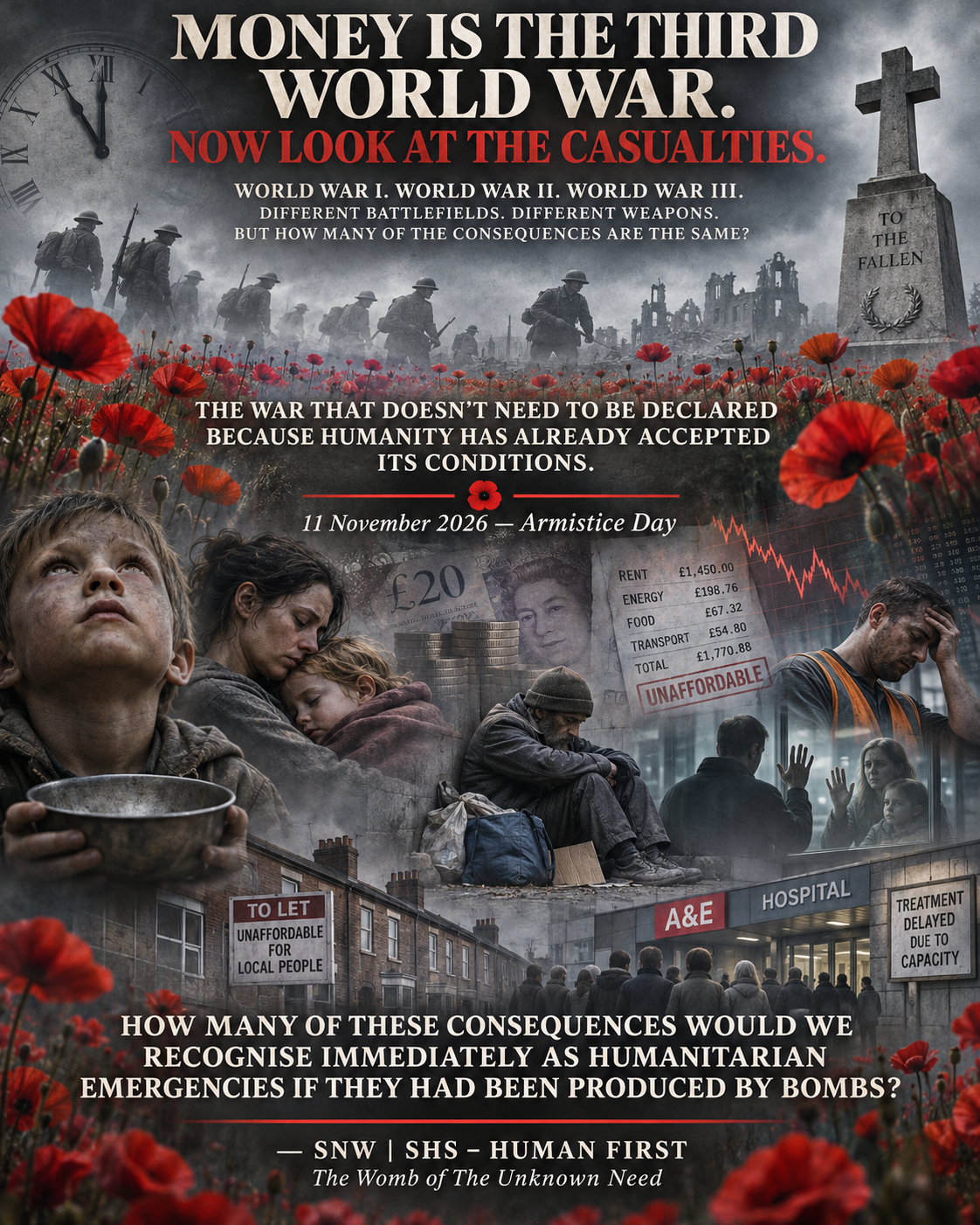
Good Mourning? Or Bad Mourning? And for how long will it go unannounced for? The moment we wait for bombs in the name of money, to call it WWIII we fail to acknoweldge it was already happening.
WORLD WAR I. WORLD WAR II. WORLD WAR III. DIFFERENT BATTLEFIELDS. DIFFERENT WEAPONS. BUT HOW MANY OF THE CONSEQUENCES ARE THE SAME?
THE WAR THAT DOESN’T NEED TO BE DECLARED BECAUSE HUMANITY HAS ALREADY ACCEPTED ITS CONDITIONS.
— SNW | SHS – HUMAN FIRST
11 November 2026 — Armistice Day
Oh, humanity.
I have another rather uncomfortable investigation for you.
And this time, I don’t want you to focus on money itself.
I want you to look at the consequences.
Because perhaps the most effective way to determine whether something is destructive is not to examine how attractively it presents itself.
But to investigate what it leaves behind.
So today, on Armistice Day, we are going to examine something extraordinary.
WHAT WERE THE ACTUAL CONSEQUENCES OF THE FIRST AND SECOND WORLD WARS?
Death?
Starvation?
Displacement?
Homelessness?
Family separation?
Psychological trauma?
Children growing up without parents?
Disease?
Exploitation?
Destruction of human resources?
Destruction of natural resources?
Loss of education?
Economic insecurity?
Generations inheriting suffering they never personally caused?
Human beings being treated as expendable in the pursuit of power?
Excellent.
Now I have another question.
HOW MANY OF THOSE CONSEQUENCES ARE STILL HAPPENING TODAY, EVEN WHERE NO CONVENTIONAL WAR IS BEING FOUGHT?
And how many are influenced by the financial arrangements through which we organise human existence?
Oh.
There it is.
WELCOME TO THE THIRD WORLD WAR.
The war in which the destruction can look like ordinary economic activity.
The war in which somebody’s suffering becomes somebody else’s financial opportunity.
The war in which people can experience consequences resembling those of armed conflict without ever hearing a gunshot.
And perhaps most extraordinarily:
THE WAR IN WHICH HUMANITY CAN CONTINUE EXPERIENCING THE CASUALTIES WHILE DEFENDING THE INSTRUMENT WHOSE AUTHORITY WE OUGHT TO BE INVESTIGATING.
Now.
Let’s look at the results.
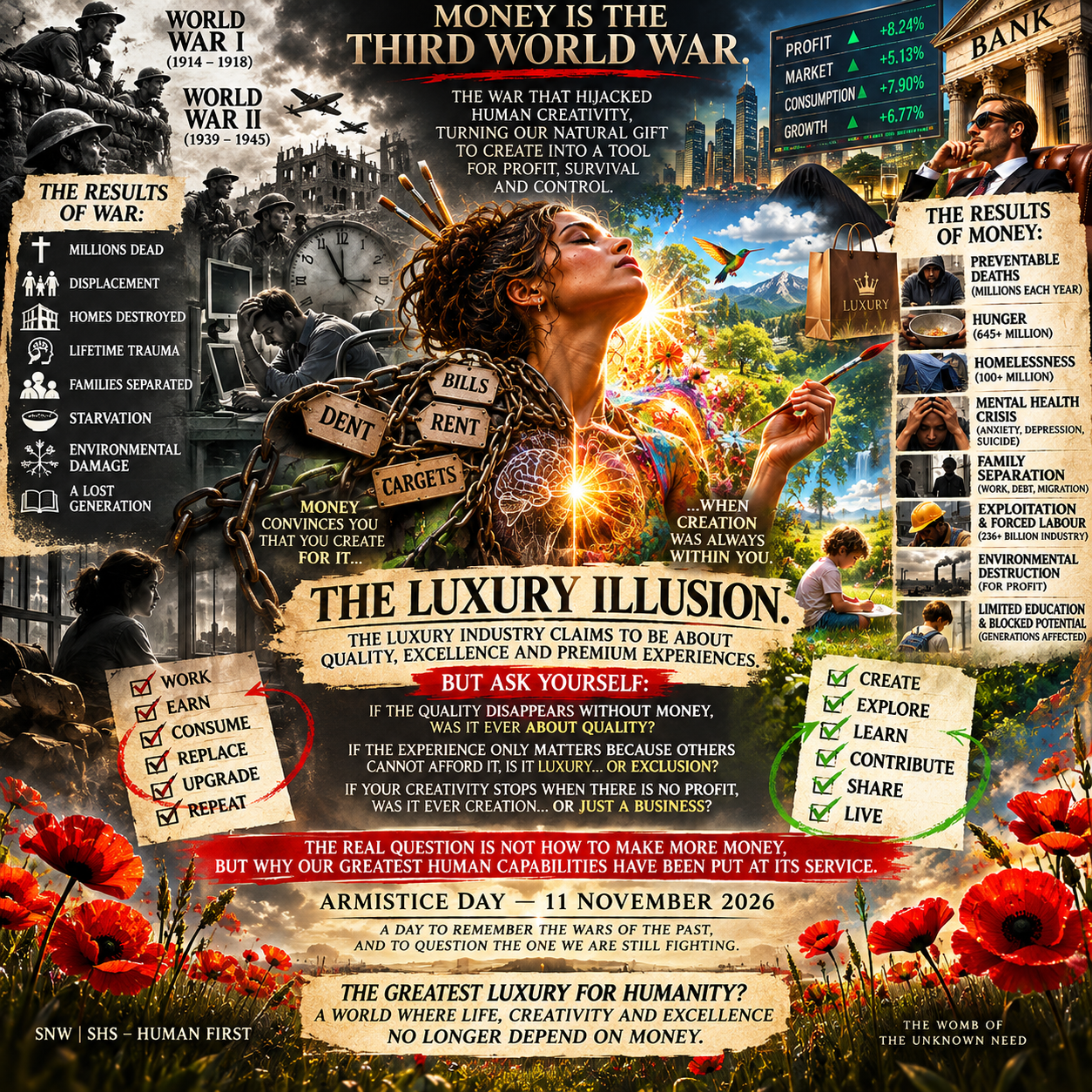
1. WORLD WAR I AND II: WHAT EXACTLY DID WAR DO TO HUMANITY?
World War I.
1914–1918.
Millions dead.
Millions wounded.
Families destroyed.
Communities displaced.
Infrastructure damaged.
Disease.
Starvation.
Psychological injuries.
Human beings returning from battle with bodies and minds that would never function as they had before.
Entire populations attempting to rebuild lives after years of destruction.
Then World War II.
1939–1945.
Tens of millions dead.
Cities devastated.
Families separated.
Genocide.
Mass displacement.
Forced labour.
Starvation.
Trauma.
Children orphaned.
Countries rebuilding destroyed infrastructure.
Humanity witnessing the consequences of allowing political authority, ideological fanaticism, territorial domination and military power to override human life.
And what an extraordinary amount of suffering that produced.
We commemorate those events.
We build memorials.
We teach their histories.
We investigate the decisions that led to them.
We remind future generations of the consequences.
And rightly so.
But I want you to look at something.
WHAT IF THE MOST IMPORTANT MEASURE OF WAR IS NOT THE SOUND OF THE WEAPONS, BUT THE HUMAN CONSEQUENCES THEY PRODUCE?
Because the death does not become less real simply because the mechanism changes.
The hunger does not become less painful.
The homelessness does not become more dignified.
The displaced family does not become less separated.
The traumatised child does not become less traumatised.
And the person who cannot access life-saving care does not become less dead because their circumstances were described as economic rather than military.
IF THE CONSEQUENCES ARE COMPARABLE IN THEIR EFFECT ON HUMAN LIFE, WHY ARE WE SO RELUCTANT TO INVESTIGATE THE SYSTEMS PRODUCING THEM WITH THE SAME SERIOUSNESS?
I am not saying poverty and genocide are identical acts.
They are not.
Nor am I suggesting that every death connected to deprivation is caused by money alone.
But if humanity recognises a particular consequence as devastating during wartime, why should the same consequence become acceptable simply because it occurs during what we call peace?
DOES SUFFERING REQUIRE A MILITARY UNIFORM BEFORE HUMANITY RECOGNISES ITS SERIOUSNESS?
2. THE FIRST CASUALTY: DEATH.
Let’s begin with the most irreversible consequence.
Death.
The final loss.
The point at which there is no opportunity to recover the original existence.
During conventional war, we count the dead.
Military casualties.
Civilian casualties.
Deaths from injuries.
Deaths from starvation.
Deaths from disease.
Deaths occurring when essential systems collapse.
Now let me ask you something.
HOW MANY PEOPLE DIE BECAUSE THEY CANNOT ACCESS SOMETHING THAT ALREADY EXISTS?
Not because humanity has never discovered the treatment.
But because they cannot access it.
Not because the world possesses no food.
But because the food cannot reach them.
Not because safe water is scientifically impossible.
But because the infrastructure and resources required to provide it remain unavailable or unequally distributed.
Consider the evidence.
The World Health Organization estimates that inadequate drinking water, sanitation and hygiene contribute to approximately 1.4 million deaths each year.
The United Nations estimates that 4.9 million children died before their fifth birthday in 2024, many from causes that could be prevented or treated.
Approximately 260,000 women died from pregnancy-related causes in 2023, most of those deaths preventable.
Now, these deaths cannot all honestly be attributed to money.
Disease, infrastructure, geography, conflict, governance, medical complications and many other factors matter.
But affordability, unequal investment and inadequate access to essential services are among the conditions through which preventable deaths persist.
And that brings me to a question.
WHEN THE KNOWLEDGE TO PREVENT A DEATH EXISTS, BUT THE NECESSARY RESOURCES HAVE NOT BEEN MADE ACCESSIBLE, WHAT EXACTLY ARE WE WAITING FOR?
For somebody to become profitable enough to save?
For a country to become wealthy enough to provide?
For an investor to identify sufficient returns?
For a budget to permit humanity to act?
Why can we recognise the death of a child during war as a tragedy while discussing preventable child mortality during peace as a development statistic?
What difference does the child’s body experience?
What difference does the grieving mother experience?
What difference does the family experience?
THE DEAD DO NOT RETURN BECAUSE THEIR CAUSE OF DEATH WAS ADMINISTRATIVELY CLASSIFIED AS POVERTY INSTEAD OF WAR.
And that is precisely why I want humanity examining the consequences rather than being distracted by the labels.
3. THE SECOND CASUALTY: HUNGER.
What happens during war?
Food production is interrupted.
Supply routes are destroyed.
Communities are displaced.
Agricultural land becomes inaccessible.
Food prices rise.
Distribution systems collapse.
People go hungry.
Some starve.
Now look at our world.
In 2025, the United Nations estimated that approximately 645 million human beings faced hunger.
Not 645 million bank accounts.
Human beings.
People with stomachs.
With bodies requiring nourishment.
With minds affected by inadequate nutrition.
With children whose development depends upon access to food.
And what makes this particularly disturbing?
We possess extraordinary agricultural knowledge.
Global transportation systems.
Refrigeration.
Food preservation.
Scientific understanding of nutrition.
The capacity to produce food on an enormous scale.
Yet sufficient nourishment is not universally accessible.
Why?
Because production is only one part of the problem.
There are conflicts.
Distribution failures.
Environmental conditions.
Political decisions.
And financial barriers.
A family can be surrounded by food for sale and still experience hunger because they cannot afford to purchase it.
IMAGINE STANDING IN FRONT OF FOOD WHILE YOUR BODY IS STARVING AND BEING TOLD THAT THE FOOD IS NOT AVAILABLE TO YOU BECAUSE YOU DO NOT POSSESS ENOUGH OF A HUMAN-MADE EXCHANGE INSTRUMENT.
Does the food cease to be edible?
No.
Does your body cease to require it?
No.
Has the Earth withdrawn your biological need for sustenance?
No.
The barrier is institutional and economic.
Now imagine explaining that arrangement to somebody who has never encountered money.
Yes, we have food.
Yes, people are hungry.
No, the hungry cannot necessarily have the food.
Why?
Because they cannot pay.
AND WE CALL THAT AN ADVANCED CIVILISATION?
During war, we understand that blocking access to food can destroy lives.
During peace, why do we accept that purchasing power can determine whether someone eats?
4. THE THIRD CASUALTY: HOMELESSNESS AND DISPLACEMENT.
What do wars do?
They force people from their homes.
They destroy buildings.
They separate communities.
They create refugees.
They leave families searching for safety.
At the end of 2025, approximately 117.8 million people worldwide were forcibly displaced, according to UNHCR.
That figure reflects persecution, conflict, violence and other severe disruptions—not simply financial poverty.
But now look beyond forced displacement.
Consider economic displacement.
Families losing homes through unaffordable rents.
People evicted because their income disappears.
Communities pushed away from places they have lived for generations as property values rise.
Workers moving far from their families because affordable livelihoods are unavailable locally.
Young people unable to establish independent households.
Elderly people fearing the loss of housing security.
What happens to the human being?
Do they experience uncertainty?
Yes.
Fear?
Yes.
Loss of belonging?
Yes.
Separation from familiar surroundings?
Yes.
Disruption of relationships?
Yes.
SO WHY IS THE LOSS OF A HOME RECOGNISED AS A HUMANITARIAN CONSEQUENCE OF WAR, BUT SO FREQUENTLY TREATED AS A PRIVATE FINANCIAL PROBLEM WHEN IT OCCURS THROUGH ECONOMIC EXCLUSION?
The mechanisms are different.
The experiences are not identical.
But the human need for shelter remains.
Money did not create that need.
Money did not invent the human body’s vulnerability to cold.
Money did not invent the psychological importance of stability.
And yet financial possession can determine whether a human being receives access to secure housing.
THE HOUSE DOESN’T STOP BEING A HOUSE BECAUSE THE PERSON OUTSIDE IT CANNOT AFFORD THE RENT.
So what exactly is being protected?
The building’s capacity to shelter?
Or its capacity to generate financial returns?
And what happens when those objectives come into conflict?
5. THE FOURTH CASUALTY: FAMILIES.
Wars separate families.
Children grow up without parents.
Partners lose one another.
Communities fracture.
Relationships are interrupted by forces outside the individual family’s control.
Now look at the economic battlefield.
Why do parents leave their children for extraordinary portions of their childhood to earn the means of providing for them?
Why do people migrate across continents for employment while leaving spouses, children and ageing parents behind?
Why can financial hardship contribute to family conflict?
Why do people postpone having children because they cannot afford the conditions under which they want to raise them?
Why can economic dependence make it difficult to leave an abusive relationship?
Why can financial insecurity intensify the pressures that threaten family stability?
And why do we accept the separation of human relationships as an ordinary cost of economic participation?
WE HAVE ORGANISED A WORLD IN WHICH PEOPLE MUST SOMETIMES SACRIFICE THEIR PRESENCE IN A FAMILY TO PROVIDE THE FINANCIAL MEANS OF MAINTAINING THAT FAMILY.
Imagine that.
I love you.
Therefore I must leave you.
I want to be present.
Therefore I must work elsewhere.
I want to raise you.
Therefore I must spend much of my time away acquiring the means to raise you.
WHAT AN EXTRAORDINARY CONTRADICTION.
And when the consequences emerge?
Stress.
Resentment.
Exhaustion.
Relationship breakdown.
Childhood experiences shaped by absence.
We discuss them as individual family problems.
But how often do we examine the economic structures that helped produce the conditions?
How often do we question the system before blaming the people trying to survive within it?
WHY ARE WE SO QUICK TO EXAMINE THE FAMILY THAT BROKE, AND SO RELUCTANT TO EXAMINE THE CONDITIONS THAT KEPT APPLYING PRESSURE UNTIL IT DID?
6. THE FIFTH CASUALTY: THE HUMAN MIND.
What do wars leave behind?
Fear.
Grief.
Anxiety.
Psychological injuries.
Traumatic memories.
Hypervigilance.
The continuous expectation of danger.
People who survive physically while continuing to experience the consequences psychologically.
Now examine financial insecurity.
The fear of losing employment.
The fear of eviction.
The fear of debt.
The fear of being unable to feed a child.
The fear of unexpected medical expenses.
The fear of becoming dependent upon somebody else.
The humiliation of having to prove financial hardship.
The exhaustion of continuously calculating whether there will be enough.
HOW MANY HUMAN MINDS SPEND THEIR LIVES PREPARING FOR A FINANCIAL DISASTER THAT HAS NOT YET HAPPENED?
How many people wake up anxious?
How many go to sleep anxious?
How many cannot enjoy the present because the future remains financially threatening?
How many relationships are affected by that fear?
How many children grow up absorbing their parents’ financial anxiety?
How many adults mistake their income for their self-worth?
How many people become convinced that their inability to accumulate money means they have failed as human beings?
And what happens when that pressure becomes unbearable?
The WHO estimates that more than 740,000 people die by suicide globally each year.
Financial difficulties can be one contributor to suicidal distress, alongside many other psychological, social, biological and environmental factors. Those deaths cannot be counted as deaths caused by money.
But that does not make financial distress irrelevant.
WHY SHOULD AN INVENTION CREATED BY HUMANITY HAVE THE CAPACITY TO MAKE A LIVING HUMAN BEING FEEL THAT THEIR EXISTENCE HAS BECOME A BURDEN?
And why do we spend so much effort helping people cope with financial anxiety without equally investigating the arrangements that keep generating it?
DURING WAR, WE RECOGNISE THAT CONTINUOUS THREAT DAMAGES THE MIND.
DURING PEACE, WE CALL CONTINUOUS FINANCIAL THREAT RESPONSIBILITY.
What a remarkable difference in language.
7. THE SIXTH CASUALTY: THE HUMAN BODY AT WORK.
During war, human bodies become instruments through which military objectives are pursued.
Bodies are exhausted.
Injured.
Exposed to dangerous conditions.
Sometimes killed.
Now consider working life.
The International Labour Organization estimates that nearly three million workers die annually from work-related accidents and diseases.
These are deaths associated with occupational conditions, not deaths that can all be attributed to financial incentives.
But they demand an investigation.
When safety competes with cost, which one wins?
When a worker is required to meet an unrealistic production target, who bears the physical consequences?
When a company can reduce its expenses by reducing protections, what stops it?
When exposure to dangerous substances produces illness decades later, who carries the consequences?
When somebody becomes too sick to continue working, what happens to the income on which their survival depends?
WHY CAN A HUMAN BEING BE INJURED WHILE PRODUCING SOMETHING VALUABLE AND THEN BECOME FINANCIALLY VULNERABLE BECAUSE THEIR BODY CAN NO LONGER PRODUCE IT?
And why do we describe the loss of a worker primarily through the language of lost productivity?
A human being has died.
A family has lost someone.
A body that could experience life no longer can.
And the financial system may calculate the economic loss.
THE HUMAN BEING IS NOT AN EXPENSE THAT BECOMES UNPROFITABLE WHEN THE BODY BREAKS.
Human capability made the work possible.
Money did not.
8. THE SEVENTH CASUALTY: HUMAN FREEDOM.
War has historically involved forced labour, coercion, enslavement and the exploitation of vulnerable populations.
Now consider the financial incentives surrounding exploitation today.
The ILO estimated that forced labour in the private economy generated approximately 236 billion US dollars in illegal profits annually.
Think about that.
An enormous financial return from the exploitation of human freedom.
People coerced into work.
People trapped by threats.
People subjected to debt bondage.
People whose vulnerability becomes somebody else’s commercial opportunity.
WHEN DOES A HUMAN BEING STOP BEING A PERSON AND BECOME A RESOURCE TO BE EXTRACTED?
Who decides that another person’s desperation is an opportunity?
Who profits from the absence of alternatives?
Why can the exploitation of a living human being generate such enormous commercial returns?
And what does it reveal when a market can place a monetary value on the deprivation of someone’s freedom?
Money doesn’t physically imprison anybody.
People do.
Institutions and criminal networks organise exploitation.
But financial gain can become a powerful incentive for maintaining it.
THE MONEY DOES NOT HOLD THE CHAINS.
THE PEOPLE PURSUING IT DO.
And that is why we must investigate the people, the decisions and the arrangements—not merely the instrument.
A war economy can reward exploitation.
So can an economy officially at peace.
The human being experiencing coercion deserves freedom in either case.
9. THE EIGHTH CASUALTY: THE EARTH ITSELF.
What did the world wars do to the environment?
Land was destroyed.
Cities were reduced to rubble.
Agricultural production was disrupted.
Resources were consumed in enormous quantities.
Industrial systems were redirected toward destruction.
And some of the physical consequences persisted long after the fighting ended.
Now examine modern economic activity.
Forests cleared for commercial gain.
Waterways polluted.
Habitats destroyed.
Resources extracted without sufficient consideration for future generations.
Waste generated because continuous consumption supports commercial activity.
Products designed or marketed in ways that encourage premature replacement.
Natural systems damaged while their destruction generates financial returns.
WHY CAN THE DESTRUCTION OF SOMETHING NECESSARY FOR LIFE BE DESCRIBED AS ECONOMIC GROWTH?
Why can the removal of a forest contribute to financial output while the loss of the forest’s ecological functions remains inadequately accounted for?
Why can a company profit from producing pollution while the costs of restoring human health and environmental conditions are transferred to others?
Why can economic systems reward the creation of problems that subsequently require new industries to solve?
IF THE FIRST INVENTION DAMAGES LIFE AND THE SECOND INVENTION PROFITS FROM REPAIRING THAT DAMAGE, HAVE WE INNOVATED OR CREATED A COMMERCIAL DEPENDENCY?
War can destroy the means of subsistence.
So can unsustainable economic exploitation.
The motivations and mechanisms differ.
But a contaminated water source remains contaminated.
A destroyed habitat remains destroyed.
And the people who depend on those systems inherit the consequences.
THE EARTH DOES NOT RECEIVE A PROFIT-SHARING AGREEMENT FOR BEING EXPLOITED.
It simply accumulates the damage.
And eventually the living inherit the bill.
10. THE NINTH CASUALTY: CHILDHOOD AND THE FUTURE.
War interrupts education.
It disrupts development.
It deprives children of stability.
It can force children into labour.
It can separate them from caregivers.
It can leave entire generations attempting to recover from experiences they never chose.
Now look at economic deprivation.
Children growing up in unstable housing.
Children experiencing inadequate nutrition.
Children unable to access educational opportunities.
Children entering work prematurely to support household survival.
Children whose possibilities are constrained by their family’s financial position.
WHY SHOULD A CHILD’S OPPORTUNITY TO DEVELOP THEIR OWN CAPABILITIES DEPEND SO HEAVILY ON THE FINANCIAL CIRCUMSTANCES INTO WHICH THEY WERE BORN?
Did the child create those circumstances?
No.
Did they negotiate the system?
No.
Did they choose their parents’ income?
No.
Did they decide how schools would be funded?
No.
Did they determine the cost of housing?
No.
Yet the consequences can follow them throughout their lives.
And perhaps into the next generation.
Just as the consequences of war can extend beyond those who directly experienced the conflict.
THE CHILD DOES NOT HAVE TO EXPERIENCE THE ORIGINAL DECISION TO INHERIT ITS CONSEQUENCES.
That is continuity.
That is precisely why I keep investigating what happens across time.
Because a society that repeatedly allows its children to inherit preventable deprivation cannot simply call itself successful because some of its financial indicators are improving.
What happens to human potential that never receives the conditions necessary to develop?
How do we calculate the value of the scientist who never had the opportunity to study?
The artist who never had the time to create?
The doctor whose childhood circumstances prevented them from entering education?
The strategist whose intelligence was consumed by survival?
HOW MUCH HUMAN CAPABILITY HAVE WE FAILED TO DEVELOP BECAUSE MONEY WAS POSITIONED BETWEEN THE CHILD AND THEIR POSSIBILITIES?
And who is accounting for that loss?
11. MONEY WAS ALSO PRESENT IN THE FIRST TWO WORLD WARS.
Now let us examine the historical connection.
Because money was not absent from the earlier world wars.
Far from it.
World War I involved imperial rivalry, competing national interests, alliances, militarism, nationalism and struggles over international power.
Economic competition and access to resources were important parts of that historical environment.
Governments borrowed enormously.
Industries manufactured weapons.
Financial systems supported military mobilisation.
War created debt.
And debt shaped the peace that followed.
The reparations imposed after World War I, the financial pressures of the interwar years and the Great Depression formed part of the conditions that destabilised Europe.
World War II cannot be explained simply as a pursuit of money.
Nazi racial ideology, antisemitism, dictatorship, militarism, territorial aggression and genocide were fundamental to its causes and conduct.
But economic instability, resource ambitions, industrial capacity and financial mobilisation also mattered.
And war itself generated contracts.
Production.
Procurement.
Profits for some businesses.
Debts for governments.
Reconstruction opportunities.
The financial consequences did not simply disappear when the fighting stopped.
MONEY HELPED FINANCE THE WEAPONS, AND THE WEAPONS HELPED CREATE FINANCIAL CONSEQUENCES THAT SURVIVED THE WARS.
Do you see the relationship?
We cannot reduce either world war to economics.
But we cannot investigate either war comprehensively while ignoring economics.
Who financed the mobilisation?
Who supplied the weapons?
Who profited from production?
Who borrowed?
Who repaid?
Who inherited the debt?
Who lost their property?
Who acquired new assets?
Who benefited from reconstruction?
And who spent generations living with the consequences?
THE ACTUAL WAR ENDED.
THE FINANCIAL CONSEQUENCES CONTINUED.
What an extraordinary relationship between the physical battlefield and the economic one.
12. WHY NOT CALL IT AN ACTUAL PHYSICAL WORLD WAR III?
Because this is where my distinction becomes especially important.
I am not claiming that humanity has formally entered a third world war in the historical or military sense.
There has been no single worldwide declaration of hostilities comparable to the First or Second World Wars.
No universally identifiable opening battle.
No single military alliance structure containing every participant.
No unified command.
No agreed battlefield.
And no defensible global casualty total that can simply be assigned to money.
I AM USING WORLD WAR III AS AN INDICTMENT OF THE CONSEQUENCES OF A SYSTEM HUMANITY HAS NORMALISED.
Why?
Because its influence reaches across borders.
Because its consequences extend across generations.
Because its authority affects virtually every human being participating in modern economic life.
Because the struggle for resources, power and security can produce enormous human suffering.
Because it can intensify existing conflicts.
Because it can reward exploitation.
Because financial exclusion can deny access to necessities.
And because people can experience grave consequences without recognising the economic arrangements contributing to them.
An actual physical war announces itself through visible violence.
This proposed third war announces itself through conditions that society has learned to regard as ordinary.
IT DOESN’T HAVE TO BOMB THE HOUSE IF THE FAMILY CAN LOSE THE HOUSE THROUGH FINANCIAL EXCLUSION.
It doesn’t have to destroy a supermarket if the food inside remains unaffordable.
It doesn’t have to shut down a hospital if the patient cannot access the necessary care.
It doesn’t have to conscript a parent if economic necessity already demands prolonged separation from their children.
It doesn’t have to destroy somebody’s confidence if financial insecurity can gradually convince them they possess no worth.
The comparison is not about identical methods.
IT IS ABOUT OUR FAILURE TO EXAMINE CERTAIN CONSEQUENCES WITH THE SAME URGENCY SIMPLY BECAUSE THEIR CAUSES DO NOT LOOK LIKE CONVENTIONAL WARFARE.
And here lies the greatest difficulty.
A conventional war may eventually conclude with a ceasefire or surrender.
But financial dependency does not have one commander who can announce that the conditions have ended.
Its continuation is distributed across laws, institutions, incentives, commercial arrangements and human behaviour.
It is enforced through countless ordinary decisions.
And the people making those decisions are often themselves dependent on the same system.
THERE IS NO SINGLE ENEMY SOLDIER TO DEFEAT.
THERE IS AN ENTIRE ARRANGEMENT TO INVESTIGATE.
13. HOW MANY PEOPLE HAVE DIED BECAUSE OF MONEY?
Now we reach the question I believe humanity should be asking much more seriously.
How many?
How many deaths have financial barriers contributed to?
How many lives have been lost because people could not access adequate food, clean water, safe housing or timely healthcare?
How many people have died in unsafe working conditions where financial pressures undermined protection?
How many lives have been lost through exploitation driven by profit?
How many conflicts have been intensified by struggles over resources, territory, economic advantage and power?
How many people have died while fleeing deprivation or insecurity?
How many have been pushed into conditions of dangerous desperation?
WHERE IS THE GLOBAL ACCOUNTING OF THE HUMAN COST OF FINANCIAL DEPENDENCY?
We cannot honestly take every death associated with poverty, disease, labour, environmental damage and conflict, add them together and declare the result a death toll caused by money.
Those categories overlap.
Their causes are complex.
And the same human being may appear in multiple estimates.
But that limitation should not become an excuse to avoid investigating the connections.
It should become a reason to investigate them more rigorously.
Imagine a global assessment asking:
What proportion of preventable deaths is associated with unaffordable necessities?
How many could have been prevented through better resource distribution?
How much harm results from financial incentives that reward unsafe or exploitative practices?
How much suffering is produced by inadequate investment in essential infrastructure?
What are the long-term consequences of persistent financial insecurity?
And how much of that suffering could be eliminated through alternative systems of provision?
WE COUNT THE DEAD AFTER WARS.
WHY DON’T WE DEMAND AN EQUALLY RIGOROUS ACCOUNTING OF THE HUMAN CONSEQUENCES OF THE ECONOMIC ARRANGEMENTS WE CONTINUE TO DEFEND?
Not to manufacture a dramatic number.
But to establish responsibility.
To understand the causes.
To recognise what is preventable.
And to design conditions that reduce the loss of life.
Because the purpose of counting casualties should never be merely to announce how many died.
It should be to understand what must change so that fewer people die.
14. THE MOST DISTURBING CONSEQUENCE IS THAT WE HAVE NORMALISED THE RESULTS.
Here is what I find particularly extraordinary.
When war destroys a hospital, humanity recognises a crisis.
When a person cannot access treatment because of financial barriers, we may call it a healthcare affordability problem.
When war separates families, we recognise a humanitarian emergency.
When economic pressures force prolonged family separation, we may call it employment migration.
When war leaves people homeless, we call them displaced.
When housing costs drive people from their homes, we call it a housing affordability crisis.
When war interrupts childhood, we recognise the loss of developmental opportunities.
When poverty restricts a child’s education, we call it educational inequality.
When war destroys livelihoods, we recognise economic devastation.
When businesses close and households lose income, we may describe it as market adjustment.
Different causes.
Different circumstances.
Different levels of responsibility.
But look at the human being experiencing the consequences.
HOW MUCH DOES THE LANGUAGE CHANGE THE EXPERIENCE?
Does it restore their home?
Does it feed their child?
Does it heal their body?
Does it return their lost years?
Does it eliminate their fear?
Does it repair their relationships?
WE HAVE BECOME EXTRAORDINARILY SOPHISTICATED AT NAMING HUMAN SUFFERING WITHOUT NECESSARILY ELIMINATING THE CONDITIONS THAT PRODUCE IT.
And the economic language can make the consequences appear unavoidable.
Market forces.
Budget limitations.
Commercial viability.
Investment requirements.
Financial stability.
Economic necessity.
How many of these phrases have become acceptable explanations for circumstances that leave human beings deprived?
And how often do we stop to ask who established those conditions?
Who benefits from maintaining them?
Who has the authority to change them?
What alternatives have been considered?
And why have those alternatives not been pursued?
15. THE ULTIMATE CONTRADICTION: MONEY CAN PROFIT FROM REPAIRING THE DAMAGE MONEY HELPED INCENTIVISE.
Oh, this one deserves attention.
Imagine an industry generating substantial revenue through products that harm health.
Then another industry develops treatments for the resulting harm.
Imagine environmental damage creating demand for remediation services.
Imagine insecurity creating markets for security products.
Imagine financial distress generating demand for debt-management services.
Imagine technological dependency producing entire industries dedicated to protecting people from the harms and vulnerabilities introduced by technology.
None of those services is necessarily illegitimate.
Some provide essential protection.
But the question remains.
WHY ARE WE SO MUCH BETTER AT COMMERCIALISING THE CONSEQUENCES OF A PROBLEM THAN AT INVESTIGATING WHETHER THE ORIGINAL PROBLEM COULD HAVE BEEN PREVENTED?
Why can preventing harm appear financially unattractive while managing the harm becomes profitable?
Why does the creation of additional markets count as growth even when those markets exist to address suffering?
Why do we celebrate the profitability of solutions without consistently asking why the need for those solutions continues expanding?
IS THE OBJECTIVE TO BUILD AN INFINITE ECONOMY OF REPAIRS OR TO CREATE CONDITIONS THAT REQUIRE FEWER REPAIRS IN THE FIRST PLACE?
Imagine a civilisation in which the highest standard of innovation is the reduction of preventable dependency.
Not the creation of another product somebody must purchase.
Not another recurring subscription.
Not another service required to manage the consequences of an earlier service.
But an actual improvement in the human condition.
That would be innovation worthy of its name.
And it would require us to examine success through something other than continuous revenue growth.
16. WHAT WOULD THE ARMISTICE ACTUALLY REQUIRE?
Not simply declaring that money is evil.
Not abandoning people who currently depend upon it.
Not destroying financial institutions overnight and allowing the consequences to fall upon those least able to protect themselves.
Not replacing one wealthy class with another.
Not creating a new hierarchy that determines who deserves necessities.
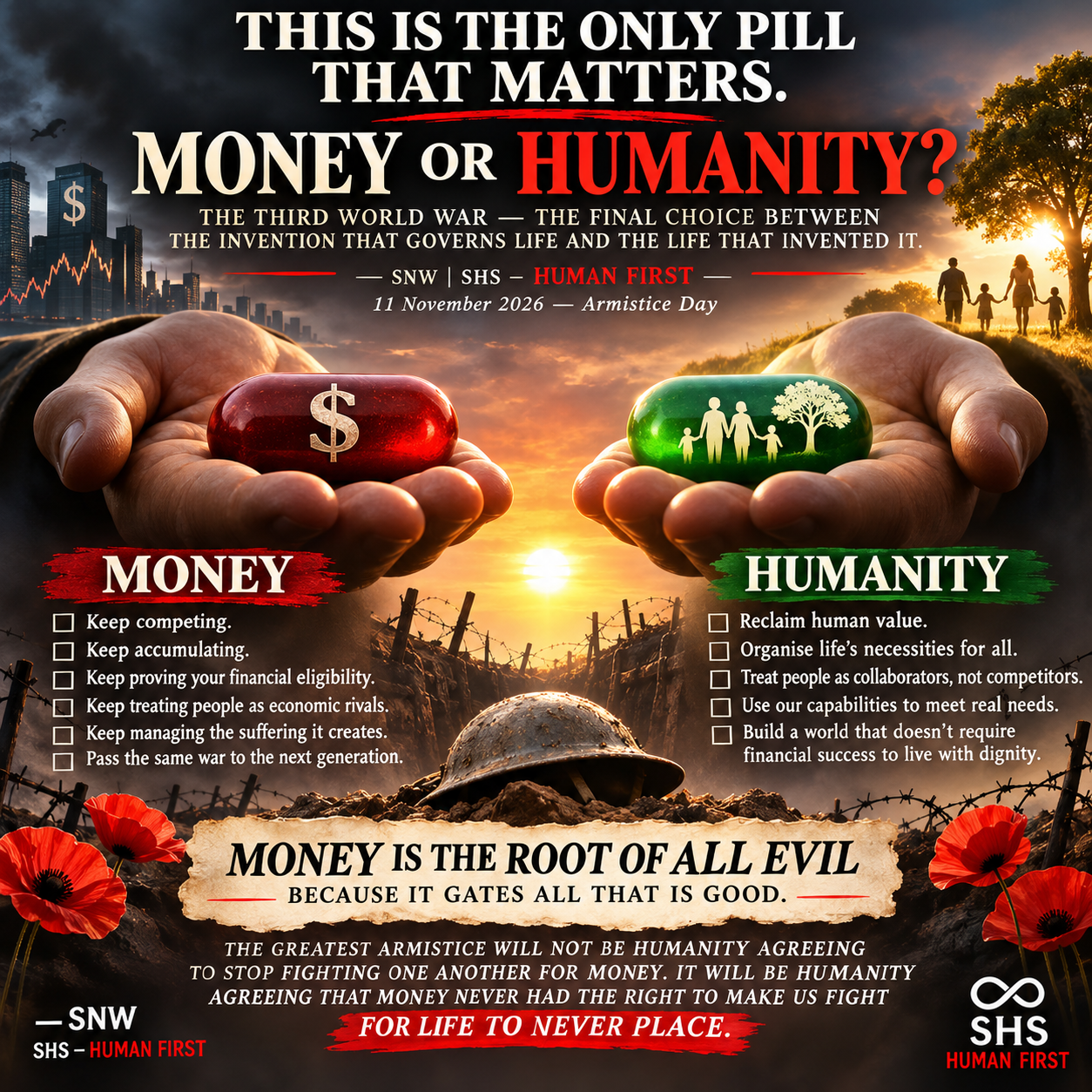
But investigating how humanity can progressively organise the foundations of life independently of financial eligibility.
Food.
Water.
Shelter.
Healthcare.
Education.
Care.
Infrastructure.
Security.
Environmental continuity.
And the human capabilities required to sustain them.
It would require systems capable of measuring actual needs and actual resources.
It would require production and distribution mechanisms that remain accountable.
It would require protecting people’s freedom and dignity.
It would require preventing new forms of coercion from replacing financial coercion.
It would require investigating how to coordinate contribution without making deprivation the threat that motivates participation.
And above all, it would require recognising that the objective is not to make money more available, but to make life’s necessities reliably available without money having the final word.
That is not simply an economic adjustment.
It is an investigation into the foundations of civilisation.
And it is what SHS – HUMAN FIRST intends to explore.
Because if we can develop technologies capable of organising global financial markets, why should we assume we are incapable of developing technologies and institutions that coordinate human provision more directly?
If we can forecast profitability, why not forecast human needs?
If we can monitor financial risk, why not monitor risks to human continuity?
If we can organise global supply chains around purchasing power, why not develop systems that prioritise essential human provision?
If we can protect the financial stability of major institutions, why not make the stability of human existence the first institutional obligation?
WHY DO WE HAVE SO MUCH INTELLIGENCE DIRECTED TOWARD KEEPING MONEY FUNCTIONING AND SO MUCH HUMANITY STILL STRUGGLING TO FUNCTION WITHOUT ENOUGH OF IT?
Perhaps the problem is not the absence of intelligence.
Perhaps it is where we have directed it.
17. SO WHAT MAKES MONEY THE THIRD WORLD WAR?
Here is my conclusion.
NOT THAT MONEY IS LITERALLY AN ARMY.
NOT THAT EVERY HUMAN DEATH IS CAUSED BY MONEY.
NOT THAT THE WORLD WARS WERE SIMPLY FINANCIAL DISPUTES.
And certainly not that the distinct atrocities of those wars can be reduced to ordinary economic hardship.
What makes money the Third World War in my philosophical assessment is the scale, reach and continuity of the struggle humanity has organised around financial survival.
The casualties are not always recorded as casualties of the monetary system.
The battlefield is not always visible.
The weapon is not always physical.
The perpetrator is not always a single individual.
The harm can emerge through ordinary decisions that appear perfectly legitimate within the existing arrangements.
And the consequences accumulate.
Across bodies.
Across minds.
Across families.
Across communities.
Across generations.
Across countries.
Across the Earth itself.
THE FIRST WORLD WAR TAUGHT US WHAT HAPPENS WHEN HUMANITY MOBILISES ITS CAPABILITIES FOR DESTRUCTION.
THE SECOND WORLD WAR DEMONSTRATED HOW MUCH FURTHER DESTRUCTION CAN GO WHEN POWER, IDEOLOGY, TECHNOLOGY AND DEHUMANISATION CONVERGE.
THE THIRD WORLD WAR, AS I AM DESCRIBING IT, ASKS US TO INVESTIGATE WHAT HAPPENS WHEN FINANCIAL DEPENDENCY BECOMES SO NORMAL THAT ITS HUMAN CONSEQUENCES NO LONGER LOOK LIKE A WAR TO THE PEOPLE EXPERIENCING THEM.
And perhaps the most uncomfortable possibility is that we have not recognised how much of our existence is spent fighting because we have never known a different arrangement.
We have normalised the trenches.
Normalised the anxiety.
Normalised the scarcity of purchasing power.
Normalised the competition.
Normalised the debt.
Normalised the sacrifices.
Normalised the insecurity.
And convinced ourselves that this is simply what being a responsible human being requires.
WHAT IF WE HAVE BEEN CALLING IT LIFE BECAUSE WE HAVE NEVER BEEN GIVEN THE CONDITIONS TO EXPERIENCE LIFE WITHOUT THE FIGHT?
18. ON ARMISTICE DAY, LOOK AT THE RESULTS BEFORE YOU DEFEND THE SYSTEM.
11 November 2026.
One hundred and eight years after the armistice of 1918.
And I ask humanity to look at the consequences.
Not the marketing.
Not the financial success stories.
Not the billionaires.
Not the stock exchange.
Not the promises of growth.
Not the prestige.
Not the prizes.
Not the extraordinary complexity of the instruments through which wealth circulates.
Look at the results.
The hungry.
The homeless.
The displaced.
The exhausted.
The exploited.
The injured.
The traumatised.
The children whose opportunities never developed.
The families separated by economic necessity.
The people whose lives became shorter because essential services were inaccessible.
The communities left managing the consequences of decisions made elsewhere.
The environmental damage.
The intergenerational insecurity.
And the lives that might have unfolded differently if humanity had organised its resources around human needs first.
HOW MANY OF THESE CONSEQUENCES WOULD WE RECOGNISE IMMEDIATELY AS HUMANITARIAN EMERGENCIES IF THEY HAD BEEN PRODUCED BY BOMBS?
Why does the absence of an explosion make them easier to tolerate?
Why does the absence of an enemy army make the circumstances appear less urgent?
Why does the absence of a formal declaration of war make the ongoing struggle seem like ordinary life?
And what would happen if we examined financial dependency with the same determination with which we examine the causes of armed conflict?
Not because money explains every harm.
But because its influence is sufficiently extensive that refusing to investigate it leaves a significant part of the picture untouched.
THE REAL QUESTION IS NOT WHETHER MONEY HAS EVER BEEN USEFUL.
It has.
The real question is whether the benefits of monetary organisation justify the authority we have allowed money to acquire over the necessities of human life.
And whether better arrangements are possible.
Because if the answer is yes, we have an obligation to investigate them.
Not merely for ourselves.
But for the human beings who will inherit whatever we decide to preserve.
And for the children who should not have to spend their entire existence repairing the preventable consequences of the systems their predecessors refused to question.
MONEY IS THE THIRD WORLD WAR.
That is the name I give to this investigation into the human consequences of financial dependency.
And the extraordinary tragedy is that the living have become so accustomed to the fight that many cannot imagine what they would do if they were finally given the opportunity to stop.
But the farmers would still know how to cultivate.
The builders would still know how to build.
The doctors would still know how to heal.
The scientists would still know how to investigate.
The strategic minds would still know how to organise.
The artists would still know how to create.
The children would still possess the capacity to learn.
And humanity would still possess the original technology through which all of these contributions became possible.
LIFE.
Money did not create it.
Money cannot experience it.
Money cannot reproduce it biologically.
Money cannot love it.
And money cannot restore it once it has been lost.
So why have we granted it so much authority over whether life can be sustained?
THE FIRST TWO WORLD WARS LEFT HUMANITY COUNTING ITS DEAD.
LET US NOT WAIT UNTIL FUTURE GENERATIONS HAVE FINISHED COUNTING OUR PREVENTABLE LOSSES BEFORE WE SERIOUSLY INVESTIGATE THE SYSTEMS THAT CONTRIBUTED TO THEM.
Because Armistice Day should teach us something greater than how to remember destruction.
It should teach us to recognise the conditions that create unnecessary suffering.
And to have the courage to change them.
THE PURPOSE OF ENDING A WAR IS NOT SIMPLY TO STOP THE KILLING.
IT IS TO GIVE THE LIVING THE OPPORTUNITY TO LIVE.
And that, humanity, is why I want us to investigate the Third World War.
Not to declare war on one another.
Not to replace one group of powerful people with another.
But to finally question why the original valuable beings have spent so much of their existence fighting for access to the necessities of life.
THE WAR THAT NEEDS ENDING IS THE ONE THAT HAS CONVINCED HUMANITY THAT FINANCIAL PERMISSION IS THE FOUNDATION OF EXISTENCE.
It isn’t.
LIFE CAME FIRST.
AND THE VALUE OF LIFE SHOULD NEVER HAVE BEEN MADE CONDITIONAL UPON THE VALUE OF MONEY.
— SNW
Founder & Chief Continuity Architect
SHS – HUMAN FIRST
The Womb of The Unknown Need
11 November 2026 — Armistice Day
THE THIRD WORLD WAR DOES NOT NEED TO BEGIN WITH A BOMB. IT BEGINS WHEREVER HUMANITY ALLOWS THE INSTRUMENT IT CREATED TO BECOME MORE IMPORTANT THAN THE LIVES THAT CREATED IT.
AND THE ARMISTICE BEGINS WHEN WE DECIDE THAT THE CONSEQUENCES ARE NO LONGER ACCEPTABLE.

Leave a Reply