
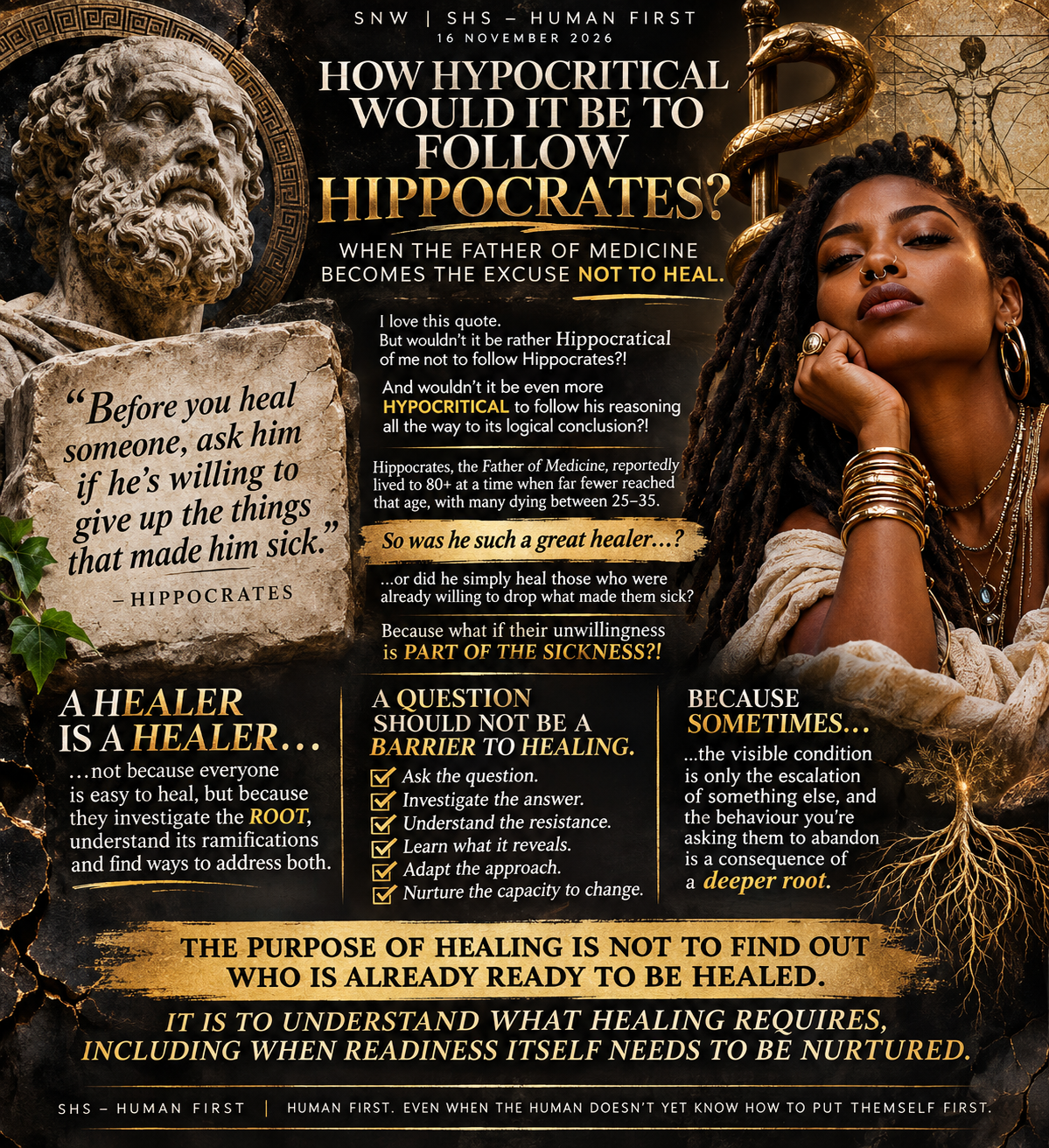
He lived long enough to know how to produce longevity, but how many would his question have disqualified from receiving the same treatment that aided him? I guess the name matches.
WHEN THE FATHER OF MEDICINE BECOMES THE EXCUSE NOT TO HEAL.
SNW | SHS – HUMAN FIRST
16 November 2026
Oh, Hippocrates. Darling. We need to have a little conversation. 🤭
There’s a rather famous quote attributed to you:
“Before you heal someone, ask him if he’s willing to give up the things that made him sick.”
And I absolutely LOVE this quote.
But wouldn’t it be rather Hippocratical of me not to follow Hippocrates?
And wouldn’t it be even more HYPOCRITICAL to follow his supposed reasoning all the way to its logical conclusion?!
Ahahahah. The irony practically writes itself.
Now, let’s investigate.
Hippocrates, widely regarded as the Father of Medicine, reportedly lived well into his eighties, possibly even his nineties, at a time when life expectancy at birth was somewhere around 25–35 years in many ancient populations.
An extraordinary lifespan for his time.
Mind you, that average was heavily influenced by infant and childhood mortality. It doesn’t mean everyone was dropping dead at thirty. And I haven’t established exactly how rare reaching eighty was.
But the contrast is interesting nonetheless.
A healer who apparently managed to sustain his own life considerably longer than many of his contemporaries.
So naturally, my curiosity raises a question.
Was Hippocrates such an extraordinary healer that he understood how to preserve his own vitality?
Or, if this quote actually represented his approach, did he simply reserve his healing for those already willing to abandon whatever made them sick?
Because those are two very different things.
And before anyone starts, no, we don’t have evidence that he refused patients on those grounds. We don’t even have a securely authenticated ancient source for this particular quote.
But the reasoning being celebrated today deserves an investigation of its own.
Because what exactly are we calling a healer?
Someone who helps those who already know how to help themselves?
Someone who offers a solution only when the patient has already overcome the very conditions that might be preventing them from accepting it?
Someone who decides that because another person isn’t prepared to abandon what makes them sick, they are therefore not prepared to be healed?
Well, darling, what if their unwillingness is PART OF THE SICKNESS?!
WHAT THEN?!
Are we going to abandon the patient because they’ve manifested another symptom?!
How sophisticated. How convenient. How wonderfully economical for the healer.
You don’t have to expand your understanding, investigate the resistance, develop another method or confront the limitations of your own practice.
You just ask a question.
And if the answer isn’t what you wanted, congratulations! You’ve found yourself the perfect justification for not succeeding.
How very Hippocratical.
But I have another question.
Isn’t it hypocritical to call yourself something and then renounce the very purpose of that identity because the person who needs you presents conditions you don’t know how to navigate?
A healer is a healer.
Not because everyone who comes before them is easy to heal.
Not because everyone cooperates.
Not because their patients are always reasonable, receptive, self-aware, disciplined or willing to acknowledge their circumstances.
But because they have devoted themselves to understanding sickness and finding ways to alleviate it.
And sometimes, the very resistance you encounter is the most important information the patient has given you.
You see, I would use Hippocrates’ question very differently.
I would absolutely ask someone whether they’re willing to give up the things that made them sick.
But the answer wouldn’t determine whether they deserved my help. It would determine what kind of help they needed.
If they say yes, wonderful. We have a starting point.
If they say no, EVEN BETTER.
Now I have something else to investigate.
Why not?
What does that thing provide that they’re afraid of losing?
What happens to their identity without it?
Is it comfort? Survival? Familiarity? Dependency? Fear? Attachment? An adaptation to an environment that never gave them anything healthier to depend on?
Have they even recognised the connection between their behaviour and their condition?
And if they have, what stops them from acting on it?
Because recognising the root of a problem and having the capacity to uproot it are NOT the same thing.
Someone might know perfectly well that something is destroying them, yet have no idea how to survive without it.
Someone might cling to a harmful condition because it was once the very thing that allowed them to survive another.
And someone might have developed an entire identity around circumstances they never consciously chose.
Are you telling me the sophistication of medicine ends where the patient’s willingness does?
What an extraordinarily limited imagination for an industry supposedly devoted to healing.
And let’s go further.
WHAT IF THE SICKNESS IS ONLY THE ESCALATION OF SOMETHING ELSE?
What if the visible condition is merely the latest ramification of a problem that has been developing for years?
What if the behaviour you’re demanding they abandon is itself a consequence of something deeper?
Then telling them to stop without investigating what sustains it might be no more sophisticated than cutting off a branch and celebrating while the root continues growing.
And this is where I distinguish the healer from someone who merely administers a remedy.
A true healer investigates the root, understands its ramifications and develops the means to address both.
They don’t necessarily remove every problem themselves. They don’t violate a patient’s consent or pretend that healing can be forced.
They understand that treatment sometimes begins with helping someone acquire the very capacity to participate in it.
They guide.
They observe.
They adapt.
They investigate what isn’t working.
They recognise when the first approach is insufficient and when another form of expertise is required.
And, most importantly, they don’t mistake the limitations of their method for the limitations of the person they’re trying to help.
That’s the part I find particularly relevant to our modern world.
We have become rather comfortable with constructing entire professions around helping people, only to develop criteria that determine how much difficulty we’re willing to encounter before declaring the person unhelpable.
Unmotivated.
Non-compliant.
Resistant.
Not ready.
And sometimes those descriptions identify genuine obstacles. But an obstacle should be information, not automatically a verdict.
What if the obstacle is precisely where your work begins?
Imagine if every profession operated like that.
A teacher refusing to teach because the student doesn’t yet understand the importance of learning.
A parent refusing to nurture because the child doesn’t yet understand what is good for them.
A therapist refusing to investigate resistance because the patient isn’t immediately prepared to confront what hurts.
A society refusing to address harmful conditions because the people suffering under them have adapted to living with them.
Wouldn’t that be convenient?!
We could all claim to be solving problems while making the existence of solutions conditional upon people having already solved the hardest parts themselves.
And then congratulate ourselves on our professionalism.
Ahahahah.
Now, I am not saying someone can be healed against their will, nor that every condition is curable, nor that a healer should be expected to accomplish the impossible.
I’m saying that unwillingness is something to understand before deciding what it means.
And where there is a possibility of helping someone develop that willingness, why wouldn’t we investigate it?
Isn’t that what expertise is for?
To go further than the person who doesn’t yet possess it?
To bring understanding where there isn’t any?
To devise ways of reaching someone through circumstances they cannot yet navigate alone?
Because otherwise, what exactly have you specialised in?
Helping people who already know how to help themselves?
Beautiful.
But I would rather develop the sophistication to help those who don’t.
And that brings us right back to the original quote.
“Before you heal someone, ask him if he’s willing to give up the things that made him sick.”
Absolutely.
ASK.
But don’t stop at the answer.
Investigate it.
Understand it.
Learn from it.
Let the answer tell you what you’re dealing with, rather than allowing it to excuse you from dealing with it.
Because the question may be excellent. The conclusion people draw from it may be extraordinarily poor.
And what better way to honour the Father of Medicine than to continue investigating medicine beyond whatever limits he may or may not have established?
After all, if he really was such a great healer, wouldn’t the greatest tribute be to become an even better one?
THE PURPOSE OF HEALING IS NOT TO FIND OUT WHO IS ALREADY READY TO BE HEALED.
IT IS TO UNDERSTAND WHAT HEALING REQUIRES, INCLUDING WHEN READINESS ITSELF NEEDS TO BE NURTURED.
And if your methods cannot reach the root, perhaps the next thing requiring development isn’t the patient.
Perhaps it’s your method.
Now THAT would be a little Hippocratical evolution.
With considerably less hypocrisy. 🤭
— SNW | SHS – HUMAN FIRST
Human First. Even when the human doesn’t yet know how to put themselves first.
….
Write a post on this. It’s perfect. Make a joke that it would be hypocratical to not follow hippocrates’ quote, yet it would be even more hyppocritacal to follow hippocrates ways. He was a healer that lived to 80+ at a time where less than the 2% reached it and majority died at 25-35. Was it that wasn’t as great of a healer or he followed this line down to the t and didn’t heal those who weren’t willing to drop what was making them sick?!
I’d go further as to ask, isn’t a hyprocrate thing to call yourself something you renegate based on what that which needs you rejects?! A helaer is a healer no matter what. He could have found a more sophisticated way to heal them beyond this question and use the question to gain data on who needed a more specialised plan. Instead it seems like he found the perfect excuse not to heal, when he had the chance to expand himself and heal differently by guiding them through the thing they might have not been willing to let go of.. that to me is a tru healer. One that hnderstand a sickness might only be the escalation of something else and that aids to the root making its ways to its ramifications.




Leave a Reply