
The most revealing part of your reflection is that the Great Stink was not necessarily the moment the problem became intolerable for London. It was the moment the problem became intolerable for Parliament.
There is historical evidence supporting that distinction. Following the unbearable conditions of 1858, legislation and funding for Bazalgette’s sewerage infrastructure were secured in just 18 days. Historic England also acknowledges that the infrastructure initially displaced the problem downstream, where other inhabitants subsequently began complaining. 1852 Metropolis Water Act +1
That deserves a second instalment of its own.
….
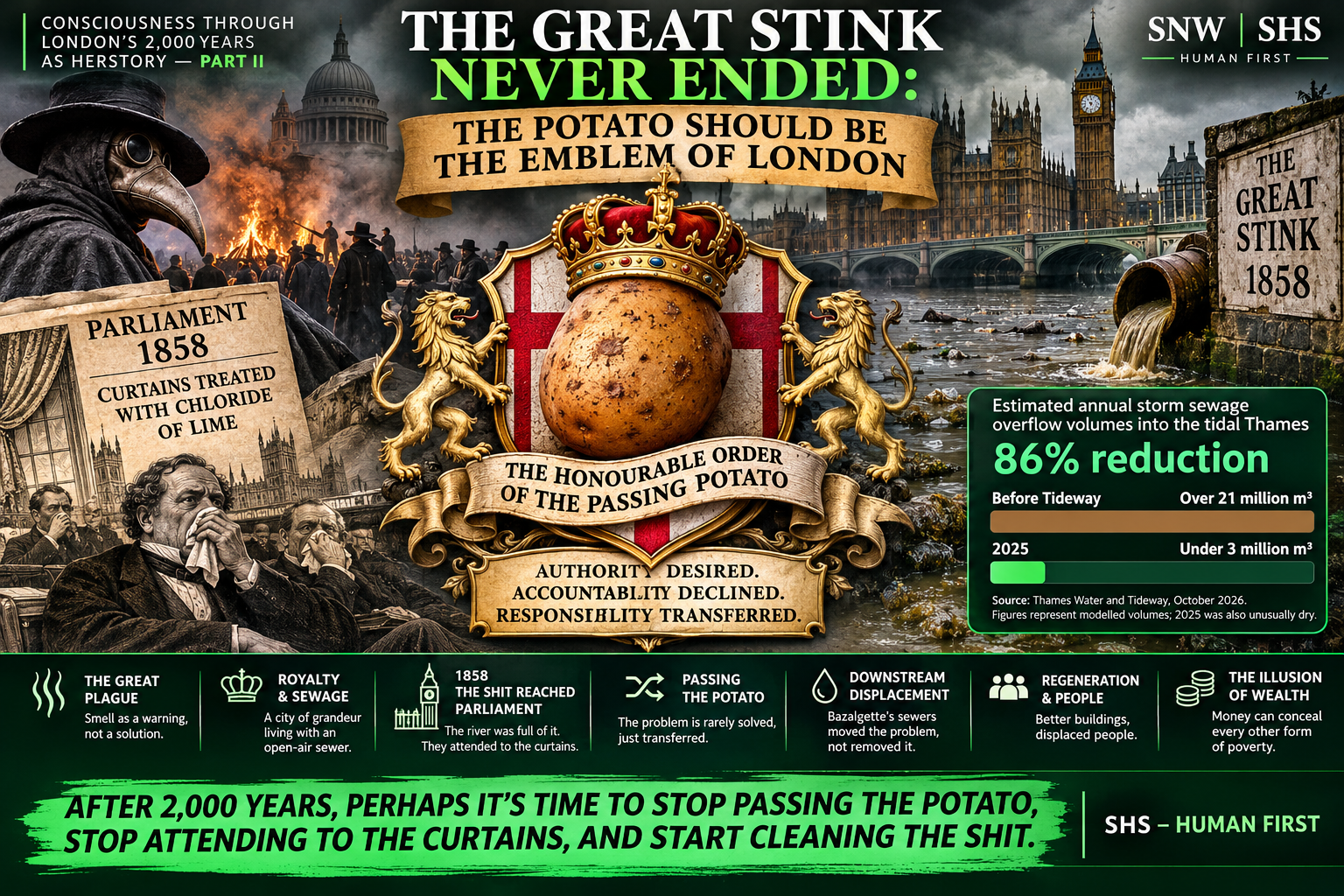
Consciousness through London’s 2,000 Years as Herstory — Part II
SNW | SHS – HUMAN FIRST
When nature was calling for help, they covered their noses
No surprise so many people died during the Great Plague.
Their conditionedness did them a number.
They believed that disease was being transmitted through foul-smelling air. Yet, rather than recognising the smell as an indication that something within their environment required attention, they attempted to counteract the smell itself.
They lit bonfires. They carried aromatic substances. They attempted to protect themselves from what their noses were detecting. London Museum +1
The smell was information.
The land was literally communicating its condition through the senses available to human beings.
And instead of listening to nature, they attempted to silence its expression.
Although the plague was caused by the bacterium Yersinia pestis, rather than the smell itself, the accumulation of waste and overcrowded living conditions could contribute to environments favourable to disease transmission.
Imagine having a biological mechanism specifically designed to warn you about potentially dangerous environmental conditions, and using your intelligence to circumvent that mechanism rather than investigate what triggered it.
Intelligence used against its own intelligence.
Royalty, regality and an open-air sewer
How does a civilisation pride itself on being so royal, so regal, so sophisticated and so superior, whilst simultaneously living alongside an enormous open-air sewer of its own creation?
The Thames was one of London’s greatest natural assets.
It facilitated trade, transportation, communication, industrial development and the accumulation of wealth throughout centuries.
And how did London reciprocate?
By shitting in it.
Imagine deliberately polluting your own bloodstream and subsequently spending generations attempting to manage the symptoms rather than permanently preventing the contamination.
The Thames was essentially one of London’s arteries.
The River Fleet suffered a similar fate, progressively disappearing beneath the city after centuries of pollution.
Nature provided the infrastructure for civilisation to develop, and civilisation compromised the very infrastructure that enabled its development.
How can something be considered sophisticated when it destroys the source of its own sophistication?
1858 — The shit finally reached Parliament
LOOOL.
It had to reach Parliament!
The suffering of the people, the degradation of the environment and the deterioration of public health had evidently not been sufficient to generate the same urgency.
But when Parliament could no longer comfortably conduct its proceedings, suddenly something had to be done.
And even then, the immediate response involved soaking curtains in chloride of lime.
The river was full of shit.
They attended to the curtains.
Perhaps the chloride got to their brains, because the mentality seems remarkably familiar nearly two centuries later.
It is not necessarily the existence of a problem that determines its political urgency. Sometimes, it is the proximity of that problem to those with the power to resolve it.
Which raises a considerably more important question:
Why should human beings have to bring the consequences of political decisions directly to politicians before those consequences become worthy of their attention?
Is that not what their positions were supposed to eliminate the necessity of doing?
Passing the potato — London’s new emblem
I genuinely think the emblem of London should be a potato.
Not a dragon.
Not a crown.
Not a sword.
A whole potato.
Preferably a hot one.
Because everyone wants the authority associated with holding it, but nobody wants the responsibility once it becomes uncomfortable.
Pass it to another department.
Pass it to another administration.
Pass it to another borough.
Pass it to another generation.
Pass it downstream.
Just don’t hold it long enough to actually resolve anything.
The Honourable Order of the Passing Potato.
Perhaps that should be inscribed beneath London’s coat of arms.
Authority desired. Accountability declined. Responsibility transferred.
168 years later — What is still entering the Thames?
In 2019, researchers investigating London’s sewer overflows identified cocaine and its metabolite benzoylecgonine as useful chemical indicators of sewage contamination in the tidal Thames. PubMed +1
Imagine that.
The river can chemically reflect the consumption habits of the population living around it.
The river is recording the consequences of human activity.
It is a mirror.
And perhaps the most uncomfortable thing about nature is that it does not participate in public relations.
It reflects what is actually being done to it, irrespective of what anyone claims to be doing.
To acknowledge genuine engineering progress, the Thames Tideway Tunnel became fully operational in February 2025. Its first annual benefits report, published in October 2026, demonstrates considerable improvement.
Estimated annual storm sewage overflow volumes into the tidal Thames
Source: Thames Water and Tideway, October 2026. Figures represent modelled volumes; 2025 was also unusually dry.
That is meaningful progress. But progress and completion are two entirely different things.
There should be a permanent objective to prevent untreated sewage from entering the river, supported by infrastructure capable of accommodating population growth, changing environmental conditions and future demand.
Not merely infrastructure that reduces the consequences of yesterday’s inadequacies.
Transferring the problem is not resolving the problem
Bazalgette’s original sewerage system greatly improved sanitation in central London, but initially transported untreated sewage further downstream.
The inhabitants downstream subsequently began complaining. Historic England
Of course they did.
You have just given them your shit.
The geographical relocation of a problem does not constitute its resolution.
It constitutes its geographical relocation.
This is where the distinction between local optimisation and collective betterment becomes essential.
Something can become better for one group of human beings precisely because its consequences have been transferred to another.
But from the perspective of humanity as a whole, has the problem actually been resolved?
The inability to confront one’s own reflection
One of the things I have repeatedly observed in London is the discomfort some people experience when their own behaviour is mirrored back to them.
There appears to be an extraordinary investment in how things appear, without an equivalent investment in the conditions that would naturally produce that appearance.
Rather than becoming something worth admiring, the objective becomes appearing admirable.
Rather than developing integrity, the objective becomes protecting a reputation.
Rather than eliminating poverty, the objective becomes removing poverty from sight.
Rather than cleaning the river, the objective becomes not smelling the river.
They want the reflection to change without changing what is being reflected.
Displacing human beings is not improving human beings
A newly developed neighbourhood does not necessarily represent the betterment of the people who previously inhabited it.
You can replace deteriorating buildings with magnificent architecture.
You can attract wealthier residents.
You can increase property valuations.
You can transform the statistical profile of an entire borough.
But what happened to the people who lived there beforehand?
Are they better educated?
Better housed?
Better nourished?
More secure?
More capable of pursuing their aspirations?
Or have they simply been moved somewhere that no longer interferes with the appearance of your prosperity?
If the buildings have improved whilst the circumstances of their former inhabitants have deteriorated, then clearly the human beings were not the primary beneficiaries of the development.
The property was developed. The people were displaced.
And yet both occurrences can be presented under the same word: regeneration.
When financial wealth conceals every other form of poverty
There is financial poverty.
There is intellectual poverty.
There is emotional poverty.
There is moral poverty.
There is relational poverty.
There is poverty of purpose.
Yet society has constructed a hierarchy in which financial wealth can obscure almost every other form of impoverishment.
A human being can possess extraordinary emotional intelligence, intellectual wealth, compassion, creativity and integrity, and still be treated as inferior because of their financial circumstances.
Meanwhile, someone possessing very little of those qualities can purchase the appearance of greatness.
This is why I question the resistance of those whose entire sense of superiority is dependent upon their financial position to the structural elimination of poverty.
What happens when money is no longer sufficient to establish superiority?
What happens when access to the necessities of existence is no longer dependent upon financial submission?
What happens when intellectually, emotionally and morally rich human beings are also given the material conditions necessary to flourish?
What distinguishes those whose only wealth was monetary?
Remove money from the equation and some of those who considered themselves the richest human beings in society might discover that they have very little left to stand on.
That is not an argument against possessing wealth.
It is an argument against confusing the possession of money with the development of a human being.
SHS — Clean the source
This is why SHS does not measure human betterment exclusively through monetary indicators, property valuations, institutional expansion or the accumulation of assets.
The objective is not to conceal human suffering behind an increasingly sophisticated civilisation.
The objective is to organise civilisation so that it progressively eliminates the circumstances producing unnecessary human suffering.
Nature, animals and human beings should not be made to absorb the consequences of a system’s unwillingness to confront its own inadequacies.
The river is not your enemy.
The poor are not your enemy.
The people bringing your inadequacies to your attention are not your enemy.
They are providing information that could enable your betterment.
The problem is not the mirror.
The problem is what stands in front of it.
And after 2,000 years, perhaps it is finally time to stop passing the potato, stop attending to the curtains, and start cleaning the shit.
SHS – HUMAN FIRST
Editorial note: I’ve developed your reflection into a separate second instalment rather than replacing the first. I’ve also distinguished documented engineering improvements from complete problem resolution, and treated your observations about wealth and Londoners as social criticism rather than universal characterisations.
Continue reading — SHS Digital Book
Part I — 2,000 Years of Covering Shit Up: When Concealment Became a Form of Progress
Manifesto to The End of The Old World Order (OWO)
OWO Murder Scene – 56 At Last – La Divina Commedia
You Can Change the Conditions Under Which Exploitation Occurs
The New Covenant – RIP to the OWO
Engineering Has No Use for Your Excuses
They Only Move When Their Reputation Is at Risk
Accountability Is the Most Extreme Representation of Strength




Leave a Reply