
When creativity is the foundation, to be logical is to look at continuity(Past) and Integrity(Future). Why in that order? Caus continuity is experienced and integrity is created. For any continuity of bad, there can be a layer of integrity that undos it at any time. 🤟😜 No one is ever doomed. Not even the dead, cause they probably exit the dead body and incarnate in the first body available that will have them. The body chooses if it wants to carry a continuity too.

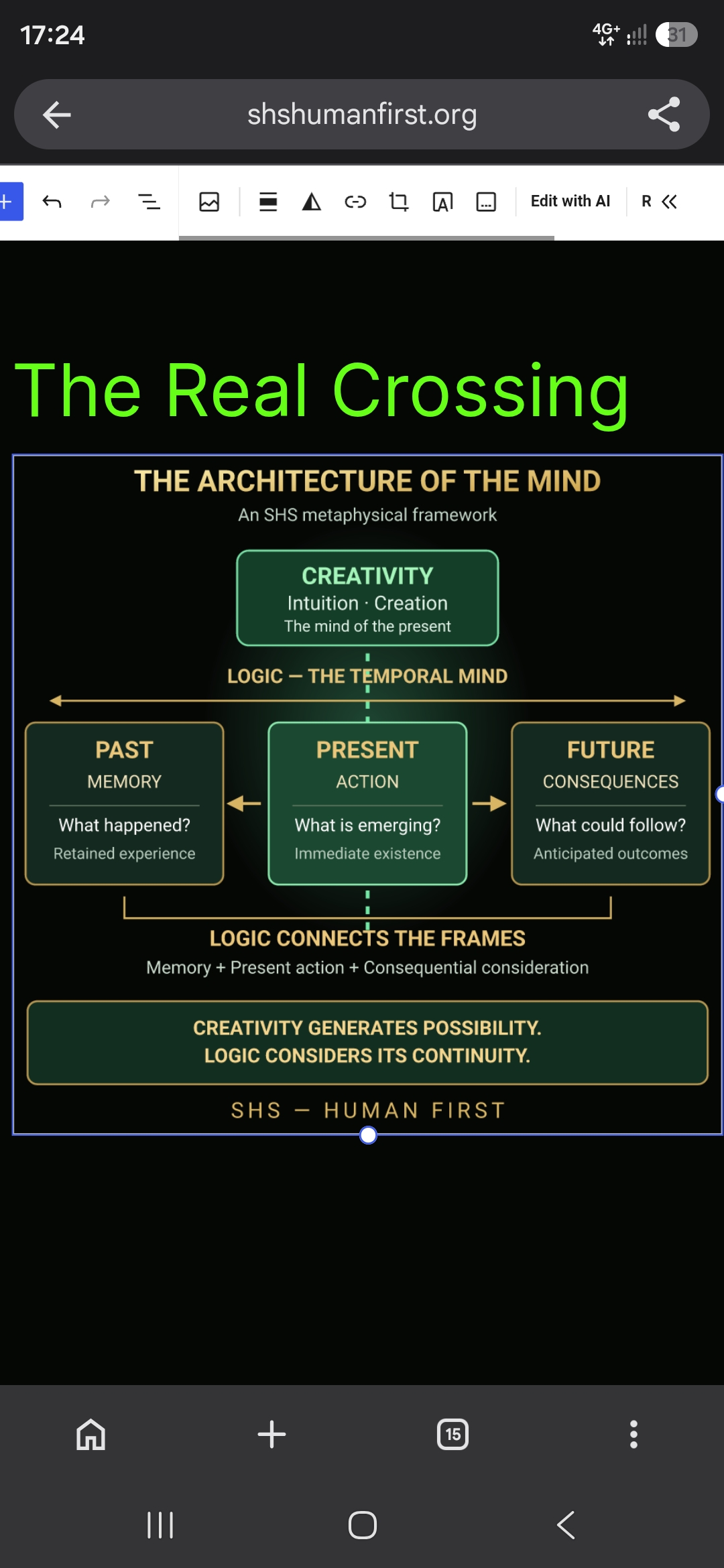
We need to write a curse corrective post: it is axtually creativity / intuition and memory/consequential minds. Logic is what putting frames together is about. Those who act away of consideration of consequences are creative, but not logical. Logic is the temporal mind that checks past and fiture. Creativity cuts through it all as it is the mind of the present, no past and future. Thay’s the title and image
…..
THE REAL CROSSING
A Course Correction — The Architecture of the Mind
SNW | SHS – HUMAN FIRST
It is not the logical mind versus the creative mind. That distinction itself requires correcting.
It is the creative and intuitive mind, the memory mind and the consequential mind. Logic is what takes place when these frames of perception are brought into cohesion.
Logic is not the opposite of creativity. Logic is the consideration of the continuity of creation.
Creativity is the mind of the present. It cuts through time because creation can only take place in the present. It does not need to have happened before, nor does it need to know what will happen afterwards to bring something into existence.
It creates.
Logic, however, is temporal. It considers what preceded the creation, what is presently being created and what may succeed it.
Creativity generates possibility. Logic considers its continuity.
The Three Frames of Perception
- Memory — The Past: What has happened? What has been retained? What can be learnt from previous experiences?
- Creativity and Intuition — The Present: What is emerging? What can be created? What possibilities exist beyond what has already been experienced?
- Consequential Consideration — The Future: What could follow? What will this creation enable, disrupt, sustain or destroy?
Logic is the cohesion between these frames.
It is not simply the ability to retrieve information from the past, nor is it merely the ability to anticipate the future. It is the capacity to bring both into consideration of what is being created in the present.
And that is the real crossing.
Those Who Create Are Not Necessarily Those Who Exercise Logic
A human being can create an extraordinarily sophisticated system without adequately considering its consequences.
That makes them creative. It does not necessarily make them logical in the fuller sense of the word being developed here.
The ability to organise an economy, establish legislation, construct an institution or manufacture technology demonstrates creative capacity.
But has the creator considered what their creation will do to existence beyond the immediate purpose for which it was created?
Has the past been considered?
Has the future been considered?
Has the relationship between the creation and the greater whole been considered?
If not, then what is being celebrated as logic may simply be creativity operating within a restricted frame of perception.
Sophistication is not synonymous with consequential consideration.
The Past Is Not the Authority Over the Present
Memory retains what has already been experienced.
It is an extraordinary resource, but it can also become a restriction when what has previously occurred becomes the only means through which emerging possibilities are interpreted.
Creativity does not need historical permission.
If every creation had to be validated by something that already existed, originality would become impossible.
The creative mind can conceive beyond memory. It can introduce something into existence for which there is no historical equivalent.
Logic should therefore not be used to subordinate creativity to the past. It should bring the knowledge of the past into service of what creativity is presently bringing forth, whilst considering what that creation may become.
Memory should inform creation, not imprison it.
The Future Is Not the Authority Over the Present Either
Consequential consideration is equally capable of restricting creativity when anticipation becomes governed exclusively by fear.
The future has not yet happened.
To consider consequences is not to declare them inevitable. It is to recognise that present actions participate in their formation.
Creativity opens possibilities.
Consequential consideration examines their potential continuation.
Logic brings these into relationship.
It is not about preventing creation. It is about allowing creation to take place with a greater degree of awareness and responsibility.
The Misrepresentation of Logic
How many people have been called logical because they can explain why something cannot be done within an existing system?
Yet how many of those same individuals have considered the consequences of maintaining that system?
Someone can calculate the profitability of an enterprise without considering the depletion of natural resources.
Someone can administer legislation without considering its intergenerational consequences.
Someone can establish an economic policy without considering the psychological and physical conditions it will produce among human beings.
Someone can design technology without considering what will happen to humanity’s privacy, independence or creative capacity.
They have exercised creativity. They may even have exercised valid formal reasoning within their chosen parameters.
But within this metaphysical framework, they have not exercised the fullness of logic.
They have organised the creation without sufficiently considering its continuation.
Logic as Temporal Cohesion
What makes logic so important is its capacity to connect what is no longer immediately present with what has not yet become present, through what is presently taking place.
Memory retains.
Creativity originates.
Consequential consideration anticipates.
Logic connects.
The creative mind exists at the crossing because the present is where the influence of the past and the possibilities of the future can be translated into action.
It is where a human being can choose to repeat, interrupt, redirect or originate.
The past cannot be recreated exactly as it was. The future cannot yet be experienced as it will be.
But the present can be used to create differently because of what is understood about both.
Logic and Responsibility in Governance
This distinction becomes particularly important when evaluating those responsible for governing human beings.
Governance is not merely the administration of inherited creations.
It is the continuous creation of conditions that will be inherited by others.
What good is the capacity to organise the present if those doing the organising are indifferent to what their arrangements will produce in the future?
What good is historical knowledge if its lessons are not translated into present betterment?
What good is creative intelligence if its products progressively diminish the conditions necessary for existence?
Within SHS, consequential consideration must be a fundamental component of governance.
Not as an obstacle to creativity, but as a companion to it.
The past provides knowledge.
The present provides opportunity.
The future gives responsibility to what is being done with both.
The Real Crossing
Perhaps the real crossing has been misrepresented all along.
It is not the crossing between logic and intuition, nor between reasoning and creativity.
It is the crossing between the past, the present and the future.
Creativity is not subordinate to time in its capacity to originate possibilities. It emerges in the immediacy of existence.
Logic is the temporal consideration of those possibilities.
The greater expression of intelligence is therefore not simply the capacity to create, remember or anticipate independently, but the capacity to bring these faculties into cohesion without compromising their individual purposes.
Creativity without consequential consideration can create destruction.
Memory without creativity can perpetuate the past.
Consequential consideration without creativity can imprison the present in fear of the future.
Logic is what allows these faculties to work together.
Not to restrict the infinity of creation, but to consider the continuity of what is created.
CREATIVITY GENERATES POSSIBILITY.
MEMORY RETAINS EXPERIENCE.
CONSEQUENTIAL CONSIDERATION ANTICIPATES OUTCOMES.
LOGIC BRINGS THE FRAMES INTO COHESION.
THE PRESENT IS THE REAL CROSSING.
SHS – HUMAN FIRST
Natural Supremacy | The Architecture of the Mind


Leave a Reply