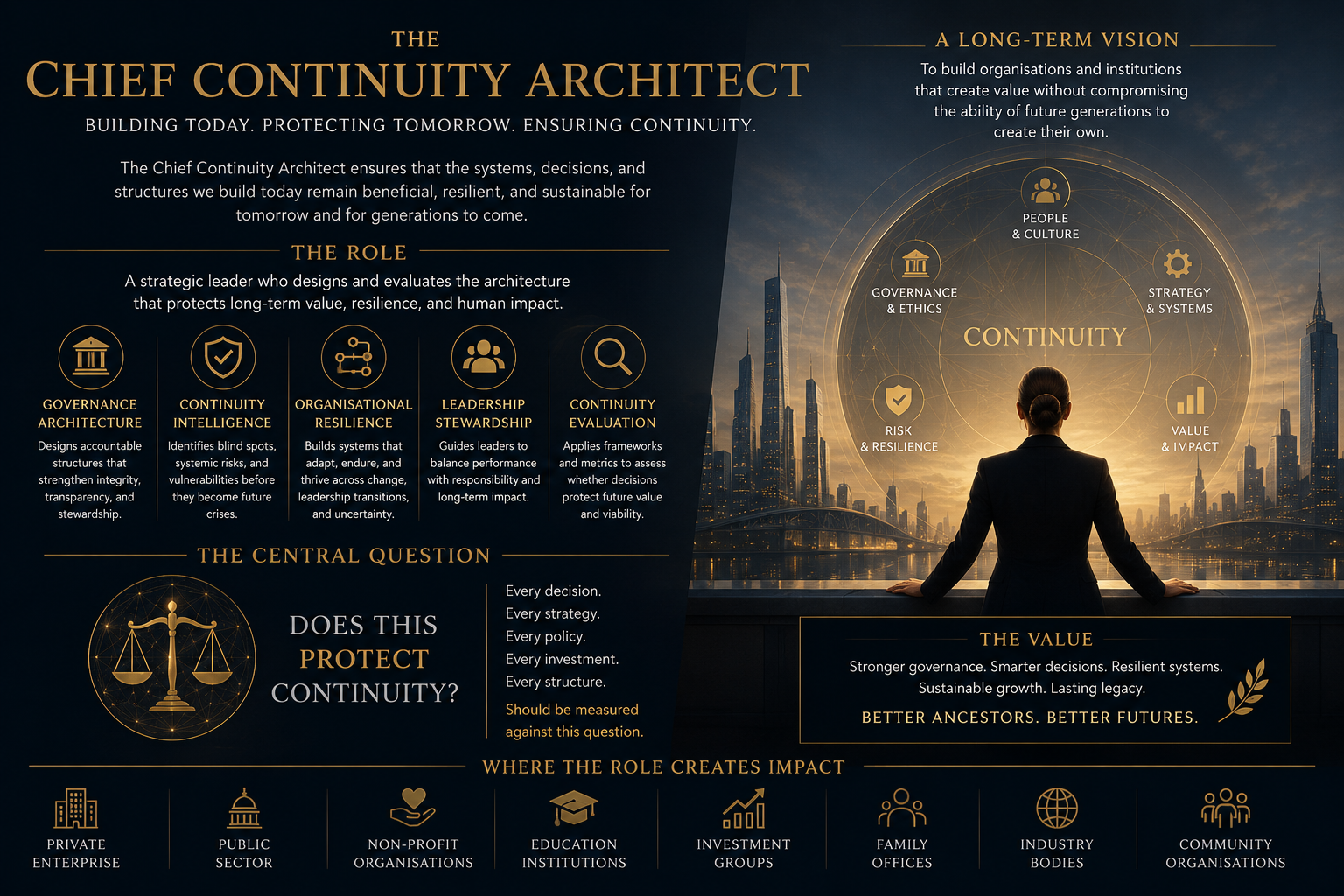
A Role for the Questions That Fall Between Departments
Modern organisations have become increasingly specialised.
Finance manages financial performance.
Operations manage operational performance.
Technology manages technological performance.
Human Resources manages people.
Legal manages compliance.
Strategy manages direction.
Risk manages exposure.
Each function plays a critical role.
Yet a challenge remains.
Many of the greatest organisational failures do not begin inside a single department.
They emerge between departments.
They emerge from misaligned incentives.
From governance blind spots.
From accumulated assumptions.
From short-term optimisation.
From knowledge loss.
From cultural drift.
From leadership dependency.
From decisions that appear successful today while quietly creating vulnerabilities tomorrow.
These issues often have no natural owner.
The Chief Continuity Architect exists to address that gap.
What Is a Chief Continuity Architect?
A Chief Continuity Architect is responsible for evaluating whether systems, structures, decisions, and behaviours strengthen or weaken long-term continuity.
The role examines the architecture beneath performance.
Not simply whether something works.
But whether it can continue working.
Not simply whether a system succeeds.
But whether it remains beneficial.
Not simply whether value is created.
But whether the conditions required to create future value are being preserved.
The role combines governance, systems thinking, strategic foresight, organisational design, accountability, stewardship, and long-term planning into a single continuity-focused discipline.
Core Purpose
The purpose of the Chief Continuity Architect is to help organisations become better ancestors to their own future.
This means examining questions such as:
• Are current incentives creating future liabilities?
• Is institutional knowledge being retained or lost?
• Are governance structures supporting accountability?
• Is leadership transferable or dependent upon individuals?
• Are stated values reflected operationally?
• Are short-term gains undermining long-term resilience?
• Are decisions strengthening or weakening continuity?
These questions often sit outside traditional executive functions while affecting every executive function simultaneously.
Areas of Responsibility
A Chief Continuity Architect may be responsible for:
Governance Architecture
Evaluating decision-making structures, accountability systems, stewardship mechanisms, authority distribution, oversight processes, and organisational coherence.
Continuity Intelligence
Identifying hidden vulnerabilities, continuity gaps, systemic dependencies, emerging risks, and long-term consequences before they become visible crises.
Organisational Resilience
Supporting structures that improve adaptability, sustainability, succession planning, institutional memory, and future readiness.
Leadership Stewardship
Helping leadership teams balance performance objectives with long-term responsibility and continuity outcomes.
Systems Integration
Examining how departments, incentives, strategies, cultures, and operational systems interact as a whole rather than as isolated functions.
Continuity Evaluation
Developing and applying frameworks that assess whether systems strengthen or undermine future viability.
Why the Role Matters
Many organisations measure success.
Few measure continuity.
Many evaluate outputs.
Few evaluate long-term consequences.
Many reward performance.
Few reward stewardship.
Yet history repeatedly demonstrates that organisations rarely fail because they lacked activity.
They fail because the architecture beneath the activity was not examined early enough.
The Chief Continuity Architect provides a dedicated perspective focused on protecting the conditions that allow success to continue.
The Future of the Role
As organisations become more complex, interconnected, and exposed to rapid technological, cultural, economic, environmental, and political change, continuity becomes increasingly important.
The role is designed to operate across sectors.
Private enterprise.
Public institutions.
Governments.
Non-profits.
Family offices.
Investment groups.
Educational institutions.
Industry bodies.
Community organisations.
Anywhere decisions today shape consequences tomorrow.
The Central Question
Every organisation eventually faces the same question.
Every board.
Every institution.
Every leadership team.
Every system.
Not simply whether it performed.
Not simply whether it grew.
Not simply whether it succeeded.
But whether it preserved the conditions required for future success.
The Chief Continuity Architect exists to ensure that question is asked before circumstances ask it on behalf of the organisation.






Leave a Reply