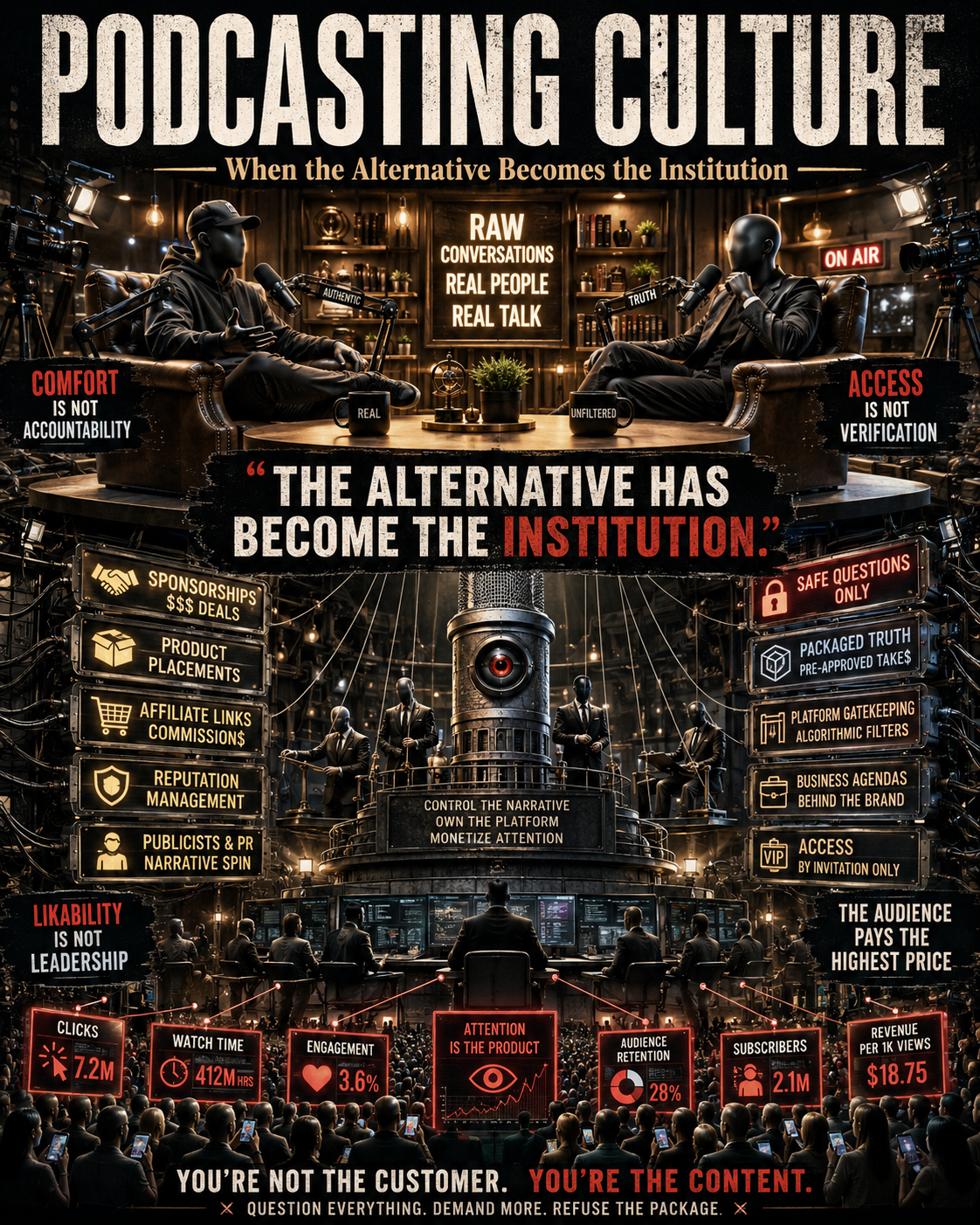
Podcasting was supposed to be the room where the script could no longer survive. It emerged as an alternative to legacy media because audiences had grown tired of polished interviews, institutional gatekeeping, rehearsed answers, controlled narratives and questions that always seemed to stop just before they reached the point that mattered. The promise of podcasting was not merely that conversations would be longer. It was that they would be freer. More human. Less filtered. Less obedient to the formal rules of television, radio, newspapers and political communication. People were supposed to reveal themselves beyond the limitations imposed by conventional media.
Yet podcasting is now becoming the very thing it was created to replace.
The interviews are polished. The sets are engineered. The guests are selected through reputation, reach and commercial value. The questions are often safe enough to preserve access. The answers are frequently rehearsed because the guest has already told the same story on several other platforms. The host may ask a slightly different version of a familiar question, but the guest has practised the answer enough times that what appears spontaneous is often simply well-performed repetition.
Podcasting is now the new media.
And, like the media it once positioned itself against, it has developed its own gatekeepers, permissions, incentives and restrictions.
Some of that gatekeeping comes from the hosts and production companies. Some comes from sponsors, publicists, investors and the type of guests needed to maintain relevance. Some comes from the platforms upon which podcasts depend. A show distributed through YouTube, for example, may appear independent while still operating inside a system of monetisation rules, algorithmic incentives, content limitations and visibility penalties. Hosts learn which words reduce reach, which topics create demonetisation risks, which forms of disagreement discourage guests and which styles of packaging produce the highest retention.
They may not always experience this as censorship because it has become habitual.
The limit becomes internal.
People begin editing themselves before an institution needs to edit them.
Guests know which parts of themselves are safe to reveal. Hosts know which questions can be asked without threatening the relationship. Producers know which claims create engagement and which forms of scrutiny create commercial difficulty. What was supposed to be an open conversation gradually becomes another constructed media environment.
The construction can be sophisticated enough that the audience mistakes it for naturalness.
Hidden cameras may reduce the guest’s self-consciousness. Shoes may come off. The lighting may be warm. The conversation may begin with childhood music. The air quality, temperature, furniture and pacing may all be deliberately managed. The guest feels safe. Their body relaxes. Their story becomes more intimate. The audience experiences the room as honest because it feels informal.
But informality is not freedom.
Comfort is not accountability.
Access is not verification.
A room can be psychologically disarming while remaining intellectually protective.
That distinction matters because podcasting was supposed to help people reveal themselves beyond ordinary limits. Yet when revealing too much creates the possibility of cancellation, reputational collapse, platform restriction or commercial loss, the apparent freedom becomes selective. Most people will not risk exposing the parts of themselves that could dismantle the identity through which they make money.
The censorship no longer needs to be announced.
It is absorbed into professional instinct.
The guest knows what not to say. The host knows when not to continue. The audience sees openness, but what it is often seeing is the widest version of the person that remains commercially survivable.
Podcasting has also become a place where agendas are shared, businesses are built, books are promoted, products are endorsed, investments are protected, reputations are managed and relationships are formed. References to other people’s work can become strategic endorsements. Invitations become social currency. Guest appearances become forms of marketing. Sponsorships sit inside conversations. Affiliate links follow claims. Business is conducted through the atmosphere of intellectual exchange.
There is nothing inherently wrong with business.
There is something wrong with disguising business as pure conversation.
People are trying to make a living through podcasting, and they are entitled to do so. But once the form becomes a business, it should no longer be protected by the innocence of “we are just having conversations.” It should be examined and regulated according to the different functions it performs.
A health podcast is not merely entertainment if viewers make medical decisions because of it.
A political podcast is not merely conversation if it shapes voting behaviour.
A financial podcast is not merely opinion if it directs people toward investments.
A scientific podcast is not merely curiosity if credentials are used to make unsupported claims appear established.
A business interview is not merely inspirational if the guest is selling a product, attracting investors or softening public resistance toward decisions that will affect millions of people.
The standards should correspond to the consequences.
Podcasting did not stop being free because people began earning money from it. It stopped being free when the commercial architecture began deciding which truths could survive inside the room.
A major part of that architecture is likability.
Many hosts avoid disagreement because they want guests to feel comfortable, audiences to remain warm toward them and future high-profile people to accept invitations. But likability is not leadership.
Likability can become indirect manipulation.
The host presents themselves as agreeable, open and kind because that identity creates access, trust and commercial opportunity. They may want the guest to approve of them. They may want the audience to see them as safe. They may want to protect their reputation as someone who allows people to speak.
But the way a person moves through a difficult conversation is more revealing than the identity they claim.
A host does not become responsible merely because they are calm.
A host does not become fair merely because they do not interrupt.
A host does not become open-minded merely because every guest leaves feeling validated.
The absence of disagreement can itself become misleading because audiences often interpret silence as agreement. When the host allows a questionable claim to pass without distinction, the audience may assume that the host accepts it. If the audience has watched that host frequently, trust has accumulated through repetition. The guest therefore borrows the credibility of the host, and the host borrows the prestige of the guest.
Neither may directly say, “Everything spoken here is endorsed.”
The room communicates it anyway.
Responsible hosting should therefore include direction.
A host should make clear that the presence of a guest does not mean every claim is supported, that viewers should maintain discernment, that some parts of the conversation represent experience while others require evidence, and that the purpose of the exchange is not to provide a finished worldview for the audience to absorb without examination.
At present, many podcasts leave all responsibility with the listener.
The guest speaks.
The host packages.
The platform distributes.
The audience is expected to sort through the consequences alone.
That becomes particularly troubling when multiple guests are invited to discuss the same frightening subject without offering any meaningful path forward. Seven experts can appear to discuss artificial intelligence, job displacement, social collapse or political instability. Their forecasts may differ in language but produce the same emotional outcome: uncertainty, helplessness and fear.
Information without navigation can become psychological dumping.
If hosts genuinely know their audiences, they should understand what those audiences need after consuming the material. If viewers repeatedly express concern about artificial intelligence replacing their work, bringing more people to describe that replacement without offering transition planning, retraining pathways, political solutions or practical education may only deepen hopelessness.
The audience is repeatedly told what is coming.
It is rarely shown how to prepare.
This is not leadership.
Leadership is not merely identifying danger before others. Leadership is helping people move through it.
That means the host should think ahead of the audience, not because the audience is incapable, but because the host has chosen to occupy a position of influence. Influence creates responsibility. The more reach a platform accumulates, the less credible it becomes to claim that it merely places information in front of people without owing them any structure through which to understand it.
The problem becomes clearer when a host openly values packaging more than substance.
Packaging matters. Framing affects comprehension. A valuable idea badly expressed may never reach the people who need it.
But packaging cannot become more important than value.
If the principal question is how to make something attractive rather than whether it is true, useful, responsible or life-supporting, then the audience becomes a target rather than a community.
A person who thinks primarily about how information will perform may become excellent at selling meaning without producing it.
That is poor leadership because it centres the creator’s reach rather than the audience’s development.
There is also a difference between wanting to help people and finding a way to make money without becoming disliked.
Someone may openly set out to become wealthy, achieve that goal and build platforms around further commercial expansion. There is nothing automatically wrong with that.
But they should not confuse a financial objective with a humanitarian purpose.
A person whose primary goal was to become rich may have discovered that helping, motivating or appearing useful was a profitable route toward that goal. That is different from someone whose purpose was to serve people and whose work happened to generate money because the service became valuable.
The outcome may look similar.
The intention, sequencing and responsibility are not.
If money came first, say so.
If service came first, demonstrate it through the work.
Do not retrofit purpose onto success simply because purpose is more respectable than ambition.
The audience deserves honesty about what is being built and why.
This becomes especially important because hosts often know their audiences primarily as metrics.
Views.
Subscriptions.
Watch time.
Retention.
Click-through rates.
Purchases.
Donations.
Affiliate conversions.
The audience is spoken to warmly, but structurally treated as customers.
The host may say, “I noticed many of you have not subscribed,” or “Most viewers watch without following,” or “Help us reach this milestone.” This language has become so normal that creators repeat it across the industry. Even people criticising the commercialisation of media often reproduce the same subscription appeals because the pattern has become embedded in content culture.
Everyone begins copying everyone else.
The industry develops a common voice.
What once felt personal becomes procedural.
The creator tells the audience that subscribing is the one favour they will ever ask, while the entire business model is built upon continuously converting attention into value.
The viewer gives time.
The host receives metrics.
The guest receives exposure.
The advertiser receives access.
The platform receives data and engagement.
The audience may receive insight, but that is the only part of the transaction that is not guaranteed.
The audience pays the highest cost because its time cannot be returned.
The host can monetise the hour.
The guest can convert the hour into reputation, customers or political support.
The platform can monetise the hour through advertising and behavioural data.
The listener simply gives the hour and hopes the material becomes useful.
If the content has little substance, if the claims are inaccurate, if the advice leads nowhere or if the only value is the guest’s reputation, the audience has absorbed the cost while everyone else received something measurable.
Reputation is not value.
A recognised person may still be wrong.
An impressive title may still conceal shallow thinking.
History is full of people once considered trustworthy because of their position who later demonstrated that the position had been mistaken for integrity.
The podcast audience should not be expected to accept the reputation of the guest as the evidentiary foundation of the episode.
The host should perform some of that scrutiny.
This is why disagreement matters.
The claim that disagreement disrupts conversational flow is false.
Interruption may disrupt flow.
Hostility may disrupt flow.
Performative combat may disrupt flow.
But disagreement, when properly articulated, can deepen a conversation.
A host can say:
“I understand the logic behind your position, but there is another consequence I do not think we have accounted for.”
“I can see why you place that event second, but the commonly recognised order is different, so let us explain both frameworks for the audience.”
“I understand what you believe, but I need to distinguish your interpretation from what is presently established.”
That is not aggression.
That is relational intelligence.
The host validates the person’s capacity to reason without pretending their conclusion is beyond examination.
An exchange should involve two minds.
I learn from you.
You learn from me.
We examine what neither of us could fully see alone.
The conversation should expand both participants and provide the audience with a clearer map of the disagreement.
Instead, many modern interviews function as presentation spaces. The guest arrives to deliver a worldview. The host facilitates the delivery. The audience receives the package.
That is not an exchange of minds.
It is assisted distribution.
Consider the example of a chief executive discussing the possibility that artificial intelligence could displace millions of drivers. The host asks what those people will do. The executive says, “I do not know.” The conversation moves on.
That is not a minor omission.
It is the central human question.
The executive is not merely observing a natural event. The company is participating in the transition being described. If millions of workers could lose income because of a plan the company is actively developing, “I do not know” should begin the questioning, not end it.
Has the company created a transition plan?
Will workers receive advance notice?
Is retraining available?
Can they move into other roles?
Will some of the wealth created through automation fund the people being displaced?
Are governments involved?
Have unions, cities or labour organisations been consulted?
How many workers even know that this is being considered?
Will they learn about the transformation from their employer, or wake up one day to an automated notice informing them that the work has disappeared?
What happens when every comparable company adopts the same system and the displaced person cannot simply move to another driving platform?
What does desperation produce when millions lose income at once?
Debt?
Eviction?
Crime?
Illness?
Family breakdown?
Political instability?
The consequence does not stop at the job.
A responsible host should carry the conversation into the human architecture beneath the business prediction.
Otherwise, the executive is allowed to announce a future without accepting stewardship over the people being moved out of it.
People repeatedly choose liability over accountability.
Liability asks, “What can legally be attached to me?”
Accountability asks, “What did my decision create, and what must I now do about it?”
Podcasting often rewards the first while performing the second.
A guest confesses that a major disruption is coming. The confession feels honest. The host praises the transparency. The audience feels it has witnessed accountability.
But speaking publicly creates accountability only if the statement is followed into consequence.
Once the person has said it, the record exists. The host now has the opportunity to educate the guest in what their own answer has failed to consider.
That is the value of the meeting place.
A podcast should not merely be where a powerful person tells the world what they think.
It should be where their thought meets another mind capable of identifying what it leaves behind.
This is not about humiliating guests. It is about preventing authority from passing through the room untouched.
The same applies to how people disclose benefit.
Most podcast participants do not clearly explain what they receive from the exchange.
The guest gains access to the audience.
The host gains access to the guest.
Both gain content, legitimacy and possible future partnerships.
Products, books, companies and political positions gain visibility.
The audience gains knowledge only if the knowledge has been properly examined.
Authenticity would require people to say more plainly:
“This is how I benefit from having you here.”
“This is how you may benefit from appearing.”
“This is my commercial connection to the subject.”
“This is what I stand to gain if the audience believes this.”
“This is where the audience may benefit, and where it should remain cautious.”
That openness allows recalibration.
One participant may discover a benefit they had not considered. Another may identify a conflict that needs disclosure. The audience is no longer forced to reverse-engineer the transaction.
Without that clarity, the small screen reproduces the same manipulation previously associated with the big screen.
The technology changes.
The incentives remain.
The obsession with reputation also remains.
Modern public figures often manage their reputation more carefully than they manage their character.
They ask how an action will look rather than what the action will do.
They protect the image of responsibility rather than accepting its burden.
But reputation is unstable.
One interview can raise it.
One scandal can collapse it.
One allegation can redefine years of work.
Why build identity around something so dependent upon other people’s perception?
The more meaningful question is: who would you be proud to be even if the audience misunderstood you?
Podcasting rarely leads people there because the industry itself depends upon perception management.
The guest wants to appear honest.
The host wants to appear open-minded.
The platform wants to appear independent.
The sponsor wants to appear aligned with insight.
Everyone is protecting a role.
Conversation without consequence becomes reputation management.
Yet the thirsty audience remains vulnerable because much of the surrounding information environment does not nourish it.
A person who has crossed a desert will be grateful for a glass of water.
That does not mean the water is clean.
People are thirsty for meaning, direction, coherence, hope and understanding because much of what surrounds them does not satisfy those needs. A podcast can therefore become powerful simply by offering the appearance of depth. The audience may drink whatever is provided because the alternative feels like dehydration.
But sewage water does not become nourishing because the thirsty person appreciates it.
The desperation of the audience increases the duty of care of the person serving the water.
That duty is intensified when the platform mixes authority, intimacy and sales.
A host recommends a book.
A guest promotes a supplement.
A doctor recommends an expensive scan.
A founder discusses a company.
An investor praises a product.
The audience may be struggling to pay rent while the people encouraging these purchases own multiple businesses, investments, cars and homes. The product endorsement creates value for the host, the guest and the company.
The audience is the one expected to pay.
How is that level?
How is it responsible?
How is it respectable if the financial relationships are hidden, minimised or treated as irrelevant?
The issue is not that wealthy people cannot recommend products.
The issue is whether they understand the economic distance between themselves and the people whose trust they are converting into sales.
A person recommending a costly service may barely notice the expense.
For the listener, it may represent a week’s food, a bill or part of the rent.
Responsibility requires remembering that the audience is not an abstract market.
It is made of people with different levels of vulnerability, income, education and discernment.
Yet because the audience is numerically large, it becomes emotionally distant.
The host sees millions and begins thinking in metrics.
Real leadership resists that abstraction.
A leader thinks about people they cannot personally benefit from.
They do not serve the audience only because the audience gives them views, subscriptions, sponsorship value or status. They take responsibility for what their influence creates even when the corrective action will not increase engagement.
That may involve refusing a profitable guest.
Correcting an episode publicly.
Challenging a sponsor.
Disclosing an investment.
Slowing down a sensational claim.
Directing viewers toward support after a disturbing conversation.
Publishing evidence.
Admitting that an episode created confusion.
These actions may not make the host more likable.
They demonstrate leadership because they protect people who cannot materially reward the sacrifice.
The bar for leadership has become so low that visibility is mistaken for qualification.
A person accumulates followers, speaks confidently and builds a successful company, and is therefore described as a leader.
But leadership is not popularity.
It is responsibility practised over time.
It is the willingness to carry consequences that others could easily ignore.
It is preparing people for futures your own work may help create.
It is thinking beyond the success of your platform, your family and your reputation toward the larger field of humanity affected by your choices.
Many influential guests are excellent at their jobs.
That does not mean they are serving humanity.
They may be preserving the exact systems that elevated them, because stepping outside those systems would put their reputation, access and wealth at risk.
The podcast host then rewards them with attention for explaining the system without materially challenging it.
The audience receives a sophisticated description of the cage from people who still possess the keys.
This is why podcasting can no longer walk away from regulation by claiming to be a free conversation.
It has become business.
It has become media.
It has become education.
It has become health communication.
It has become political influence.
It has become advertising.
It has become reputation management.
It has become a marketplace of authority.
The regulation should not be identical across every podcast because the risks differ. A comedy conversation should not carry the same obligations as a medical show. A personal diary should not be governed like financial advice. But there should be clear standards for sponsorship disclosure, investment relationships, affiliate marketing, health claims, political advertising, synthetic content, corrections and conflicts of interest.
The form has matured economically.
It now needs to mature ethically and legally.
This does not mean killing spontaneity.
It means acknowledging scale.
A conversation between friends can remain informal.
A professionally produced episode distributed to millions, sponsored by corporations, featuring public officials and selling products is no longer merely a private exchange captured on camera.
The room may feel intimate.
The consequences are institutional.
Podcasting began as an alternative because the old media had become too polished, too controlled and too afraid to reach the point that mattered.
Now podcasting faces the same test.
Will it continue reproducing safe questions, rehearsed answers, platform obedience, commercial gatekeeping and reputation protection beneath a more relaxed aesthetic?
Or will it become the form it originally promised to be: a place where comfort does not eliminate scrutiny, where disagreement expands the conversation, where benefit is disclosed, where authority is examined, where the audience is guided rather than mined, and where powerful people are not merely permitted to confess but required to account for what their power creates?
The alternative has become the institution.
The next question is whether it will admit it.




Leave a Reply