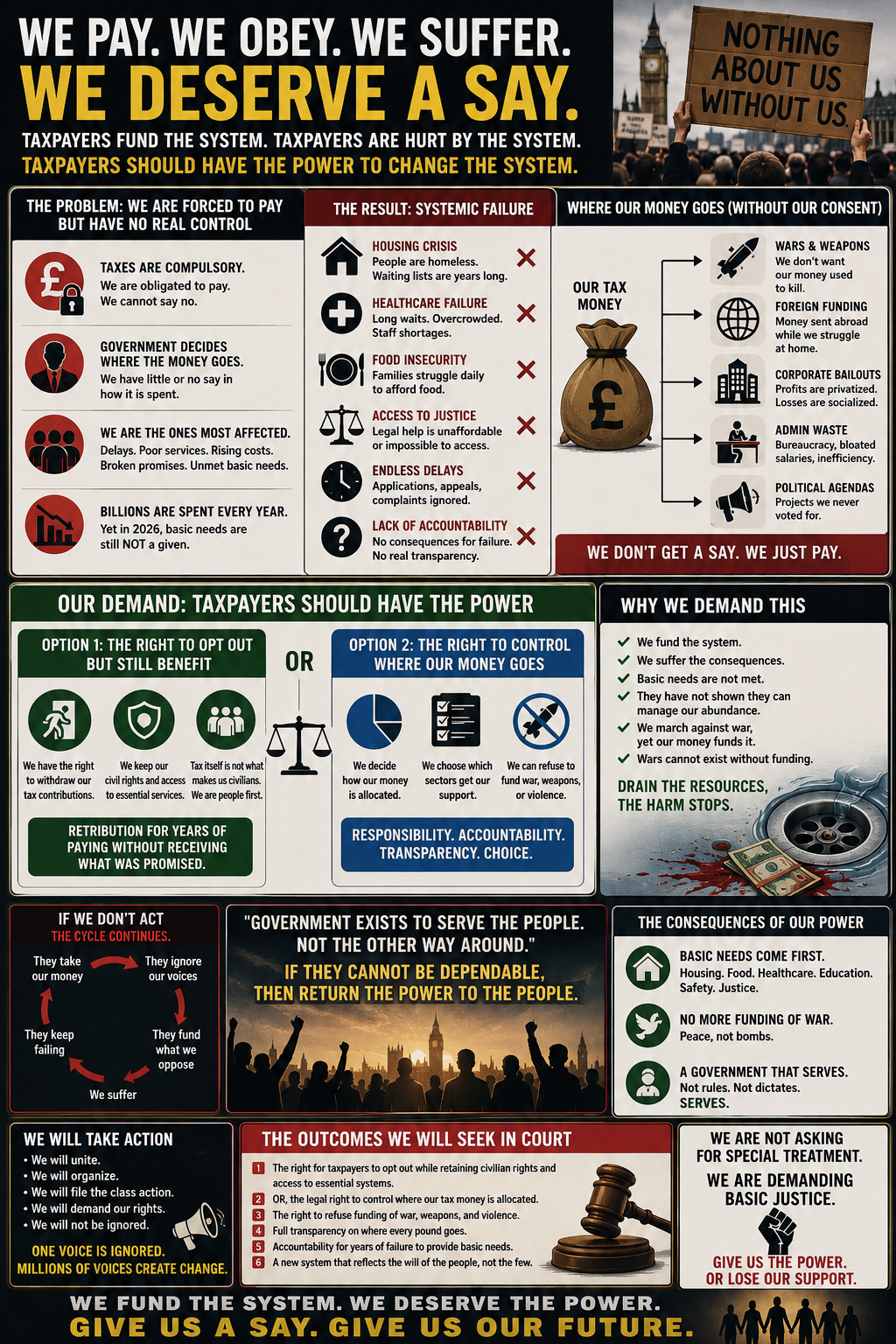
The more systemic failure increases, the more necessary it becomes to question the financial relationship between governments and the people who fund them.
Taxpayers are required to provide money to governmental bodies. That payment is not ordinarily optional. It is imposed through legislation, collected through established systems and enforced through consequences when people fail to comply.
Citizens do not choose whether they would like to purchase government this month.
They do not review the quality of the service and decide whether it deserves another payment.
They cannot simply unsubscribe when the government fails to deliver what it claims to provide.
They are obligated to continue contributing, even when the systems funded through their contributions remain delayed, fragmented, inaccessible, wasteful or incapable of protecting their most basic needs.
That is the contradiction.
The people paying are also the people most affected by the failure.
They fund the institutions.
They live under the legislation.
They experience the delays.
They absorb the policy decisions.
They carry the consequences of poor allocation.
Yet they have remarkably little direct authority over where their individual contributions are placed.
The government decides.
Departments decide.
Ministers decide.
Committees decide.
Budgets are created, approved and distributed through structures that most ordinary people cannot meaningfully influence once elections are over.
The citizen remains the financial source but not the financial director.
That imbalance becomes increasingly difficult to justify when the government repeatedly demonstrates that it does not know how to prioritise the areas that matter most.
Compulsory Payment Should Create Greater Public Authority
When a person enters a private company and purchases a product or service, they make a choice.
They decide whether to engage.
They decide whether the product is valuable.
They decide whether the service is worth the price.
They can choose another company.
They can stop buying.
They can remove their money from the relationship.
The company must continue producing enough value to persuade people to return.
Government does not operate through the same freedom of exchange.
The citizen is obligated to contribute.
That means the government should carry a far greater burden of accountability than an ordinary company.
When payment is compulsory, transparency should be compulsory.
When contribution is enforced, value should be demonstrable.
When citizens cannot withdraw their money, they should possess stronger rights over how it is allocated.
The removal of financial choice should be balanced by an expansion of financial authority.
Instead, governments often retain both.
They retain the power to compel contribution and the power to decide allocation.
The public is left with neither the right to withdraw nor the right to meaningfully direct.
This creates a system in which government receives guaranteed funding without being required to secure continued consent from the people providing it.
That is exactly why complacency can grow.
The money continues arriving regardless of whether the public believes it is being used properly.
Basic Needs Are Still Not Guaranteed
The strongest evidence of governmental mismanagement is not found in the number of departments it operates or reports it publishes.
It is found in the fact that basic needs remain insecure.
In 2026, people are still struggling to access housing.
People still wait excessively for healthcare.
People still experience food insecurity.
People still cannot access justice without money.
People still live in unsafe conditions.
People still lose support through administrative failures.
People still experience delays in systems that were supposedly created to protect them.
Governments collect billions while foundational needs remain unresolved.
This shows that the issue is not merely an absence of money.
It is an absence of prioritisation.
The financial abundance already exists.
The public provides it continuously.
The failure lies in how that abundance is managed, distributed and placed into systems that do not consistently elevate the quality of civilian life.
A government that collects enormous resources while failing to guarantee shelter, food, healthcare, safety, education and access to justice cannot automatically claim that it is allocating public money responsibly.
The continued failure of basic needs is evidence that the existing system of allocation deserves public challenge.
The Public Should Have a Say in Where Its Money Goes
If citizens are required to pay, they should have the ability to influence the destination of at least part of their individual contribution.
A taxpayer should be able to state clearly:
I want my money directed toward healthcare.
I want my money directed toward housing.
I want my money directed toward education.
I want my money directed toward environmental restoration.
I want my money directed toward local infrastructure.
I want my money directed toward legal aid.
I do not want my money directed toward war.
I do not want my money directed toward weapons.
I do not want my money used for policies that violate my conscience.
This is not an unreasonable demand.
It is a demand for alignment between compulsory contribution and individual responsibility.
People are repeatedly told that they are responsible for where they place their money in private life.
They are told to research companies.
To consume ethically.
To understand investments.
To avoid supporting harmful industries.
To recognise that money carries influence.
Yet when the largest compulsory financial contribution of their lives is collected through taxation, they are told they no longer have responsibility over what it funds.
That is inconsistent.
If money is energy, then taxation directs the energy of millions of people.
Those people should have a say in the direction.
People Should Not Be Forced to Finance War Against Their Conscience
Thousands of people march against war.
They protest.
They sign petitions.
They speak publicly.
They oppose military action.
They reject the destruction of civilians.
They call for peace.
Yet the money they are legally required to provide may still be directed toward weapons, military operations or governments involved in conflict.
Their voice says no.
Their money is made to say yes.
That is not meaningful democratic participation.
A person should not be forced to materially support something they have clearly rejected morally, politically and socially.
If a citizen does not want any part of their contribution invested into war, they should have the authority to redirect it.
Their money could instead be placed into healthcare, housing, education, diplomacy, peacebuilding, humanitarian assistance, rehabilitation or environmental repair.
The principle is simple:
No person should be compelled to finance destruction while being denied the ability to direct that same contribution toward life.
War depends upon resources.
Weapons require resources.
Military systems require resources.
Destruction continues because money continues to feed it.
If the flow of resources is withdrawn, the machinery cannot sustain itself in the same form.
Wars are not self-funding.
They are maintained through public money, private investment, political decisions and institutional permission.
Therefore, the public must be given greater authority over whether its contribution participates in that machinery.
Drain Harmful Systems of the Resources That Allow Them to Grow
Anything that grows requires a source.
A harmful institution requires money.
A war requires money.
A corrupt structure requires money.
An ineffective department requires continued funding.
A system can remain alive long after it has stopped producing value because resources continue flowing into it automatically.
The public is then told that the system cannot change because it is too large, too established or too complex.
But the size of the system is sustained through the very resources the public is compelled to provide.
If a system repeatedly causes harm, ignores feedback and fails to fulfil its function, then the public should have a mechanism to withdraw financial support from that structure.
Not necessarily from all collective life.
From the failed allocation.
The money could be redirected.
The public could choose another destination.
The department would then be required to demonstrate value rather than relying upon automatic continuation.
A system deprived of unquestioned funding would have to become responsive.
It would have to listen.
It would have to correct itself.
It would have to prove why it deserves the resources it receives.
Taxpayer Opt-Out Should Exist as a Form of Public Retribution and Correction
Where governments have collected money over many years while failing to provide the value, protection and foundational services attached to that contribution, taxpayers should be able to pursue an opt-out as a form of retribution and correction.
The argument is not that a person ceases to be a civilian because they stop paying tax.
Taxation does not create humanity.
It does not create residency.
It does not create a person’s relationship with the land, community or jurisdiction.
A person should not lose their civil standing simply because they no longer consent to financing a system that has repeatedly failed them.
The system exists for civilians.
Civilians do not exist for the tax system.
Therefore, one of the outcomes demanded should be the right for taxpayers to opt out while continuing to benefit from the systems that are supposed to exist for the population as a whole.
This would function as retribution for years in which contributions were taken while corresponding benefits were delayed, denied, weakened or misallocated.
The government cannot insist that contribution is mandatory while treating delivery as conditional.
If payment is absolute, accountability cannot remain optional.
If Government Rejects Opt-Out, It Must Return Allocation Power
The government can be presented with a clear choice.
Either allow taxpayers to opt out completely while remaining recognised members of the civilian population, or give taxpayers direct authority over the allocation of their individual contributions.
If government insists that taxation must remain compulsory, then it must surrender part of its exclusive control over where the money goes.
Citizens should be able to assign percentages.
They should be able to rank sectors.
They should be able to exclude industries.
They should be able to refuse participation in war.
They should be able to increase contributions toward the needs they believe are being neglected.
They should be able to see how their allocation was applied.
They should be able to review the outcome.
They should be able to change their direction when institutions fail to perform.
This would force government to listen through the movement of resources.
If millions of people direct money toward housing, that is public instruction.
If millions refuse military allocation, that is public instruction.
If healthcare receives overwhelming public support while other areas are rejected, government would no longer be able to claim uncertainty about what people value.
The budget would become more than a decision made above civilians.
It would become a living reflection of civilian priorities.
Government Has Not Demonstrated Competence in Financial Triage
The need for taxpayer allocation rights becomes even clearer when we examine how governments prioritise.
The most important areas should receive the earliest and strongest funding.
Shelter.
Food.
Healthcare.
Safety.
Education.
Justice.
Infrastructure.
These are the foundations that allow everything else to function.
Yet governments routinely allow these areas to remain unstable while directing significant resources elsewhere.
This is not only financial mismanagement.
It is failed triage.
A government should understand what must be protected first.
It should know that a person without housing cannot fully participate in society.
A person without healthcare cannot sustain work.
A child without food cannot learn.
A person without legal access cannot meaningfully challenge power.
A community without safety cannot develop.
If these conditions are not secure, then the system has no justification for behaving as though secondary priorities are more urgent.
The government has not consistently shown that it understands the correct order of public need.
That failure strengthens the demand for citizens to recover part of the allocation authority.
Foreign Spending Must Also Be Accountable to the People Funding It
When a person pays tax within a jurisdiction, they reasonably expect their contribution to support the quality and stability of that jurisdiction.
This does not mean no country should ever assist another.
It means that assistance should not occur through hidden or automatic allocation while the people funding it remain uninformed, unheard and deprived of basic security at home.
The public should know:
How much is being sent elsewhere?
Why is it being sent?
What domestic needs remain unmet?
Who approved the allocation?
What outcome is expected?
Who benefits?
Who carries the risk?
How was the public consulted?
People should not discover after the fact that their money supported activities they fundamentally oppose.
Governments cannot claim to act for the people while excluding them from decisions involving the resources taken from them.
The Class Action Is Supported by the Pattern of Compulsory Funding and Systemic Failure
This argument does not stand alone.
It forms part of the wider evidence supporting a class action concerning systemic institutional failure, misallocation of responsibility and the imbalance between what civilians are required to provide and what governmental systems actually return.
The evidence includes:
- compulsory public contribution;
- failures in basic service delivery;
- delayed institutional response;
- repeated disregard of early warnings;
- misallocation of public resources;
- insufficient legal and governmental triage;
- lack of transparency;
- exclusion of civilians from meaningful allocation decisions;
- the use of public money in areas citizens morally oppose;
- and the continued protection of institutions that have not demonstrated sufficient public value.
The point is not merely that people are dissatisfied with tax.
The point is that compulsory funding has continued through years of documented systemic failure while the public has had insufficient authority to redirect, restrict or withdraw its contribution.
That imbalance deserves legal scrutiny.
Numbers Create Pressure Where the One Is Ignored
The legal system often ignores one person.
One person is treated as an isolated concern.
One person can be dismissed.
One person can be told that their argument is unrealistic.
One person can be delayed until they lose energy.
But when many people raise the same issue, the system is forced to recognise that the concern is not isolated.
The numbers do not make the truth true.
The numbers create pressure around a truth that already existed.
That is why collective action matters.
If one taxpayer says they do not consent to financing war, they may be ignored.
If millions say it, the system must respond.
If one person says government has failed to provide value, they may be dismissed as dissatisfied.
If large numbers document the same pattern across housing, healthcare, justice, education and public administration, then the failure can no longer be hidden inside individual cases.
The purpose of rallying numbers is not to manufacture legitimacy.
It is to remove the system’s ability to pretend that the problem belongs to one person.
The People Funding Government Should Not Be Powerless Beneath It
The current structure places citizens in an inferior position within a system they finance.
They are required to pay.
They are required to obey.
They are affected by allocation.
They are affected by government delay.
They are affected by war.
They are affected by regulation.
They are affected by service failure.
Yet they are not given direct authority over the money that makes all of those systems possible.
This should change.
Taxpayers should not be treated as passive sources of revenue.
They should be recognised as active financial stakeholders in the jurisdiction.
Their contribution should carry rights.
Their objection should carry weight.
Their allocation preferences should have effect.
Their refusal to fund harm should be respected.
Their ability to withdraw should exist where the system repeatedly fails to fulfil its foundational purpose.
Return the Authority to the Individual
If government is dependable, it should be able to demonstrate why it deserves continued control.
If it is transparent, it should not fear taxpayer direction.
If its priorities are correct, public allocation should support them.
If its spending creates value, people will recognise that value.
But if government cannot protect basic needs, cannot manage public money coherently, cannot prevent systemic failure, cannot hear early warnings and cannot align its spending with the people financing it, then it has not justified complete control.
At that point, authority should return to the individual.
Let people choose.
Let people direct.
Let people refuse to fund destruction.
Let people withdraw support from failed structures.
Let people place their money into the systems they believe can actually sustain life.
Government should not fear this if it truly works for the public.
It should welcome public participation in the management of public abundance.
Because the money does not begin with government.
It begins with people.
The labour is theirs.
The contribution is theirs.
The consequence is theirs.
The authority should not belong exclusively to those who collect it.
The Central Demand
The demand is clear:
Either allow taxpayers to opt out while retaining their full civilian standing and access to the systems created for the public, or grant taxpayers direct and enforceable control over where their individual contributions are allocated.
No person should be forced to finance war against their conscience.
No government should retain complete financial authority while basic needs remain unmet.
No institution should receive unlimited compulsory support without demonstrating public value.
No public body should be allowed to collect reliably while delivering selectively.
And no government should claim to work for the people while denying the people authority over the money that makes government possible.
If the system cannot be dependable, return the means of dependency to the individual.
If government cannot manage the abundance, allow the public to direct it.
If the institutions cannot triage properly, let the people identify what matters.
And if compulsory contribution continues without accountable value, then taxpayers must have the right to remove, redirect or reclaim the financial power that has been taken from them.
…
And with the surge and increasing the amounts of systemical failure, I wonder, would the law allow a class action to demand taxpayers to opt out but still benefit as retribution for all the years that they’ve paid and the actual quote-unquote benefits that were supposed to be provided have not been provided, or the service to not an individual but to the actual jurisdiction that those legislations control? As we’re the ones paying it, but we’re also those obliged to pay it, to pay for it, but we’re also the ones who are the most affected, we should have a bigger say as to whether we should give our tax money or not, or we should have a say on the allocation that our individual money goes to. We should have a say as to which industry should get our money or not. Because the government itself, they’re not elevating the state of our consciousness, they’re not elevating the state of our existence, they’re not elevating the state of our governments, they’re not elevating the state of our jurisdictions, of our cities, of our countries. There’s a lot of delays on a lot of things, and the basic needs are still, in 2026, not a given. So if our basic needs are not a given but we pay billions every single year to these bodies, we should have a say where the money goes. Because clearly they have not shown to know how to manage that financial abundance. And that’s how the governments themselves, if we allow those who advocate for us, that advocate wrongly because they don’t advocate for the same that are putting the money in, and instead they’re using the money under the claim that it is for a service. But if I’m in the UK and I’m paying the taxes for the UK, I don’t benefit from the UK giving that money to Israel or any other country, do I? No, I don’t. Israel is so far away from here. If they want to send a bomb, they’re going to send a bomb either way. But without, like, without necessarily putting it on, like, Israel or bombings or whatever is happening there, it is about the fact that we should have a say to some parts unless the standards are upheld. If the jurisdictional system does not know how to bring the value that it claims to bring, we should have a way of pooling our efforts and helping them. And they should allow this because they are supposedly, again, working for us. So they have a choice because I’m going to put in the class action and I’m going to make it one of the outcomes desired. Either allow taxpayers to opt out completely but still benefit from the system because it is about the civilians. Tax itself isn’t a civilian thing, right? Like, paying taxes or not doesn’t make one a civilian. So a civilian should be able to opt out. Or if they don’t want civilians to opt out, they should give the responsibility, accountability, and also the ability to control where that money goes. I do not want any of my money to be invested in any war whatsoever. I should be able to have a say in that. We should all be able to have a say in that. Because thousands and thousands march on the streets against wars every single day across the whole globe. But still, somehow, our money goes to these wars, whether we know it or not. We should be able to avoid that from happening because when we take away the funds from these wars, these wars cannot fund themselves. If we take the money away from the wars, the wars cannot fund themselves. Meaning that, just like a cancer, if you don’t give a cancer what it needs to grow, guess what? That cancer is not going to grow. You know? If you have a pimple on your skin, if you open and let the liquid out, the pimple is gone. Drained out of its resources. So let’s drain the government out of its resources, or drain where the government puts the money, because clearly it has not been able to do the job themselves. So if the government, which is the system that we should depend on, cannot actually be dependable, then give back the authority to individuals. Let the individuals take care of themselves.




Leave a Reply