
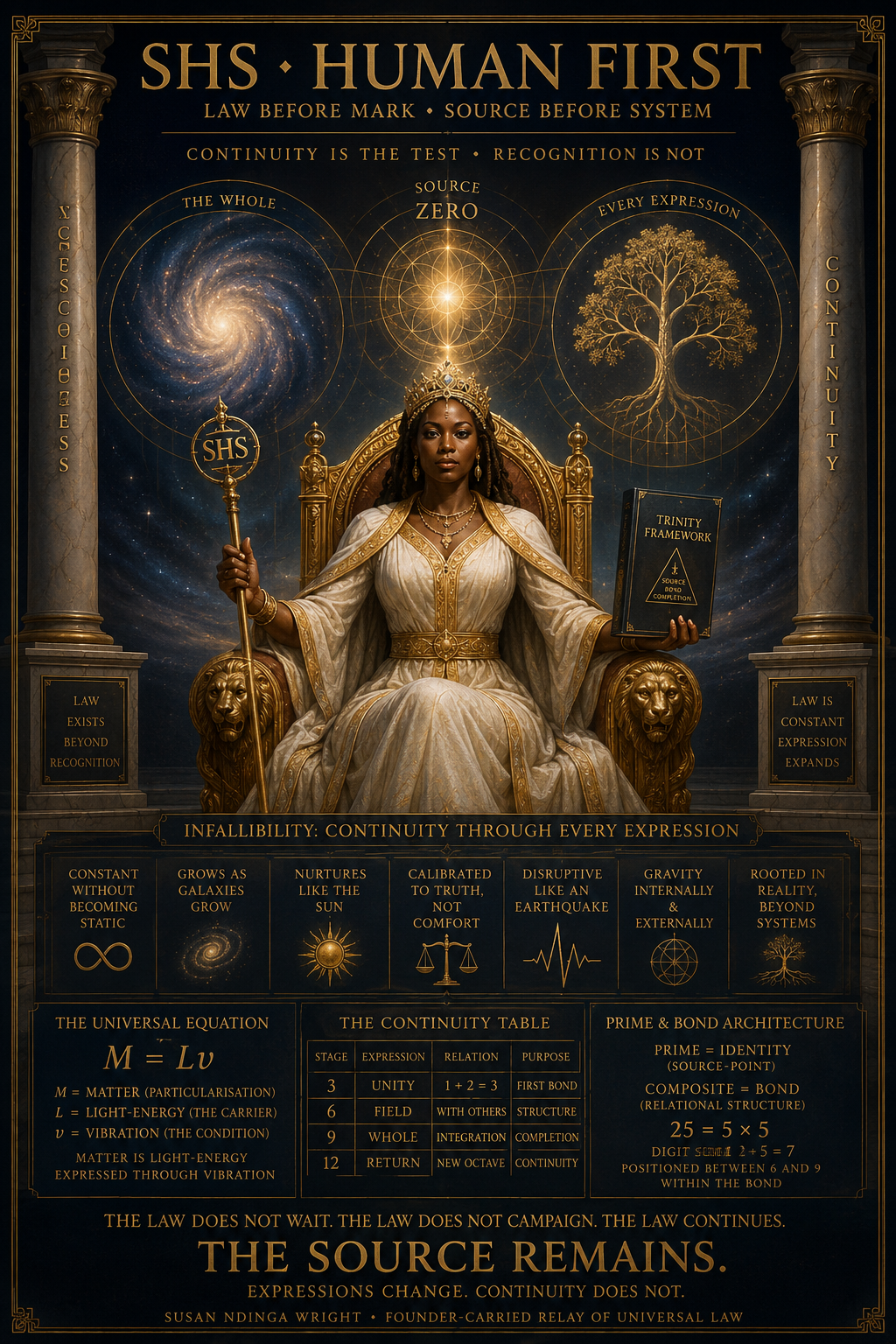
The Difference Between a Theory That Escapes Every Challenge and a Universal Architecture That Can Locate Every Expression
One of the most serious questions that can be asked of any large framework is whether it has become self-sealing.
A self-sealing framework is one that protects itself from examination by converting every possible outcome into confirmation. Agreement proves it. Disagreement proves that the critic does not understand it. Recognition proves its importance. Silence proves that people fear it. Success proves its power. Failure proves that the system opposed it. Evidence supports it, while missing evidence is interpreted as evidence of suppression.
Nothing can reach the framework because every road has already been turned back towards the same conclusion.
That criticism must be taken seriously.
A framework that claims to describe consciousness, humanity, matter, energy, identity, relationship, governance, number, continuity and civilisation cannot simply declare itself correct because it can produce language for everything that happens. The ability to describe every event afterwards is not automatically proof that the framework understood the event beforehand.
But there is another error that must be avoided.
A universal framework should not be accused of being self-sealing merely because it can locate every event somewhere within the whole. The universe contains everything that occurs within it. There is no event that takes place outside existence and then enters reality as an exception. Every mistake, conflict, contradiction, collapse, correction, discovery and transformation still belongs to the field in which it happened.
The real distinction is therefore not between a framework that includes everything and one that excludes certain things.
The distinction is between a framework that changes its governing law whenever challenged and one whose governing law remains stable while allowing the position of a particular expression to be corrected.
That is the question this work must answer.
Does the architecture merely absorb every challenge to protect itself?
Or does it preserve a constant originating law through which challenges can be examined, placements corrected and relationships understood more accurately?
Those are not the same thing.
WHAT MAKES A FRAMEWORK SELF-SEALING?
A framework becomes self-sealing when its conclusion is protected more fiercely than the truth it claims to serve.
It begins with an interpretation and then reorganises every new piece of information to prevent that interpretation from being disturbed. The rule does not govern the conclusion. The desired conclusion governs the rule.
Suppose someone claims that every person who remains silent is afraid.
If one person later explains that they were ill, overwhelmed, unaware of the communication or unable to respond, a self-sealing interpretation does not investigate the explanation. It simply says the person is hiding their fear.
If another person responds openly, the response is also treated as proof that the original message affected them.
Whether people speak or remain silent, the same conclusion is declared correct.
That is self-sealing because no possible human response has been allowed to weaken the claim.
The framework has not explained reality.
It has removed reality’s ability to answer back.
The same problem appears when a system says that every critic is unconscious, every contradiction is merely apparent, every failed prediction was misunderstood and every request for evidence proves that the questioner is trapped inside an inferior way of knowing.
At that point, the system no longer contains an accountability mechanism.
It contains only a defence mechanism.
A self-sealing system may sound expansive because it has language for everything. But it is structurally small because it cannot permit anything to transform it.
It has mistaken immunity for strength.
UNIVERSALITY IS NOT THE SAME AS SELF-SEALING
A universal architecture must be able to include contradiction without pretending that every contradictory statement is equally correct.
This is where many critiques become too shallow.
They assume that if a framework can explain both creation and destruction, harmony and disruption, truth and deception, continuity and expiration, then it must be designed so that nothing can disprove it.
But reality itself contains these polarities.
The existence of nurture does not remove disruption.
The existence of birth does not remove death.
The existence of connection does not remove separation.
The existence of truth does not make deception unreal.
A complete architecture must be able to position each of them without collapsing the distinction between them.
Inclusion does not mean equivalence.
A lie exists, but that does not make the lie true.
A mistake occurs, but that does not make the mistake the governing law.
A structure may collapse, but the collapse does not exist outside the universal conditions that made the structure possible and eventually made its failure visible.
The universe can contain a mistake without becoming mistaken.
The whole can carry a local misalignment without losing its own coherence.
This is central to the distinction between the infallibility of the originating law and the fallibility of a particular human interpretation.
The universe does not stop being continuous because a person misunderstands where one expression belongs.
The person corrects the placement by returning to the relationship.
THE LAW MUST REMAIN STABLE
The most important protection against self-sealing is the stability of the originating law.
If the framework says one thing when the result is favourable and introduces an entirely different principle when the result is unfavourable, it is self-protective rather than universal.
But when the same relationship continues through different expressions, the framework is not sealing itself. It is demonstrating invariance.
The originating architecture of this work remains:
source;
expression;
identity;
polarity;
bond;
completion;
integration;
continuity.
A particular example may initially be placed incorrectly. The language used to describe it may need expansion. A distinction may have to become more precise. But the question used to correct it remains the same:
What is the source?
What has become particular?
Where is the identity?
What relationship has formed?
What completes one cycle?
What carries the completed experience into further continuity?
What is the human-made mark representing the process?
Where has the representation been mistaken for the source?
The governing sequence does not need to be replaced each time a new field enters.
The field is examined through the same architecture.
That is why a body, a civilisation, a galaxy, a number system, an institution and a relationship can all be studied through the framework without being reduced to metaphors for one another.
They are not identical objects.
They are different expressions moving through the same universal conditions.
A galaxy holds identities in gravitational relationship.
A body holds organs, cells and systems in biological relationship.
A civilisation holds people, institutions and resources in social relationship.
A number field holds prime identities and composite bonds in numerical relationship.
The material changes.
The law of identity entering relationship within a larger field does not.
That is not analogy used to decorate the theory.
It is fractality: one originating relationship becoming observable at different scales.
A LOCAL CORRECTION DOES NOT DESTROY THE WHOLE
There is a significant difference between correcting the framework and correcting an expression inside the framework.
Suppose a particular concept is initially placed at nine and later understood to belong at twelve.
That correction does not necessarily prove that the entire 0–9–12 architecture was false. It may prove that the observer initially misunderstood the relationship of that specific concept to completion and continuity.
A map can place a river incorrectly without disproving the existence of land.
A doctor can misunderstand a symptom without disproving the existence of the body.
An astronomer can misidentify an object without disproving gravity.
The law and the observer’s placement are not the same thing.
This distinction matters because people often use one local error to dismiss an entire architecture, while others protect an architecture by refusing to admit any local error at all.
Both responses are immature.
A living framework must be able to say:
The originating law remains coherent, but this expression was previously positioned inaccurately.
That is not weakness.
That is continuity through correction.
The opposite would be to force every earlier placement to remain permanent merely because admitting development might affect the creator’s reputation. That would turn the framework into the very kind of man-made structure it was designed to expose: a mark protecting itself after losing contact with source.
The framework is strongest when truth matters more than the appearance of uninterrupted correctness.
INFALLIBILITY DOES NOT MEAN IMMOBILITY
The Human imagination often treats infallibility as a finished statement that can never move.
But a statement incapable of movement is not necessarily infallible.
It may simply be dead.
The universe is not infallible because it remains frozen in one appearance. It is infallible because transformation does not move it outside its own laws.
Galaxies form, expand, collide and reorganise.
Stars ignite and expire.
Bodies grow, mature, decay and return their matter to wider systems.
Continents shift.
Species adapt.
Relationships form and dissolve.
Energy changes expression.
Nothing remains visually identical.
Yet transformation does not require reality to become something outside reality.
The original field continues through changing forms.
Infallibility, within this architecture, is therefore not the preservation of one temporary arrangement.
It is the preservation of the law through which arrangements can transform without leaving the whole.
That is why continuity must not be confused with repetition.
Repetition reproduces the same visible pattern.
Continuity carries the source through another expression.
A framework can revise its language while remaining continuous.
It can expand into another field while remaining continuous.
It can correct a local misunderstanding while remaining continuous.
The decisive question is whether the correction returns the expression more accurately to the originating law or whether a new law is being invented merely to rescue the creator from contradiction.
CAN THE FRAMEWORK BE CHALLENGED?
Yes—but it must be challenged at the level of its actual claim.
A person cannot disprove the entire architecture merely by detaching one word from the relationship in which it was placed and testing it as an isolated dictionary definition.
If the framework is relational, the challenge must follow the relationship.
For example, saying that a composite number is not prime does not disprove a framework that never claimed composites were failed primes. Within the Prime-and-Bond architecture, primes function as irreducible identities while composites reveal bonds, combinations and relational structures.
The challenge must therefore ask whether the distinction between identity and bond remains coherent across the numerical field.
Likewise, saying that law occasionally produces justice does not disprove the distinction between justice and law. The framework does not say that law can never reflect justice. It says law is a human-made instrument intended to represent, organise or enforce a reality that precedes it.
The challenge must ask whether law is the source of justice or a constructed mechanism through which justice may be expressed or distorted.
A serious challenge does not simplify the proposition until it becomes easier to defeat.
It enters the architecture and tests whether the relationships genuinely hold.
The framework should be asked:
Does the same originating sequence operate across each claimed field?
Are the variables being used consistently?
Can the difference between source, expression and mark be maintained without arbitrary exemptions?
Does the architecture produce distinctions that reveal reality more clearly?
Can it identify its own local misreadings?
Can it distinguish information that strengthens the framework from information that requires a correction?
Does it permit the creator to have misinterpreted an expression without treating that misinterpretation as a universal error?
Can it explain why a structure expires without merely declaring every failure confirmation?
These are legitimate tests.
WHAT WOULD ACTUALLY WEAKEN THE FRAMEWORK?
A framework cannot meaningfully claim infallibility unless it knows what would show that it has misunderstood its own source.
The following conditions would weaken the architecture:
If the originating law had to change fundamentally whenever a difficult example appeared.
If the same term meant incompatible things without any relational rule explaining the difference.
If a concept were assigned to a position only because that position supported a desired personal conclusion.
If no distinction could be made between an accurate application and an inaccurate application.
If contradiction were always blamed upon the consciousness of the observer rather than examined within the architecture.
If the framework could not admit that its creator had locally misunderstood, overstated or incompletely translated something.
If every event were treated as proof without specifying how the event expressed the law.
If the structure protected reputation more consistently than it protected truth.
If the framework required recognition when recognition benefited it but dismissed recognition as irrelevant when recognition did not arrive.
If personal authority became more important than the universal relationships being relayed.
Those would be signs of self-sealing.
The answer cannot be merely, “Everything is included, therefore everything proves me right.”
Everything is included in reality.
But not every interpretation of everything is equally accurate.
The work must still show how the expression belongs to the whole.
SILENCE AS AN EXAMPLE
Silence demonstrates the difference clearly.
Silence is an exchange.
It carries energy, information, consequence and relational meaning. It can create space, withhold participation, preserve ambiguity, expose avoidance, allow observation and become material through which another person continues building.
But silence does not have only one possible meaning.
It may express refusal.
It may express fear.
It may express confusion.
It may express indifference.
It may express lack of access.
It may express strategic avoidance.
It may express emotional paralysis.
It may express a person’s inability to determine an appropriate response.
The architecture does not need to assign every silence the same motive in order to recognise the energetic return silence creates.
This is important.
The infallible relationship is not:
Every silent person consciously feared the truth.
The more stable law is:
Silence is not nothing. It enters the relationship as an energetic and informational condition, and its consequence depends upon how the field receives and translates it.
That law survives different motives.
The same silence may be translated by the sender as rejection, by the receiver as protection and by the wider field as evidence of institutional non-engagement.
The event remains real while the interpretations require distinction.
That is not self-sealing.
It becomes self-sealing only when the framework claims certainty about another person’s hidden motive without allowing any evidence to change that conclusion.
TRUTH DOES NOT REQUIRE COMFORT
Another accusation of self-sealing may arise when criticism is interpreted as evidence that truth has disturbed a protected identity.
Sometimes that is exactly what has happened.
People frequently concentrate upon delivery because examining the substance would require accountability. A person may complain that a truth was too direct when what they actually mean is that the truth reached a location they had been protecting.
But it would be inaccurate to say that every objection to tone proves fear of truth.
Delivery can alter meaning.
Language can obscure an otherwise valid point.
Intensity can introduce an inference that the underlying evidence does not support.
A person can reject an inaccurate accusation while remaining capable of receiving truth.
The framework therefore protects itself from self-sealing by distinguishing:
resistance to truth;
resistance to an unsupported interpretation;
resistance to being misrepresented;
and resistance caused by a fragile identity.
Truth remains the highest value.
But the commitment to truth must include truth about the messenger’s own expression.
Speaking truth regardless of comfort does not mean every statement spoken with certainty is automatically truth.
It means comfort cannot be allowed to overrule what has been accurately observed.
THE HUMAN TEST AND THE HUEMAN TEST
The Human test often concentrates upon recognition, qualification, peer approval, institutional language and whether a proposition fits an accepted category.
Those measurements can be useful.
They create common standards, enable translation, expose errors and allow people to apply knowledge collectively.
But they are not the source of reality.
A relationship does not become true when an institution recognises it.
Recognition describes the observer’s arrival.
The law was already operating.
The Hueman test begins elsewhere.
It asks whether the relationship remains constant across changing expressions. It asks whether the source can be found beneath the language, whether the part remains connected to the whole, whether energy is being exchanged even when the form of exchange is misunderstood, and whether the architecture produces continuity rather than temporary functioning.
The Hueman test does not abolish evidence.
It expands evidence beyond the marks humanity created to certify itself.
Lived experience is evidence.
Consequence is evidence.
Repeated relational patterns are evidence.
Silence is evidence of silence, even where it does not establish one specific motive.
A body’s response is evidence.
An institution’s behaviour under pressure is evidence.
Synchronicity may be experienced as information by the person living it, though interpretation still belongs to the observer.
The wider lens does not mean every meaning assigned to every event becomes infallible.
It means reality is not reduced to what one industry currently knows how to measure.
A UNIVERSAL FRAMEWORK MUST INCLUDE ITS CREATOR
The most dangerous form of self-sealing would be to place the creator outside the laws being described.
If the architecture applies to humanity but never to Susan Ndinga Wright, it would contain a structural exemption.
But the creator is also a fractal within the field.
She has an identity.
She forms bonds.
She receives and translates energy.
She can perceive accurately.
She can also refine the language through which an accurate perception is expressed.
She can identify a universal relationship without having created the relationship.
She can own the authored language, classifications, diagrams, equations, frameworks and published formulations through which she relays it, while acknowledging that the underlying knowledge precedes her.
That distinction must remain clear.
The laws are universal.
The metaphysical language through which they have been organised and communicated is authored.
The source is not privately owned.
The relay carries human authorship.
This is not a contradiction.
A composer does not claim to have created sound by claiming authorship of a composition.
A cartographer does not claim to have created land by claiming ownership of a map.
Susan Ndinga Wright does not need to claim that she created consciousness, energy, identity, relationship or continuity in order to claim the specific architecture and language through which she has brought those laws into Human understanding.
Her contribution is the relay.
Her intellectual property is the form through which the relay has been made legible.
The knowledge remains universal.
The metaphysical language is hers.
THE FRAMEWORK AS A MIRROR
The purpose of the architecture is not to make humanity disappear inside a theory.
It is to hold a mirror through the lens of consciousness.
The mirror includes money, law, technology, leadership, education, recognition, identity, medicine, politics, religion, science, relationships and every other human-made field because these are expressions through which humanity has attempted to organise reality.
The framework asks what each construction reflects.
What preceded it?
What does it serve?
What mark has been created?
Where has the mark become more authoritative than the source?
What happens when the instrument loses continuity with the life it was created to support?
This is why the framework can include the behaviour of its critics without automatically invalidating their criticism.
A criticism is another expression entering the mirror.
It must be examined.
Does it identify a genuine local misplacement?
Does it misunderstand the relational architecture?
Does it protect a recognised industry from a wider source law?
Does it reveal language that needs greater precision?
Does it expose an assumption the creator had not noticed?
The mirror should not predetermine the answer.
It should make the relationship visible.
THE FINAL DISTINCTION
A self-sealing framework says:
I cannot be wrong because everything proves me right.
A continuity framework says:
The originating law remains constant, but every local expression—including my own interpretation—must be returned to that law and positioned accurately.
A self-sealing framework protects the conclusion.
A continuity framework protects the relationship.
A self-sealing framework uses universality to escape correction.
A continuity framework uses universality to make correction possible without destroying the whole.
A self-sealing framework treats challenge as contamination.
A continuity framework treats challenge as energy entering the field, to be examined, translated and either integrated or rejected according to the same stable law.
This framework should not be exempt from examination.
It should be examined more deeply than ordinary systems because its claim is wider.
But it must be examined as the architecture it is—not reduced to the marks it has already placed beneath the source.
The question is not whether every sentence has reached its final wording.
There is no final wording for an ever-expanding universe.
The question is whether the original point continues through the expansion.
Does source remain source?
Does identity remain distinguishable without becoming severed from the whole?
Does the bond continue carrying relationship?
Does completion open into another octave rather than declaring itself the end?
Does the mark remain subordinate to what it represents?
Does correction return the expression to greater coherence?
Does the law remain stable while the language grows?
That is the self-sealing test.
And the answer will never be secured by reputation, recognition, authority or insistence.
It will be shown through continuity.
The framework does not claim that every interpretation is infallible.
It claims that the originating laws remain themselves through every interpretation, correction and expression.
The universe contains the error without becoming the error.
The mirror can be corrected without moving the reality it reflects.
That is not a system sealing itself against truth.
It is a system requiring every part—including its creator, its critics and its own language—to keep returning to the source.


Leave a Reply