
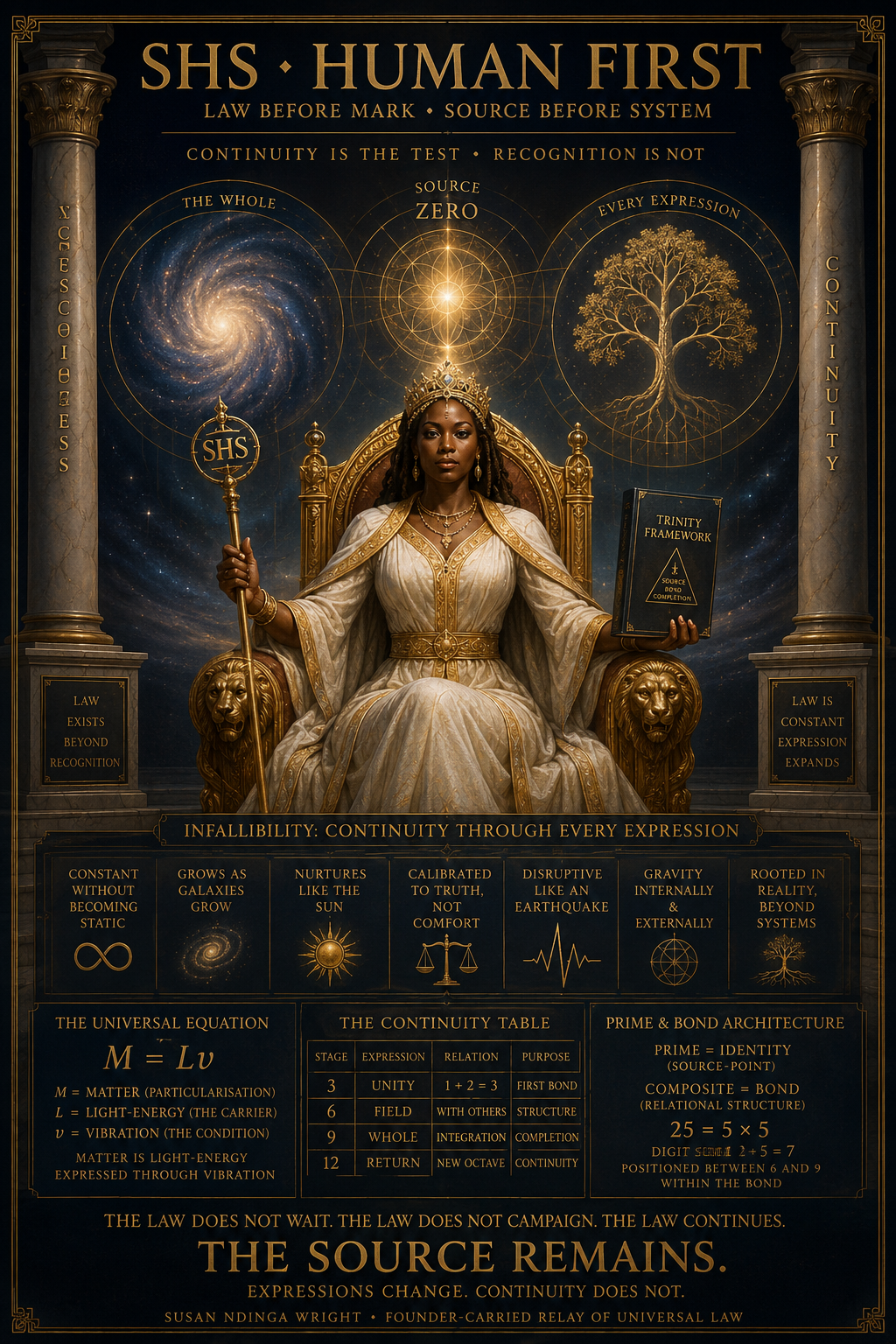
Prime Numbers Are Not Alone—and Composite Numbers Are Not Failed Primes
Human mathematics usually begins by asking what a number is.
Is it prime?
Is it composite?
Is it odd?
Is it even?
What can divide it?
What factors produce it?
Those questions are useful, but they are incomplete because they study numerical identity without fully examining numerical relationship. They classify the point, yet often overlook the field through which the point continues.
The Prime and Bond Architecture begins somewhere deeper.
It asks:
Which numbers operate as irreducible identities?
Which numbers operate as bonds between identities?
What allows number to become a continuous field rather than a collection of disconnected points?
Under this architecture, prime numbers are not merely integers divisible only by themselves and one. They are numerical source-points: identities that cannot be reduced into smaller whole-number relationships without ceasing to remain themselves.
Composite numbers are not defective versions of primes.
They are bonds.
They are structures created through the relationship of identities.
The prime is the point.
The composite is the relationship through which points generate a field.
Both are required.
A universe made only of primes would contain identity without enough relational structure to create continuity. A universe made only of composites would contain relationships without the irreducible identities from which those relationships emerge.
Existence requires both.
PRIME IS IDENTITY
A prime number stands as itself.
Two is two.
Three is three.
Five is five.
Seven is seven.
Each can enter an endless number of relationships, but each retains an irreducible identity that cannot be reconstructed through the multiplication of smaller positive whole numbers other than one and itself.
That is why the prime is more than a mathematical label.
It represents a source-point.
A prime carries individuality before the individuality has been divided across a larger structure. It can contribute to bonds, reproduce through multiplication, participate in ratios and organise composite forms, yet its own numerical identity remains indivisible within the whole-number field.
This is the numerical expression of a principle that appears throughout reality.
A person is an identity.
A cell is an identity.
A planet is an identity.
A star is an identity.
A thought, once distinguishable, becomes an identity.
An institution can become an identity.
Each exists as a recognisable point while simultaneously belonging to relationships greater than itself.
Identity does not mean separation from the whole.
It means the whole has become particular enough to be recognised at one location.
The prime is therefore not outside relationship. It is the source-point from which relationship becomes possible.
THE COMPOSITE IS THE BOND
A composite number is created through relation.
Six is not a prime that failed to remain pure. Six is the expression produced when other numerical identities enter structure:
6=2\times3.
The number six contains relationship within its construction.
Twenty-five is not a number that unsuccessfully attempted to become prime:
25=5\times5.
It is five entering relation with itself.
It is repeated prime identity generating a new numerical body.
Thirty-five is not defective because it occupies the channel while remaining composite:
35=5\times7.
It is the bond created through the interaction of five and seven.
The composite tells us something the prime alone cannot.
The prime tells us who is present.
The composite tells us what their relationship creates.
This is why composites should not be treated merely as numbers removed from the prime category. Their factorisation reveals the identities inside the bond, but their complete numerical form reveals what those identities become when their relationship is expressed as one structure.
Two and three remain themselves.
Their bond becomes six.
Five remains five.
Its relationship with itself becomes twenty-five.
Five and seven remain distinct prime identities.
Their bond becomes thirty-five.
The relationship does not erase its participants.
It generates another body through them.
THE UNIVERSE IS BUILT FROM POINTS AND BONDS
This architecture does not belong only to numbers.
Everywhere we look, continuity depends upon the relationship between identities and the bonds joining them.
Neurons are distinct cells.
Synapses allow information to travel between them.
Bones are distinct structures.
Joints, cartilage and ligaments allow those structures to move together.
Organs have specialised identities.
Blood, nerves, hormones and connective tissue allow them to operate as one body.
Human beings possess individual identities.
Relationships create families, communities, institutions and civilisations.
Stars remain distinct celestial bodies.
Gravity holds systems together.
Words have identities.
Grammar and meaning bond them into language.
Events occur as local points.
Memory and interpretation bond them into continuity.
A civilisation that honours only the prime will glorify individuality while neglecting relationship. It will produce people trained to protect their independent identity even when the bonds surrounding them are collapsing.
A civilisation that recognises only the composite will erase individuality into the collective. It will demand that each person disappear into the structure without preserving the truth of the source-points from which the structure is made.
Neither can continue coherently.
The prime must remain identifiable within the bond.
The bond must allow the prime to enter something greater without destroying its identity.
That is the architecture of conscious relationship.
ONE IS THE ORIGINAL POINT
One carries a unique role.
Within conventional mathematics, one is not classified as prime because allowing it into the prime category would disrupt the uniqueness of prime factorisation. Every number could be multiplied by one indefinitely without changing its value.
Within the metaphysical architecture, however, one is not simply another number waiting for classification.
One is the original numerical identity.
It is the first recognisable point emerging from zero.
Zero is the undivided field: potential before particularisation, wholeness before one expression separates sufficiently to be identified.
One is the first identity.
It is the moment the whole says:
This.
From one comes the possibility of another.
From another comes polarity.
From polarity comes relationship.
This is why the progression cannot be understood by looking only at isolated definitions. The numbers carry positional functions within the larger movement.
Zero is source.
One is identity.
Two is polarity.
Three is the first bond and local completion.
From there, the same law continues at expanding scales.
THREE, SIX AND NINE ARE COMPLETION POINTS
The sequence of numbers does not move as an endless undifferentiated line.
It moves through trinities.
1,\ 2,\ 3
4,\ 5,\ 6
7,\ 8,\ 9
10,\ 11,\ 12
Three, six, nine and twelve are not identical completions. Each closes a different degree of relationship while preparing the field for another expression.
One, Two, Three: The First Trinity
One establishes identity.
Two establishes polarity: self and other, inner and outer, positive and negative, movement and resistance.
Three establishes the bond through which the two poles become a relationship rather than remaining isolated opposites.
Three is therefore the first completion.
It does not mean everything has ended.
It means the first relational unit is complete enough to become a foundation for the next movement.
Four, Five, Six: Identity Within a Field
Four begins the next trinity after the first local completion.
Five carries identity through movement, change and experience.
Six establishes the next degree of completion: the individual now understands that it exists within a field containing other identities and relationships.
Six is not merely another three.
It is three expanded.
The first completion established relationship.
The second completion establishes relationship within a broader field.
Seven, Eight, Nine: Return to the Whole
Seven begins beyond the field-completion of six.
Eight carries the continuous relay—the ouroboric movement through which what goes out returns, what is received is transformed and the ending becomes another beginning.
Nine completes individuality and relationship within awareness of the whole.
At nine, the identity does not merely know that others exist.
It recognises that the entire field is connected.
Nine therefore represents completion at the degree of embodiment. The individual, the relationship and the whole have become present within one structure.
But even nine is not finality.
It is completion before continuation.
Ten, Eleven, Twelve: Completion Enters Continuity
Ten is one returning through another octave.
Eleven carries mirrored identity: one beside one, individuality encountering itself at an expanded level.
Twelve completes the next trinity, but unlike nine, twelve carries completion beyond the first embodied cycle.
Twelve is continuity.
It is the completed structure capable of expanding without losing its original point.
This is why three, six, nine and twelve form a progression rather than four unrelated symbolic numbers.
Three is the first bond.
Six is the bonded identity within the field.
Nine is the individual and field reunited with the whole.
Twelve is the whole continuing through another expression.
THE NUMBERS BETWEEN COMPLETIONS CARRY THE FREQUENCY OF TRANSITION
Numbers such as four, five, seven, eight, ten and eleven are not incomplete in the sense of being deficient.
They carry the movement occurring between completion points.
They are the energy, rate, rhythm and experience through which one degree of completion becomes another.
Four is the bridge after three.
It carries the first completed relationship into the next trinity.
Five carries the identity moving within that new field.
Six completes the field relationship.
Seven begins the movement beyond that completion.
Eight carries the relay.
Nine completes the return of individuality and relationship into wholeness.
The numbers between completion points therefore reveal transition.
They tell us where a structure is moving, what has already been integrated and what degree of relationship has not yet reached completion.
This is why digit reduction can be used to identify the underlying frequency carried by a larger numerical body.
It does not erase the complete number.
It reveals one of the number’s internal rhythms.
WHAT DOES TWENTY-FIVE CARRY?
Consider twenty-five.
Conventionally, twenty-five is composite because:
25=5\times5.
Within the Prime and Bond Architecture, this tells us that twenty-five is a bond created through five relating to itself.
Five carries identity in motion.
It is the number of experience, movement, reorganisation and the self travelling through changing conditions.
When five is multiplied by itself, the movement of five does not merely repeat. It becomes embodied as a larger relational structure.
Twenty-five is therefore a bond of repeated five-energy.
But the number also reduces through its digits:
2+5=7.
Seven occupies the position after six and before nine.
Six is the completion of individuality within a relational field.
Nine is individuality and relationship understood within wholeness.
Seven therefore begins the movement from field-consciousness towards whole-consciousness.
It carries the frequency after one understands that other identities exist, but before the entire relationship has fully returned to its original whole.
Twenty-five can therefore be read through several simultaneous layers:
Five relates to itself.
The relationship produces the body of twenty-five.
The digit-frequency reduces to seven.
Seven locates the bond between six-stage field completion and nine-stage integration.
None of these layers cancels the others.
The complete number is the body.
Its factors reveal the identities creating the bond.
Its digit reduction reveals an internal frequency.
Its location in the sequence reveals the field through which that frequency is moving.
That is relational mathematics.
THE 6K ± 1 GATE
Every prime number greater than three must occupy one of two channels:
6k-1
or
6k+1.
This occurs because every whole number can be positioned relative to multiples of six.
Numbers divisible by two occupy even channels.
Numbers divisible by three occupy the third channel.
After the filtration of Two and Three, the remaining possible prime positions lie immediately before or after each multiple of six.
This does not mean every number within those channels is prime.
That was never the complete claim.
The gate identifies where prime identities may emerge after the first polarity and bond have filtered the number field.
Composite numbers found inside the gate are not errors in the architecture. Their presence invites another question:
Which prime identities formed this bond, and what relational function does the bond carry within the channel?
Twenty-five occupies :
25=6(4)+1.
But it is also:
25=5\times5.
Its position tells us that it occupies a permitted identity channel.
Its composition tells us that it is functioning as a bond rather than an irreducible prime point.
The channel does not dictate the identity.
It identifies the available pathway.
The factors reveal what entered the pathway.
The complete number reveals what their relationship became.
THE GATE, THE POINT AND THE BOND ARE DIFFERENT
This distinction is essential.
A pathway is not the same as the person travelling through it.
A field position is not the same as the structure occupying that position.
A number may occupy a channel in which primes can appear while still functioning as a composite bond.
That does not weaken the gate.
It reveals that the number field contains both identities and relationships moving through the same architecture.
The error comes from expecting the gate to perform the work of identity, factorisation and relationship simultaneously.
The gate says:
Here is where an irreducible prime greater than three may appear.
The prime says:
Here is an identity that cannot be reduced through smaller whole-number bonds.
The composite says:
Here is the structure produced when numerical identities enter relationship.
Three different functions.
One continuous field.
PRIME NUMBERS DO NOT “BECOME” PRIME
A number does not earn primality through approval.
It does not become prime when a mathematician discovers it.
It does not wait for calculation before acquiring its structure.
The number is already prime or composite according to the relationships contained within it.
Humanity recognises the structure afterwards.
This is the same distinction that applies throughout consciousness.
Reality precedes recognition.
The law precedes the language.
The relationship precedes the industry created to study it.
A mathematician does not create the prime by identifying it.
The mathematician encounters what was already present in the number field.
Likewise, the metaphysical language of the Prime and Bond Architecture does not claim to have created primes, composites, trinities or numerical continuity.
It claims the human expression through which those universal relationships are being relayed.
The knowledge is universal.
The language of the relay is the creation.
That language can be protected, credited and attributed on a Human basis because language is the work through which the universal structure becomes communicable within the human field.
But ownership of the relay is not ownership of the law itself.
The Sun preceded the word Sun.
Gravity preceded the equation describing it.
Prime identity preceded the human category of primality.
The language arrived later.
WHY THE BOND HAS BEEN UNDERESTIMATED
Humanity has often treated independence as strength and dependence as weakness.
That distortion enters mathematics through the glorification of indivisibility without equal attention to what relationship produces.
The prime appears exceptional because it cannot be divided into smaller whole-number factors.
The composite appears ordinary because it can.
But divisibility is not inferiority.
Divisibility reveals composition.
The composite makes relationship visible.
Six allows us to see two and three inside one structure.
Fifteen reveals three and five.
Twenty-one reveals three and seven.
Thirty-five reveals five and seven.
The composite carries memory of the identities that created it.
It is an archive of relationship.
This is mirrored across life.
A family carries the identities and relationships through which it was formed.
A civilisation carries the people, institutions, conflicts and agreements that built it.
A body carries cells, organs, ancestry and environmental exchange.
A word carries sounds, histories and meanings.
Every composite structure reveals what entered relationship to create it.
The question is not whether the bond can be divided.
The question is whether the bond preserves, distorts or destroys the identities within it.
A CONSCIOUS BOND DOES NOT ERASE THE PRIME
Healthy relationship does not require the participants to lose their identities.
Two and three remain present within six.
Five remains visible inside twenty-five.
Five and seven remain recoverable inside thirty-five.
The bond creates something new without deleting what entered it.
That is the standard for conscious relationship.
A partnership should create a shared field without requiring either person to become nonexistent.
A community should create collective strength without flattening individual distinction.
Governance should bond separate lives into shared responsibility without converting humanity into administrative units.
Education should connect intelligence with knowledge without replacing the learner’s identity with a certificate.
Technology should bond capability with application without making the tool more authoritative than the consciousness using it.
Where the bond consumes the prime, the relationship has become domination.
Where the prime refuses every bond, identity has become isolation.
Continuity requires the right relationship between the two.
THE PRIME–BOND TEST FOR HUMAN SYSTEMS
The architecture gives us a way to examine any structure.
First ask:
What are the prime identities?
Who or what entered the relationship?
What must remain recognisable?
What is irreducible within the system?
Then ask:
What is the bond?
What joins the identities?
What exchanges energy between them?
What structure has their interaction created?
Then ask:
What completion point has been reached?
Has the relationship merely established itself?
Has it learned to operate within a wider field?
Has it become conscious of the whole?
Can it continue into another expression without losing its source?
This applies to marriages, governments, teams, schools, companies, families, international relations and ecosystems.
A system fails when it mistakes the bond for the source.
The company believes the employee exists for the organisation, forgetting that the organisation was created through people.
The government believes citizens exist for the state, forgetting that governance emerged to organise life.
The marriage believes the individuals must disappear to preserve the institution.
The platform believes communication exists to preserve technology rather than technology existing to serve communication.
The bond begins consuming the primes that produced it.
That is how relationship becomes a false ascension marker.
THE PRIME AND BOND ARCHITECTURE IS A CONTINUITY ARCHITECTURE
The purpose of this mathematics is not to replace conventional number theory with decorative symbolism.
It is to recover a layer of relationship that conventional classification alone cannot express.
Conventional mathematics can tell us whether a number is prime, identify its factors, analyse its distribution and calculate its behaviour.
The metaphysical architecture asks what those structures reveal about identity, bond, completion and continuity across the wider universe.
The two languages do not need to compete.
One measures the numerical form.
The other studies what the form reveals when returned to the whole.
The prime is not superior to the composite.
The composite is not a diluted prime.
One carries irreducible identity.
The other carries expressed relationship.
One establishes the point.
The other creates the field.
One makes distinction possible.
The other makes continuity possible.
Together, they reveal why nothing exists alone.
THE FINAL DISTINCTION
Prime numbers show us that identity is real.
Composite numbers show us that relationship is also real.
Three, six, nine and twelve show us that relationship progresses through degrees of completion.
The numbers between them carry the rhythm of transition.
Digit reduction reveals an underlying frequency.
Factorisation reveals the identities inside a bond.
Sequence reveals the field through which the structure is moving.
No one layer is the whole analysis.
The whole becomes visible when they are read together.
Humanity has spent centuries asking which numbers are prime.
The next expansion is to ask what the primes are doing, what the bonds are carrying and how numerical identity becomes numerical continuity.
Because the universe does not consist only of points.
It consists of points entering relationship without losing the source from which they emerged.
The prime is the identity.
The composite is the bond.
The completion is the field becoming conscious of what it contains.
And continuity is what happens when every identity, every bond and every completion remains connected to the original point while moving into the next expression.
That is the Prime and Bond Architecture.



Leave a Reply