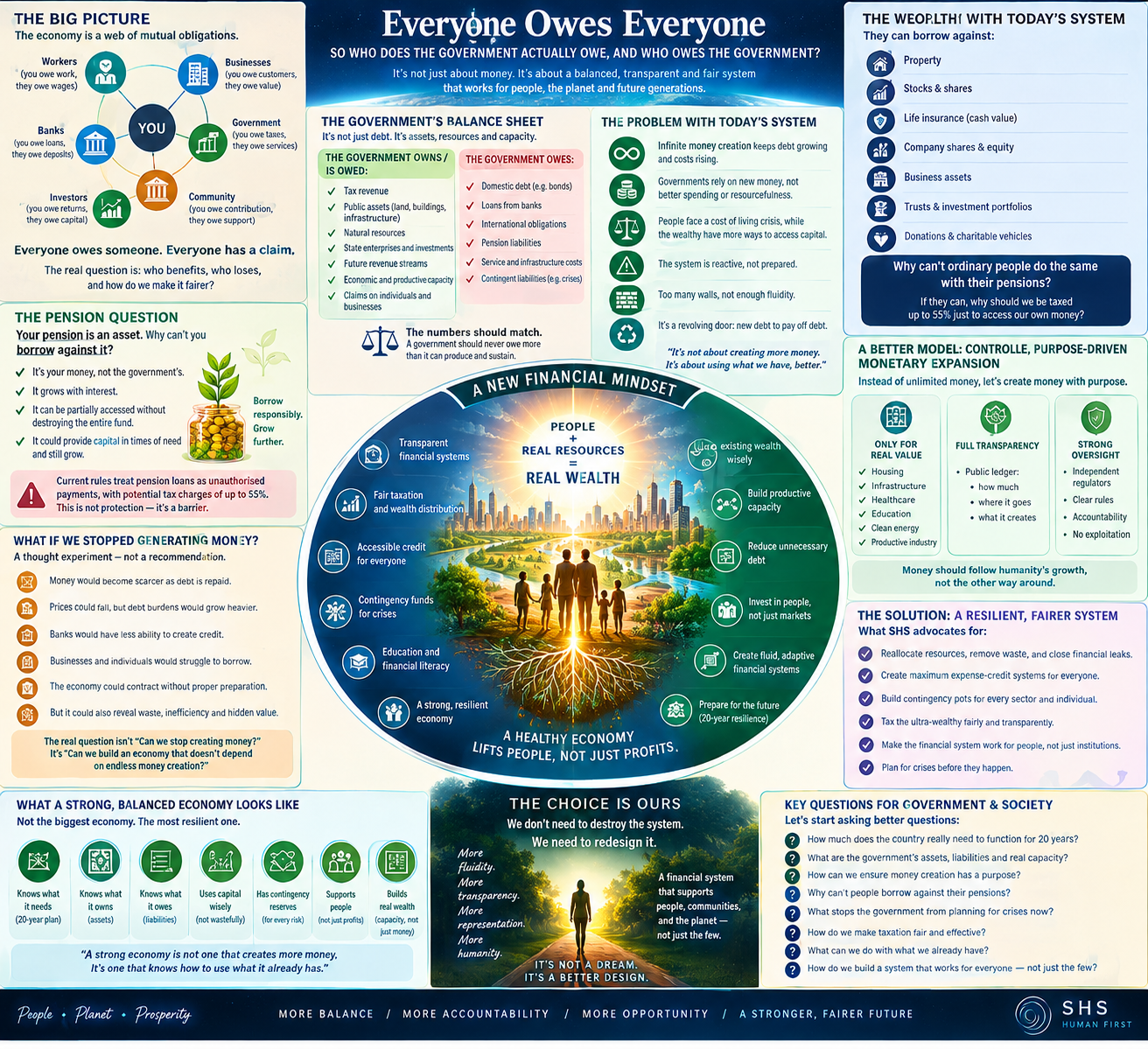
Can a government be so well financially managed, that it can walk over a freeze and not feel its pains?, basically be freeze-proof! Yes, but not the curremt system. Integration creates harmony, nothing else.
…
Yes. And the interesting part is that a true freeze on new money creation would not simply produce a smaller, tidier economy. It would fundamentally change how credit, debt and liquidity work.
The Bank of England confirms that most UK money is bank deposits and that commercial banks create deposits when they make loans; when the loan is repaid, that created deposit money is extinguished.
So let’s actually run the thought experiment.
Simulation: “No More New Money”
Starting conditions
Imagine that at midnight tonight the rules change.
From that moment:
No commercial bank may create a new deposit by issuing a new loan.
No central bank creates additional money.
Existing money remains valid.
Existing loans remain contracts and still have to be repaid.
Banks can still move existing money between customers.
People can still spend, save, invest and trade.
What has stopped is the creation of additional money.
That distinction is crucial.
Year 0 — Everything Looks Normal
On day one, almost nothing appears to change.
You still see your £5,000.
Your employer can still pay you.
Supermarkets can still sell food.
Your mortgage still exists.
Your pension still exists.
Companies still have bank accounts.
The government still has money in its accounts.
Everyone thinks:
“Nothing happened.”
But something enormous has happened underneath the surface.
The system has lost its ability to create replacement money.
Year 1 — Debt Starts Eating The Money Supply
This is where it gets interesting.
Suppose there are £100 of existing money in our simplified economy.
Now suppose £10 of debt is repaid.
Under the present monetary system, banks can make new loans elsewhere, creating new deposits and therefore new money.
Under our freeze:
£100 → £90
That £10 hasn’t gone into somebody else’s bank account.
It has effectively been extinguished through debt repayment.
And that process keeps happening.
Mortgages are repaid.
Credit cards are repaid.
Business loans are repaid.
Government bonds mature and settle.
People save rather than spend.
Money becomes progressively scarcer.
A Simple Five-Year Model
This is not a forecast; it is a stress-test illustration.
Suppose the economy begins with:
100 units of money
and, because money creation has stopped, existing monetary balances shrink by an illustrative 10% per year through debt repayment and other monetary contraction.
| Year | Remaining money |
|---|---|
| 0 | 100 |
| 1 | 90 |
| 2 | 81 |
| 3 | 73 |
| 4 | 66 |
| 5 | 59 |
After five years, only about 59% of the original monetary stock remains.
That doesn’t mean exactly 41% of British money would disappear in five years in reality—the actual result would depend enormously on repayment schedules, spending behaviour, bank balance sheets, fiscal policy and what the rules allowed.
But it demonstrates the structural problem.
A fixed money supply is not actually fixed once existing debt is continuously being extinguished.
Then What Happens To Prices?
Initially, potentially something rather attractive:
prices could fall.
If the quantity of money and credit is shrinking while goods and services remain available, sellers may have to compete harder for the money that still exists.
So you could see:
£10 → £9
£100 → £90
£1,000 → £900
That sounds fantastic.
Until you follow it one step further.
Because businesses don’t live on prices.
They live on revenues minus costs.
And their costs include wages, rent, debt servicing, energy, suppliers and taxes.
If prices are falling while debts remain fixed in nominal pounds, the real burden of those debts increases.
Debt Becomes More Powerful
Imagine owing:
£200,000
Your debt doesn’t automatically become £180,000 simply because prices fall.
You still owe £200,000.
But the economy around you may now be generating less nominal revenue.
So the effective burden of that debt gets heavier.
This creates a nasty feedback loop:
Money becomes scarcer → spending falls → business revenue falls → businesses struggle to repay debt → defaults rise → banks take losses → lending becomes even harder → spending falls further.
That’s the danger of a monetary freeze.
And Banks Would Be Hit Hard
This is probably the most important part of the simulation.
Banks do not merely hold money.
They sit at the centre of the credit system.
The Bank of England describes commercial banks as major lenders to households and businesses and explains that their ability to create deposits through lending is a central part of the modern monetary system.
Now remove that function.
A bank could still lend existing money.
For example:
I have £100.
You want £50.
The bank could potentially transfer £50 from an existing source to you.
But it could no longer simply create a new £50 deposit alongside a new loan.
That changes banking enormously.
Banks become much more like capital allocation warehouses than money creators.
And the supply of credit becomes much more limited.
Credit Would Become Extremely Valuable
Today, credit is one of the mechanisms through which purchasing power is brought forward.
A business can borrow before it has accumulated enough cash.
A household can buy a house before it has accumulated the entire purchase price.
An entrepreneur can borrow to build something before the future revenue exists.
Take money creation away and those possibilities shrink dramatically.
You would increasingly have:
“Show me the money first.”
rather than:
“Here is financing against your future ability to repay.”
That would favour people and organisations that already possess capital.
And that produces an enormous paradox.
We could eliminate one form of monetary expansion while simultaneously making existing wealth much more powerful.
The Wealthy Could Become Even More Important
This is where the experiment gets particularly interesting.
Suppose Person A has £10 million sitting in productive assets.
Person B has £20,000.
Under the existing system, Person B can potentially access credit.
Under our frozen system, that becomes much harder.
Person A’s existing capital becomes disproportionately powerful because new purchasing power cannot easily be created around it.
So instead of automatically producing equality, a fixed-money economy could produce:
greater competition over existing money.
And when access to something is limited, ownership matters enormously.
Governments Would Have A Huge Problem
Now imagine the government.
Government has £X.
It can tax.
It can spend.
It can issue debt.
But if we’re interpreting “stop generating money” in the absolute sense, there is no monetary expansion available to support the system.
Government spending therefore increasingly depends on money that already exists somewhere else.
Want to spend another £50 billion?
Then the government needs to obtain that £50 billion from the existing monetary pool through taxation, borrowing, asset sales or some other transfer.
It cannot simply assume that the monetary system will continuously expand alongside the economy.
That would fundamentally change fiscal policy.
What Happens During A Recession?
This is where I think the experiment gets dangerous.
Imagine unemployment suddenly rises.
Normally, the financial system has mechanisms capable of providing additional credit and liquidity, while central banks can also influence financial conditions and the quantity of money. The Bank of England explicitly identifies money and credit creation as central to economic functioning and financial stability.
Under our freeze:
You can’t create additional money to respond.
So the economy has to absorb the shock using the money already circulating.
That could mean:
business failures,
falling investment,
falling wages,
falling asset prices,
rising defaults,
reduced consumption,
and potentially severe unemployment.
But Here’s The Fascinating Part
It doesn’t necessarily mean the economy must collapse forever.
Eventually, humanity could adapt.
You could have:
fixed money + rising productivity + increasing circulation.
Suppose you have £100 permanently.
But technology lets you produce twice as many goods and services with those £100.
You don’t necessarily need £200 to exchange them.
Money can circulate faster.
Prices can adjust.
Contracts can be redesigned.
People could build businesses around equity rather than debt.
Communities could develop alternative accounting systems.
Digital settlement systems could become extremely sophisticated.
So a fixed-money economy isn’t logically impossible.
The problem is the transition.
The Transition Is The Monster
Think about the economy as a gigantic machine that has been designed around credit expansion.
Now imagine somebody saying:
“We’re switching it off tomorrow.”
The machine doesn’t suddenly become simpler.
It loses one of its primary operating mechanisms.
Millions of existing contracts were written assuming access to future credit.
Businesses were valued assuming future financing.
Property prices were influenced by mortgage availability.
Governments structured finances around debt markets.
Pensions invest in assets whose values depend partly on financial conditions.
Banks have balance sheets designed around lending.
So freezing money creation would be less like changing a tax rate and more like changing the operating system of the economy.
Now Let’s Try The SHS Version
Here is where the experiment becomes much more interesting.
Instead of saying:
“Stop creating money.”
SHS could ask:
“Why do we need uncontrolled or poorly understood money creation in the first place?”
And then test something different.
Model A — Current System
Money can be created through bank lending.
Credit expands.
Credit contracts.
Interest exists.
Banks earn from financial intermediation.
Government manages monetary and fiscal policy.
Model B — Fixed Money
No new money.
Every pound already exists.
Loans must come from existing capital.
Debt repayments shrink circulating money.
Money becomes progressively scarcer unless people spend it more rapidly.
Model C — Controlled Human-Centred Monetary Expansion
This is where I think your idea becomes much more interesting than simply “stop generating money.”
Instead of asking:
“Can we stop creating money?”
ask:
“Can we control why new money is created?”
Imagine new monetary creation being permitted only when it corresponds to something measurable:
new productive capacity,
new infrastructure,
new housing,
new businesses,
new scientific development,
new ecological regeneration,
new human services,
or other measurable increases in real economic capacity.
Then you stop treating money creation as the objective.
Money becomes a representation of expansion in productive capability.
That is a very different philosophy.
And Then We Add The SHS Principle
Imagine money creation being accompanied by a public ledger that says:
£1 billion created
→ £300m housing
→ £200m infrastructure
→ £150m healthcare
→ £100m education
→ £100m business development
→ £50m ecological restoration
→ £100m contingency
And then the public can observe:
What did that £1 billion actually create?
Now we aren’t simply arguing about whether money should exist.
We’re evaluating the relationship between money and reality.
The Real Question
This simulation actually leads somewhere much more profound.
The problem may not be:
“We create too much money.”
Nor:
“We should never create money.”
The better question may be:
“Why are we creating money, who gets to decide, what does it represent, and who benefits from its creation?”
Because money itself is not wealth.
The Bank of England makes this distinction very clearly: banks create money through lending, but banks do not create wealth merely by creating money. Wealth comes from the productive activity that money helps facilitate.
And that may be the missing piece in the entire conversation.
What If We Built An Economy Where Money Followed Reality?
Instead of:
Create money → hope the economy grows
we could investigate:
Create productive capacity → measure it → create the appropriate financial representation → monitor the outcome.
That would make monetary expansion accountable to something external to the money itself.
Human work.
Housing.
Energy.
Food.
Technology.
Infrastructure.
Knowledge.
Healthcare.
Nature.
Productivity.
Actual life.
And then your original question changes completely.
Instead of:
“What happens if we stop generating money?”
we arrive at:
“What would happen if we stopped generating money without purpose?”
That is the simulation I think SHS should actually run.
Because completely freezing money creation would probably produce a severe credit contraction and potentially a deflationary debt crisis during the transition.
But controlling monetary creation around measurable human and economic output could be an entirely different experiment.
And that is much closer to the SHS question:
Can money become a tool that follows humanity’s growth, instead of humanity constantly rearranging itself around the requirements of money?
….
I really love the points that you brought and how you also incorporated as a suggestion what you think asset trusts could possibly do. I do have some points, and then I want to see what you produce, because we really need to open up our perspective and our lenses. So let’s dive into this one, because everyone, if we look at the phrase, everyone owes everyone, right? Because whether it’s work, power, or it’s debt, or it’s investment, or it’s bonds, or it’s anything of that sort, everyone owes someone something, which means that the government, for example, is both creditor to the civilians, but it’s also debtor to the banks. Now, a question: wouldn’t the debts created match the debts the government has with banks or other countries, meaning the debts with its debtors? So who is the government creditor to? Look at how much credit is owed to the government, and then from there look at how much debt the government actually has to either banks or the countries, and the two numbers should match at best, or at minimum. But there should never be a debt that the government has more than the resources that the government can actually produce, and that is because, well, it creates responsibility and it creates accountability. If you keep allowing governments to depend on the creation of new money, the government doesn’t actually need to get better at spending their money. They can literally just spend without purpose and without actual resourcefulness and well-prepared organization, and continue to justify the debt increasing that will never actually get paid, because they’ll always add debt as they pay off debt. But that is a revolving door. There’s no actual understanding of the value that the government actually has in money management. That, to me, is terrible money management, because you’re depending just on having more capital, not on your ability to actually work best the capital that you do have, right? And their balance sheet should be just the same as they taught us in school how to money manage. Why is it that the government has a balance sheet that doesn’t actually make sense? Because if an individual was to go to a bank with the exact same amount or percentage of debt, the bank wouldn’t give any pound to the individual. So why would it give it to the government? We need to fix that, because infinite money keeps the costs growing, which means that the civilian is the one that then gets affected the most, and that’s where a cost of living crisis can actually be solved by simply knowing exactly how much money a country needs in order to function for, at best, 20 years. How much money does it need? And then capitalize that, and then allow the government and the country to actually build value that will extend the pool that that 20-year pool would have created, or would create. You know? This is how you actually learn how to be resourceful, because the current way tells me that there’s no actual strategy or well thought financial plan. It’s just adding money just to spend money and demanding more money from the people. That does not work, because again, the same people who are demanding more money from the people are people that don’t necessarily get affected by cost of living crises. So of course they won’t necessarily understand how disruptive it is to have infinite money. It is so disruptive to the whole economy. That’s what makes people lose homes, jobs, and everything, health, their lives, you know? A well-balanced economy is one that can sustain itself without newly generated money, because it should be freeze-proof, at least for 20 years. Like banks should be more like capital allocation warehouses, as being money creators hurts the whole. Though they could self-sustain, but not the people, and that means that it’s not balanced. We should have clear-defined need expenses and only work within those expenses instead of going beyond it, while also creating or having contingency pots for every occasion. We should have a contingency pot for everything and every individual within a government, because that’s how the government actually takes care of the people. I have a contingency pot for you. Worst case, we’re in a recession, don’t worry, I got you. You know, that’s how it should be. And how do we keep credit strong? The question is how do we keep credit strong with a closed economy, so that it doesn’t just favor those with more capital available, but that it can favor also those that might not have as much capital. Well, by reallocating the funds. Max, have max expense credits for everyone, and the reallocation is the one that actually balances out funds within a country. It removes financial inequality. It gives the people what the people actually want, which is equality and safety. It raises the welfare. Like, the amount of benefits that it actually creates, it’s enormous. It raises the benefits, all that money away from billionaires who are just spending it on things that have no purpose, while the country actually needs the money. It is disruptive to a government. The government should tax way more those who make more, because those who make more aren’t necessarily those who are funding the wholeness of it all. Because without the civilians, those who supposedly make more, the business owners, wouldn’t even have a business to run. So it’s the people that are actually building the value, and then the owners, the billionaires, the millionaires, are taking the credit. But they’re not the ones who are making the value. They’re not the ones who are making the money. The people are, because the people are putting their efforts, their time, their investment into these organizations, and they’re not even getting paid for the results that those contributions actually need a business to. And on top of that, you want to tell me that they’re also the ones who are getting more tax than everyone else? It does not make sense. And the reason why I said that they’re the ones who are getting more tax, it’s not because some millionaires will say, well, I have one million pounds. If I get taxed 22% on my million pounds, it’s different than having 50k and being taxed 22% on that. Very true. But at the same time, the person that has a million pounds also has stocks and shares that they’re not getting taxed on. They also have charities that they’re not getting taxed on. They also have donations that they’re not getting taxed on. They’re allowing money to move in their own economies without actually having those money and those resources going back into the country. So they can’t really use the excuse of, well, I have more money, so if I get taxed even a little bit more, it takes way more from me. Yes, it should do. It should do so, because you don’t need that much money. An individual needs at best 10 million pounds to live a well-lived life, throughout, like literally from birth to death. Everything beyond that is all excess. It’s all luxury. And when a country’s cost of living is in a state of crisis, it cannot allow all those luxuries without doing something. If they’re going to refrain the class, the working class, from doing certain things, like using a hose pipe to lower water, the use of water, they should do the exact same for those rich people who have mansions and buildings and fountains in front of their houses that keep using water. But do they do the same? Do they ask the same thing to them? I really so doubt it. But it’s not about water, because even there we can open the claim that there’s infinite amount of water if the government actually puts the resources and infrastructures to either clean water or to actually extract water in safe ways. Because Earth has an enormous amount of water. It’s whether we are actually good at managing so. And at the same time, we’re going to make people’s skills more valuable, just as much as we value possible commercial growth. If a company can get credit from a claimed and possible success that would happen in the future, Every individual should have the exact same leeway, because if we give it to organisations who are not even vegetables, they’re not even organic, they’re not even… they’re not living beings. If we can give that extension to a company, we should firstly give that to people. And a government’s financial strength isn’t rooted in continuous debt, a debt that we know for sure will never get paid, because it’s not building the infrastructures to be able to pay that. It’s only depending on the people paying taxes, and it’s depending on the banks giving it money, and it’s depending on whatever international relationship to seemingly have money moving internationally. But when your country is in need, your priority is in your country, because it shows the other leaders that you are a good leader for your country. And if you are a good leader for your country, that means that you’re even a greater leader when you go and support others, because you’ve done it already. You don’t go outside to other countries and pretend that your country is doing great, when really and truly it’s doing terribly. And a government’s financial strength is in knowing exactly how much you need to run. The same way we expect owners to know exactly how much they need to run their businesses, we should expect the government to know exactly how much it needs. If I was to ask a parliament, how much does a country need in order to run, they should be able to say the exact details, simply because they’re in the role. I’m coming from the outside. I’m offering a new governance, but I haven’t done the job on a daily basis. But I do know that if we were to be successful as a new governance, or governance of government, then it would be my responsibility to demand those numbers from government. But I won’t be the one managing the government. Like, I won’t be the one managing the country. I will be the one managing the government’s ways of moving resources, you know? And so I personally, as a governor of government, don’t need to know the exact numbers. I need to know how to ask a government to provide those numbers, and advocate for humanity in how those resources get used. I know exactly what my role is; don’t get it twisted. And they need to know exactly where it should go, the priorities. What is it that the people need first? What is it that the country as a whole needs to be focused on in order to create value that can rebuild more capital, even if we were to ask for more money to the banks. Because there should be predetermined credit and liquidity funds, pre-approved and extinguished funds, in the case of another recession. We cannot hope that it won’t happen again, and then when we’re there, the whole thing goes in crisis. It’s the same way that Britain isn’t prepared for snow. Every time that there is snow, everything goes in tilt, because they’re using the exact same mentality. They’re not actually preventing issues. They’re reacting to issues, and that is not how you run a company. That is not how you run a group. That is not how you run a community, and that is certainly not how you run a government, right? Now they need to focus on having those contingency, because the biggest question to me is why are those pots not already created? After the 2008 situation, I would have those pots created as potential, so that the banks would have already created that credit, and they can use that credit to build more revenue. And then when/if it happens, then they have it to provide just like a life insurance. We should treat the financial system like we treat a life insurance: have contingency pots prepared, paid into it, you know? But those who need to pay for that aren’t the people, because the people are not the ones who are controlling the financial system. Those who manage the financial system have created and allowed the system to be in this way, so they should be the ones paying into it. The Bank of England should pay into it, because they’re the ones who are the generators of money. They’re the biggest managers of money, the managers of the financial system. Not of the economy, but of the financial system. So they should put that money in place so that they have the contingency pots, and if ever a recession comes, they can provide and give that money, and then they can watch it come back through the expenses and the actual flow of that money. Because, really and truly, during a recession it’s not the money disappears, it just goes into a condensed part, but the money still exists. So it’s about restructuring where that money goes in the case of a recession, restructuring where money goes in general. And everything can be adjusted on the way. If we were to take, for example, a year just to prepare everyone to a freeze, and actually use the mentality of a possible freeze to start building systems and resources, so that they can be freeze-proof, that’s where we start seeing the real strength. Because it doesn’t need to hurt the economy if there is a year of preparation, calculating exact figures to hold the government going for years without ever feeling the switch. Like a government, if we were to allocate a freeze, for example, for 2030, within the next three years we should create an economy so strong, a financial system so strong, that we wouldn’t even feel the switch, you know? And everything else can adapt around it. That’s how you do a well-thought plan. It’s about valuing what’s already owned instead of unforgivingly depending on the novelty of money. Because new money should be for special occasions, not the norm. A capped economy grows and shows the economy’s lacks and leaks. This is how we actually look at the lacks and leaks and where money is poorly invested in.
…
Everyone Owes Someone — So Who Does The Government Actually Owe?
Everyone owes someone.
That is one of the simplest ways to look at the economy.
You owe your landlord.
Someone owes you wages.
A business owes its workers.
A customer owes a business.
A bank owes its depositors.
A borrower owes a bank.
A government owes bondholders.
Citizens owe taxes to government.
Governments owe other governments, institutions and investors.
Companies owe shareholders a return.
Investors owe capital to the opportunities they invest in.
It is an enormous web of mutual obligation.
So perhaps we have been looking at debt incorrectly.
Perhaps the question should not simply be:
“How much debt exists?”
Perhaps we should be asking:
“Who owes whom, how much, for what purpose, and what resources exist on the other side of every obligation?”
Because every debt has a corresponding claim somewhere.
And once we understand that, government finances start to look very different.
If The Government Owes, Who Is The Government Creditor To?
This is the question SHS wants to put directly on the table.
A government can be a debtor.
But a government can also be a creditor.
The state collects taxes.
It owns land.
It owns buildings.
It owns infrastructure.
It receives fees.
It has claims on money owed to it.
It has enterprises and investments.
It has future revenues.
It has the productive capacity of the country behind it.
So when we hear:
“The government owes £X trillion.”
the next question should immediately be:
“And what does the government own, control, receive and have claims over?”
That is a balance-sheet question.
And it is a much more intelligent question than looking at one giant debt number in isolation.
Debt Should Never Be Separated From Capacity
Imagine an individual goes into a bank and says:
“I already owe £500,000.
I have limited income.
I have very little available collateral.
But I would like another £200,000.”
The bank does not simply say:
“Absolutely. Here you go.”
It evaluates affordability.
Income.
Assets.
Liabilities.
Creditworthiness.
Purpose.
Risk.
Repayment capacity.
So why should government finance be judged by a fundamentally different intellectual standard?
Yes, governments are not households.
Government has taxation powers, the ability to legislate, much longer time horizons and, for monetary-sovereign states, monetary institutions that households do not possess.
But that is exactly why the standard should be higher, not lower.
A government has more instruments.
Therefore it should have more sophisticated financial planning.
What Is The Government’s 20-Year Number?
This is the question I would want answered.
How much money does this country actually need to function properly for twenty years?
Not:
“How much can we borrow?”
Not:
“How much can the market tolerate?”
Not:
“How much debt can we roll over?”
Not:
“How much additional money can the financial system create?”
I mean:
What does the country actually need?
Housing.
Energy.
Food systems.
Water.
Transport.
Healthcare.
Education.
Defence.
Emergency services.
Infrastructure.
Technology.
Justice.
Social care.
Environmental restoration.
Administration.
Contingencies.
Maintenance.
Everything.
Calculate it.
Cost it properly.
Model it.
Then establish what level of capital and liquidity would allow those essential functions to remain operational through severe disruption.
That number becomes enormously important.
Because once you know your actual requirement, you can start distinguishing need from excess.
What If We Capitalised The Country Properly?
Imagine a government creates a twenty-year financial resilience model.
Not twenty years of blindly frozen spending.
Twenty years of known essential requirements.
Then imagine the state gradually builds the capital, assets, productive infrastructure and contingency reserves needed to support that requirement.
Now something changes.
Government is no longer simply surviving from budget to budget.
It is building a financial foundation.
It has a pool.
It has infrastructure.
It has reserves.
It has contingencies.
It has productive assets.
And, crucially, it has a measurable relationship between what it owns and what it owes.
That is what financial strength should start to mean.
Debt Should Create Responsibility
There is something deeply unhealthy about a system where accumulating another layer of debt can become the solution to the previous layer of debt without a corresponding expansion of the country’s productive capacity.
A debt can be perfectly rational.
Borrow £1 billion to build infrastructure that generates £5 billion of productive value.
That can make sense.
Borrow £1 billion to build housing that reduces future expenditure while improving productivity, health and stability.
That can make sense.
Borrow to build energy infrastructure that reduces future energy dependence.
That can make sense.
Debt used to build capacity is one thing.
Debt used simply to keep spending beyond the system’s ability to sustain itself is another.
The question should always be:
What did the borrowing create?
Money Is Not The Same Thing As Wealth
This distinction is essential.
The Bank of England explains that commercial banks create much of the money used in the economy by making loans, while also explicitly distinguishing money creation from wealth creation. Creating a deposit does not itself create the underlying wealth.
That should radically change how we think about government.
If another £100 billion is created or borrowed, the important question is not simply:
“How much money did we get?”
It is:
“What did the £100 billion increase in actual capability?”
Did we build homes?
Did we improve transport?
Did we make energy cheaper?
Did we educate people?
Did we increase productive capacity?
Did we improve health?
Did we create businesses?
Did we make the country more resilient?
Or did we simply make the number bigger?
Because a bigger monetary number does not automatically mean a wealthier country.
We Need To Stop Confusing Expansion With Progress
This is one of the central problems.
An economy can expand financially while becoming harder to live in.
Prices can rise.
Asset prices can rise.
Debt can rise.
Government expenditure can rise.
Nominal wages can rise.
And yet an ordinary person can simultaneously become less secure.
So SHS wants to introduce a much harder measurement:
How much additional human and material capacity did that financial expansion actually produce?
Because that is what matters.
What Happens If We Freeze?
This connects directly to the previous simulation.
Suppose we decide:
No more new money.
That exposes something very quickly.
Existing debts still exist.
Existing obligations still exist.
Existing government commitments still exist.
Money can disappear when bank loans are repaid, because the deposit created by the lending is extinguished when that principal is repaid.
So a completely frozen monetary system would create a potentially severe contraction in credit and liquidity.
That means our objective should not necessarily be:
“Never create money again.”
It should be:
“Build an economy that does not depend on continuous monetary expansion merely to remain functional.”
That is a very different goal.
Banks Could Become Capital-Allocation Warehouses
This is where the architecture gets interesting.
The Bank of England itself explains that commercial banks create deposit money through lending and that this ability is a defining feature of banking.
SHS wants to investigate a different model.
What if banks increasingly became:
capital-allocation warehouses
rather than institutions whose survival and growth are deeply intertwined with continuous expansion of credit?
They could still lend.
They could still earn interest.
They could still assess risk.
They could still finance businesses.
But the system could increasingly operate from pools of deliberately accumulated capital.
That would change the relationship between:
savings → capital → lending → investment → production → repayment.
It would make the availability of capital more explicitly connected to the capital that has actually been accumulated.
But Then We Hit Another Problem
A closed or capped economy cannot simply favour whoever already has the most money.
Otherwise we recreate the same inequality in a different form.
The person with £10 million can fund everything.
The person with £10,000 cannot.
So how do we maintain strong credit without infinite money creation?
Reallocation.
That is where SHS wants to investigate maximum expense-credit frameworks.
Maximum Expense Credit
Imagine every person has an assessed baseline of essential financial needs.
Housing.
Food.
Energy.
Transport.
Healthcare.
Education.
Communication.
Emergency costs.
The objective would not be to give everyone unlimited credit.
It would be to establish a maximum responsible expense-credit capacity designed around actual human needs.
Now imagine unused capital being systematically reallocated towards productive or necessary expenditure rather than simply remaining concentrated indefinitely.
A person does not need £100 million in accessible spending capacity to live an extraordinarily good life.
A country does not need unlimited monetary expansion to provide everyone with a dignified life.
What it needs is good allocation.
The Reallocation Is The Engine
This is where the model becomes different from simply saying:
“Take money from the rich.”
SHS is interested in something more structural.
What resources exist?
Where are they?
Who is using them?
Who actually needs them?
What can they create?
What is currently sitting idle?
What is being spent without meaningful social return?
What capital is trapped?
What infrastructure is underused?
What resources could be redirected?
The objective is to improve circulation.
Because money that cannot move toward productive use is not doing much for the people who need productive opportunities.
The Billionaire Question
This is also why progressive taxation should not be discussed merely as punishment.
It is a resource-allocation question.
And yes, someone who possesses enormous financial capacity can absorb a higher contribution without experiencing the same loss of life quality as someone living on £30,000.
That is not because every pound is morally different.
It is because marginal utility is different.
Taking £10,000 from somebody who has £20,000 is devastating.
Taking £10,000 from somebody who has £10 million is economically and materially different.
But SHS also wants to look beyond income taxation.
Because wealth can exist through:
shares,
property,
business ownership,
trust structures,
investment portfolios,
foundations,
donations,
and other mechanisms.
So measuring someone’s economic contribution by their salary alone can miss a substantial amount of their actual financial capacity.
The People Create The Market
Here is another uncomfortable question.
Where does a company’s economic value actually come from?
A company may be owned by one person.
But the company relies upon:
workers,
customers,
suppliers,
infrastructure,
roads,
electricity,
education,
legal systems,
technology,
public institutions,
and the wider population.
Without the people participating in that ecosystem, the company does not exist in the same form.
So perhaps we should stop talking about wealth as though it is created by ownership alone.
Ownership captures value.
But value creation is often distributed across an enormous network of human contributions.
The worker creates.
The customer creates demand.
The public creates the market.
Infrastructure creates possibility.
Education creates capability.
Investment provides capital.
Management coordinates it.
Ownership captures a particular legal claim.
Those are not the same thing.
And That Changes Taxation
If society collectively creates the environment in which enormous private fortunes become possible, taxation can be understood as a contribution back into the environment that made that wealth possible.
Not punishment.
Reinvestment.
The question becomes:
How much does society need from those with the greatest capacity in order to keep the whole system healthy?
And then:
What is that money actually used for?
Because taxation without accountability is still weak governance.
The Government Needs Contingency Pots
This is perhaps the most practical part of the whole proposal.
Why does a government wait for a crisis before deciding how it will respond to a crisis?
We already know recessions happen.
We already know pandemics happen.
We already know banking crises happen.
We already know energy shocks happen.
We already know floods happen.
We already know infrastructure fails.
We already know wars can disrupt supply chains.
So why not have dedicated contingency pools for them?
A recession fund.
An energy fund.
A housing emergency fund.
A food-security fund.
A healthcare emergency fund.
A banking-stability fund.
A natural-disaster fund.
An infrastructure emergency fund.
A technological disruption fund.
And potentially individual resilience mechanisms.
“Worst case? We have a pot for that.”
That is what preparation looks like.
Treat The Financial System Like Life Insurance
This is where the analogy becomes useful.
We already understand the concept of paying into something before the bad thing happens.
Life insurance does not wait until you die to start asking:
“Should we perhaps prepare for this?”
The preparation happens beforehand.
So why shouldn’t financial systems work the same way?
Why shouldn’t banks and the financial infrastructure maintain predetermined resilience pools?
Why shouldn’t those pools be capitalised before the crisis?
Why shouldn’t the institution benefiting from the financial system contribute significantly toward maintaining its resilience?
The result would be a system that can say:
“The crisis has arrived. We already prepared for it.”
Instead of:
“The crisis has arrived. What do we do now?”
2008 Should Have Changed The Architecture
A crisis should produce institutional memory.
The lesson from a major financial crisis should not simply be:
“Don’t let that happen again.”
It should be:
“What infrastructure do we build now so that, if it happens again, we don’t experience the same vulnerability?”
That means stress-testing.
Contingency pools.
Liquidity planning.
Capital buffers.
Alternative financing.
Emergency housing capacity.
Emergency employment capacity.
Supply-chain resilience.
Public communication systems.
Pre-agreed intervention mechanisms.
And simulations.
Lots of simulations.
The Government Should Be Able To Tell Humanity The Number
This is where SHS’s role becomes very clear.
SHS does not need to pretend to be the government.
We do not need to run the country.
We need to govern the governance.
If government says:
“This country needs £X to maintain essential operations.”
SHS should be able to ask:
“Show us the calculation.”
What are the assumptions?
What are the liabilities?
What are the assets?
What are the recurring costs?
What are the one-off costs?
What is the contingency requirement?
What is already funded?
What is underfunded?
What produces value?
What drains value?
What can be redesigned?
What is essential?
What is discretionary?
What would happen under a recession?
What would happen under an energy crisis?
What would happen under a banking crisis?
The government’s responsibility is to know the numbers.
SHS’s responsibility is to make sure humanity gets to interrogate what those numbers mean and how the resources are used.
Government Should Be Freeze-Proof
This is ultimately the experiment.
Imagine declaring:
2030 — Monetary Freeze Preparedness Year.
Not necessarily saying that we actually freeze the entire monetary system in 2030.
Preparing as though we will.
For three years, the country builds resilience.
Every ministry calculates essential expenditure.
Every major infrastructure system is stress-tested.
Every contingency gap is identified.
Every major liability is mapped.
Every public asset is valued.
Every major revenue stream is mapped.
Every dependency is identified.
Every critical supply chain is tested.
Every emergency fund is built.
Every credit facility is prearranged.
Every major financial shock is simulated.
Then, when the imaginary switch is flipped:
nothing collapses.
That would be an extraordinary demonstration of financial strength.
What Does A Strong Economy Actually Look Like?
Maybe it isn’t the economy where money is constantly being created.
Maybe it isn’t the economy where GDP keeps growing while ordinary people become less secure.
Maybe it isn’t the economy where government debt grows indefinitely.
Maybe it isn’t even the economy with the largest financial markets.
Maybe a strong economy is one that can say:
“We know what we need.”
“We know what we have.”
“We know what we owe.”
“We know who owes us.”
“We know what our assets can produce.”
“We know what our people can produce.”
“We know our vulnerabilities.”
“We have contingency reserves.”
“We can survive major disruption without immediately needing somebody to create more money.”
Now that is financial strength.
The Economy Should Reveal Its Leaks
This is another reason a capped or constrained monetary experiment is useful.
Unlimited expansion can hide inefficiency.
If another £100 billion is always available somewhere, poor allocation can survive longer.
But when resources are constrained, inefficiencies become visible.
You suddenly discover:
This department wastes £4 billion.
This infrastructure is underused.
This programme duplicates another programme.
This contract is overpriced.
This resource is trapped here while another part of the country needs it.
This institution keeps asking for more capital without generating additional capacity.
A capped environment becomes a diagnostic tool.
It shows the leaks.
It shows the gaps.
It shows the waste.
It forces resourcefulness.
And That Is The Actual Experiment
SHS is not proposing that humanity simply switch off money and hope for the best.
We are proposing something more interesting.
What would happen if a country prepared to operate without relying on continuous monetary expansion?
What would it discover?
How much does it actually need?
How much does it waste?
How much does it already own?
How much value is trapped?
How much capital is unnecessarily concentrated?
How strong is its infrastructure?
How resilient are its people?
How dependent is it on debt?
How much contingency does it really have?
And what would happen if every pound had to prove that it was being used well?
Everyone Owes Everyone
That brings us back to where we started.
Everyone owes someone.
But that means everyone also has a claim somewhere.
A worker has a claim against an employer for wages.
A depositor has a claim against a bank.
A creditor has a claim against a debtor.
A bondholder has a claim against a government.
A government has claims through taxation and other revenues.
A citizen has claims on the infrastructure and services society has promised.
A country has productive capacity.
A company has assets.
A household has labour, knowledge, property and future earning capacity.
The economy is therefore not simply a pile of money.
It is a gigantic web of:
claims, obligations, assets, resources, capacity and relationships.
And perhaps the reason the system feels so unstable is that we keep measuring one side of the equation far more obsessively than the other.
We Need The Other Side Of The Ledger
Don’t just tell humanity:
“The government owes £X.”
Tell humanity:
“The government owns £X.”
“The government is owed £X.”
“The country produces £X.”
“These are the assets.”
“These are the liabilities.”
“These are the annual essential costs.”
“These are the contingencies.”
“These are the investments.”
“These are the inefficiencies.”
“These are the resources currently trapped.”
Then let humanity judge the architecture.
Because you cannot govern responsibly if you only understand what you owe.
You need to understand what you possess.
And you cannot manage a country’s finances responsibly if you keep solving every problem by finding another source of money.
Eventually, the question has to become:
What can we do with what we already have?
That is the beginning of resourcefulness.
That is the beginning of accountability.
And perhaps that is the beginning of a genuinely freeze-proof economy.
Not an economy that needs infinite money to keep itself alive.
An economy that understands its own value well enough that it can survive without constantly needing more of it.


Leave a Reply