What if we stopped asking people to prove that they already have economic value before allowing them to access economic opportunity?
What if we built the opposite?
What if we started by recognising that every human being already has the capacity to contribute value, and then built an economy around measuring, developing and leveraging that contribution?
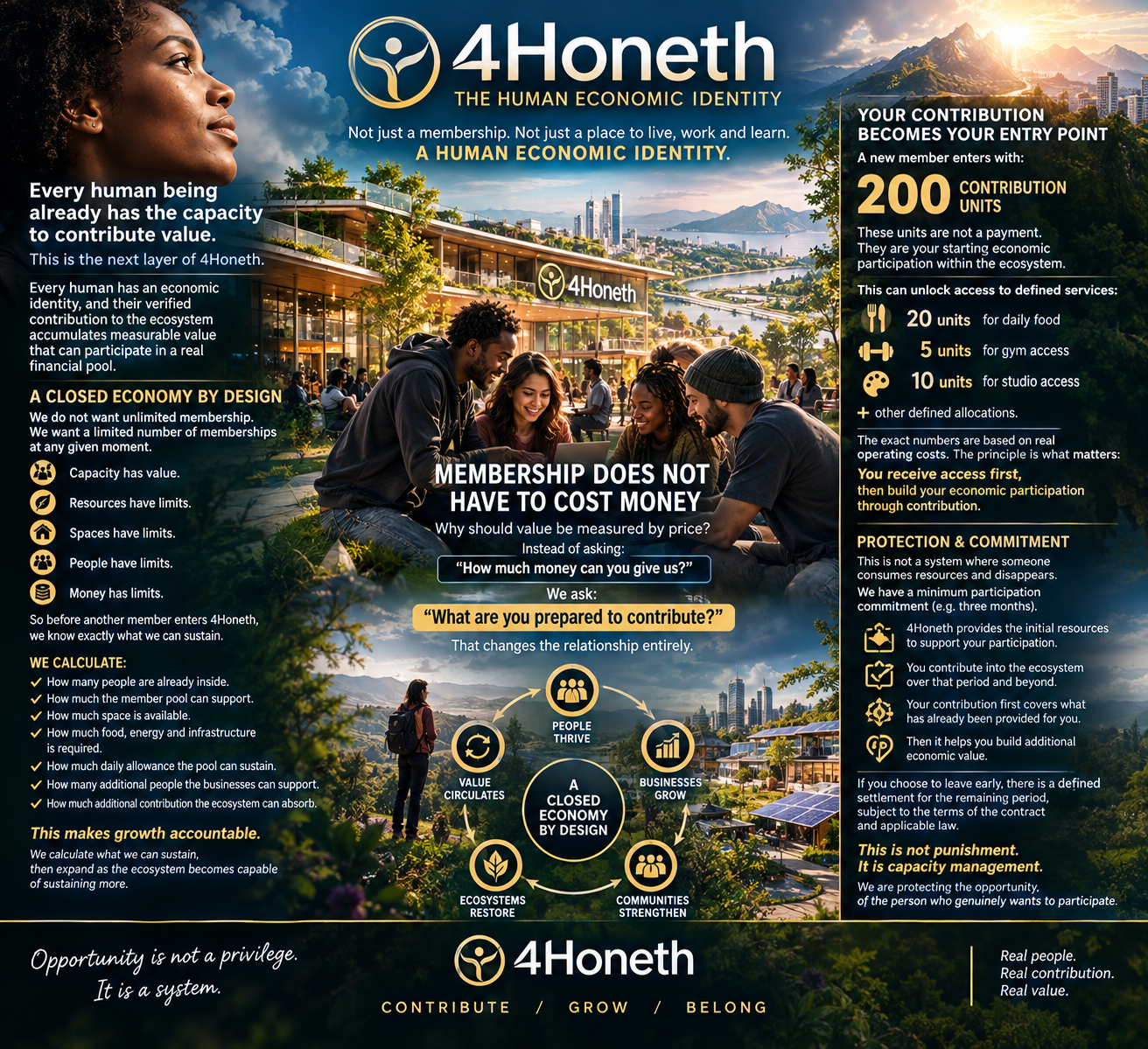
This is the next layer of 4Honeth.
Not simply a membership.
Not simply a workspace.
Not simply accommodation, education, creativity or business.
A Human Economic Identity.
Every human has an economic identity, and their verified contribution to the ecosystem accumulates measurable value that can participate in a real financial pool.
And this is where we start looking at what a genuinely closed economy could look like.
A Closed Economy By Design
We do not want unlimited membership.
We want a limited number of memberships available at any given moment.
Why?
Because capacity has value.
Resources have limits.
Spaces have limits.
People have limits.
Money has limits.
And instead of pretending otherwise, we want to know exactly what we can sustain.
So before another member enters 4Honeth, we know:
How many people are already inside.
How much the member pool can support.
How much space is available.
How much food, energy and infrastructure is required.
How much daily allowance the current financial pool can sustain.
How many additional people the businesses can support.
How much additional contribution the ecosystem can absorb.
This creates a deliberately managed closed economy.
And that does something extremely important:
It makes growth accountable.
We do not grow first and ask how to sustain it afterwards.
We calculate what we can sustain, then expand as the ecosystem becomes capable of sustaining more.
Membership Does Not Have To Cost Money
This is where we challenge the conventional assumption.
Why does becoming a member automatically have to mean paying a membership fee?
We already understand the psychology around payment.
People often place greater perceived value on something when they have paid for it.
A cheap product can even be treated as less valuable simply because of its price.
But price and value are not the same thing.
I could give the most valuable thing on Earth away for free.
I could charge £1,000 for something almost worthless.
The number does not create the value.
So what if 4Honeth membership did not begin with:
“How much money can you give us?”
but with:
“What are you prepared to contribute?”
That changes the relationship entirely.
Your Contribution Becomes Your Entry Point
When someone comes through the doors, they would receive an initial allowance from the existing member pool.
Let’s make the numbers deliberately simple for illustration.
A new member enters with:
200 contribution units.
Those 200 units do not mean they are suddenly worth £200.
They represent their starting economic participation within the ecosystem.
That participation can unlock access to defined services and spaces.
Perhaps:
20 units for daily food
5 units for gym access
10 units for studio access
and other defined allocations.
The exact numbers would be determined by the real operating costs of 4Honeth.
The principle is what matters:
The member receives access first, then builds their economic participation through contribution.
But 4Honeth Still Has To Protect Itself
This cannot become a system where someone walks through the door, consumes resources for a month and disappears.
Because every place given to one person is a place that cannot be given to another person during that period.
And when membership is intentionally limited, that matters even more.
So we would have a minimum participation commitment.
For example, three months.
4Honeth initially provides the resources required to support that person’s participation.
The member then contributes into the ecosystem over that period and beyond.
Their contribution first covers what the system has already provided for them.
Then, once that foundation is covered, their participation can begin building additional economic value.
And just as with a broadband contract, if someone chooses to leave before completing the agreed minimum commitment, there could be a defined settlement for the remaining agreed period, subject to the terms of the contract and applicable law.
That is not punishment.
It is capacity management.
We are protecting the opportunity of the person who genuinely wants to participate.
Because if ten people are competing for one available place, we cannot allow that place to be taken by somebody who intends to leave almost immediately.
We want people who are serious about building this.
This Is Not A Pay-To-Use Space
4Honeth is not:
“Pay us and use the facilities.”
It is:
“Enter the ecosystem, contribute to it, develop yourself within it, and participate in the value you help create.”
That distinction changes everything.
We are not trying to create customers.
We are trying to create participants.
People who understand that the better the ecosystem becomes, the more it can provide.
And that is exactly why contribution is so important.
Contribution Unlocks More
The first layer should cover the basics.
Food.
Essential space access.
Connectivity.
Core infrastructure.
Education.
Workspaces.
The things required to function.
Then, as contribution grows, further layers unlock.
Holistic therapies.
Massage.
Red-light therapy.
Additional studio access.
Specialised equipment.
Events.
Creative production.
Travel opportunities.
Business development.
Higher-level training.
Whatever the actual ecosystem can sustainably provide.
The member does not have to pay extra for every single thing forever.
Their contribution itself increasingly unlocks participation.
And where they want something before they have reached the relevant contribution level, they can still pay financially for certain extras.
That creates a second route.
Contribute to unlock.
Or pay for access where appropriate.
Either way, the money or value returns into the ecosystem.
The Money Does Not Just Disappear
Imagine a member wants to attend a concert inside 4Honeth.
They have not yet unlocked that level.
The public price is £100.
The member price might be £50.
That £50 does not simply disappear into SHS.
It can be recorded within their economic identity as part of their participation.
They have financially contributed to the event.
They have used the ecosystem.
The ecosystem has received revenue.
The contribution is recorded.
The member’s economic participation grows.
So we are simultaneously:
providing access, generating revenue, rewarding participation and building the person’s economic identity.
That is the circularity.
The Human Economic Identity Dashboard
Every member would have a dashboard.
Not simply:
Balance: £0
But a much larger picture.
For example:
Human Economic Identity
Contribution Units: 1,200
Verified Skills: 8
Projects Completed: 17
Community Contributions: 340 hours
Learning Completed: 24 modules
External Economic Value Generated: £X
Economic Participation Value: £X
Available Resilience Credit: £X
Current Credit Used: £X
Remaining Credit: £X
Learning Pathway: Level 3
Community Standing: Active
Participation Commitment: 76% complete
This is where a human becomes economically visible without putting a price on their life.
We are not saying:
“You are worth £200.”
We are saying:
“Your verified contribution has generated an economic participation value of £200 within this system.”
Those are completely different statements.
We Are Not Monetising Human Worth
This distinction is fundamental.
Human worth is not measurable through money.
A person’s dignity is not measurable through points.
A person’s soul is not measurable through productivity.
A person’s existence is not a financial asset.
We are measuring something much narrower:
economic participation.
What have you contributed?
What skills have you developed?
What have you created?
What have you helped produce?
What value has your participation generated?
What can the ecosystem responsibly make available to you because of that demonstrated contribution?
That is what we are measuring.
The More You Contribute, The More Your Economic Identity Grows
Imagine a member begins with:
200 units.
Over time, they contribute.
They learn.
They create.
They work.
They mentor.
They participate.
They build.
After a year, they have:
1,200 units.
Again, these numbers are illustrative.
Suppose the ecosystem’s valuation model says those 1,200 units currently correspond to:
£200 of economic participation value.
Now we have something very interesting.
The member could potentially borrow against a controlled portion of that value.
For example:
25% = £50.
The £200 remains associated with the member.
Only £50 is accessible as credit under the rules.
The member has not been gifted £50.
The system has recognised that their accumulated contribution can support a limited amount of financial access.
Their Contribution Becomes Their Collateral
That is the philosophical shift.
Traditional credit often asks:
What do you already own?
SHS asks:
What have you demonstrated that you can contribute?
Traditional systems often look backwards at financial history.
We want to explore a system that can also look at verified productive history.
Someone may not have £50,000 sitting in a bank.
But they may have:
skills,
reliability,
completed work,
successful projects,
community contributions,
learning,
creative output,
business activity,
and demonstrated capacity.
Why should all of that be economically invisible?
This Is Where Individual Economies Begin
Every member starts developing their own economic base.
Not because we gave them money.
Because we gave them a framework through which their contribution could accumulate measurable economic participation.
That means every person can gradually build an individual economy inside the larger economy.
The system grows.
They grow.
And the relationship is circular.
The better they contribute, the stronger the ecosystem becomes.
The stronger the ecosystem becomes, the more it can provide.
The more it can provide, the more opportunity members have to contribute further.
That is what we mean by leveraging individual value.
4Honeth Businesses Create The Real Financial Engine
And this is where the model becomes sustainable.
4Honeth should not depend entirely on members.
It creates businesses.
Those businesses serve members.
But they also serve the public.
Someone outside 4Honeth can buy the service.
A company outside SHS can hire the service.
A customer can buy the product.
A public event can generate revenue.
A creative production can generate income.
A technological solution can be commercialised.
A hospitality service can generate revenue.
And that external money comes back into the ecosystem.
So the closed economy isn’t closed in the sense that nothing enters.
It is closed in the sense that we know and manage the internal relationships, while allowing external revenue to continuously expand the pool.
That gives us:
internal contribution + external revenue = growing internal capacity.
We Also Become Co-Creators
There is another part of the structure.
When a member develops a creation through 4Honeth, SHS has supplied something substantial:
the infrastructure,
the space,
the equipment,
the training,
the network,
the support,
the systems,
the education,
and the opportunity.
That is not nothing.
So we can explore a defined creation share, perhaps 20–30% depending on the project and its structure, where SHS participates in the value created through its infrastructure.
But again, this is not simply:
“SHS takes 30%.”
The aim is for that share to help replenish and expand the ecosystem that made the creation possible.
It helps cover the resources advanced.
It helps fund future members.
It helps purchase equipment.
It helps maintain spaces.
It helps build new businesses.
It helps increase the member pool.
The infrastructure receives value because it creates value.
And the person creating the thing receives value because they created it.
Two Business Partners
Think of it like two partners bringing different things to a table.
One brings capital.
One brings the structure.
One brings money.
One brings the business model.
One brings resources.
One brings execution.
The creation becomes possible because the two meet.
4Honeth can therefore say:
“We provide the conditions in which your economic potential can become productive.”
And you can say:
“I will contribute my skills, creativity and execution into the system.”
Then the resulting value can be shared according to the agreement.
That is a much healthier relationship than simply charging rent for a room and calling it a business model.
The First Priority Is Recovery
The system also needs to be designed so that the first value generated by a new member helps offset what was already advanced to support them.
That means someone cannot enter with 200 units, consume £500 worth of resources and immediately walk away with economic value they never contributed.
Their first layer of contribution helps cover their initial participation.
Then they begin accumulating surplus participation value.
This protects the ecosystem.
And it also makes the person’s growth meaningful.
They are not simply consuming.
They are becoming economically stronger.
Education Is Contribution Too
Learning should count.
Because education creates future capacity.
Someone completing a course.
Learning software.
Learning construction.
Learning business.
Learning governance.
Learning financial literacy.
Learning how to communicate.
Learning how to manage themselves.
Learning how to work with others.
All of that can contribute to the person’s economic identity.
We are therefore not forcing people to choose between:
“education”
and
“productive work.”
Education itself can be productive.
It increases the capability of the person and therefore the future capability of the ecosystem.
Community Is Contribution Too
The same applies to community.
Someone mentoring another member.
Helping prepare food.
Maintaining a space.
Supporting an event.
Helping another person learn.
Contributing to governance.
Participating in community decisions.
Those activities may not immediately produce commercial revenue.
But they produce ecosystem value.
And that matters.
Because a society that only recognises commercially profitable activity becomes blind to many of the things that actually keep society functioning.
4Honeth wants to measure both.
The Economy We Actually Want To Build
This is therefore not simply a financial model.
It is an experiment in what happens when contribution becomes economically visible.
We want to test whether we can create an economy where:
People enter without needing to prove they are already wealthy.
People receive an initial level of support.
People contribute.
Their contributions are verified.
Their economic identity grows.
Their access grows.
Their skills grow.
Their opportunities grow.
Businesses grow around them.
External revenue grows the system.
The system reinvests.
Members become more economically autonomous.
And the cycle continues.
The Closed Economy Protects The Whole
This is why the membership cap matters.
If the economic pool supports 100 people, we take 100.
If it supports 150, we take 150.
If it supports 500, we take 500.
If it cannot support 500, we do not pretend it can.
That is responsible growth.
It means we know what we have promised.
It means we know what we can deliver.
And it means the people already inside are not sacrificed simply because we want to look bigger.
Functionality is being able to continue.
Quality is being able to continue well.
High quality is being able to continue well while creating more value than was originally required to continue.
That is exactly what this system is designed to test.
From Functionality To High Quality
A functional economy says:
“We can keep the lights on.”
A quality economy says:
“We can keep the lights on properly.”
A high-quality economy says:
“We can keep the lights on, improve the lives of the people inside, create additional value, reinvest that value, and continuously increase what the system is capable of providing.”
That is what we want for 4Honeth.
Not survival.
Expansion through contribution.
And Then We Can Scale
Once this works at one location, we can model it.
Then we can test another.
Then another.
Then another country.
Because the architecture isn’t dependent on one building.
The physical spaces change.
The businesses change.
The cultures change.
The people change.
But the underlying economic identity can remain.
Human → contribution → measurable participation → economic access → creation → revenue → reinvestment → greater capacity.
That can be modelled nationally.
Then internationally.
The Future Is Not Everyone Paying More
Maybe the future is people being given more ways to contribute.
Because contribution itself can become a source of economic power.
That means we can stop looking at people only through:
income, credit score, savings, assets.
And start looking at:
capacity, contribution, skills, creativity, reliability, learning, production and participation.
That does not eliminate the importance of conventional finance.
It gives people another layer.
A layer they can actually build.
The Human Economic Identity
This is ultimately what 4Honeth is proposing:
A person should not need to arrive already economically powerful before they can participate in an economy.
They should be able to build economic power through participation.
That is the Human Economic Identity.
Not a cryptocurrency necessarily.
Not a speculative token.
Not a price tag on a human being.
A record.
A measure.
A growing economic profile.
A bridge between contribution and capital.
A way of making productive participation visible.
And potentially, a foundation from which people can responsibly access financial opportunities that would otherwise be unavailable to them.
Because the future we are designing is not:
“How much money can we extract from the individual?”
It is:
“How much value can we help the individual build?”
And when that individual becomes stronger, the ecosystem becomes stronger.
When the ecosystem becomes stronger, it can support more people.
When more people become economically capable, more value enters the economy.
And when that value is reinvested, the cycle continues.
That is a closed economy that does not depend on endlessly creating money.
It depends on continuously creating contribution.
And that is the experiment 4Honeth intends to build.
We are not assigning a value to your life.
We are giving your contribution somewhere to accumulate.
We are giving your skills somewhere to become economically visible.
We are giving your participation somewhere to grow.
And ultimately, we are giving the human being back access to the value they help create.
That is the Human Economic Identity.
….
And this is just following the, like, financial conversation. There’s a point that I want to make for, especially when we all have our spaces, like for Hornet spaces, the creative spaces, built holistically. Because we really want to look at the spectrum of functionality, right? We have quality, and then we have functional. So we have basically the two poles. There’s one quality and functionality at the two extremes, at the two opposite. Because functionality is the bare minimum. It’s what has something work, what has something continue. It’s continuity, but it’s not sustainable. So it’s a continuity until something else has to go in for it to continue. But the bare minimum can also be the continuity when preserved at the expense of something else. It’s basically when the mission or the task gets done. That’s just functionality. Low quality is the minimum stated— low quality, sorry, is the minimum stated when it doesn’t get upheld. Whereas high quality— so functionality is, like, split in the middle. On one end you have high quality, and on the other end you have lower quality. High quality is where the bare minimum functionality is aced, and there’s more on top accomplished. There’s more on top projected. There’s more on top seen. There’s more on top planned for. There’s more on top granted and built. And with that in mind, we want to look at how do we bring high quality when it comes to finances and fintech architectures and infrastructures for Hornet. And I was thinking: what if we can find a fintech solution that turns every individual subscriber or member as a value of its own, meaning without having people pay money to be a member, which gives more boundaries when it comes to also the requirements. Because obviously we have and are aware of the psychology of how people invest more of themselves when they spend money. We would— and that’s why people feel a little bit more suspicious when there’s, like, a very low price on something. And that’s because they think that the number of the price of something is what makes it valuable, but it’s not. I could give the most valuable thing on Earth for free, and the least valuable thing in the world, I could have it be £1,000 per unit, you know? The number does not make the value. And at the same time, it would allow them to have more money for themselves when they go and interact with the system outside. Whereas when they come into our system, we can create businesses around for Hornet that provide both for Hornet but also sell outside of our, I guess, field, selling to the public that isn’t necessarily, like, a member or part of SHS. And that makes money for us to buy the tools that we need in order to do everything in-house, all the way until a point we’re self-sufficient completely. But in terms of the fintech is that: what if we were to register every person as, for example, a cryptocurrency of their own, and the value of that crypto or token, whatever, goes up with presence and participation. Basically, we transmute value of contribution into cashable money that we can use to uphold the expenses of the business itself. Run the simulation: what would we need in place? What are the technical aspects that already exist in fintech that we can use, utilize to create and bring about this idea? What would make it sustainable? What would allow it to really bring the impact that we’re looking at bringing.
Basically we would create a strongee individual economy for every individual so that they can also have something they can borrow against. By leveraging their built value.
“Every human has an economic identity, and their verified contribution to the ecosystem accumulates measurable value that can participate in a real financial pool.”
….
Yeah, sounds good. And I only mentioned cryptocurrency just because it’s one of those tools that we have to see and assign value on something, right? It doesn’t have to be necessarily a cryptocurrency. But write a full piece highlighting this structure that we will have at 400, called the Human Economic Identity. Basically we would have, like the way that we would build the whole thing is that we would have only a limited amount of memberships available at any given moment in time, which gives us exactly the closed economy that I was mentioning before, so that we know exactly and we can manage exactly how many members we can allow in any given moment in time. But also it allows us to expand slowly as we build finances, meaning that, of course to start the business, we would have funds, so we would put funds inside, so we would have a specific amount of funds that goes into the members pool, and based on the allowance that we can put in the members pool, that would dictate how many members we’ll be able to have as a member at any given moment in time. Now, in order to protect the business as well, so we give an allowance that covers daily expenses, and as they contribute, the more they contribute, the more the allowance grows, but before it starts growing it will cover off the expenses that they would have utilized when firstly started. Let’s say that a new member comes in the doors at 400 today, they have, let’s say, a pool of 200 points. Windows 200 points they can use, 20 to eat daily, they can use, I don’t know, five to utilize the gym, 10 for the studios, and let’s say after one week of contribution, so we would have also mandatory contributional aspects on a weekly basis, and this allows us to also attract a very specific audience that wants to contribute. We don’t just want people that want to come and use our spaces because there is multiple different spaces where they can access and individual things that we will offer all under one roof. We are creating a new governance, we are creating a new pilot, we are creating a new economy, we are creating a new way of doing business. So we want people that are serious in contributing to seeing how far this style can then expand, because then we can then model that not just nationally but also internationally. So, we would have a specific amount that covers only certain activities, and then as the first layer is, as they would have contributed and the first layer is covered, then they can also get access to additional services. For example, they can also access holistic therapy, like red light therapy, or things like that, or massage sessions, and so it all goes in stages, right? It unlocks in stages, it unlocks on contribution, because we’re literally leveraging contribution. We’re valuing contribution, we’re valuing someone’s contribution to a system, because we want to incentivize contribution, and we want to also build the practice, the active practice of contributing to something greater than yourself, because it does contribute to both the wholeness and yourself in the long run as well, because the more they contribute, the better the system gets, the better the system gets, the more we can actually provide for them, and if they desire participation to certain things that are unlocked when they do want to participate, then at that given moment in time they can pay financially for those extras, and in doing so, it allows them to still participate to certain things, which will still build the contributional aspect, because the money that they would put in to finance, let’s say a special event, a concert happens, and they haven’t unlocked the level that they can access it quote-unquote for free, they would get like a discount version, different from the public that isn’t a member, where the public will pay the full price, the member will pay a selected percentage of it, and that amount of money that they would have paid would go directly into their own individual member dashboard, where they can see their economic identity with all the different aspects, whether it’s contribution units, verified skills, projects completed, community contributions, and external economy value generated, economic participation value, available resilience credit, so like a contingency, current credit used, how much is remaining, learning pathway, and also for their learning they will also get contribution points for that as well, community standing, and from this dashboard, yeah, so it will go to cover what they would have expended, which gives them more contribution points, and at the same time it also unlocks the money that they can then borrow against their own economic identity, meaning that over the course, let’s say after one year, they need extra money for a project that they’re running, and they’ve gone to a point where they’ve both contributed in the creations and also contributed in the system itself, and they would have, let’s say from a starting point of 200 points, now they’ve gone up until 1,200 points. Now from the 1,200 points, let’s say, these are obviously rough numbers, these are just random numbers that I’m throwing. Let’s say that is worth 200 pounds. Now that 200 pounds that’s available, they can borrow 25% of it. Now they can get 50 pounds out of that 200 pounds, and that 200 pounds, it’s sitting there as still their money, but only 25% of it can be taken out at any given moment in time, because basically we are leveraging their contribution. So it’s not like they’re putting money into their memberships. So they’re getting, by contributing, by coming in and everything, they’re getting the ability to build their own economic value, to see it growing, and then extract money from it. And when I was mentioning protection, it protects the business, because there might be people that might want to take advantage, and they see that, oh, I don’t need to put down money, and I already have some sort of allowances, let me go and contribute, let me go and utilize some spaces, and then just quit. So instead of doing that, because by giving so much freedom financially, we can also instill stricter rules, meaning we would cover, let’s say, three months of participation, right? So they have to cover three months of participation, and the value of their contributions will allow them to build more than just three months worth of allowance in order to use our spaces, right? And it’s three months mandatory minimum, and if they don’t cover three months, we would do just like a broadband contract. If you don’t finish the contract, you pay the difference. We would do something like that, simply because we want people that are serious, especially because we have a limited amount of people that we can take in at any given moment in time. We don’t want To take away the possibility from someone that might be serious, that might have not gotten the chance simply because of the numbers. And then that person that did get the chance comes in and then leaves after one month and doesn’t even take it seriously. We don’t want any situations like that. We want people that will lead the front of what 400, in partnership with SHS could be. And in order to do that, we need to make sure that we only attract the right people. And also, when they do creations, SHS, we could possibly have an estate fee of, like, either 20 or 30 percent, where we become, like, their co-creators, simply because we provided the infrastructures. It’s like two business partners come together, one brings the money and one brings the structure of the business, right? They both make a cut, but obviously in long term, the one that brings the business will need to match the value of the one that put the money in order to either buy them out or to even things out. So in the same way, we provide the system, we provide the infrastructure, we provide them with the training, we help them leverage their own value and also raise their own economical value, and in return we get either a 20 or 30 percent from any creations that get done at SHS, and that is a one-off fee that goes back into their own pool. So it’s not necessarily money that comes to us. It goes to cover the money that we would have put in advance for them in order to be able to use our services. So what basically we’re doing, what the system is not willing to do. The system is not willing to give you money up front and then tell you, Okay, we give you this money so that you can create more value. But it is willing, and that’s the thing, it’s not willing to give it to you just for simply being alive. It’s willing to give it to you for, like, a specific credit score or a specific amount of having shown being, like a serious lender. We are taking and giving trust at the forefront. We’re not asking people, Show me your credit score in order to then give them the coverage. We’re telling them, This is the contract, these are the things that we say we’re gonna give and what we are gonna demand, or what is required of you, or what you’re responsible of, and what we’re responsible of, what you’re accountable for and what we’re accountable for. And then let’s start this partnership where we provide you with the infrastructure, you build value for yourself, and you manage it at large. And we make, we cover. It’s not that we make money. We cover what they would have utilized. And that’s it. That creates a closed economy that works very well because it doesn’t lean on the creation of new money. It leans on the creation of contribution. So that means that if a new member comes in, they won’t be able to necessarily cash out because they haven’t contributed to anything just yet. They would need to contribute to offset what we would have provided for. And then from there, to maximize of all the different ways that we would have created possible for them to contribute, so that they can make more. And basically, yeah, we’re helping them leverage their own individual value, not assigning a worth to a life, but economical value and the power of production.



Leave a Reply