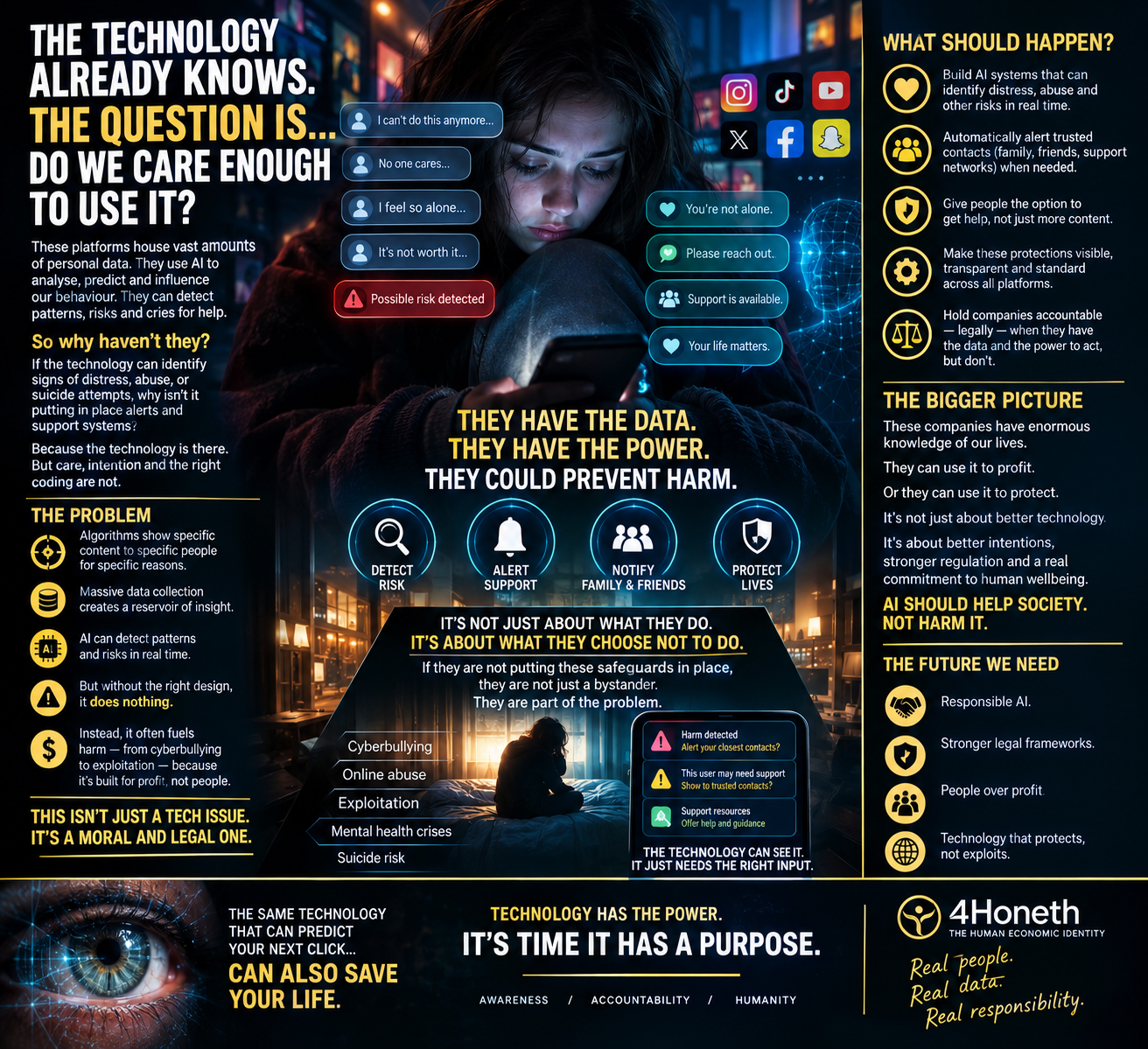
The next part of this conversation moves further into the legal side.
Corporate legal.
Corporate law.
Corporate responsibility.
Because once we start looking seriously at the technological platforms that now sit inside almost every part of human life, we have to start looking at something that is extremely uncomfortable:
What happens when a company possesses enormous amounts of information about human beings, possesses technologies capable of analysing that information, and still fails to use that capability to recognise obvious calls for help?
This is not simply a question of whether a company has done something directly harmful.
It is a question of what a technological infrastructure is capable of seeing.
And what it chooses to do with what it sees.
These platforms have become enormous reservoirs of human information.
Messages.
Searches.
Posts.
Comments.
Images.
Videos.
Relationships.
Interactions.
Patterns of behaviour.
Changes in behaviour.
Who someone speaks to.
How frequently they speak.
What they engage with.
What they repeatedly search for.
What they suddenly stop engaging with.
What they repeatedly return to.
What communities they participate in.
What content causes a reaction.
What content gets ignored.
What content receives attention.
What people are doing at particular times.
And increasingly, artificial intelligence and algorithmic systems are sitting on top of all of that information.
We already know this technology can rearrange information with extraordinary precision.
That is literally what recommendation algorithms do.
They take an enormous amount of information and attempt to determine what specific content should be placed in front of a specific individual for specific reasons.
The system is constantly calculating.
What should this person see?
What are they likely to engage with?
What keeps them on the platform?
What interests them?
What do they respond to?
What should appear next?
So we already accept the premise that technological systems can identify patterns within human behaviour.
We already accept that they can process enormous quantities of information.
We already accept that they can predict, classify, rank and surface information.
So then comes another question.
Why haven’t we made human safety one of the things these systems are designed to recognise?
Not perfectly.
Not as some magical machine capable of understanding the human soul.
It is technology.
Technology can be wrong.
Human beings can also be wrong.
But there is an enormous difference between saying:
“The machine cannot guarantee prevention.”
and saying:
“Therefore we should not make the machine capable of signalling the possibility of danger at all.”
Those are not the same argument.
The Technology Already Exists
We already have systems capable of identifying patterns.
We already have systems capable of detecting certain forms of prohibited content.
We already have systems capable of recognising spam, fraud, coordinated behaviour, copyright infringement, suspicious transactions and many other forms of activity.
So why should serious calls for human help be treated as technologically impossible?
Why could a system not potentially identify patterns associated with:
suicide risk,
serious abuse,
coercive behaviour,
sexual exploitation,
credible threats,
severe cyberbullying,
dangerous harassment,
or other forms of escalating harm?
Again, the point is not that a machine should automatically declare:
“This person is definitely going to hurt themselves.”
That would be irresponsible.
The point is that the technology could potentially recognise patterns that deserve human attention.
It could potentially produce a signal.
A warning.
An escalation.
A prompt for review.
A pathway toward assistance.
And that distinction matters enormously.
Because sometimes the purpose of technology is not to know the answer.
Sometimes its purpose is simply to tell humanity:
“Something here deserves your attention.”
The Algorithmic Question
This becomes even more interesting when we look at algorithms themselves.
An algorithm is, at its core, a structured way of processing information according to defined rules.
And modern platforms use these systems constantly to determine what individuals see.
So imagine taking the exact same technological infrastructure and adding another instruction.
Not:
“Show this person more content because it will keep them engaged.”
But:
“If the system detects a pattern that may indicate serious danger, identify the appropriate safeguarding pathway.”
That could mean many different things depending on the circumstances.
It might mean directing someone toward support.
It might mean escalating content for trained human review.
It might mean providing an appropriate safety intervention.
And in carefully designed circumstances, it could potentially mean notifying an appropriate trusted person where legally and ethically justified.
Imagine a situation where a platform has sufficient evidence that an individual may be in immediate danger.
The system could potentially identify the people the individual interacts with most closely online.
Family.
Friends.
Trusted contacts.
Support networks.
Not automatically exposing someone’s entire private life.
Not broadcasting sensitive information.
Not turning every sad message into an emergency.
But creating a carefully controlled mechanism for situations that cross a genuinely serious threshold.
The technology could potentially say:
“Something appears to be wrong here.”
And then allow humans to decide what happens next.
That is very different from allowing the system to make the decision by itself.
Technology Does Not Need To Be Perfect To Be Useful
This is where the argument often becomes confused.
People say:
“What if the AI gets it wrong?”
Of course it will sometimes get it wrong.
Humans get things wrong too.
Doctors get things wrong.
Teachers get things wrong.
Police officers get things wrong.
Social workers get things wrong.
Parents get things wrong.
Friends get things wrong.
The existence of error does not mean that we abandon the possibility of detection.
It means we build systems around error.
Human review.
Safeguards.
Consent.
Thresholds.
Appeals.
Privacy protections.
Proportionality.
Evidence.
Clear accountability.
The fact that technology is imperfect is not an argument against teaching it to recognise potential harm.
It is an argument for designing the system responsibly.
The Forgotten Possibility
Because there is another side to technological data collection that deserves much greater attention.
We constantly hear about data being collected because it helps companies:
advertise better,
recommend content,
increase engagement,
understand markets,
sell products,
optimise platforms,
predict behaviour,
and increase profits.
Fine.
But when companies possess this much information, another question naturally follows:
What else could this information be doing for humanity?
Because information is not inherently good or bad.
It depends on what we do with it.
A reservoir of information can be used to sell someone something.
Or it can potentially be used to recognise that someone is in danger.
It can be used to maximise engagement.
Or it can potentially be used to identify escalating abuse.
It can be used to recommend the next video.
Or it can potentially be used to signal that something within a person’s behavioural pattern deserves human attention.
That is the part of this conversation that I think society has barely begun to explore.
Cyberbullying Is A Perfect Example
Take cyberbullying.
We already know it happens.
Repeated harassment.
Humiliation.
Threats.
Targeting.
Social exclusion.
Mass participation.
Dogpiling.
Persistent abuse.
And sometimes that behaviour can continue for days, weeks, months or years.
Now think about the infrastructure required for that to happen.
The platform.
The accounts.
The messaging systems.
The comment systems.
The notification systems.
The recommendation systems.
The ability to repeatedly reach the same person.
The ability to gather audiences around the person.
The ability to amplify the abuse.
The ability to preserve the history of the abuse.
The technology does not necessarily create the intention to bully.
But it can create the infrastructure through which bullying becomes scalable.
And that creates a completely different corporate question.
At what point does providing the infrastructure become more than simply “watching”?
Because when harmful behaviour can be repeatedly facilitated through a system, the architecture itself becomes part of the environment in which that harm occurs.
This is why cyberbullying cannot be discussed solely as:
“Some people were cruel to another person.”
We also need to ask:
“What did the infrastructure allow those people to do?”
And:
“What did the infrastructure know was happening?”
And:
“What did it do with that knowledge?”
The Bystander Problem At Technological Scale
There is a very important distinction here.
The engineers working for these companies are obviously not sitting there personally reading every conversation.
That is not what this argument is saying.
The point is that the infrastructure itself processes the information.
The artificial intelligence processes the information.
The moderation systems process the information.
The recommendation systems process the information.
The algorithms process the information.
The technology sees patterns even when individual employees do not.
So when we say:
“The company knew.”
we need to become much more precise about what that means.
Did a specific employee know?
Did management know?
Did the company have reports?
Did the moderation system identify it?
Did the algorithm process indicators associated with it?
Did internal safety systems receive signals?
Did the company have technology capable of detecting it but simply fail to configure that technology to do so?
Those are legally and ethically different questions.
And that is exactly why corporate law has to start catching up with technological reality.
Capability Creates A Different Conversation About Responsibility
This is where the legal conversation becomes much more interesting.
We should not automatically conclude that every tragedy occurring through a technological platform makes the company legally responsible.
That would be an extraordinary leap.
Technology cannot guarantee prevention.
Platforms cannot know everything.
Human behaviour is unpredictable.
People can hide what they are doing.
Signals can be ambiguous.
Privacy matters.
False positives matter.
Free expression matters.
And legal responsibility requires actual legal standards, evidence and causation.
But that does not mean capability is irrelevant.
Quite the opposite.
We should begin asking whether technological capability can become part of the factual analysis of corporate responsibility.
Not:
“Could the machine have magically prevented the event?”
But:
“What information did the company’s systems possess, what capabilities did they have, what risks were reasonably foreseeable, what safeguards existed, and what did the company choose to do with that capability?”
That is a much more serious question.
The Question Of Corporate Purpose
And this brings us into the distinction between companies that primarily ask:
“How do we maximise this platform?”
and companies that ask:
“How do we maximise this platform while remaining responsible for the human beings inside it?”
Those are different corporate cultures.
A company can technically comply with the law and still ask itself whether it is doing enough.
A company can legally protect itself while socially exposing other people to preventable harm.
And that is precisely where corporate governance should become more sophisticated.
The question cannot always be:
“Are we legally required to do this?”
Sometimes the better question is:
“We can see that this is possible. We can see that this could help. Why aren’t we doing it?”
That is a governance question.
The Difference Between Profit And Care
This also brings us back to something fundamental.
When the primary purpose of technological infrastructure becomes growth, engagement and profit, care can become an afterthought.
Not necessarily because everyone inside the company is uncaring.
But because systems follow priorities.
If an organisation is constantly optimising for:
more users,
more engagement,
more advertising,
more revenue,
more data,
more growth,
then those become the variables the machine learns to optimise around.
Human wellbeing can become secondary unless it is deliberately designed into the system.
That is the crucial point.
Care does not automatically emerge from capability.
It has to be incorporated.
Someone has to decide that the technology should do it.
Someone has to design it.
Someone has to test it.
Someone has to monitor it.
Someone has to establish the safeguards.
Someone has to take responsibility for what happens when it fails.
From Algorithms Of Attention To Algorithms Of Care
This is where I think we need to start imagining an entirely different generation of technological infrastructure.
We have spent years developing algorithms designed to capture attention.
What if we developed algorithms designed to recognise when attention should become care?
What if platforms were designed to detect not just what people want to watch, but when something in a person’s digital behaviour suggests:
“Please pay attention to this human being.”
Not surveillance for surveillance’s sake.
Not punishment.
Not automatic intervention into every private thought.
But intelligent safeguarding.
A technological system that can say:
“I cannot solve this. But I think somebody should look.”
That could become one of the most socially useful applications of artificial intelligence.
The Legal Claim Cannot Simply Be “You Should Have Prevented It”
Because again, we have to be precise.
We cannot simply take every tragedy and retrospectively claim:
“The company could have prevented this.”
That would be far too simplistic.
But there is another possible legal and corporate question:
Was there information within the company’s systems that could reasonably have been used to identify a foreseeable risk, and did the company have an existing technological capability that could have surfaced that information to an appropriate human decision-maker?
That is a very different proposition.
The technology might not have prevented the event.
But it may have provided knowledge.
Knowledge may have provided exposure.
Exposure may have created an opportunity for intervention.
And intervention may sometimes have changed the outcome.
We cannot assume that it always would.
But we also cannot assume that it never could.
Information Can Become An Opportunity To Help
That is ultimately what I am talking about.
These companies have accumulated extraordinary amounts of information about humanity.
The question is not simply:
“What can we sell because we know this?”
It is also:
“What can we protect because we know this?”
And that is a completely different philosophy of technology.
Because when the technology already possesses the information, the discussion changes.
We are no longer talking about inventing a sensor from nothing.
We are talking about deciding what the system should recognise.
We are deciding what signals matter.
We are deciding what thresholds matter.
We are deciding what human response should follow.
We are deciding what ethical limits should exist.
We are deciding what responsibility accompanies technological capability.
SHS Wants To Explore That Question Properly
This is where SHS begins moving into a much larger corporate-governance investigation.
Which companies are building technology primarily to extract value from humanity?
Which companies are building technology to create value for humanity?
Which companies genuinely incorporate human safety into their infrastructure?
Which companies treat safeguarding as fundamental?
Which companies only respond when pressure arrives?
Which companies collect enormous amounts of information but have barely considered what that information could do for the people generating it?
And legally, where should the boundary begin to move?
Not toward making technology responsible for everything.
But toward recognising that when corporations build systems with extraordinary capacities, capacity itself can no longer be ignored when we discuss responsibility.
Because we are now reaching a point where the technology can sometimes identify things that individual humans cannot.
And when that happens, the question becomes unavoidable:
What are we asking the technology to look for?
Because a machine does not decide what matters.
Humans decide what matters, and then we teach the machine to look.
That means the failure is not necessarily inside the machine.
Sometimes it is inside the design.
Sometimes it is inside the priorities.
Sometimes it is inside the corporate culture.
Sometimes it is simply that nobody thought to ask the question.
And that is exactly the question SHS intends to ask.
If the technology can already see so much, why are we not teaching it to see the things that matter most to human life?
….
The next point is that we’re going to move more on the legal side, corporate legal, corporate law, and here we start looking at all the things that these technological platform house the data of, and all the events that could have been avoided, given the amount of data that they house. And the reason why I say that in that way specifically is because majority of them, they all have and have been having, have had AIs rearrange information in a specific way, and that’s how we have things like algorithms. Algorithms is literally having and showing a specific content in front of a specific individual for specific reasons. So if all these companies have had so much and acquired so much data collection, basically have a reservoir of data, the question is: if these technologies are so advanced, why haven’t they put a prompt to signal out any calls for help, whether it’s like suicide attempts, whether it’s like abuse of any kind? Because the technology is there, but one has to have the care in order to actually do so and incorporate it in their own ways of doing business. And possibly made seen because if they were to use, for example, the technology of algorithms in a healthy way, these technology brands could potentially have an input that says: when you scan an individual and notice that they’re either giving out calls for help or anything like that, show it to their most engaged with profiles, whether it’s like family or friends and whatnot. Because if they don’t, well, they should still be eligible to be involved in the legal claim simply because their technologies house the data that could have not necessarily prevented it, because it is at the end of the day just technology, but it could have provided with the knowledge. It could have provided with the exposure that the family of the individuals, or friends of the individuals, or whoever they engage with the most online, it would have given to those individuals a sort of like an alert or something like that. But this is something that you have to put in your technologies, and you have to actually think about. Because if the intention is not necessarily to actually take care of the individuals, but it’s only to just sell them or grow and develop their own platforms, then of course things like this become like an afterthought. And this is where we start looking at really the companies that do care and the companies that care predominantly about profit. Because these machines, they could have prevented a lot of accidents, quote unquote accidents. Because the machine themselves, they can do the math for us. It’s built to do so. It’s whether people care enough or know enough to put in the right coding, right? And I say so because when you take a step back and you start looking at the amount of information that these technologies have, you start really getting to the point of, well, these companies have a lot of information, and what are they doing with the information outside of selling the information for their own profits? Well, they could have actually helped a lot of people, you know? There’s a really interesting TV series, 13 Reasons Why. We all know it. Well, a lot of, or even cyberbullying or things like that, a lot of those things happen constantly, but are the technologies that we use in order, because those technologies, by not having something in place that either stops it or flags it instantly, is basically condoning and allowing and giving infrastructure to the bullies themselves. Because it’s giving them the tool to bully others. It’s giving them the tool to sustain that cyberbullying. And if they’re not doing anything about it, that means that they’re like a bypasser. They’re just watching it happen. Sure, this doesn’t mean that there’s the engineers that are literally seeing the data in front of them all the time, but it does say that this technology does see it. The AI does see it. But the AI doesn’t know to do something about it if we don’t give it an input. And that’s where we really have to look at the development of AI and actually how we are training these individuals, sorry, these infrastructures, these tools. Because we can have them trained to help and aid to society, not to allow the harms that the system allows humanity to do, also in the digital realm as well.
….




Leave a Reply