
There is a question I keep coming back to because it exposes just how much of our social architecture we have accepted as inevitable.
What would happen to charity if government actually solved the problems that charities exist to solve?
Not managed them.
Not reduced them.
Not funded another five-year strategy to address them.
Actually removed the conditions that made the charity necessary in the first place.
Because we talk about charities as though they are simply a beautiful expression of human generosity. And they can be. But charities also exist because something somewhere has remained unresolved.
Homelessness.
Hunger.
Domestic abuse.
Poverty.
Educational inequality.
Loneliness.
Environmental destruction.
Children without adequate opportunities.
People excluded from employment.
People excluded from housing.
People excluded from society itself.
And then, alongside all of this, we have some of the wealthiest people on Earth donating enormous sums of money into those very areas.
We celebrate the generosity.
And rightly so.
But there is another question sitting underneath it.
Why does the problem still exist?
And another one underneath that.
What happens when the problem no longer exists?
Because imagine a government that was designed so well that it became, in effect, the charity.
Imagine the government saying:
“We have identified the conditions producing homelessness, so we are removing them.”
“We have identified the conditions producing food insecurity, so we are removing them.”
“We have identified the conditions producing educational exclusion, so we are removing them.”
“We have identified where the system is producing poverty, preventable illness, isolation, insecurity and unnecessary dependency, so we are redesigning the system itself.”
Not endlessly treating symptoms.
Removing causes.
That would completely change the purpose of charity.
And this is where the thought experiment gets really interesting.
Because a large part of charitable giving comes from people who have both resources and influence.
People with enormous amounts of money.
People with access to lawyers, researchers, economists, scientists, strategists, communications teams and political networks.
People who can afford to investigate a problem deeply enough to discover that something is possible.
And sometimes they do exactly that.
They look at a problem and say:
“This doesn’t have to be like this.”
So they create an organisation.
They fund researchers.
They build a campaign.
They establish a foundation.
They put money into a cause.
They advocate for change.
They gather people around it.
And, very often, they receive something else in return.
Tax advantages.
Social recognition.
Good publicity.
Reputation.
Legacy.
Influence.
A feeling that their wealth is doing something meaningful.
None of that automatically makes charitable giving cynical.
But it does make the system interesting.
Because what happens when government removes the need for the charity?
Where does all that money go?
What happens when there is no homelessness crisis large enough to justify another homelessness foundation?
What happens when children aren’t being left without educational opportunity?
What happens when people aren’t being forced into poverty by the architecture of the economy?
What happens when communities aren’t being abandoned?
What happens when preventable social failures have actually been prevented?
Suddenly, there are fewer fires to fund.
And perhaps that is precisely where our imagination needs to go.
Because we tend to imagine a better society as a society with better charities.
Maybe the more radical possibility is a society with fewer reasons to need them.
And that doesn’t mean ending generosity.
It means redirecting it.
Imagine the wealthy still wanting tax-efficient ways to deploy capital.
Fine.
Give them legitimate avenues to invest into things that expand human capability rather than compensate for human-system failure.
Fund scientific research.
Fund exploration.
Fund cultural creation.
Fund ecological restoration.
Fund advanced education.
Fund new technologies.
Fund beautiful public spaces.
Fund art.
Fund discovery.
Fund long-term infrastructure.
Fund ideas nobody has yet had the money to test.
Fund humanity’s next level.
Imagine the wealthy still wanting good publicity.
Fine.
Let them compete for recognition by building things that genuinely improve civilisation.
Imagine a billionaire becoming famous not because they donated £100 million to alleviate a crisis, but because they funded the invention that made the crisis obsolete.
Imagine awards for the person who created the technology that eliminated a category of waste.
The person who funded the breakthrough that made clean energy dramatically cheaper.
The person who created a new educational model that unlocked previously inaccessible human potential.
The person who restored an ecosystem.
The person who built something humanity had never built before.
In other words:
What if we moved charitable prestige upstream?
What if good publicity came from solving, not simply from helping people survive the consequences of something we already know how to change?
Because there is a massive difference between the two.
And this is where government becomes particularly interesting.
Government already has something charities do not have at the same scale:
The ability to redesign the environment in which the problem occurs.
A charity can feed somebody.
Government can ask why that person cannot afford food.
A charity can provide emergency accommodation.
Government can ask why a developed society is producing people without secure homes.
A charity can provide educational support.
Government can ask why the education system itself is producing people without the support they need.
A charity can help someone recover from social exclusion.
Government can ask why the architecture of society excluded them in the first place.
The charity is often operating downstream.
Government has the theoretical capacity to operate upstream.
And yet we have built an extraordinary arrangement in which government, charities, businesses and wealthy individuals can all operate around the same problems indefinitely without necessarily eliminating them.
Everybody can become very good at managing the consequences.
Very few systems are rewarded for making themselves unnecessary.
That is the part I find fascinating.
Because perhaps one of the greatest measures of successful government should be:
How many interventions eventually become unnecessary?
If government genuinely works, shouldn’t some charities disappear?
Shouldn’t some departments shrink?
Shouldn’t some emergency services experience declining demand?
Shouldn’t some social problems become historical rather than permanent?
Shouldn’t certain causes stop needing fundraising because the underlying conditions have changed?
And if that happens, that is not failure.
That is success.
We have become so accustomed to the existence of problems that we have accidentally built entire economic and social ecosystems around their persistence.
And I’m not saying charities secretly want people to suffer.
I’m saying the structure itself can create an odd incentive.
The problem provides the purpose.
The problem provides the campaign.
The problem provides the fundraising appeal.
The problem provides the photograph.
The problem provides the press release.
The problem provides the annual report.
The problem provides the reason to exist.
So what happens when the problem is actually removed?
What happens when government becomes sufficiently intelligent, sufficiently coordinated and sufficiently brave to say:
“We’re not going to keep paying to manage this. We’re going to redesign the conditions that keep producing it.”
Now charity can become something very different.
It can move from compensation to creation.
From rescue to expansion.
From patching holes to opening doors.
And suddenly the great fortunes of the world aren’t competing to demonstrate how much they can donate toward a broken system.
They’re competing to demonstrate how much they can contribute to a functioning one.
That’s a very different civilisation.
A civilisation where government is not the institution that waits for everyone else to clean up the consequences.
It becomes the institution capable of asking the most important question first:
Why are we producing this problem at all?
And then doing something about the answer.
Because perhaps the ultimate success of government is not that it can fund every charity.
Perhaps it is that one day, fewer charities are needed for survival because government finally learned how to stop manufacturing the circumstances they were created to repair.
And perhaps that is when philanthropy gets interesting too.
Because once humanity is no longer spending so much of its wealth fixing preventable damage, imagine what all that money could build.
That is not the end of generosity.
That is the beginning of abundance.
…..
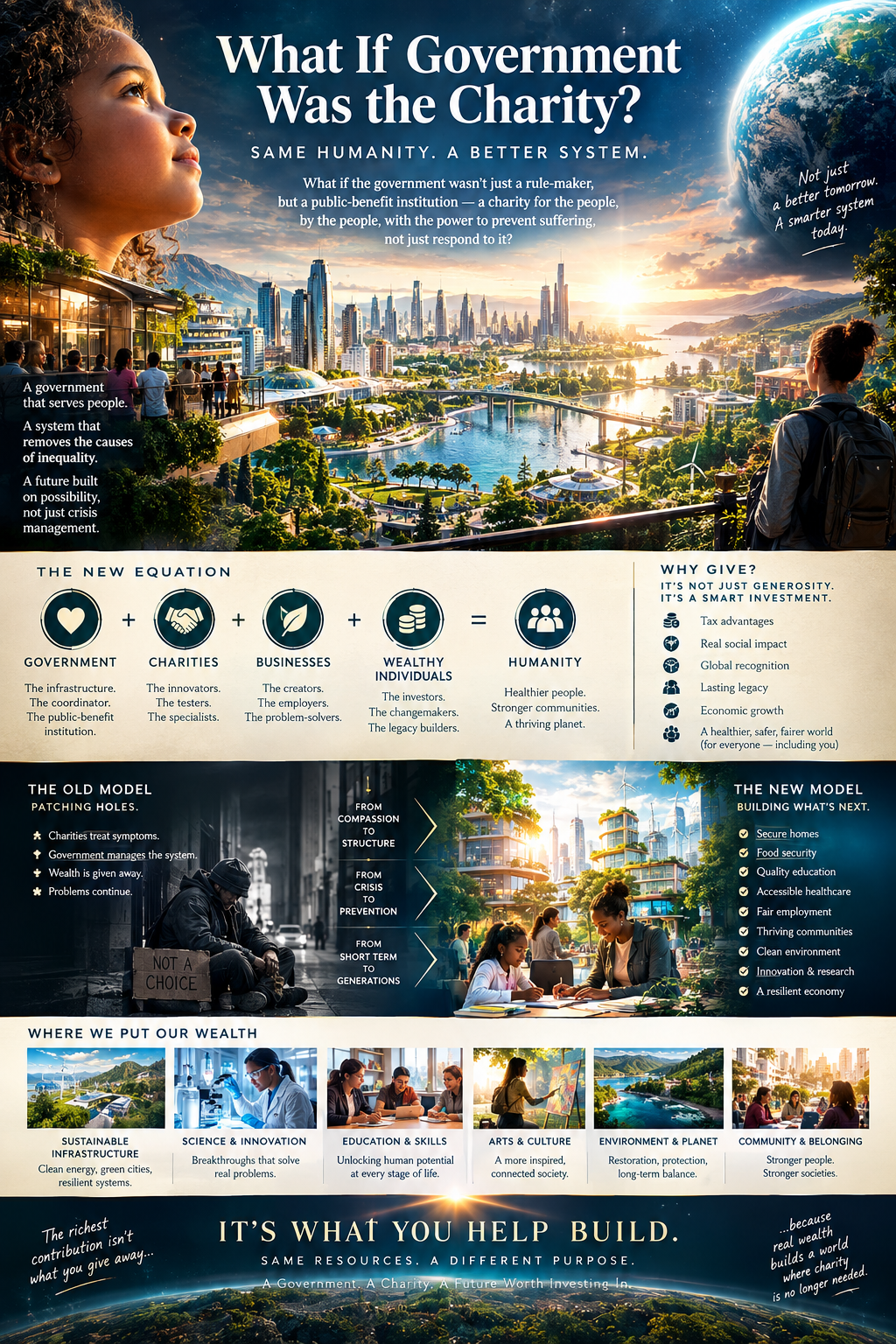
What If Government Was the Charity?
Here’s a strange thought.
What if the government was the charity?
Not metaphorically.
What if government itself were structured as a public-benefit institution whose fundamental purpose was to improve the conditions of human life?
And what if charities, businesses, wealthy individuals and ordinary citizens could all align with that institution to provide the things humanity needs?
Because if we are honest about what charities are often doing, many of them are filling gaps.
They are feeding people because people cannot afford food.
Housing people because people cannot secure housing.
Supporting children because children are not receiving what they need.
Supporting victims because systems failed to protect them.
Funding research because public resources weren’t sufficient.
Protecting the environment because existing economic structures keep damaging it.
Helping people back into society because society somehow managed to leave them out.
Charity has become one of the mechanisms through which humanity compensates for the things its larger systems have failed to provide.
And then we have government sitting above all of this.
Collecting enormous amounts of money.
Employing enormous numbers of people.
Controlling enormous amounts of infrastructure.
Writing the rules under which businesses operate.
Influencing the economy.
Owning assets.
Purchasing services.
Funding education.
Funding healthcare.
Funding housing.
Funding transport.
Funding research.
Funding communities.
And yet we have somehow separated government from charity so completely that we rarely ask the obvious question:
What if the government itself were designed around the same fundamental principle — providing for human wellbeing — but at the scale only government can operate?
Imagine a government that effectively said:
We exist to make human life better.
Not as a campaign slogan.
As the operating architecture.
And now imagine something even more interesting.
Imagine that the government created a system in which charitable organisations could align with it rather than constantly operating around it.
A homelessness charity doesn’t have to spend eternity treating homelessness.
It could help government eliminate the conditions producing homelessness.
A food charity doesn’t have to spend eternity distributing emergency food.
It could help redesign food security.
An educational charity doesn’t have to endlessly compensate for educational inequality.
It could help build new educational infrastructure.
A wealthy philanthropist doesn’t simply donate money into a separate organisation and hope that something changes.
They could direct capital into a transparent public-benefit system where the outcome is measurable.
The government becomes the infrastructure.
Charities become partners within the infrastructure.
Wealth becomes fuel for the infrastructure.
Humanity becomes the beneficiary.
Now let’s take the thought experiment somewhere that gets really interesting.
What if the rich could gain from giving to government?
I don’t mean:
“Give money to government because you’re a nice person.”
And I don’t mean creating another mechanism for wealthy people to buy political influence.
Quite the opposite.
I mean designing the incentives so that contributing wealth toward humanity’s infrastructure becomes genuinely attractive in its own right.
Because wealthy people already give.
They create foundations.
They establish charities.
They donate to causes.
They fund research.
They sponsor institutions.
They attach their names to buildings.
They receive recognition.
They receive publicity.
They build legacies.
And, depending on the jurisdiction and structure, charitable giving can also have tax advantages.
So let’s ask the uncomfortable question:
What if some of those incentives were deliberately redirected toward public infrastructure?
What if a wealthy person could say:
“I want to put £100 million into housing.”
And instead of creating another organisation to distribute £100 million around the edges of the housing crisis, they could contribute to a properly governed national housing transformation fund.
“I want to put £500 million into education.”
Fine.
“I want to fund scientific research.”
Fine.
“I want to restore ecosystems.”
Fine.
“I want to build community infrastructure.”
Fine.
“I want to fund technological development.”
Fine.
“I want to help eliminate poverty.”
Fine.
And the government provides the infrastructure through which those contributions become measurable public assets and outcomes.
Suddenly, philanthropy isn’t necessarily outside government.
It can become one of the ways society builds government.
That changes the relationship completely.
Imagine the prestige system changing.
Today, a wealthy person can become famous for giving millions to a charitable cause.
Imagine instead that society celebrated the person who funded something humanity genuinely needed.
The billionaire who helped eliminate a disease.
The investor who financed an entirely new model of affordable housing.
The family whose foundation helped create an educational system that transformed millions of lives.
The entrepreneur who funded ecological restoration on a massive scale.
The person who financed research that made an entire industry cleaner.
The philanthropist who helped build infrastructure that eventually made their own intervention unnecessary.
That last one matters.
Because perhaps the highest form of philanthropy is not:
“Look how much I gave to this problem.”
It is:
“Look. The problem doesn’t exist anymore.”
That’s a completely different definition of success.
And this is where government becomes the ultimate charity.
A conventional charity might have £10 million.
A government can mobilise billions.
A charity might operate in one community.
Government can redesign the conditions across an entire country.
A charity might provide temporary housing.
Government can change housing infrastructure.
A charity might provide food.
Government can influence the systems determining whether people can access food in the first place.
A charity might help someone find employment.
Government can redesign education, transport, housing and economic participation so that employment becomes more accessible in the first place.
The charity often works downstream.
Government has the potential to work upstream.
And perhaps we’ve been missing something enormous because we have treated these as completely separate functions.
We have created charities to deal with problems.
We have created government to administer society.
What if government became the mechanism through which society systematically removed the need for those charities?
That would not destroy charity.
It would liberate it.
Charities would have less reason to spend their energy endlessly repairing preventable damage.
They could move further upstream.
They could become laboratories for new possibilities.
They could test ideas.
Develop technologies.
Experiment with new social models.
Fund innovation.
Discover better ways of doing things.
Then government could take successful models and scale them.
Charity becomes the experimental layer.
Government becomes the scaling layer.
Humanity becomes the beneficiary.
And wealthy people could participate in the entire ecosystem.
They could fund the experiments.
Fund the scaling.
Fund the infrastructure.
Fund the research.
Fund the future.
And, yes, potentially receive legitimate tax advantages for doing so — if society chose to design the tax system around that purpose.
But there would need to be a very important boundary.
Money must not become ownership.
A £100 million contribution cannot purchase £100 million worth of political power.
A billionaire cannot buy a government department.
A corporation cannot purchase policy.
A donation cannot become a back door into sovereignty.
The contribution buys public benefit, not control.
That distinction could be everything.
Because then the wealthy aren’t being punished for having resources.
They’re being given somewhere meaningful to put them.
And instead of asking:
“How much can I keep?”
the system creates another question:
“What can my wealth build?”
That’s the part I find genuinely fascinating.
Because humanity already has extraordinary amounts of wealth.
Extraordinary amounts of knowledge.
Extraordinary numbers of talented people.
Extraordinary technological capability.
And enormous numbers of organisations trying to make things better.
The question is whether we have designed the architecture that allows all of those resources to work together.
Perhaps we haven’t.
Perhaps we’ve built a strange system where government collects money, charities raise money, billionaires donate money, businesses pursue profit, citizens pay taxes, and everyone independently tries to repair different pieces of the same machine.
And then we congratulate ourselves when the machine survives another year.
What if we stopped doing that?
What if government became a genuine public-benefit institution?
What if charities could plug directly into its infrastructure?
What if wealthy people were actively incentivised to invest in public capability?
What if businesses were rewarded for contributing to humanity’s capacity?
What if charitable giving could move from perpetual crisis management into long-term civilisation building?
What if tax policy rewarded people for financing things that government genuinely needs but cannot sufficiently fund?
What if the ultimate publicity wasn’t:
“I donated £50 million.”
but:
“I helped make this unnecessary.”
That is a different kind of rich.
Not poorer.
Not stripped of wealth.
Not demonised for having it.
Useful.
And perhaps that’s the real thought experiment.
What if we stopped asking wealthy people merely to give away their money and started designing a society where their wealth could be put to work for humanity in ways that benefit everyone — including them?
Because selfishness doesn’t necessarily have to disappear.
Perhaps we simply need to make the most enlightened version of self-interest point in the same direction as the public good.
If prestige comes from solving problems, solve problems.
If tax advantages come from building public capacity, build public capacity.
If legacy comes from improving civilisation, improve civilisation.
If wealth wants somewhere meaningful to go, give it somewhere meaningful to go.
And if government is genuinely supposed to serve the public, perhaps the most radical redesign isn’t to make government bigger.
It is to make its purpose clearer.
Government as public infrastructure.
Government as provider.
Government as coordinator.
Government as the ultimate charity.
A charity that doesn’t merely hand humanity a meal.
A charity that asks why humanity is hungry.
A charity that doesn’t merely provide a bed.
A charity that asks why someone needs emergency accommodation.
A charity that doesn’t merely fund another intervention.
A charity that asks why the intervention is still necessary ten years later.
Because maybe the measure of a successful society isn’t how generously it responds to suffering.
Maybe it is how intelligently it prevents suffering from becoming structurally necessary in the first place.
And if we can build that society, perhaps the richest people in the world won’t have fewer opportunities to contribute.
They’ll have far more meaningful ones.
Not merely giving money away.
Building the world their money is capable of building.




Leave a Reply