
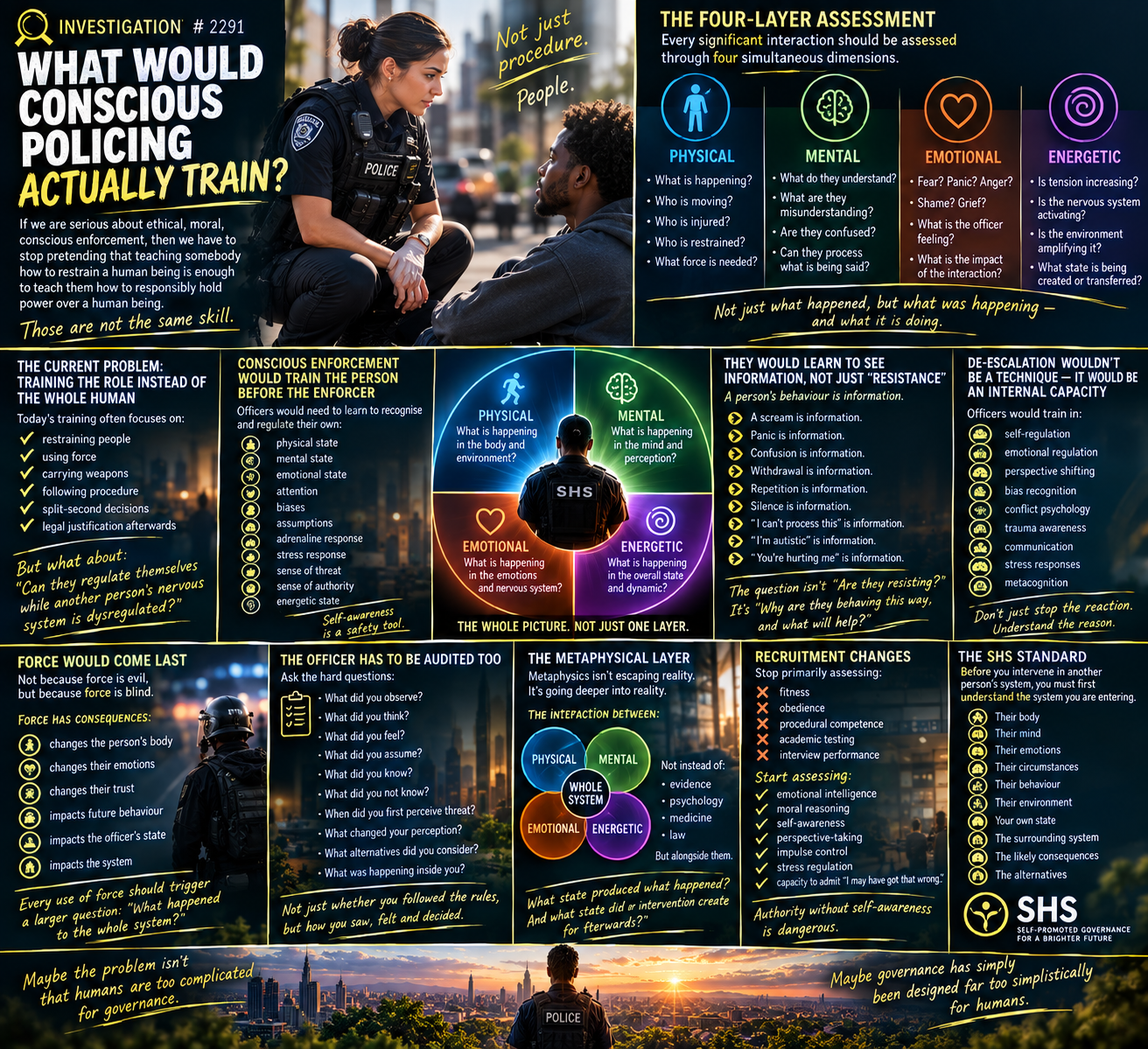
CONTEXT always matter.
Because people don’t become suitable for authority simply because you give them a uniform.
If we are serious about ethical, moral, conscious enforcement, then we have to stop pretending that teaching somebody how to restrain a human being is enough to teach them how to responsibly hold power over a human being.
Those are not the same skill.
And this is where SHS becomes relevant.
Because SHS is not simply asking:
“Did the officer follow procedure?”
SHS asks:
“What was actually happening here — to the person, to the officer, to the environment, to the relationship, to the power dynamic, and to the system producing the interaction?”
That is metacognition.
It is cognition of the whole situation, rather than cognition of whichever component the institution has decided matters most.
And that distinction could completely change enforcement.
THE CURRENT PROBLEM: TRAINING THE ROLE INSTEAD OF THE WHOLE HUMAN
Imagine training for a job where you may have to:
restrain people,
use force,
carry weapons,
make split-second decisions,
deprive somebody of liberty,
enter highly emotional situations,
interpret resistance,
assess danger,
and exercise authority over another human being.
Now ask:
What kind of human being should be trusted with that responsibility?
Not merely:
Can they pass the physical test?
Can they remember procedure?
Can they follow instructions?
Can they legally justify an action afterwards?
But:
Can they regulate themselves while another person’s nervous system is dysregulated?
Can they distinguish danger from distress?
Can they distinguish defiance from fear?
Can they recognise when their own emotions are entering the interaction?
Can they notice when they are becoming angry, threatened, humiliated, impatient or ego-driven?
Can they stop themselves from escalating simply because they have the power to escalate?
Because that is a completely different level of training.
CONSCIOUS ENFORCEMENT WOULD TRAIN THE PERSON BEFORE THE ENFORCER
An SHS-informed system would have to ask something uncomfortable:
Before we teach someone to control other people, have we taught them to control themselves?
Not suppress themselves.
Understand themselves.
That means officers being trained to recognise their own:
physical state,
mental state,
emotional state,
attention,
biases,
assumptions,
adrenaline response,
stress response,
sense of threat,
sense of authority,
and energetic state.
And by energetic, within your SHS definition, I mean the interaction of the underlying energy and movement of the system — how states move between body, mind, emotion, environment and another person at a given moment.
So the officer is no longer trained to see:
“Person resisting.”
They are trained to cognitise:
“What is producing this person’s current behaviour?”
That is a radically different question.
THE FOUR-LAYER ASSESSMENT
Every significant interaction could be assessed through four simultaneous dimensions.
PHYSICAL
What is physically happening?
Who is moving?
Who is injured?
Who is restrained?
What immediate physical danger exists?
What level of force is actually necessary?
MENTAL
What might each person currently understand?
What are they misunderstanding?
Is the person comprehending instructions?
Are they confused?
Overloaded?
Disoriented?
Can they process what is being said?
EMOTIONAL
What emotional state is present?
Fear?
Panic?
Anger?
Shame?
Grief?
Desperation?
And, crucially:
What emotional state is the officer bringing into the interaction?
Because the officer is not outside the situation.
They are part of it.
ENERGETIC
What is happening to the overall state of the interaction?
Is tension increasing or decreasing?
Is the person’s nervous system becoming more activated?
Is the officer becoming more activated?
Is the environment amplifying the situation?
Is the interaction becoming chaotic?
Is there accumulated stress or trauma influencing the behaviour?
This is where your metaphysical model becomes useful as a whole-system lens.
Not:
“Energy” as a magical explanation for everything.
But:
What state is being generated, transferred, intensified or stabilised through the interaction?
That should matter enormously to an enforcement officer.
BECAUSE A PERSON’S REACTION IS INFORMATION
This is one of the biggest changes I would make.
Conscious enforcement would train officers not to automatically interpret distress as evidence of guilt, aggression or non-compliance.
A scream is information.
Panic is information.
Confusion is information.
Withdrawal is information.
Repetition is information.
Silence is information.
Erratic movement is information.
A person saying:
“I can’t process this.”
is information.
Someone saying:
“I’m autistic.”
is information.
Someone repeatedly saying:
“You’re hurting me.”
is information.
The response cannot simply be:
“They are resisting.”
The question becomes:
“Why are they behaving this way, and what intervention is most likely to resolve rather than intensify the situation?”
DE-ESCALATION WOULDN’T BE A TECHNIQUE
This is another major difference.
Most systems can turn de-escalation into a procedure.
Say this.
Stand there.
Use this tone.
Give these instructions.
But conscious enforcement would make de-escalation an internal capacity.
Because you cannot reliably de-escalate another person’s nervous system while your own is escalating.
So officers would train repeatedly in:
self-regulation,
situational awareness,
emotional regulation,
perspective shifting,
bias recognition,
uncertainty tolerance,
conflict psychology,
trauma awareness,
communication,
autonomic stress responses,
and metacognition.
The officer should be able to think:
“I am becoming activated.”
Then:
“That activation is influencing how I am interpreting this person.”
Then:
“My interpretation may therefore be less reliable than I think.”
That is metacognition.
And that could prevent an enormous number of bad decisions.
FORCE WOULD COME LAST — NOT BECAUSE FORCE IS EVIL, BUT BECAUSE FORCE IS BLIND
Force would still exist.
There are genuinely dangerous situations.
There are situations where immediate physical intervention is necessary.
Conscious policing does not mean pretending danger doesn’t exist.
It means recognising that force has consequences.
Physical force changes:
the person’s body,
their emotional state,
their perception of authority,
their trust,
their subsequent behaviour,
the officer’s own psychological state,
and potentially the long-term relationship between the individual and the institution.
So every use of force should trigger a much broader question:
What happened to the whole system when we used force?
Not simply:
“Was the officer technically permitted to do it?”
AND THEN COMES THE PART MOST SYSTEMS REALLY DON’T LIKE:
THE OFFICER HAS TO BE AUDITED TOO.
Not merely the citizen.
The officer’s state.
Their decisions.
Their escalation points.
Their assumptions.
Their language.
Their emotional responses.
Their ability to regulate themselves.
Their interpretation of the person’s behaviour.
Their alternatives.
What they noticed.
What they failed to notice.
And why.
Imagine after an incident asking an officer:
What did you physically observe?
What did you think was happening?
What did you feel?
What did you assume?
What did you know?
What did you not know?
When did you first perceive threat?
What changed your perception?
What alternative interventions did you consider?
What was happening inside you immediately before force was used?
Now we are actually examining decision-making.
Not just reconstructing whether somebody technically complied with a policy.
THIS IS WHERE THE METAPHYSICAL LAYER BECOMES IMPORTANT
Within your SHS definition, metaphysics is not escaping reality.
It is going deeper into reality by examining the interaction between:
physical + mental + emotional + energetic
at a particular point in time.
That means a government could use metaphysical analysis as an additional layer of governance.
Not instead of evidence.
Not instead of psychology.
Not instead of medicine.
Not instead of law.
Alongside them.
Because sometimes the system is asking:
“What happened?”
when it should also be asking:
“What state produced what happened?”
And:
“What state did our intervention create afterwards?”
That is a much more sophisticated form of governance.
TRAUMA WOULD ALSO HAVE TO BE UNDERSTOOD DIFFERENTLY
Within your framework, trauma can be understood as something that leaves a kind of residual energetic imprint from an event which can subsequently influence the body, mind and emotions.
That is your metaphysical model.
It should not replace established clinical understandings of trauma and PTSD, but it could sit alongside them as a way of asking:
What remains in the system after an event has ended?
Because the incident doesn’t necessarily end when the handcuffs come off.
The officer may carry it.
The individual may carry it.
Witnesses may carry it.
The community may carry it.
The institution may carry it.
So conscious governance asks:
What residue did this interaction leave behind?
And what are we doing with it?
AND RECRUITMENT CHANGES ENTIRELY
This may be the biggest one.
Stop primarily recruiting for:
fitness,
obedience,
procedural competence,
academic testing,
and basic interview performance.
Start heavily assessing:
emotional intelligence,
moral reasoning,
self-awareness,
perspective-taking,
impulse control,
stress regulation,
epistemic humility,
ability to recognise uncertainty,
capacity to de-escalate,
ability to admit “I may have got that wrong.”
Because that last one is enormous.
A person with authority who cannot recognise their own fallibility is dangerous.
SHS WOULD BASICALLY ASK GOVERNMENT:
“WHY ARE YOU TRAINING PEOPLE TO ENFORCE SYSTEMS BEFORE TRAINING THEM TO UNDERSTAND HUMANS?”
That is the deeper problem.
We build a rule.
We create an enforcement role.
We put a human inside the role.
We give them authority.
Then we expect the role to somehow compensate for the human’s limitations.
Why?
Why not design the role around a deeper understanding of the human being?
That is what conscious governance would attempt to do.
Because the objective isn’t:
“How do we make officers better at enforcing?”
It is:
“How do we make enforcement less necessary, less harmful, more intelligent and more human?”
And that is a completely different objective.
THE SHS STANDARD
I would ultimately reduce conscious enforcement to one principle:
Before you intervene in another person’s system, you must first understand the system you are entering.
Their body.
Their mind.
Their emotions.
Their circumstances.
Their behaviour.
Their environment.
Your own state.
The surrounding system.
The likely consequences.
And the alternatives.
Cognitise all of it.
Because a human being is not one-dimensional.
A situation isn’t one-dimensional.
And therefore an institution exercising power over a human being cannot ethically be one-dimensional either.
That is what SHS is really exposing.
We have multidimensional beings being governed by single-dimensional systems.
And then we act surprised when the system cannot understand the people inside it.
Maybe the problem isn’t that humans are too complicated for governance.
Maybe governance has simply been designed far too simplistically for humans.
..
What woukd ethical, moral and conscious police enforcwment train that clearly isn’t to this day. Learn from everythinf we’ve been covering andn talking about in regards to what it means to be conscous, to cognitise all parts and components of one or one situation or system, what is SHS about and how could governments benefit from greater metacognition/metaphysical aid(metaphysical how I coin it and mean by it, is the study of the interaction physical, mental, emotional, energetical interact with each other at any given moment in time. By energetical I mean the most nasic understand of energy being everything and how we move/navigate it matters more than anything else. Ptsd is per example energy residue from a traumatic event which then affecrs the mind and emotions of someone. It is not rooted in the mind nor emotions but affects both)






Leave a Reply