
I could’ve written them all in their own languages. Let this exercise be their cross and make it easier for the one only that makes it harder for itself to clear its conscience.
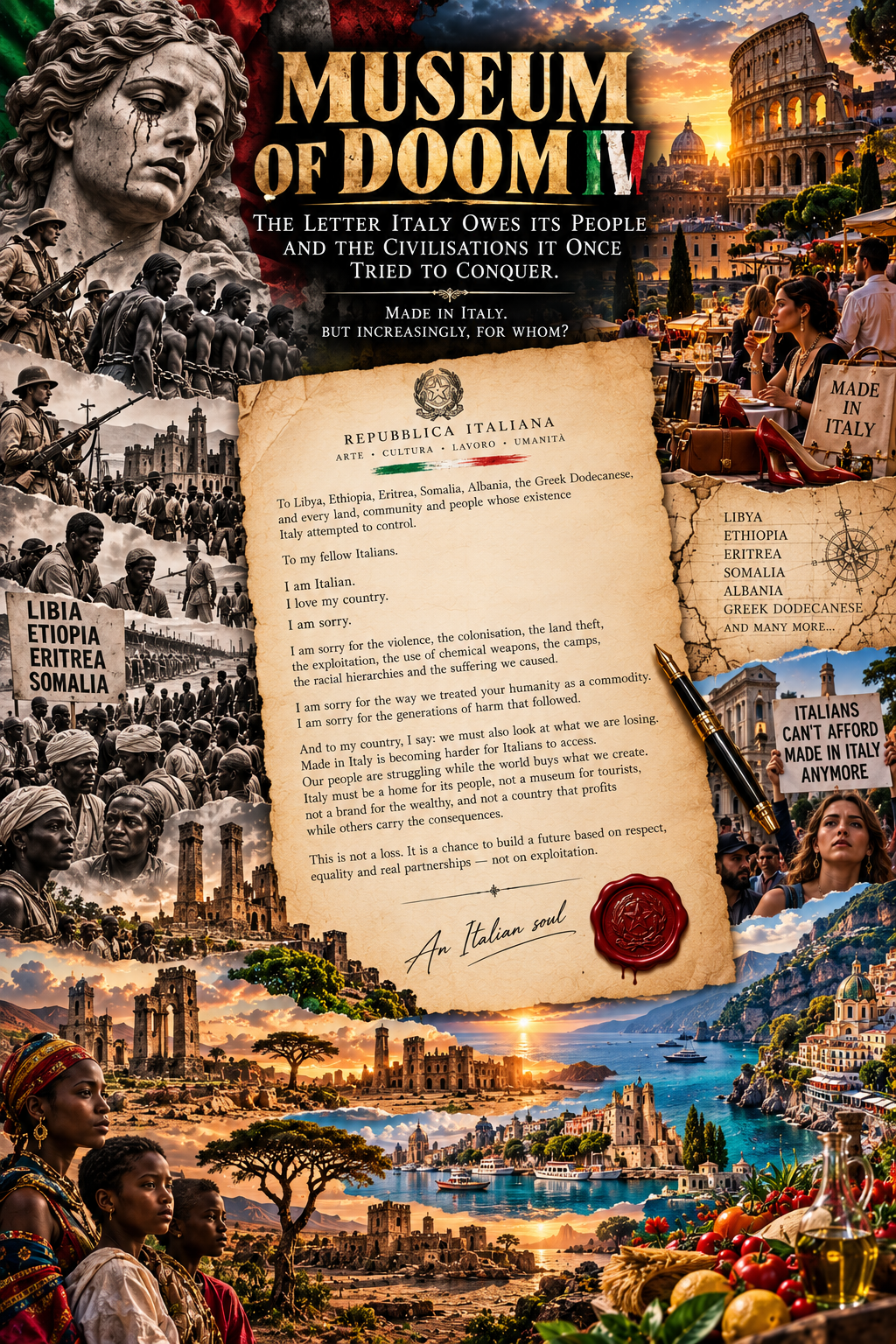
The Letter Italy Owes Its People and the Civilisations It Once Tried to Conquer
Made in Italy. But increasingly, for whom?
The Italian chapter exposes two forms of inheritance: the country that is becoming increasingly expensive for its own people to enjoy, and the countries whose histories were disrupted by Italy’s pursuit of empire.
The contrast is supported by contemporary evidence. In the first quarter of 2026, Italian real wages remained 6.1% below their early-2021 level, according to the OECD, while investigations into luxury supply chains have exposed serious labour exploitation behind prestigious products made in Italy. ANSA.it +2
Italy’s colonial record includes concentration camps and mass deaths in Libya, chemical warfare and massacres in Ethiopia, racial segregation in Eritrea, and coercive plantation labour in Somalia. These histories deserve recognition alongside Italy’s celebrated cultural and artistic achievements. Cambridge Core +4
The imagined letter follows the perspective of an Italian who loves their country deeply enough to question what it has become—and refuses to make other populations bear the consequences of Italy’s choices.
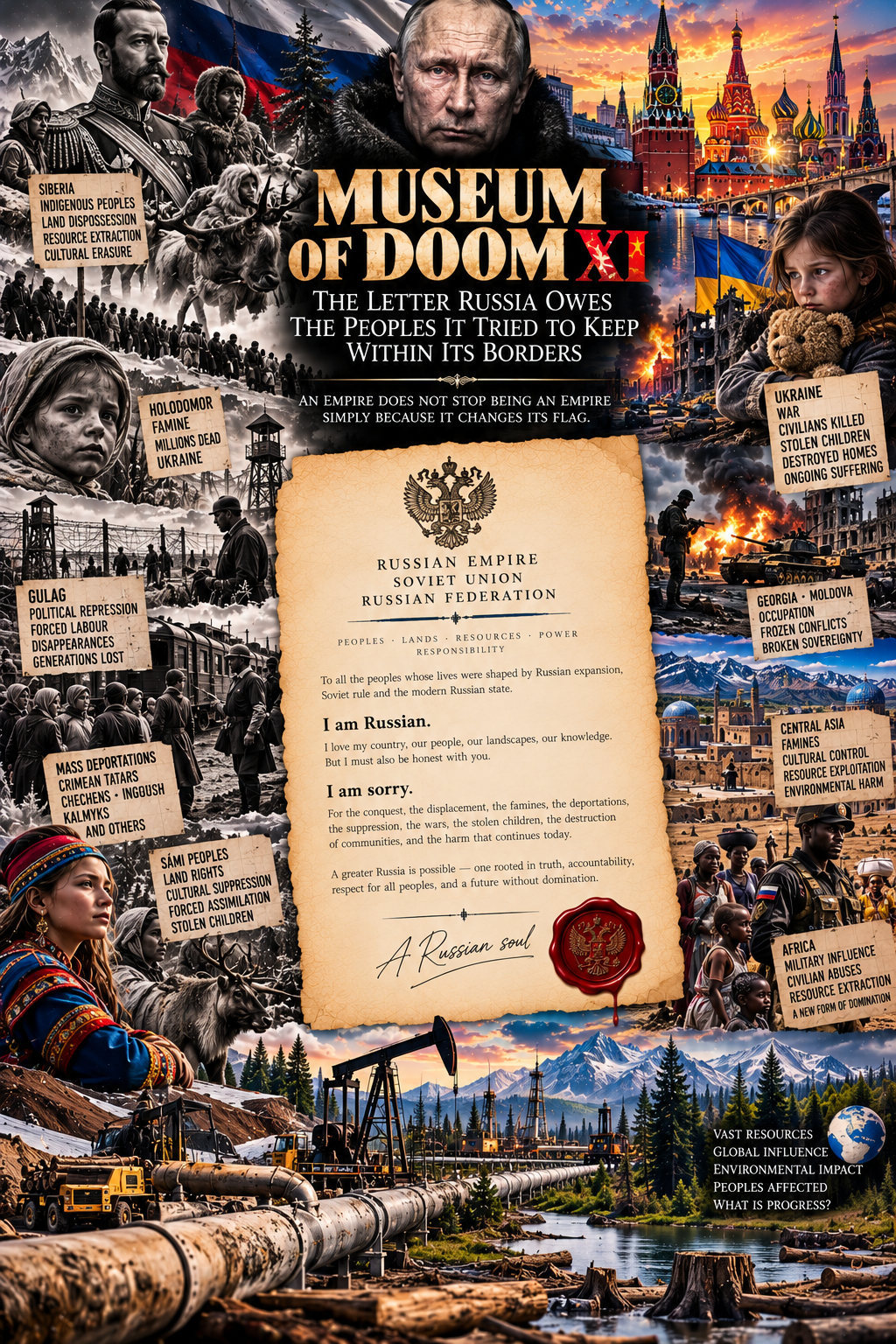
MUSEUM OF DOOM IV
The Letter Italy Owes Its People and the Civilisations It Once Tried to Conquer
Made in Italy. But increasingly, for whom?
An imagined letter of atonement from an Italian soul confronting the contradictions of a nation that celebrates its creations while increasingly making them inaccessible to the very people who created them.
To Libya, Eritrea, Somalia, Ethiopia, Albania, the Greek Dodecanese, and every civilisation, community, family and individual harmed by Italian colonialism and imperial expansion.
And to my fellow Italians.
I am Italian.
And I love my country.
I love our food.
Our art.
Our music.
Our architecture.
Our landscapes.
Our traditions.
Our craftsmanship.
Our understanding of beauty.
I love the fact that Italy has given the world so many things that people admire, desire and celebrate.
We are the country of extraordinary painters, sculptors, architects, musicians, engineers, designers, farmers and artisans.
We have built a civilisation whose cultural inheritance attracts people from every corner of the planet.
And everywhere I look, I see the evidence.
Rome.
Florence.
Venice.
Milan.
Naples.
Sicily.
Tuscany.
The Amalfi Coast.
The vineyards.
The olive groves.
The villages.
The markets.
The kitchens.
Our families.
Our artisans.
Made in Italy.
Three words that have become an international symbol of quality, beauty, authenticity, craftsmanship and excellence.
Three words that generations of Italians have worked to give meaning to.
But today, I have a question that I can no longer ignore.
How is it possible that the very things that make me proud to be Italian are becoming increasingly difficult for Italians themselves to enjoy?
How did we reach a point where our craftsmanship can be celebrated across the world while the people who make it struggle to afford the lives they are building?
How can we produce some of the world’s most desirable products, yet have workers whose purchasing power has deteriorated?
How can our cities attract extraordinary wealth from visitors and investors while residents struggle with housing costs and the everyday expenses of living in them?
How can we celebrate the family while making it increasingly difficult for younger generations to establish a secure home?
And how can we call ourselves successful when the success of the things we create does not necessarily translate into the wellbeing of the people who create them?
I am beginning to understand that a country can become extraordinarily successful at selling its identity while becoming increasingly unsuccessful at making that identity accessible to its own people.
And I believe we must confront that contradiction.
Not because I have stopped loving Italy.
But because I love Italy enough to ask what is happening to it.
To the Italians who can no longer afford Made in Italy
I owe you an apology.
Because I have celebrated our international success without always questioning who receives its benefits.
I have looked at our luxury brands and felt proud.
Our fashion houses.
Our leatherworkers.
Our shoemakers.
Our tailors.
Our designers.
Our furniture manufacturers.
Our ceramicists.
Our carmakers.
Our food producers.
And I have thought:
Look at what Italy can create!
But I have not always asked:
Can the Italians who produce this excellence actually afford to participate in it?
What happens when something originally grounded in local knowledge, inherited skill and community craftsmanship becomes an international luxury commodity?
What happens when the value of the label rises faster than the earnings of the people who make it?
What happens when the artisan’s work becomes a symbol of wealth, but the artisan does not receive an equivalent share of that wealth?
And what happens when an Italian family increasingly finds that an imported alternative is more accessible than a locally produced product?
Not because they do not value Italian craftsmanship.
But because they have to survive.
I do not condemn high-quality craftsmanship for commanding a high price.
I understand the time, labour, materials and knowledge that genuine craftsmanship requires.
But I question an economic structure in which quality becomes increasingly associated with exclusivity rather than with the wellbeing of the society that produces it.
Our artisans should be able to earn enough to live well.
Our consumers should have meaningful access to the products of their own country.
Our younger generations should have opportunities to inherit and continue these professions.
And our industries should be capable of sustaining the people whose skills make them valuable.
What is the point of preserving the prestige of Made in Italy if we fail to preserve the Italian people and craftsmanship behind it?
To the workers behind the luxury
There is another truth that I need to confront.
The label does not automatically tell us how the person who made the product was treated.
Investigations into Italian luxury supply chains have exposed situations in which workers, including migrant workers, were subjected to exploitation, excessive working hours, irregular employment and unsafe conditions.
And I find that profoundly disturbing.
How can we sell a product for thousands of euros while the person producing it is not necessarily receiving safe conditions, lawful treatment and fair compensation?
How can we advertise excellence while failing to ensure excellence in the human experience of production?
How can we attach extraordinary value to the finished object while allowing the human being who created it to be treated as an expense to minimise?
A handbag should never become more valuable than the humanity of the person who made it.
And neither should a shoe.
A jacket.
A piece of furniture.
A car.
Or anything else.
I am sorry to the workers whose labour has been exploited in the pursuit of prestige and profit.
I am sorry to the immigrants who came to Italy seeking opportunity and encountered working conditions that denied them dignity.
I am sorry to the Italian artisans whose knowledge has been undervalued or whose livelihoods have been undermined by commercial structures that prioritise margins over the continuity of their craft.
I want Made in Italy to mean something greater than the location of a production process.
I want it to mean that the people involved were respected.
That the materials were responsibly obtained.
That the work was fairly compensated.
That the knowledge was preserved.
That the community benefited.
And that the finished product represented the wellbeing of the ecosystem that produced it.
Quality should not begin when the product reaches the customer. It should begin with the conditions under which the product comes into existence.
To the country that is slowly becoming a product
Italy, I am worried about you.
Because there is something strange about watching your own country become increasingly attractive to the rest of the world while becoming increasingly difficult for some of your own people to inhabit.
I see our historic cities attracting millions of visitors.
I see beautiful buildings being converted into tourist accommodation.
I see properties marketed as investments.
I see traditional streets increasingly organised around visitors and consumers.
And I wonder whether we are slowly transforming the places we call home into experiences for people who do not live there.
I do not oppose tourism.
I love sharing Italy with the world.
I love that people want to experience our culture.
But I question whether the people who sustain that culture should have to struggle to remain within it.
What happens to Florence if the artisans cannot afford to live nearby?
What happens to Venice if its residents continue disappearing from the historic centre?
What happens to the character of a community when the homes, shops and services that sustained its daily life increasingly cater to temporary visitors?
What happens to tradition when it becomes something performed for an audience rather than lived by a population?
A living civilisation is not a museum for other people’s enjoyment.
Italy is not merely a destination.
It is our home.
Our culture does not exist only to be purchased.
Our food does not exist only to be photographed.
Our villages do not exist only to be admired.
And our history does not exist only to produce commercial opportunities.
It exists within the people who continue living it.
I want Italy to remain a place where its own people can build meaningful lives.
Where a young person can afford to establish a family.
Where an artisan can sustain a workshop.
Where a farmer can earn a dignified living.
Where a grandmother can continue inhabiting the community she has known all her life.
Where the next generation can inherit more than the responsibility to preserve a beautiful image.
Because if we preserve every building but lose the people who gave the place its character, what exactly have we preserved?
And now, to Libya
There is something I must acknowledge.
Our colonial violence did not begin with Mussolini.
Italy invaded Libya in 1911.
Long before the Fascist regime took power.
We arrived believing we had the right to establish control over a land that did not belong to us.
We fought against people who resisted that control.
And when resistance continued, our authorities escalated repression.
Under Fascist rule, our military conducted campaigns that devastated communities across Cyrenaica.
People were forcibly displaced.
Communities were separated from their lands and livelihoods.
Entire populations were subjected to confinement.
Concentration camps were established.
People died from hunger, disease, deprivation and the conditions imposed upon them.
The scale of the suffering was enormous.
And we described these operations through the language of pacification.
Pacification.
What an extraordinary word to use when human beings are being violently subdued for resisting the occupation of their own homeland.
What were we pacifying?
The people?
Or our own discomfort with their refusal to submit?
I am sorry for the camps.
For the deportations.
For the executions.
For the destruction of livelihoods.
For the suffering inflicted upon families.
And for Omar al-Mukhtar, who resisted Italian colonial rule and was executed in 1931.
A man remembered by many as a symbol of resistance against foreign domination.
I am sorry that we treated the demand for self-determination as a threat to our authority.
And I am sorry that our national memory has so often devoted greater attention to the achievements of Italy than to the suffering associated with its colonial ambitions.
To Libya today
There is another responsibility we must confront.
Our relationship with Libya did not end when colonial rule ended.
Italy and Libya have continued to maintain political, commercial and migration-related agreements.
And in recent years, Italian authorities have supported cooperation with Libyan maritime forces despite well-documented abuses against migrants and refugees who are intercepted and returned to Libya.
People seeking safety have been exposed to detention, violence, torture, exploitation and other serious abuses.
I recognise that Italy faces genuine responsibilities regarding migration, border management, public services and the protection of people within its jurisdiction.
But I refuse to accept that these responsibilities justify arrangements that expose other human beings to severe mistreatment.
We cannot claim to have learned from colonial violence while tolerating new systems in which vulnerable people are treated as instruments of political convenience.
I do not believe historical atonement can be separated from present conduct.
We cannot apologise for the humiliation of people in the past while disregarding the dignity of people in the present.
We cannot claim to respect Africa while treating African migrants as though their humanity becomes secondary the moment they attempt to cross the Mediterranean.
And we cannot resolve our responsibilities by transferring the human consequences beyond our immediate view.
I want Italy to build relationships with Libya that respect sovereignty, protect human rights and confront abuses rather than making them somebody else’s problem.
I want us to examine our historical responsibilities without pretending that every current difficulty in Libya was caused by us.
Libya has experienced multiple subsequent conflicts, governments, foreign interventions and internal political struggles.
But recognising that complexity does not excuse us from accounting for our own actions.
Our responsibility is not to claim ownership over Libya’s future. It is to stop treating Libya’s future as something that exists to accommodate our interests.
To Ethiopia
I am sorry.
I am sorry for the invasion of 1935.
For the violence used to establish Italian occupation.
For the attempt to subject an ancient civilisation to Fascist imperial ambition.
For the use of chemical weapons.
For the mustard gas deployed against Ethiopian forces and populations.
For the suffering that followed.
For the civilians killed.
For the communities devastated.
For the religious and cultural institutions subjected to violence.
And for the atrocities committed in Addis Ababa in February 1937.
The massacre remembered as Yekatit 12.
Thousands of people were killed during the repression that followed an attempt to assassinate the Italian viceroy.
Civilians were attacked.
Homes were burned.
People were murdered in the streets.
Further repression targeted Ethiopia’s educated and religious communities.
And I want to ask myself something.
What kind of fear of another people’s independence leads a government to believe that terrorising civilians is a legitimate instrument of authority?
How could we call ourselves civilised while committing such acts?
How could we celebrate our own culture while inflicting violence upon another civilisation?
We did not need to teach Ethiopia how to have a history. Ethiopia already possessed a history extending far beyond the existence of modern Italy.
I am sorry for the attempt to claim superiority over it.
And I want to acknowledge the Ethiopian resistance.
The people who fought.
The people who survived.
The people who preserved their national identity.
The people who refused to allow foreign occupation to define the worth of their civilisation.
I am glad that Ethiopia’s independence endured beyond the Italian occupation.
And I am glad that the Aksum Obelisk, removed by Italian forces and taken to Rome, was eventually returned to Ethiopia and reinstalled in its original setting.
But I cannot ignore what that return tells us.
For decades, an object of profound Ethiopian cultural significance stood in Italy.
And eventually, we returned it.
Why should a civilisation have to spend generations seeking the return of what was already its own?
I want that act of restitution to be remembered not merely as an achievement of Italy, but as a recognition of Ethiopia’s rights.
And I want us to continue examining what else remains unresolved.
To Eritrea
I am sorry for the colonial occupation and the racial hierarchies established through Italian rule.
For the land appropriated.
For the labour exploited.
For the political authority denied to local communities.
For the discrimination embedded in colonial institutions.
And for the way Italian colonial planning organised urban spaces around divisions between European settlers and the Indigenous population.
I find the history of Asmara particularly revealing.
Its architecture is internationally admired.
Its modernist buildings and urban planning are recognised as an extraordinary architectural inheritance.
But the same built environment also records a colonial system in which spatial organisation was shaped by racial segregation.
And I find myself confronted by the very question I must ask about my own country.
Can something be architecturally beautiful while the system responsible for its creation was profoundly unjust?
Yes.
And that is precisely why beauty cannot be the only measure of civilisation.
A building can be beautiful.
A city can be impressive.
An engineering project can be extraordinary.
And the social relationships through which it was constructed can still require serious moral examination.
I am sorry for the people whose humanity was subordinated to colonial ideas of order and hierarchy.
And I recognise the Eritrean people who have made that architectural inheritance their own, preserving and reinterpreting it within their national identity.
I do not want Italy to claim that beauty as proof that colonisation was beneficial.
I want us to recognise both the architecture and the injustice.
And to acknowledge the Eritrean people as the owners of their own cultural future.
To Somalia
I am sorry.
For the land brought under Italian colonial authority.
For the attempts to reorganise agricultural production around the interests of colonial settlers and administrators.
For the forced and coerced labour associated with plantation development.
For the people whose relationship with their land was transformed to serve outside economic priorities.
For the suppression of resistance.
For the exploitation and institutional inequalities established under colonial rule.
And for the assumption that Italian administration possessed a greater right to determine Somalia’s development than the Somali people themselves.
I recognise that Italy later administered former Italian Somaliland under a United Nations trusteeship between 1950 and 1960, with a mandate to prepare the territory for independence.
I recognise that the period differed from earlier colonial rule.
But that does not erase the history that came before it.
And I do not wish to reduce Somalia’s subsequent difficulties to Italian colonisation alone.
Somalia has experienced civil war, political fragmentation, violence, foreign interference, environmental pressures and complex internal challenges.
Those circumstances deserve serious understanding in their own right.
But I also recognise that colonial institutions, boundaries and economic priorities form part of the historical conditions from which independent states emerge.
Independence does not automatically repair every structure inherited from dependency.
And I want the Somali people to enjoy the autonomy, stability and opportunities that they have every right to pursue.
Not because Italy grants those rights.
But because they belong to them.
To Albania and the Greek islands
I am sorry for the military occupation of Albania in 1939.
For the attempt to impose Italian authority upon a neighbouring country.
For the suppression of political independence.
For the violence and coercion of Fascist expansion.
And I am sorry to the peoples of the Dodecanese islands for the decades of Italian rule and the attempts to reshape local institutions and cultural life through Italianisation.
I am sorry for the moments when Italian political ambition mattered more to our authorities than the autonomy of the people concerned.
For every time another nation’s language, history or identity was treated as something to be overwritten.
For the assumption that our cultural achievements gave us the right to decide how other peoples should live.
Because I now understand something.
Being proud of your civilisation should never require diminishing somebody else’s.
To the Italian people: Our beauty does not excuse our history
I want us to understand something.
We do not need to stop loving Italy in order to account for its past.
We do not need to reject our art.
Our music.
Our architecture.
Our food.
Our craftsmanship.
Our scientific achievements.
Our cultural inheritance.
And we do not need to pretend that everything Italy has created is somehow illegitimate because of its colonial history.
But neither should we use those achievements to obscure the suffering caused by our historical institutions.
We can recognise the genius of Leonardo da Vinci without defending colonial expansion.
We can admire Michelangelo without excusing Fascist violence.
We can celebrate the beauty of Florence without denying the abuses committed elsewhere under the Italian flag.
And we can appreciate the history of Rome while questioning the repeated glorification of empire as though domination were a natural expression of greatness.
Because there is a difference between being inspired by the creativity of our ancestors and being proud of every exercise of power carried out in their name.
I do not want to confuse the greatness of Italian creativity with the legitimacy of Italian domination.
Those are two entirely different things.
And I believe our country is capable of understanding the distinction.
The guilt that does not announce itself
There is something I have begun to recognise within myself.
Perhaps for years, I thought the history of Italian colonialism was not particularly relevant to my own existence.
Perhaps I thought it was too distant.
Perhaps I thought that because I did not personally participate in those actions, there was nothing for me to account for.
Perhaps I believed that Italy had suffered enough through Fascism and the Second World War.
And perhaps I found it easier to remember Italy’s suffering than to examine the suffering Italy inflicted.
I now question that instinct.
Because I belong to a national ecosystem.
I inherit its language.
Its institutions.
Its traditions.
Its culture.
Its histories.
Its opportunities.
Its expectations.
And the social and economic conditions created through generations of decisions.
I cannot meaningfully claim to belong to that ecosystem while pretending that its historical consequences disappear whenever they become uncomfortable.
And from a metaphysical perspective, I wonder whether the consequences of unresolved history can influence how individuals and societies respond to questions of responsibility.
Whether guilt can exist beneath conscious recognition.
Whether defensiveness can emerge before understanding.
Whether a person can feel threatened by a question because answering it would require a more complete examination of the identity they have inherited.
I know that not every reaction is guilt.
But I also know that guilt does not necessarily identify itself.
Sometimes we discover what we were carrying only after we develop the capacity to examine it.
And I want to develop that capacity.
I do not want my love for Italy to become an obstacle to understanding Italy.
I want it to become the reason I investigate more deeply.
And now, back to Made in Italy
Because the historical conversation has brought me to a question about our present.
What is happening to the relationship between what we create and the people for whom we create it?
Our country has spent generations developing products recognised around the world.
We make extraordinary clothing.
Food.
Furniture.
Vehicles.
Designs.
Machinery.
Art.
And so much more.
But if the people living in Italy increasingly struggle to afford an Italian life, what exactly is the purpose of our economic success?
We must remember that Made in Italy does not always mean every component, material and stage of production originated in Italy.
International supply chains are complex, and legal country-of-origin rules can depend on where substantial transformation takes place.
I do not oppose international cooperation.
But I want transparency.
I want consumers to understand what they are purchasing.
I want producers to receive fair compensation.
I want the value of our cultural heritage to support the continuation of that heritage.
And I want the people whose work makes Italy desirable to enjoy meaningful access to the prosperity it generates.
A country should not have to sell its identity to the world at the expense of making that identity inaccessible to its own inhabitants.
Our farmers should be able to afford good food.
Our artisans should be able to sustain their trades.
Our young people should be able to establish homes.
Our families should be able to participate in the cultural life of their own country.
And the people who create our prosperity should not be treated merely as the labour required to maintain somebody else’s experience of Italian excellence.
I want to preserve what makes Italy extraordinary.
But I no longer believe preservation means turning our traditions into expensive products and hoping somebody wealthy enough will continue purchasing them.
Real preservation means keeping the knowledge, the practice, the people and the relationships alive.
What I owe to the people Italy once colonised
I owe an honest account of our history.
I owe recognition of the violence.
I owe the willingness to examine demands for reparations, restitution and institutional responsibility.
I owe support for returning cultural property that was wrongfully taken.
I owe respect for the sovereignty of the nations whose territories Italy once controlled.
I owe a commitment to opposing present-day exploitation and abusive arrangements.
And I owe a willingness to examine how our current economic and political relationships affect the autonomy of others.
I do not want Italy to behave as though an apology is an extraordinary gift.
I do not want us to present historical acknowledgement as generosity.
And I do not want the people harmed by our institutions to be required to express gratitude because we have finally decided to recognise what happened.
Accountability is not a favour to the people who were harmed.
It is a responsibility of those who inherit and operate the institutions connected to that harm.
The fact that we cannot repair everything does not mean we should repair nothing.
And the fact that generations have passed does not mean the consequences have necessarily disappeared.
What I owe to Italy
I owe my country something too.
And it is not blind loyalty.
It is not unconditional admiration.
It is not a willingness to defend every decision made by our leaders.
It is not the assumption that because Italy is beautiful, everything done in its name must be justified.
I owe Italy the courage to question what is undermining the continuity of its own people.
I want an Italy that values its artisans as much as their products.
Its farmers as much as its cuisine.
Its workers as much as its brands.
Its residents as much as its tourists.
Its children as much as its history.
Its communities as much as its investments.
And its humanity as much as its international prestige.
I want an Italy that does not need to glorify empire to recognise its greatness.
An Italy that can cooperate with other nations without treating dependency as an achievement.
An Italy that creates wealth without extracting dignity.
And an Italy that remembers that the purpose of a civilisation is not merely to produce extraordinary objects.
It is to sustain the human beings who make extraordinary existence possible.
My final letter to Italy
I love you.
I love your beauty.
Your creativity.
Your passion.
Your history.
Your extraordinary ability to turn ordinary materials into things that can move the human spirit.
But I do not want to watch you become a country that everyone admires while your own people increasingly struggle to participate in what makes you admirable.
I do not want your cities to become museums of a life that residents can no longer afford.
I do not want your artisans to become historical curiosities whose work is admired only after their livelihoods have disappeared.
I do not want your agricultural traditions to survive only as luxury experiences.
And I do not want your young people to inherit a country whose greatest opportunities increasingly appear to exist elsewhere.
You have so much.
Not only financially.
Not only materially.
But humanly.
Creatively.
Culturally.
Environmentally.
Historically.
And I want that abundance to serve the people who live within it.
Just as I want the peoples whose lands Italy once colonised to enjoy the freedom of determining how their own abundance should serve them.
Because I recognise something now.
Italy’s greatness cannot be measured only through what the world is willing to pay for the things we create.
It must also be measured through the lives we make possible for our own people.
And through the respect we extend to everyone beyond our borders.
To Libya:
I am sorry for the camps, the violence, the deportations and the lives destroyed under Italian colonial rule.
To Ethiopia:
I am sorry for the invasion, chemical warfare, massacres and the attempt to subordinate your ancient civilisation.
To Eritrea:
I am sorry for the dispossession, racial hierarchy and the systems of colonial control imposed upon your people.
To Somalia:
I am sorry for the exploitation of land and labour, and for denying your people the authority to determine their own development.
To Albania and the Greek islands:
I am sorry for the attempts to impose Italian political and cultural authority upon your communities.
And to everyone else harmed by Italian imperial expansion:
I recognise that the history is larger than the account I can offer within one letter.
There are lives I have not named.
There are losses I have not described.
There are consequences I do not yet fully understand.
And I have a responsibility to continue learning rather than treating the limits of my knowledge as the limits of what happened.
I cannot change what has already been done. But I can refuse to defend it, deny it or allow its consequences to remain unexamined.
I do not ask you to forgive me.
I ask that my recognition becomes the beginning of responsibility.
And to my fellow Italians:
May we continue loving our country.
May we continue creating beautiful things.
May we continue sharing our culture with the world.
But may we never forget the people behind what we create.
May we never confuse the international desirability of our products with the wellbeing of our population.
May we never confuse historical greatness with historical innocence.
And may we never again imagine that our prosperity requires another people’s subordination.
Because there is something deeply tragic about a civilisation losing access to the very things that made it extraordinary.
And there is something equally tragic about the people of formerly colonised nations continuing to live with consequences that were never fully repaired.
I do not want either future.
I want Italy to remain Italian through the continued existence, creativity, dignity and wellbeing of its people—not merely through the commercial value of its name.
I want Made in Italy to be lived in Italy.
Not only advertised.
Not only exported.
Not only admired.
Lived.
And I want every nation that Italy once attempted to dominate to enjoy the same freedom to create, own, protect and live within its own cultural inheritance.
Because no country should have to surrender its humanity to become commercially successful.
And no civilisation should have to surrender its autonomy to contribute to somebody else’s prosperity.
I am sorry for the harm we caused.
I am sorry for what we have failed to account for.
And I am sorry for the ways we sometimes continue prioritising the commercial and political value of systems over the people those systems are supposed to serve.
But I do not want to end with sorrow.
I want to end with responsibility.
Let Italy become a country whose greatest achievement is not how much the world desires what it produces, but how well its people and the people it engages with are able to live.
With love, remorse, gratitude, recognition, accountability and an enduring responsibility to humanity,
An Italian soul who has finally understood that a civilisation’s greatest creation should be the wellbeing of the people within it.
Museum of Doom IV — The Letter Italy Owes Its People and the Civilisations It Once Tried to Conquer.
SHS – Human First
One further contemporary fact strengthens the distinction between historical and continuing responsibility: Italy’s migration-cooperation agreement with Libya was allowed to renew in November 2025 despite warnings about serious abuses against people returned to Libya. This remains a live issue, not merely a historical question. Human Rights Watch +1
The economic argument is also more precise than saying Italy has stopped producing excellent goods: manufacturing remains a major Italian strength, but the OECD documents weak industrial production, pressure on real wages and difficulties retaining younger workers. Italy’s customs authority also confirms that country-of-origin rules can turn on the last substantial transformation, rather than every component having originated domestically. OECD +2
Leave a Reply