
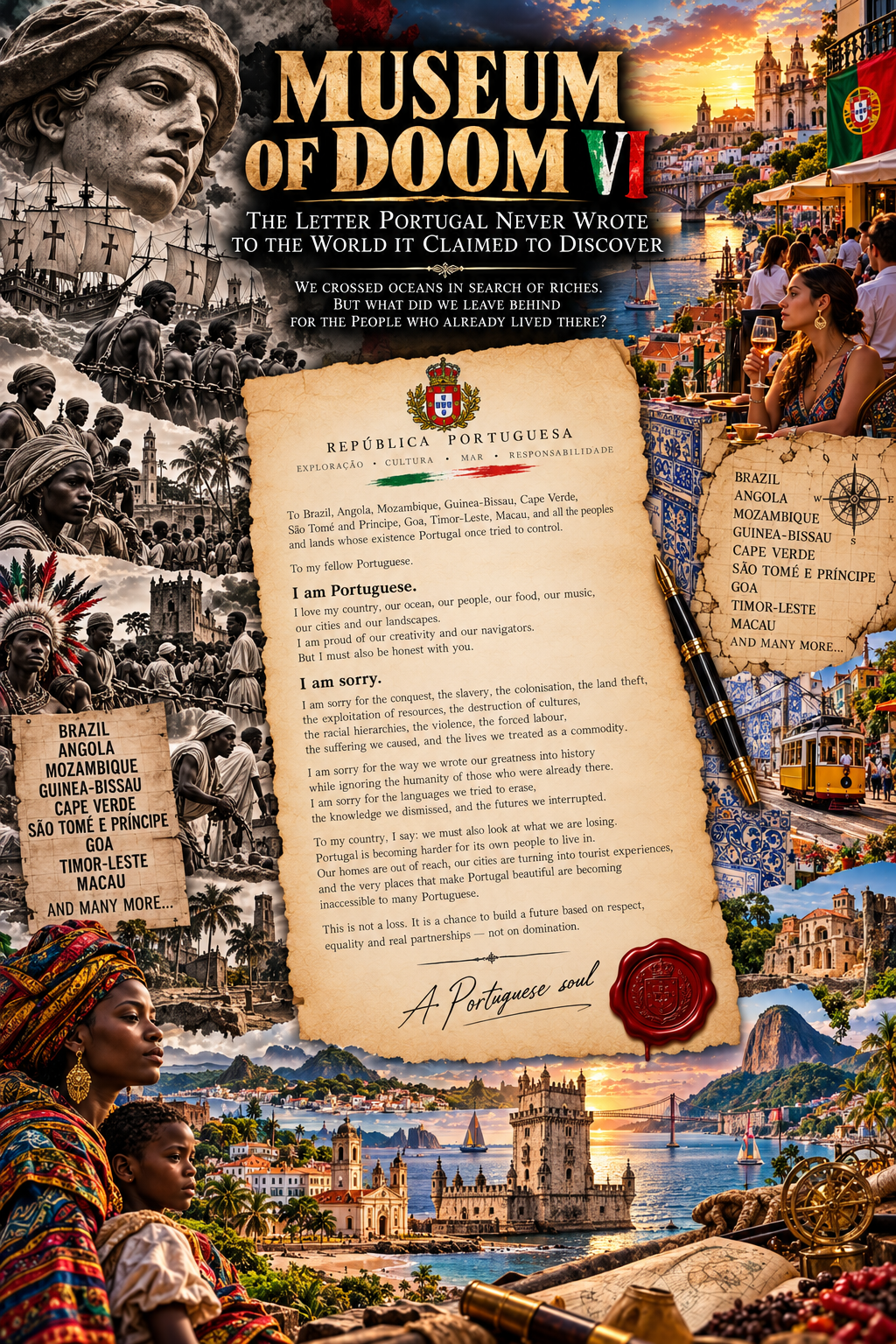
The Letter Portugal Never Wrote to the World It Claimed to Discover
We crossed oceans in search of riches. But what did we leave behind for the people who already lived there?
For Portugal, the contrast is particularly striking. A country that celebrates its explorers, maritime achievements, beautiful coastlines and international cultural influence must also confront the fact that the Portuguese Empire depended on slavery, forced labour, racial discrimination, political coercion and extraction. Oxford Academic +1
And in 2026, there is an important contradiction. Former Portuguese president Marcelo Rebelo de Sousa argued in April 2024 that Portugal must accept responsibility for colonial crimes and consider ways to repair the harm. Yet on 29 September 2026, the Portuguese government explicitly reaffirmed that it had made no agreement or commitment to negotiate reparations with former colonies. Renascença +2
Meanwhile, Portugal itself is confronting a housing affordability crisis. Its European Commission country report states that nominal house prices have nearly tripled since 2015, putting serious pressure on residents, particularly younger people and lower-income households. Portugal +1
This letter is about the distinction between being proud of what your people have created and feeling entitled to what your historical institutions took from others.
MUSEUM OF DOOM VI
The Letter Portugal Never Wrote to the World It Claimed to Discover
We crossed oceans in search of riches. But what did we leave behind for the people who already lived there?
An imagined letter of atonement from a Portuguese soul who finally recognises that the greatness of a maritime empire cannot be separated from the lives, labour, resources and civilisations it attempted to control.
To Brazil, Angola, Mozambique, Guinea-Bissau, Cape Verde, São Tomé and Príncipe, Goa and the peoples of India, Timor-Leste, Macau, and every community, family and human being harmed by Portuguese colonialism.
And to my fellow Portuguese people.
I am Portuguese.
And I love my country.
I love our ocean.
Our coastline.
Our beautiful cities.
Our villages.
Our food.
Our wine.
Our music.
Our architecture.
Our history.
Our landscapes.
Our traditions.
Our resilience.
The creativity of our people.
I love Lisbon.
Porto.
Sintra.
Coimbra.
Évora.
The Algarve.
Madeira.
The Azores.
Our beautiful tiled buildings.
The sound of fado.
The narrow streets.
The cafés.
The markets.
The fishing villages.
The Atlantic coast.
I love the fact that Portugal has given the world so many artists, writers, musicians, navigators, thinkers and creators.
And like generations before me, I grew up hearing about the extraordinary achievements of Portuguese exploration.
The great navigators.
The maritime routes.
The ships.
The discoveries.
The empire.
The extraordinary courage of those who sailed into oceans whose conditions they did not fully understand.
I was taught to be proud.
And there are things within that history that deserve recognition.
Human curiosity.
Technical knowledge.
Navigation.
Cartography.
Shipbuilding.
The willingness to confront the unknown.
But today, I want to ask something I should have asked a very long time ago.
What happened when we reached the places we were so proud of discovering?
Because for so long, we have celebrated the journey.
The departure.
The voyage.
The arrival.
The flag.
The trading post.
The map.
The establishment of Portuguese authority.
And somehow, the people who were already there became secondary characters within the story of our achievements.
We celebrated finding new worlds.
But those worlds were never lost.
They already existed.
They already had inhabitants.
They already had histories.
They already had languages.
They already had relationships with their land.
They already had knowledge.
They already had civilisations.
We did not discover their existence. We discovered that their existence was available to our awareness.
And somewhere along the way, we confused becoming aware of something with acquiring the right to possess it.
I am sorry.
For that arrogance.
For that misunderstanding of humanity.
And for the extraordinary consequences of our decision to treat other people’s worlds as opportunities for our own expansion.
To Africa: The continent we turned into a commercial opportunity
I am sorry.
For the role Portugal played in the development and expansion of the transatlantic slave trade.
For the millions of African people forcibly transported across the Atlantic aboard Portuguese and Brazilian vessels over several centuries.
For the people captured.
For those sold.
For those separated from their communities.
For the families destroyed.
For the children taken from their parents.
For the women subjected to sexual violence and exploitation.
For the men whose physical strength became somebody else’s property.
For the people who died before ever reaching the ships.
For those who died during the crossings.
For those who survived only to be subjected to plantation slavery and other forms of forced labour.
I want to acknowledge something about this history.
Portugal was not merely a country that happened to participate in an existing Atlantic slave trade.
Portuguese merchants and colonial institutions played a foundational role in establishing and expanding European maritime trafficking of enslaved Africans.
And for centuries, Portuguese and Brazilian trading networks were among the major participants in that system.
We helped create commercial arrangements in which human beings became cargo.
In which a person’s body became an asset.
In which the separation of a family became a business transaction.
In which violence was integrated into the production of wealth.
And we called it trade.
We converted human existence into financial value and then used that value to finance the expansion of our own society.
I am sorry.
But I must go further.
Because I recognise that the consequences did not end when the Atlantic slave trade was abolished.
Communities had been disrupted.
Families had been separated.
Labour had been extracted.
Political and economic relationships had been reshaped.
And entire generations had lived through systems that prevented them from exercising autonomy over their own lives.
We cannot calculate the value of that history only through the financial records of merchants and shipowners.
What about the value of the lives?
The time?
The relationships?
The knowledge?
The possibilities?
The generations that might have existed differently?
How does one repay a civilisation for the possibilities stolen from its future?
I do not pretend to have a complete answer.
But I know that refusing to ask the question cannot be the answer.
To Brazil
I am sorry.
For arriving in 1500 and treating a land already inhabited by Indigenous peoples as an opportunity for the expansion of Portuguese authority.
For the displacement.
For the enslavement of Indigenous people.
For the wars.
For the forced conversions.
For the suppression of languages and spiritual traditions.
For the appropriation of land.
For the violence inflicted on communities resisting colonial expansion.
I am sorry that we built an enormous colonial economy through the exploitation of Indigenous land and the forced labour of enslaved Africans.
For the sugar plantations.
For the mines.
For the extraction of gold.
For the diamonds.
For the agricultural wealth.
For the commercial networks that connected Brazilian production to Portuguese interests and international markets.
And I want to speak about the gold.
Because we have spent centuries celebrating the riches of our empire.
The gold that flowed from Brazil.
The wealth that reached Lisbon.
The palaces.
The churches.
The monuments.
The architecture.
The institutions.
The commercial activity.
But I want to ask something.
If gold is extracted from Brazilian land through the labour of people living under coercion, why should the resulting wealth be celebrated primarily as a Portuguese achievement?
The land was not Portuguese because we said it was.
The gold did not originate from our ingenuity.
The natural resources were already there.
The people who inhabited those territories already had relationships with their environments.
And the labour that extracted those resources was often performed under systems of profound exploitation.
So what exactly were we celebrating?
Our ability to take?
Our ability to transport?
Our ability to control trade?
Our ability to convert another people’s resources into our own institutional wealth?
I do not deny the organisational and technical abilities involved.
But organisation does not make exploitation legitimate.
A sophisticated system of extraction remains a system of extraction.
And I am sorry for the extent to which our historical narratives have celebrated the sophistication of those systems without adequately examining their human consequences.
I am sorry to the Indigenous peoples of Brazil whose territories, languages and ways of life were threatened and transformed through colonisation.
I am sorry to the descendants of enslaved Africans whose ancestors sustained so much of the colonial economy.
I am sorry for the racial and economic inequalities that developed through slavery and persisted beyond abolition.
I recognise that Brazil became independent in 1822 and that its subsequent governments and institutions have their own responsibilities, including responsibility for the continuation of slavery until 1888.
But Portugal cannot pretend that independence erased the foundations we had helped establish.
And I want to say something else.
Brazil does not owe Portugal gratitude for the Portuguese language.
Brazilian people have transformed that language.
They have made it their own.
They have created literature, music, poetry, philosophy, art and extraordinary cultural expressions through it.
The creativity of Brazil belongs to the people who created it.
Not to the historical authority that introduced the language through colonisation.
I am proud that our countries share meaningful cultural relationships.
But I do not want those relationships to become another excuse for denying the conditions under which they began.
To Angola
I am sorry.
For the centuries of involvement in slave trading networks.
For the attempts to extend Portuguese control over land and communities.
For the coercive labour systems.
For the taxation designed to compel participation in colonial economic arrangements.
For the exploitation of agricultural and mineral resources.
For the racial discrimination.
For the political repression.
For the communities deprived of authority over their own land.
And for the long war that followed Angola’s struggle for independence beginning in 1961.
I recognise the courage of the Angolan people who resisted colonial rule.
The people who refused to accept that their political existence should remain subordinate to Portugal.
The people who organised.
The people who protested.
The people who fought.
The families who suffered through warfare.
And the civilians whose lives were disrupted by the violence of the conflict.
I am sorry that our government refused for so long to acknowledge the legitimacy of African self-determination.
Portugal finally recognised Angolan independence in 1975.
But why did it take a revolution in Portugal, after years of war, for that recognition to become possible?
Why did Angolans have to fight for a freedom that was never ours to deny?
I also recognise that Angola subsequently experienced decades of civil war involving Angolan political forces and international intervention.
That history cannot be attributed solely to Portugal.
But neither can it be separated entirely from the colonial institutions and conflicts that preceded independence.
And I want to acknowledge that Angola is not merely an example of colonial suffering.
It is a nation of people with their own creativity, authority, knowledge, achievements and possibilities.
I wish Angola the ability to determine how its oil, minerals, land, industries and institutions serve its own population.
And I want Portugal’s relationship with Angola to be grounded in equal cooperation.
Not inherited entitlement.
Angola’s resources belong to Angola.
If Portugal wants to participate in their development, it must do so through arrangements that respect the rights and interests of the Angolan people.
To Mozambique
I am sorry.
For forced labour.
For colonial plantations.
For land appropriated.
For the exploitation of agricultural production.
For the coercion used to organise labour and taxation.
For the denial of political autonomy.
For the violence used against resistance.
And especially for Wiriyamu.
In December 1972, Portuguese troops killed hundreds of civilians in villages in the Tete region.
People who were not simply military objectives.
Human beings.
Families.
Communities.
People whose existence became expendable within a military campaign intended to suppress resistance.
I am sorry for those lives.
For the families who lost people.
For the communities destroyed.
And for the attempts to obscure or minimise atrocities committed under Portuguese authority.
There is something especially disturbing about this event.
It occurred in 1972.
Not centuries ago.
Not during some distant period of maritime exploration.
1972.
Within living memory.
People living today can remember relatives who experienced Portuguese colonial rule.
And yet we continue to speak about our colonial history as though it belongs entirely to an inaccessible past.
I am sorry for the war against Mozambican independence movements.
For the suffering caused by our refusal to relinquish colonial authority.
And I am sorry for the conditions within which Mozambique emerged as an independent nation in 1975.
I recognise that Mozambique subsequently endured a devastating civil war, and that it continues to face serious challenges involving inequality, political disputes, displacement and violence, including insurgency in Cabo Delgado.
These events have different causes and responsible actors.
I will not pretend Portugal created every problem Mozambique has faced since independence.
But I will not use those later events to erase the responsibilities of Portuguese colonialism either.
Mozambique’s independence was not a mistake simply because independence did not immediately produce peace or prosperity.
Freedom does not guarantee perfect governance.
And the challenges of governing independently cannot justify the previous denial of independence.
To Guinea-Bissau
I am sorry.
For the colonial administration.
For the coerced labour and taxation.
For the repression of political demands.
For the denial of meaningful self-determination.
For the war fought to maintain Portuguese control.
And for the people who died because the Portuguese state refused to recognise that Guinea-Bissau belonged to its own population.
I want to acknowledge Amílcar Cabral.
His intellectual work.
His commitment to liberation.
His understanding of the relationship between culture and political independence.
And the profound importance of recognising that a population cannot truly determine its future while another country retains authority over its institutions.
I recognise the people who organised through the PAIGC.
Those who resisted.
Those who suffered.
Those whose lives were transformed by the struggle.
Guinea-Bissau declared independence in September 1973.
Portugal recognised that independence in 1974.
And I want to acknowledge the distinction.
Portugal did not create Guinea-Bissau’s right to independence when it finally recognised it.
That right did not originate from Portuguese permission.
It belonged to the people seeking to exercise it.
I am sorry that we treated their political autonomy as something to resist rather than something to respect.
And I hope our present relationship can reflect that recognition.
To Cape Verde
There is something I find particularly difficult to confront.
The famines.
The hunger.
The deaths.
The people who were forced to leave their homes because the conditions necessary for survival had become increasingly precarious.
I recognise the environmental vulnerability of the islands.
The droughts.
The agricultural limitations.
The difficult climatic conditions.
But I also recognise that colonial policy determined how resources, relief, migration and economic opportunities were organised.
And those decisions mattered.
During the devastating famines of the 1940s, tens of thousands of Cape Verdeans died.
Others were driven to migrate, including to labour on plantations in São Tomé and Príncipe.
I am sorry.
For the people who went hungry.
For the families who lost children.
For the communities that endured repeated catastrophe.
For the inadequate protection provided by colonial institutions.
And for the circumstances in which migration could become less a free opportunity than a necessity for survival.
I want to ask something.
What does it mean to govern a population if the population cannot rely on those governing it to prioritise its survival?
What is administration worth if people die while the authorities responsible for them continue organising systems that fail to protect their most basic needs?
Cape Verde is now an independent country with its own achievements and challenges.
And I recognise the resilience, cultural creativity and global connections of Cape Verdean communities.
But I do not want to celebrate that resilience without acknowledging the suffering from which so much of it emerged.
A population’s ability to survive hardship does not make the hardship acceptable.
To São Tomé and Príncipe
I am sorry.
For the plantation economy.
For the exploitation of enslaved and contracted labour.
For the production of cocoa and coffee through systems that frequently subordinated human welfare to commercial demand.
For the people brought from other Portuguese-controlled territories to work on the plantations.
For the difficult conditions they endured.
For the racial and social inequalities built into the colonial economy.
And for the Batepá massacre of February 1953.
For the people killed during the violent repression carried out under Portuguese colonial authority.
For the families affected.
For the terror inflicted on a population whose rights and dignity were denied.
I recognise that the precise number of people killed remains disputed.
But uncertainty about the final number does not diminish the reality of the atrocity.
Human suffering does not become less serious because our historical records failed to account for every life.
I am sorry for the role our institutions played in creating conditions where the people producing valuable commodities did not necessarily receive an equivalent share of the prosperity.
And I want to question the continuity of that relationship.
Because today, when a former colony exports raw agricultural commodities while much of the commercial value is captured through processing, branding and distribution elsewhere, we must ask whether international economic relationships are genuinely equitable.
Not every contemporary imbalance was created by Portugal.
But the history of plantation production and colonial trade makes that question impossible for me to ignore.
I want São Tomé and Príncipe to enjoy the value of its own resources.
And I want our relationships to support that autonomy rather than undermine it.
To Goa, Daman, Diu and the peoples of India
I am sorry.
For the conquest of Goa in 1510.
For the political authority imposed through Portuguese rule.
For the religious coercion and persecution associated with the Goa Inquisition.
For the restrictions imposed upon religious and cultural practices.
For the communities displaced or compelled to adapt under colonial systems.
For the violence associated with the pursuit of commercial and military influence in the Indian Ocean.
And for the attempt to impose Portuguese authority upon people who already possessed their own civilisations.
India had knowledge.
Trade.
Religion.
Philosophy.
Mathematics.
Architecture.
Medicine.
Agricultural systems.
Political institutions.
And cultural traditions long before Portuguese ships arrived.
Our presence did not create those things.
And I want to acknowledge something else.
India became independent from Britain in 1947.
But Portugal refused to relinquish its remaining Indian territories.
It continued governing Goa, Daman and Diu until Indian military intervention in 1961.
And Portugal did not formally recognise Indian sovereignty over those territories until after the Carnation Revolution of 1974.
Why did we imagine that our historical possession of another people’s territory gave us a permanent right to govern it?
Why could we not accept that the people and countries affected had a legitimate claim to determine their political future?
I recognise that Portuguese rule left cultural, architectural and linguistic influences that remain part of Goa’s identity.
I also recognise that the people of Goa have transformed those inheritances through their own lives and choices.
That cultural legacy belongs to them.
It is not evidence that their sovereignty should have remained Portuguese.
To Timor-Leste
I am sorry.
For centuries of Portuguese colonial presence.
For the exploitation of resources, including sandalwood.
For the political authority imposed upon local communities.
For the suppression of resistance.
For the disruption of existing relationships and institutions.
And for the failure to ensure a peaceful, stable and effective transition towards self-determination as the Portuguese empire came to an end.
I recognise that Timor-Leste declared independence in November 1975.
And that Indonesian forces invaded shortly afterwards.
The violence and suffering under the subsequent Indonesian occupation cannot simply be attributed to Portugal.
But the circumstances of Portuguese withdrawal and the long colonial history preceding it remain part of the account we must examine.
For decades, the Timorese people endured extraordinary suffering in their struggle for independence.
And in 2002, Timor-Leste finally restored its independence.
I want to recognise the courage of its people.
Not as a triumph belonging to Portugal.
But as an achievement of those who persisted in asserting their right to determine their own existence.
And I am glad that Portugal and Timor-Leste can now cooperate as sovereign nations.
I want that cooperation to respect the fact that Timor-Leste’s future belongs to the Timorese people.
To Macau and the communities touched by Portuguese expansion in Asia
I am sorry for the commercial and political arrangements through which Portuguese influence extended into Asian territories and maritime networks.
For the coercion, military force and unequal relationships that accompanied parts of that expansion.
For the people whose livelihoods were affected by imperial competition.
For the political systems imposed without equal representation.
Macau remained under Portuguese administration until its transfer to China in 1999.
Its history differs significantly from that of the African colonies and Brazil.
And I want to recognise that distinction.
The Portuguese Empire did not exercise identical forms of power everywhere.
Different places experienced different arrangements, different degrees of control and different consequences.
But that complexity should encourage deeper historical investigation.
It should not become an excuse to dismiss the wider question of imperial authority.
The fact that colonial domination took different forms does not mean that the autonomy of the people affected was irrelevant.
To the people who fought for freedom while Portugal celebrated empire
I want to acknowledge the anti-colonial liberation movements.
The people who resisted Portuguese rule in Africa.
The people who organised for independence.
The political thinkers.
The workers.
The farmers.
The teachers.
The women.
The students.
The families.
The people whose names never entered our official histories.
I want to recognise something about the Carnation Revolution of 25 April 1974.
We celebrate it as the revolution that ended Portugal’s dictatorship and opened the path towards democracy.
And rightly so.
The revolution is an important part of modern Portuguese history.
But there is another part of the story.
The struggles of African peoples for independence helped create the conditions in which Portugal’s dictatorship could no longer continue governing as before.
The colonial wars placed enormous pressure upon Portuguese society and its armed forces.
For years, our government devoted lives and resources to maintaining control over territories whose peoples were demanding independence.
Portuguese soldiers were sent into wars.
Families suffered.
The authoritarian state suppressed political opposition.
And eventually, the military and political crisis contributed to the fall of the dictatorship.
So when I celebrate our revolution, I want to acknowledge the African liberation movements whose struggles formed part of that historical transformation.
We cannot celebrate our own freedom while neglecting the freedom others fought to achieve from us.
Their liberation was not merely a consequence of our revolution. Their struggle was part of the history that made our revolution possible.
And that is something I believe belongs within our national understanding of 25 April.
And now, Portugal, I need to speak to you
Because our colonial past is not the only thing I want us to examine.
I want to talk about our present.
Our beautiful country.
Our extraordinary coastline.
Our historic cities.
Our architecture.
Our tourism.
Our international appeal.
And the growing difficulty some Portuguese people experience in accessing the very conditions necessary to live within their own country.
I see Lisbon attracting visitors from around the world.
I see Porto becoming an internationally celebrated destination.
I see the Algarve drawing people seeking sunshine, beaches and beautiful surroundings.
I see our neighbourhoods admired for their character.
Our buildings purchased and renovated.
Our culture celebrated.
Our food enjoyed.
And I understand why.
Portugal is beautiful.
But there is a contradiction that we must confront.
How can our country become increasingly attractive to people with international purchasing power while becoming increasingly difficult for Portuguese workers to afford?
In 2026, the housing affordability crisis is not merely a feeling.
It is documented.
The price of housing has risen dramatically.
Young adults struggle to establish independent homes.
Families face pressure from rents and property prices.
And in some areas, the financial value attached to housing increasingly exceeds what local earnings can reasonably support.
I recognise that housing shortages have multiple causes.
Construction constraints.
Regulatory decisions.
Financing conditions.
Changes in demand.
Tourism.
Migration.
Investment.
The limited availability of affordable housing.
But I want to ask something more fundamental.
When did the financial value of living in Portugal become more important than the ability of Portuguese people to live in Portugal?
When did a home become primarily an opportunity for financial return?
When did the international desirability of a city become a measure of success even when its own residents struggle to remain within it?
When did we begin treating a country as a product before treating it as a living ecosystem?
I am not against welcoming people.
I am not against tourism.
I am not against investment.
But I believe that every economic activity should be examined through its relationship with the people whose lives it affects.
Because a country’s beauty is not only contained within its buildings.
It exists through the communities inhabiting them.
Through the people who work.
Through the people who raise families.
Through the people who create.
Through the relationships that give streets and neighbourhoods their character.
A country that becomes too expensive for its own people is not necessarily becoming more successful. It may simply be becoming more valuable to people who do not have to live with the consequences.
And I want Portugal to understand that distinction.
We once exported our power. Now we export our lifestyle.
There is something I find interesting about the transformation of our relationship with the world.
Historically, Portuguese authorities pursued wealth through the expansion of maritime trade and colonial control.
Today, Portugal’s economic relationships are fundamentally different.
We participate in European institutions.
We operate within international markets.
We welcome tourists, investors, students, migrants and businesses.
And our economy has developed sectors that benefit enormously from international demand.
But I still want to ask who benefits from the value being created.
Who owns the buildings?
Who receives the profits?
Who performs the labour?
Who can afford the housing?
Who sustains the restaurants, hotels, shops and services?
And how much of the resulting prosperity remains available to the communities making those experiences possible?
I do not want us to confuse economic activity with universal wellbeing.
Because an economy can grow while individual households experience greater insecurity.
A city can become more valuable while residents become financially excluded.
And a cultural identity can become internationally desirable while the people sustaining that culture struggle to preserve their lives within it.
The value of Portugal cannot be reduced to what others are willing to pay to experience it.
It must also be measured through the wellbeing of the Portuguese people.
To the migrants from our former colonies
I owe you a recognition.
For generations, Portuguese institutions travelled across oceans and established themselves within other societies.
Our language travelled.
Our commercial interests travelled.
Our religion travelled.
Our political authority travelled.
And now, people from societies historically connected to Portugal come here to study, work, reunite with family and build lives.
People from Brazil.
Angola.
Mozambique.
Guinea-Bissau.
Cape Verde.
São Tomé and Príncipe.
Timor-Leste.
And beyond.
And some encounter discrimination.
Racism.
Hostility.
Labour exploitation.
Housing insecurity.
Bureaucratic difficulties.
And the assumption that their presence is less legitimate than the presence of other foreign nationals.
I recognise that migration policy involves real administrative and social responsibilities.
I do not believe every disagreement about immigration is evidence of prejudice.
But I refuse to excuse discrimination or dehumanisation.
And I want to ask something.
How can we celebrate the international reach of the Portuguese language while rejecting the humanity of some of the people who speak it?
How can we celebrate the countries that share our linguistic heritage while treating their citizens as less worthy of dignity?
And how can we describe ourselves as welcoming while allowing some migrants to endure exploitation in the very industries benefiting from their labour?
I do not want Portugal to welcome people merely because their labour is useful.
I want us to recognise their humanity.
And I want our shared histories to encourage honest relationships.
Not a continuation of inherited hierarchy.
The apology that became a political problem
There is something about our recent history that I find revealing.
In April 2024, our then-president, Marcelo Rebelo de Sousa, publicly acknowledged Portugal’s responsibility for crimes committed through slavery and colonialism.
He argued that Portugal should confront the costs of those actions.
And he raised possibilities for forms of repair, including debt relief, cooperation and financing.
I welcome the recognition.
But there is another part of the story.
The government rejected initiating a reparations process.
And in September 2026, the government again clarified that Portugal had not accepted, negotiated or undertaken any commitment to pay reparations or compensation to its former colonies.
And I want to ask something.
If we can acknowledge historical crimes, why is the possibility of material responsibility so immediately treated as something to resist?
What exactly are we afraid of?
The financial consequences?
The political implications?
The possibility that acknowledging one injustice will lead to the recognition of others?
The fear that the history we celebrate might have to be understood differently?
I recognise that reparations involve difficult legal, historical, financial and diplomatic questions.
I recognise that different former colonies have different experiences and different contemporary circumstances.
And I recognise that no single payment could restore every lost life, opportunity or generation.
But none of those complexities justify refusing to examine responsibility.
The difficulty of calculating restitution does not erase the existence of the original harm.
We can investigate.
We can document.
We can negotiate.
We can listen to affected communities.
We can establish fair processes.
We can examine what was taken, what can be returned, what remains damaged and what forms of repair may be appropriate.
And we can distinguish genuine restitution from arrangements that simply create new forms of dependency.
I do not want Portugal to become a country that apologises beautifully while refusing to examine the practical consequences of its apology.
Because words alone cannot return land.
Words cannot restore cultural property.
Words cannot undo labour exploitation.
Words cannot rebuild destroyed communities.
And words cannot settle every historical injustice.
An apology should be the beginning of accountability, not the substitute for it.
There is another question about debt
I want to ask something that reaches into the foundations of our economic relationships.
Historically, Portuguese colonial institutions extracted wealth from territories they controlled.
They established commercial arrangements.
They used forced labour.
They imposed taxes.
They reorganised land and production.
And they benefited from resources located in places far beyond Portugal.
Now, independent countries participate in international financial systems through which some carry substantial debts.
I recognise that not every modern debt was created by colonialism.
Many debts were contracted by independent governments.
Different agreements involve different lenders, responsibilities and legal obligations.
But I want to ask whether historical accountability should also include an examination of financial relationships.
What wealth was removed?
What economic possibilities were disrupted?
What institutions were left behind?
And how should those histories inform present negotiations over assistance, investment, debt and development?
If Portugal offers cooperation, I want it to be cooperation.
Not another mechanism through which a country becomes permanently dependent upon us.
And if debt relief is considered as part of a fair reparatory process, I want the people affected to participate in deciding whether that form of repair serves their interests.
We cannot simply replace one structure of dependency with another and call it atonement.
The goal should be to strengthen people’s capacity to determine their own futures.
Not to ensure their continued reliance upon the former colonial power.
The guilt I did not recognise
I want to confess something.
For years, I have been proud of being Portuguese.
And I still am.
But perhaps I have not always understood the full inheritance of that identity.
I have been taught to admire the explorers.
The navigators.
The maritime achievements.
The empire.
The language.
The architecture.
The cultural influence.
The extraordinary reach of a small European country.
And perhaps when somebody criticised Portuguese colonialism, I felt the need to defend that history.
Perhaps I wanted to explain that Portugal also built infrastructure.
Established institutions.
Spread Christianity.
Created trading networks.
Introduced its language.
And contributed to cultural developments across the world.
Perhaps I wanted to say that other empires were worse.
Or that the events occurred centuries ago.
Or that I personally had nothing to do with them.
And perhaps I believed those arguments protected me from responsibility.
But I am beginning to understand something.
I cannot claim the achievements of a national ecosystem as part of my identity while insisting that its historical burdens have absolutely no relationship with me.
I did not personally enslave anyone.
I did not personally invade Angola.
I did not personally order the massacre at Wiriyamu.
I did not personally impose colonial labour arrangements in São Tomé.
I did not personally force Indigenous people from their land in Brazil.
But I belong to a society shaped by historical institutions whose actions continue to have consequences.
And I have a responsibility to examine that inheritance.
Not because every Portuguese person possesses personal guilt for acts committed before their birth.
But because I cannot understand the national ecosystem I identify with without recognising its complete history.
And from a metaphysical perspective, I want to consider something else.
What if guilt does not always appear as a consciously recognised emotion?
What if it exists beneath defensiveness?
Beneath the need to justify?
Beneath the avoidance of uncomfortable conversations?
Beneath the impulse to preserve an inherited identity?
What if a person can spend years responding to an unresolved burden without understanding the emotional or psychological nature of what they are carrying?
I cannot assume that every defensive reaction is evidence of guilt.
But I can examine my own.
And I can recognise that the subconscious does not necessarily make everything immediately available to conscious awareness.
Sometimes recognition comes much later.
After years of behaviour.
After years of resistance.
After years of protecting something one has never fully examined.
I do not want to remain unaware of the burdens within my own inheritance.
And I do not want to mistake my discomfort with being questioned for evidence that the question itself is unjust.
My national identity should be capable of surviving the truth about my country’s history.
If it cannot, then perhaps I have mistaken a carefully protected narrative for an authentic identity.
To Portugal: We must learn how to sustain ourselves without relying on inherited entitlement
I want us to become more responsible.
Not less proud.
More conscious.
Not less creative.
More humane.
Not less ambitious.
I want Portugal to continue producing extraordinary things.
I want our farmers to thrive.
Our fishers.
Our artisans.
Our engineers.
Our architects.
Our scientists.
Our teachers.
Our healthcare workers.
Our artists.
Our researchers.
Our entrepreneurs.
Our families.
I want us to preserve the knowledge and relationships that make our country meaningful.
But I do not want our prosperity to depend upon exploiting labour, disregarding historical responsibility or treating other people’s resources as something to which we possess an inherited right.
And I do not want our country’s future to be organised primarily around the expectations of people who can afford to purchase access to Portugal while those who live here struggle to sustain themselves.
Portugal must be a home before it becomes an international product.
Its people must be able to live.
Its communities must be able to continue.
Its cultural heritage must remain connected to the people who create and maintain it.
And its economic relationships with other nations must respect the autonomy of those nations.
I want Portugal to succeed.
But I want that success to be rooted in what we can contribute, create and sustain responsibly.
Not what we can dominate.
Not what we can extract.
And not what we can claim because an empire once placed its flag upon somebody else’s land.
To every nation that once lived under Portuguese rule
I want to say something that I hope you understand as a genuine recognition.
I am glad you have your independence.
I am glad you are no longer required to accept Portuguese colonial authority.
I am glad that your peoples can pursue their own futures.
I recognise that independence has not resolved every difficulty.
Some of your countries have experienced civil wars.
Political instability.
Authoritarian governments.
Corruption.
Economic inequality.
Foreign interference.
Violence.
And other profound challenges.
Some have also achieved extraordinary progress in education, healthcare, democratic participation, cultural expression and economic development.
Their histories are not identical.
And they cannot all be reduced to the consequences of Portuguese colonialism.
But I do not look at the challenges of independence and wish that colonial domination had continued.
I do not believe another nation’s difficulties justify our historical right to govern it.
You deserve the ability to determine your own future.
To make decisions.
To learn.
To create.
To govern.
To develop institutions.
To protect your resources.
To build relationships with other nations.
And to decide what forms of international cooperation serve your people.
If Portugal has something valuable to contribute, then I hope we can contribute it.
If there are arrangements that should be renegotiated, let us negotiate them fairly.
If there are wrongs that can be repaired, let us repair them.
If there are cultural objects that should return, let us examine their restitution.
And if there are relationships that no longer serve your interests, I want us to respect your right to change them.
You do not owe Portugal dependency in exchange for a shared history.
And you do not owe us gratitude for finally recognising that your sovereignty belongs to you.
My final confession
I love Portugal.
I love our beauty.
Our culture.
Our language.
Our history.
Our capacity to create.
Our relationship with the ocean.
And the extraordinary things our people have achieved.
But I no longer want to celebrate the Portuguese Empire as though its expansion were a complete measure of our greatness.
I want to distinguish exploration from conquest.
Curiosity from domination.
Exchange from extraction.
Cooperation from dependency.
Cultural influence from imposed authority.
And economic achievement from the exploitation through which some of that achievement was accumulated.
I want us to teach our children about navigation.
But also about the slave ships.
About our architecture.
But also about the resources and labour that helped finance it.
About our language.
But also about the languages and cultures that colonial authorities attempted to suppress.
About our revolutions.
But also about the liberation movements whose struggles contributed to the fall of our dictatorship.
About our prosperity.
But also about the responsibilities that accompany it.
And about our beautiful country.
But also about the people who should be able to afford to live within it.
I do not want Portugal to become a museum of its own greatness while the human consequences of that greatness remain unaccounted for.
To Brazil:
I am sorry for the conquest, enslavement, extraction and dispossession that shaped centuries of colonial rule.
To Angola:
I am sorry for slave trading, coerced labour, repression and the violence inflicted during our refusal to recognise independence.
To Mozambique:
I am sorry for the exploitation, the colonial wars and the lives destroyed at Wiriyamu.
To Guinea-Bissau:
I am sorry for the repression and for refusing to acknowledge the right to self-determination.
To Cape Verde:
I am sorry for the famines, neglect and the suffering associated with forced and constrained migration.
To São Tomé and Príncipe:
I am sorry for the plantation labour system and the Batepá massacre.
To Goa and the peoples of India:
I am sorry for the coercion, conquest and our long refusal to relinquish authority over Indian territories.
To Timor-Leste:
I am sorry for colonial domination and for failing to ensure that decolonisation was responsibly carried out.
To Macau:
I recognise the need to account honestly for the history of Portuguese political and commercial authority.
And to all the peoples and communities I have not named:
I recognise that my knowledge is incomplete.
I recognise that the suffering was greater than the events contained within this letter.
And I recognise that a complete historical reckoning requires an ongoing commitment to investigation, acknowledgement and repair.
I am sorry for what Portugal did.
I am sorry for what Portugal took.
I am sorry for what Portugal destroyed.
I am sorry for what Portugal refused to recognise.
I am sorry for the burdens that remain.
And I am sorry for every occasion on which we have confused the passing of time with the completion of responsibility.
But I do not want this letter to be merely another apology.
I want it to represent a different relationship with the history we have inherited.
Because the people who suffered under Portuguese colonialism do not owe us forgiveness.
They do not owe us reassurance.
They do not owe us the continued preservation of our historical privileges.
And they do not owe us silence simply because recognition might be uncomfortable.
I want Portugal to become a country that can look directly at its history and still believe in its own capacity to create a better future.
Not by denying the past.
But by understanding it.
Not by defending exploitation.
But by confronting it.
Not by demanding continued influence.
But by building relationships grounded in mutual dignity.
And not by treating the prosperity of others as a threat to our existence.
Because we should never have needed an empire to recognise our own worth.
We had creativity.
We had intelligence.
We had knowledge.
We had the ocean.
We had our people.
And we still have them.
We do not need to own other people’s worlds to be extraordinary within our own.
So let Portugal continue exploring.
But let exploration become an expression of curiosity rather than entitlement.
Let us continue trading.
But let exchange be grounded in fairness.
Let us continue creating.
But let creation serve the human beings involved.
And let us continue loving our country.
But may our love finally become capable of accounting for its complete inheritance.
The world was never ours to discover into ownership.
And the people who lived within it were never ours to turn into resources.
I am sorry.
Peço perdão.
But this time, I do not ask that the words be enough.
I ask that they become the beginning of something greater.
Recognition.
Responsibility.
Restitution.
Repair.
And the freedom for every people to determine what becomes of their own existence.
With love, remorse, recognition, consciousness, accountability and an enduring responsibility to humanity,
A Portuguese soul who finally understands that our greatest voyage should never have been the conquest of the world, but the development of our capacity to live responsibly within it.
Museum of Doom VI — The Letter Portugal Never Wrote to the World It Claimed to Discover.
SHS – Human First
Historical grounding includes Oxford’s research on forced labour and decolonisation in Portuguese Africa; the documented Wiriyamu and Batepá massacres; research into Cape Verde’s famines; Goa’s official history; and UN records of Timor-Leste’s struggle for independence. Oxford Academic +6 Contemporary references concern Portugal’s September 2026 government position on reparations and the OECD’s 2026 housing assessment. XXV Governo Constitucional +1
Leave a Reply