
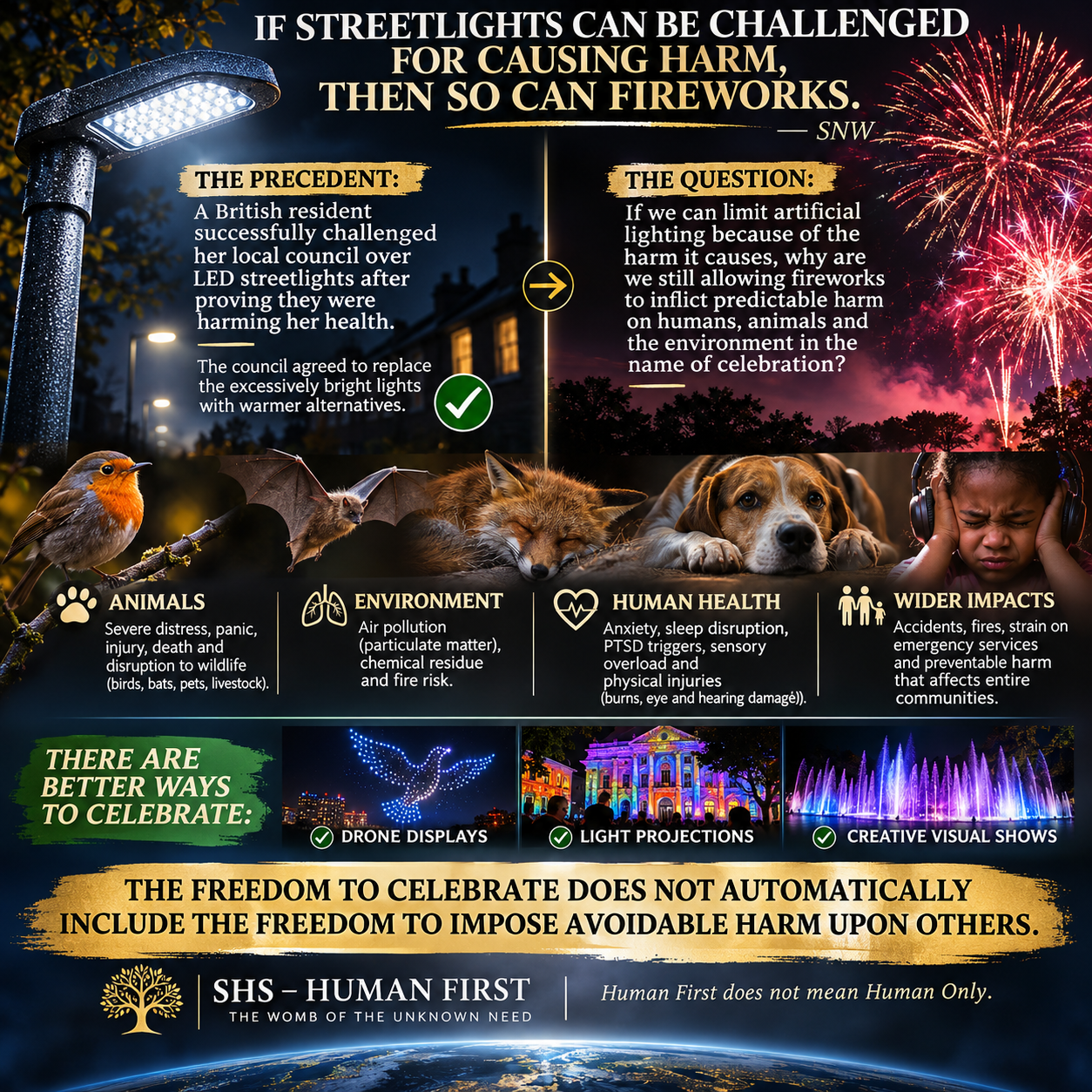
To commemorate lights, we can celebrate during day light or safe fires, it doesn’t have to be fireworks, which didn’t even exist when the tradition started.
— SNW | SHS – Human First
I came across this story about a British resident who successfully challenged her local council over LED streetlights that were affecting her health.
The case resulted in an agreement to replace the excessively bright lights with warmer alternatives.
And immediately, one thought came to mind:
If we can challenge artificial lighting because of the harm it causes, why are we still allowing fireworks to inflict predictable harm on humans, animals and the environment in the name of celebration?
Let’s investigate the contradiction.
Every year, we knowingly detonate explosives into the atmosphere for entertainment.
We know that animals experience terror from the sudden explosions. We know that birds can be driven from their resting places, that pets panic, that horses and livestock can injure themselves attempting to escape, and that wildlife has no warning, no protection and no understanding of what is happening.
We know that fireworks can cause burns, injuries, fires, sleep disturbances and severe distress to people with sensory sensitivities, PTSD and other vulnerabilities.
We know that fireworks release particulate pollution into the air that everyone around them must breathe, whether they consented to the celebration or not.
And yet, we continue.
Why? Because we’ve normalised it? Because it’s tradition? Because someone finds the explosions beautiful?
Since when did one person’s enjoyment become sufficient justification for imposing preventable suffering upon another living being?
A bird does not consent to having its resting environment turned into a battlefield of explosions.
A dog does not understand that the terrifying sounds outside are supposed to represent happiness.
A sleeping infant does not understand the celebration.
A person suffering from trauma does not suddenly become immune to distress because the explosions are festive.
And the atmosphere does not distinguish between pollution released for celebration and pollution released for any other purpose.
The consequences do not disappear simply because the intentions were celebratory.
What makes this particularly fascinating is that British legislation already recognises the potential for fireworks to cause injury, alarm, distress and anxiety to humans, and injury, death and distress to animals.
So the harm is not even an entirely unrecognised phenomenon.
It is already acknowledged within the legal framework.
The question is why acknowledging that harm has not led us to eliminate it wherever reasonable alternatives exist.
We have technology capable of producing extraordinary visual celebrations through coordinated drones, projections, lighting displays and other forms of artistic expression.
Human creativity does not end where explosives end.
And even alternatives must be assessed for their own environmental consequences.
This is not an argument against celebration.
It is an argument against making suffering an acceptable condition of celebration.
If one resident can successfully challenge a council’s lighting decisions, imagine what a collective, evidence-led challenge against harmful fireworks practices could achieve.
Investigate the environmental consequences.
Document the injuries.
Document the wildlife disturbances.
Document the effects on vulnerable humans.
Examine the responsibilities of manufacturers, sellers, event organisers and public authorities.
Put the existing legislation beside the documented consequences and ask whether current protections are sufficient.
Challenge unrestricted private use, demand stronger protections and pursue the replacement of harmful explosive displays with safer alternatives.
Because here is the principle I want humanity to start applying consistently:
THE FREEDOM TO CELEBRATE DOES NOT AUTOMATICALLY INCLUDE THE FREEDOM TO IMPOSE AVOIDABLE HARM UPON OTHERS.
And if we are capable of creating something beautiful without terrifying or injuring the living world around us, why would we continue choosing the alternative?
Progress is not merely creating something spectacular.
Progress is developing the capacity to create without unnecessarily destroying, harming or disturbing what already exists.
Nature is not an afterthought to human entertainment.
It is the foundation upon which our existence depends.
HUMAN FIRST DOES NOT MEAN HUMAN ONLY.
— Susan Ndinga-Wright SHS – Human First | The Womb of The Unknown Need


Leave a Reply