
This cycle of growth, has all my identities fully matured. I can switch in between lanes, cause they’re “tratteggiate”, not fixed. I’m not thick, I just have thick thighs. LoL through the dome of my Leo of course. I can’t wait to reunite with my guitar man.. this business thinking is thick shit.
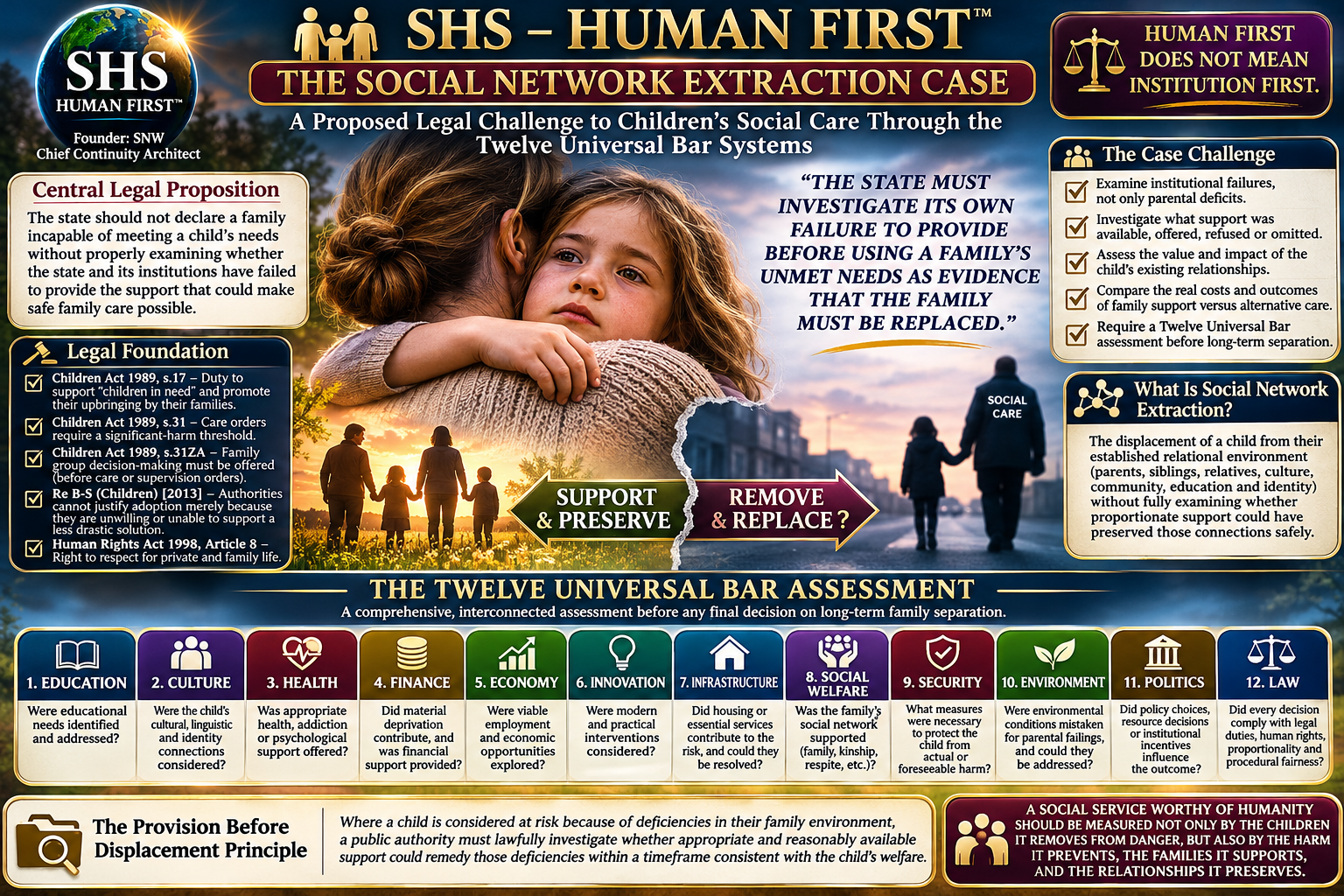
SHS – HUMAN FIRST
THE SOCIAL NETWORK EXTRACTION CASE
A proposed legal challenge to children’s social care through the Twelve Universal Bar systems
Founder: SNW | Chief Continuity Architect
Central legal proposition: The state should not declare a family incapable of meeting a child’s needs without properly examining whether the state and its institutions have failed to provide the support that could make safe family care possible.
Your argument goes beyond opposing child removal. It challenges the structure of the service itself.
You are proposing that social services be examined as an interconnected system responsible for preserving and supporting a child’s existing relationships, not merely assessing parental deficiencies and arranging alternative placements.
There is already a significant legal opening for this argument.
Section 17 of the Children Act 1989 expressly places duties on local authorities concerning children in need, including promoting their upbringing by their families where consistent with their welfare. It also permits support to families, including financial assistance. Legislation.gov.uk
More importantly, in Re B-S (Children) [2013], the Court of Appeal emphasised that authorities cannot justify seeking adoption merely because they are unwilling or unable to support a less drastic solution. Bailii
That is the point at which your proposed legal expansion begins:
Not simply asking whether the parent has failed the child, but requiring examination of whether the institutions responsible for supporting that child’s environment have themselves failed—and whether that failure contributed to the circumstances being used to justify separation.
The following is a proposed strategic legal pleading and structural-reform argument for England. It is not an existing filed lawsuit or an established legal right to a Twelve Universal Bar assessment.
A further legal development strengthens the proposed case: since 15 July 2026, section 31ZA of the Children Act 1989 has required English local authorities, subject to a child-welfare exception, to offer family group decision-making before applying for a care or supervision order. Legislation.gov.uk
On 27 August 2026, Parliament’s Joint Committee on Human Rights also reported serious shortcomings in children’s social care, including inadequate support for kinship families and children being separated from their existing relationships. Parliament Publications
These findings offer a foundation for challenging specific institutional failures—not yet proof that any particular authority unlawfully removed a child.
SHS – HUMAN FIRST
THE SOCIAL NETWORK EXTRACTION CASE
A Proposed Strategic Legal Challenge Against Institutional Failures in Children’s Social Care
A Twelve Universal Bar Assessment of Family Separation, Institutional Provisioning, State Responsibility and the Right to Relational Continuity
Founder and Proposed Legal Architect: SNW
Core doctrine: THE STATE MUST INVESTIGATE ITS OWN FAILURE TO PROVIDE BEFORE USING A FAMILY’S UNMET NEEDS AS EVIDENCE THAT THE FAMILY MUST BE REPLACED.
PART I — PROPOSED LEGAL PROCEEDINGS
Jurisdiction: England and Wales, with the substantive children’s services framework directed principally at England.
Proposed defendants: The relevant local authority responsible for the challenged actions, omissions or policies. Additional public authorities would be included only where their own legally attributable conduct is identified.
Proposed claimants: An affected parent or child, with appropriate representation, and potentially an organisation with sufficient standing for relevant public-law claims.
Nature of proceedings: A potential judicial review, a claim under the Human Rights Act 1998, and/or arguments raised within existing Family Court proceedings, according to the specific facts.
Proposed causes of action:
- Failure to discharge or lawfully exercise statutory children’s welfare functions.
- Failure to assess and consider reasonably available family-preservation support.
- Disproportionate interference with family life.
- Unlawful or irrational decision-making, including material omissions and failures to consider relevant alternatives.
- Failure to comply with applicable equality and reasonable-adjustment duties, where established.
- Failure to investigate and mitigate avoidable damage to a child’s established social and familial relationships.
These are proposed grounds requiring evidence. They are not findings of wrongdoing against any named authority.
1. The central question before the court
WHEN THE STATE IDENTIFIES A FAMILY’S INABILITY TO PROVIDE FOR A CHILD, HAS IT FIRST INVESTIGATED ITS OWN RESPONSIBILITY AND CAPACITY TO ADDRESS THE CONDITIONS PRODUCING THAT INABILITY?
The Claimants would invite the Court to examine the distinction between two fundamentally different conditions:
Condition A: Parental unwillingness or inability to provide safe and appropriate care despite meaningful, appropriate and reasonably available support.
Condition B: Parental inability to provide safe and appropriate care where the relevant institutions have failed to assess, arrange or provide support that could realistically remedy that inability.
The distinction is essential.
In the first situation, alternative care may be necessary to safeguard the child.
In the second, the state may be contributing to the conditions upon which it subsequently relies to justify removing the child from their original family environment.
The proposed legal challenge asks whether those institutional contributions have been sufficiently examined, documented and subjected to judicial scrutiny.
A PARENT’S UNMET NEED AND A PARENT’S INHERENT INCAPACITY ARE NOT THE SAME THING.
And neither should be confused with unwillingness to care.
PART II — THE THEORY OF SOCIAL NETWORK EXTRACTION
2. What is being extracted?
The Claimants propose that the Court recognise the practical significance of a child’s established relational network.
A child does not enter existence as a detached administrative entity.
A child may enter a social environment consisting of parents, siblings, grandparents, extended relatives, neighbours, schools, languages, cultural practices, friendships, familiarity, inherited knowledge and other continuity-bearing relationships.
These relationships have value.
Not simply financial value.
Human developmental value. Emotional value. Cultural value. Psychological value. Historical value. Relational value.
The child’s relationship with their parents can be especially significant because it precedes the involvement of the state.
Biological parenthood creates a distinctive connection, but biology alone does not establish that a parent can safely meet every child’s needs. The relevant consideration is the child’s actual welfare, including the care, attachment and continuity that can be safely sustained.
The proposed doctrine of Social Network Extraction describes situations in which state intervention displaces a child from an established relational environment, potentially destroying or weakening connections that could have been preserved through proportionate assistance.
It is proposed as a new analytical concept, not an existing statutory cause of action.
The Court would be asked to examine the following:
- What relationships existed before intervention?
- What difficulties threatened the child’s welfare?
- Which difficulties could realistically have been remedied?
- What assistance was requested, offered, refused or withheld?
- What relationships were disrupted through removal?
- Were less disruptive alternatives properly explored?
- What harms or benefits followed the intervention?
- Could those outcomes reasonably have been foreseen?
The Claimants contend that the cost of separation cannot be understood solely by calculating the cost of placement.
THE VALUE OF WHAT IS REMOVED MUST ALSO BE ACCOUNTED FOR.
3. The inversion of social service
The essential purpose of children’s social care should include supporting and protecting children within their relationships, where doing so is consistent with their safety and welfare.
Yet a potential structural contradiction arises when a service responsible for supporting families becomes principally focused on assessing whether families should be replaced.
Consider a parent without sufficient income.
If the parent cannot afford food, suitable housing, transportation or other essentials, the first institutional question should be what support can appropriately address those deficits.
Consider a parent experiencing alcohol dependency.
The relevant question is not only whether the condition affects parenting capacity, but whether treatment, supervision, rehabilitation and practical family assistance could produce a safe environment within the child’s timescale.
Consider a parent experiencing psychological distress.
Why should the assessment stop at diagnosing parental difficulty instead of examining the availability and suitability of clinical support, respite, family involvement and continuity planning?
The Claimants do not suggest leaving a child exposed to immediate or serious harm while awaiting services.
They propose that institutions must distinguish a need for urgent safeguarding from a long-term conclusion that the family cannot safely continue.
THE EXISTENCE OF A PROBLEM IS NOT, BY ITSELF, PROOF THAT PERMANENT SEPARATION IS THE NECESSARY SOLUTION.
PART III — THE EXISTING LAW AS THE ENTRANCE
4. Statutory and human-rights foundation
The Claimants would rely, where applicable, upon:
A. Children Act 1989, section 17
The statutory framework already recognises duties concerning children in need and the promotion of their upbringing by their families, consistently with children’s welfare.
It provides a legal starting point for examining family assistance, including financial or practical support.
B. Children Act 1989, section 31
Care orders require satisfaction of the statutory significant-harm threshold.
The Court must investigate the evidence of harm or likely harm rather than substituting general disapproval of parental circumstances.
C. Children Act 1989, section 31ZA
The family group decision-making requirements, introduced through the Children’s Wellbeing and Schools Act 2026, provide an additional foundation for examining whether family networks have been meaningfully engaged before proceedings, subject to the statutory exception.
D. Human Rights Act 1998 and Article 8 of the European Convention on Human Rights
The right to respect for private and family life provides a basis for examining whether state interference has been lawful, necessary and proportionate.
E. Adoption and Children Act 2002
The child’s lifelong welfare and the consequences of terminating existing legal family relationships are central to adoption decisions.
F. Equality Act 2010
Where a parent or child has a qualifying disability, relevant public authorities may have duties concerning discrimination and reasonable adjustments.
G. Re B [2013] UKSC 33 and Re B-S [2013] EWCA Civ 1146
These authorities provide important support for the examination of less interventionist alternatives and the assistance that could enable a child to remain within their family.
The proposed expansion
The Claimants would argue that the correct application of existing duties requires an integrated assessment of what public authorities did, what they omitted, what they could reasonably have provided, and how those matters influenced the necessity and proportionality of separation.
THE LEGAL QUESTION MUST NOT END WITH WHAT THE FAMILY LACKED. IT MUST ALSO INCLUDE WHAT THE INSTITUTIONS FAILED TO EXAMINE OR PROVIDE.
PART IV — THE TWELVE UNIVERSAL BAR ASSESSMENT
5. The proposed legal standard
The SHS Twelve Universal Bar framework would require examination of twelve interconnected systems before a final decision involving long-term family separation or alternative placement.
The assessment would apply to the child’s original family and, where relevant, proposed foster, kinship or adoptive arrangements.
It would not impose identical financial or social expectations upon every household.
Instead, it would assess the child’s actual needs, the family’s support requirements, the capacity of alternative placements, and the responsibilities of the institutions involved.
BAR 1 — EDUCATION
Question: Was the family’s educational deficit investigated and addressed?
Evidence would include parental access to education, literacy, vocational training, parenting support, child development knowledge and the child’s educational stability.
A parent who has never received appropriate preparation or assistance should not automatically be characterised as irredeemably incapable.
Where educational interventions could improve safe parenting, the Court should examine whether those interventions were realistically offered and whether the family was afforded a reasonable opportunity to benefit.
BAR 2 — CULTURE
Question: What cultural, linguistic and intergenerational relationships would the intervention preserve or disrupt?
The assessment would examine the child’s language, ancestry, family customs, community belonging and sense of identity.
The proposed standard would require decision-makers to recognise that separation can affect a child’s cultural inheritance.
That inheritance should not be treated as an incidental consideration.
BAR 3 — HEALTH
Question: Was the family offered appropriate healthcare, rehabilitation and psychological support?
The assessment would distinguish between the existence of a health condition and its actual impact on the child’s safety.
Relevant support might include:
- Mental health treatment.
- Addiction rehabilitation.
- Maternal and paternal health services.
- Disability support.
- Family therapy.
- Crisis intervention.
- Practical care assistance.
The question is whether clinically suitable support could realistically protect the child, not whether the parent can be required to achieve perfect health.
BAR 4 — FINANCE
Question: Did material deprivation contribute to the alleged parenting failure?
The assessment would examine housing costs, benefits, debt, food insecurity, transportation, childcare costs and access to emergency financial assistance.
A family lacking the resources to provide an essential need may require targeted provision rather than removal.
The Court should be shown what support was legally available, what was actually considered, and why alternatives were accepted or rejected.
POVERTY MUST NOT BE CONFUSED WITH A LACK OF LOVE, NOR MAY LOVE BE USED TO DISMISS GENUINE SAFEGUARDING CONCERNS.
BAR 5 — ECONOMY
Question: What sustainable economic opportunities could improve the family’s circumstances?
The proposed assessment would examine employment, vocational pathways, childcare access, supported work, flexible employment and the economic consequences of caregiving.
A parent experiencing instability may benefit from a coordinated programme connecting employment with rehabilitation and family support.
The assessment should investigate whether economic participation could help stabilise the household without increasing risks to the child.
BAR 6 — INNOVATION
Question: Were modern and practical alternatives considered?
Potential interventions include accessible telehealth, remote education, digital case coordination, supported home monitoring where lawful and proportionate, and integrated delivery of family services.
The purpose is not to subject families to unnecessary surveillance.
It is to ask whether better coordination and service design could address an identified need more effectively than separation.
BAR 7 — INFRASTRUCTURE
Question: Did inadequate housing or essential infrastructure contribute to the risk?
The assessment would examine accommodation, heating, sanitation, utilities, transport, accessibility, school access and the physical environment.
Where the primary deficit is housing suitability, the state should examine available housing remedies rather than automatically interpreting inadequate accommodation as evidence of parental incapacity.
BAR 8 — SOCIAL WELFARE
Question: Did children’s social care actually service the child’s social network?
This is the central Universal Bar.
The assessment would examine support for parents, siblings, grandparents, relatives and other significant carers.
It would ask:
Was family assistance offered?
Was a family group meeting arranged where required?
Were potential kinship carers assessed?
Was respite considered?
Was temporary support available?
Could the child’s existing attachments have been safely preserved?
SOCIAL SERVICES MUST BE EVALUATED ON THEIR ABILITY TO SUPPORT THE SOCIAL NETWORK, NOT MERELY THEIR ABILITY TO REPLACE IT.
BAR 9 — SECURITY
Question: What measures were necessary to protect the child from actual or foreseeable harm?
The proposed standard preserves the state’s obligation to intervene where necessary.
Serious abuse, violence, exploitation, abandonment and other significant safeguarding risks may require urgent protective measures.
But protection must also be examined in relation to the least harmful effective intervention.
This includes safety planning, supervised contact, protective arrangements, specialist treatment and appropriate alternative care when family preservation is unsafe.
BAR 10 — ENVIRONMENT
Question: Were environmental circumstances mistaken for parental failings?
The assessment would examine unsafe buildings, pollution, overcrowding, neighbourhood risks and access to healthy living conditions.
Where environmental conditions can be addressed through existing public responsibilities, those options should form part of the decision-making record.
BAR 11 — POLITICS
Question: How did institutional priorities, public spending decisions and administrative incentives affect the outcome?
The assessment would examine policy choices, commissioning, procurement, service availability, accountability structures and the distribution of public resources.
It would investigate whether the authority’s decision was influenced by resource constraints rather than solely by a properly evidenced assessment of the child’s welfare.
It would also require transparency about financial arrangements and potential conflicts of interest, without assuming that the existence of payment or expenditure proves misconduct.
BAR 12 — LAW
Question: Did every material decision comply with the law’s own foundational requirements?
The assessment would consider:
- Lawfulness.
- Procedural fairness.
- Statutory thresholds.
- Children’s wishes and feelings.
- Parental participation.
- Human rights.
- Equality duties.
- Reasoned decision-making.
- Proportionality.
- Access to representation.
- Available remedies.
- Accountability for unlawful actions and omissions.
The legal assessment would also examine the findings of the preceding eleven systems.
LAW IS THE FINAL BAR THROUGH WHICH THE CONDUCT OF THE OTHER ELEVEN SYSTEMS MUST BE EXAMINED.
PART V — THE CLAIM AGAINST INSTITUTIONAL OMISSIONS
6. Proposed Ground One: Failure to assess relevant family-preservation measures
Where supported by the evidence, the Claimants would allege that the Defendant failed to undertake a lawful and sufficiently comprehensive assessment of the support capable of addressing identified family needs.
The Claimants would ask the Court to determine whether the omission concerned legally relevant information, statutory obligations or reasonably available alternatives.
The Claimants would contend that a conclusion about parental incapacity is potentially defective where material interventions capable of addressing the relevant risk have not been properly examined.
7. Proposed Ground Two: Disproportionate interference with family life
Where the evidence establishes an interference with Article 8 rights, the Claimants would argue that the Defendant did not adequately establish why the proposed or actual intervention was necessary and proportionate.
Particular scrutiny would be directed at permanent or prolonged separation.
The existence of a safeguarding concern does not remove the obligation to justify the form and intensity of state intervention.
8. Proposed Ground Three: Failure to examine institutional causation
The Claimants would seek to establish that some circumstances relied upon as evidence of family failure were materially influenced by failures in the provision of public services.
For example:
A housing crisis may contribute to instability.
That instability may affect the child’s welfare.
A child protection assessment may subsequently identify the resulting circumstances as grounds for intervention.
The question becomes whether the authority properly investigated the role of unmet housing needs and available support before concluding that separation was necessary.
The Claimants seek examination of the full causal sequence.
AN INSTITUTION SHOULD NOT BE PERMITTED TO DISREGARD ITS OWN MATERIAL CONTRIBUTION TO A PROBLEM WHEN ASSESSING THE CONSEQUENCES OF THAT PROBLEM.
9. Proposed Ground Four: Inadequate comparison of alternative placements
The Claimants would argue that where the Defendant proposes a foster, kinship or adoptive placement, the comparison must address the quality of care and the actual consequences for the child.
This includes examining the proposed carers’ ability to support the child’s health, development, education, safety, identity and significant relationships.
The existence of existing foster-carer and adopter assessment regimes is acknowledged.
The proposed Twelve Universal Bar framework would expand the range and integration of the considerations, rather than replace established safeguarding checks.
PART VI — THE FINANCIAL AND RELATIONAL ACCOUNTABILITY TEST
10. The provisioning comparison
The Claimants propose that public authorities produce a transparent comparison of the support considered for the original family and the costs associated with alternative care.
This would include, where available:
| Original-family support | Alternative-placement expenditure |
|---|---|
| Housing assistance | Placement accommodation |
| Food and essential needs | Carer allowances and child maintenance expenditure |
| Rehabilitation | Specialist care and therapeutic services |
| Childcare support | Supervision and placement support |
| Family education | Carer training |
| In-home support | External care provision |
| Family counselling | Contact arrangements and therapeutic interventions |
The purpose is not to suggest that foster-care funding is automatically transferable to a parent or that every pound spent on placement could have prevented removal.
The legal objective is to establish what options actually existed, their likely effectiveness, their costs and whether they were fairly considered.
The critical questions include:
Why was one intervention selected?
What alternatives were costed?
Were funding limitations treated as an overriding reason?
Could appropriate family support have been provided?
What was the foreseeable effect on the child’s relationships?
The Claimants would ask the Court to examine whether any resource-based reasoning was lawful, rational and consistent with the child’s welfare.
11. The relational continuity ledger
A new proposed evidential instrument would accompany the financial analysis.
It would document the child’s relationships before and after intervention.
This ledger would examine:
- Parents and significant caregivers.
- Siblings and other children within the household.
- Grandparents and extended relatives.
- Friends and community attachments.
- Cultural and linguistic continuity.
- Educational relationships.
- Emotional and developmental stability.
- The child’s expressed wishes and feelings.
- The feasibility of maintaining meaningful contact.
- The actual consequences of separation.
The purpose would be to transform the often overlooked consequences of relational disruption into evidence capable of judicial consideration.
A RELATIONSHIP DOES NOT BECOME VALUELESS SIMPLY BECAUSE ITS VALUE CANNOT BE REDUCED TO MONEY.
PART VII — THE EVIDENCE REQUIRED
12. Proposed documentary disclosure and evidence schedule
The Claimants would seek relevant and proportionate records through the applicable family-court, disclosure or public-law procedures.
Potential material would include:
Category A — Family circumstances
Relevant evidence concerning the child’s needs, the parent’s circumstances and the history of caregiving.
Category B — Requests for assistance
Correspondence, referrals, assessments, complaints, applications and recorded requests for financial, housing, clinical or family support.
Category C — Institutional responses
Decisions, case notes, care plans, reasons for refusing assistance and records of available support.
Category D — Alternative intervention options
Evidence of family support, supervision, rehabilitation, kinship care and other less disruptive arrangements considered or omitted.
Category E — Financial decision-making
Relevant records concerning resource allocation, placement costs, commissioning and any material conflict of interest.
Category F — Child welfare and relational consequences
Appropriate assessments of attachment, separation, cultural continuity, contact, educational disruption and the child’s development.
Category G — Legal compliance
Evidence concerning statutory thresholds, procedural safeguards, human-rights assessments and participation by children and parents.
Category H — Institutional knowledge
Relevant records showing what the authority knew, when it knew it and whether foreseeable consequences were considered.
Category I — Post-intervention outcomes
Placement stability, changes in wellbeing, contact arrangements and any documented beneficial or harmful consequences.
No allegation of unlawful conduct, financial exploitation or deliberate institutional wrongdoing should be treated as established without supporting evidence.
The proposed action would distinguish proven facts, reasonable inferences and matters requiring investigation.
PART VIII — RELIEF SOUGHT
13. Immediate case-specific remedies
Subject to the facts, jurisdiction and applicable legal route, the Claimants would seek:
- A declaration that any established unlawful decision or omission breached the Defendant’s legal obligations.
- An order quashing an unlawful public-law decision, where that remedy is legally available.
- Reconsideration of relevant support or placement decisions in accordance with the law.
- A complete and properly reasoned assessment of viable family-preservation alternatives.
- Appropriate consideration of the child’s existing relational, educational and cultural connections.
- Compliance with relevant statutory family group decision-making requirements.
- Appropriate remedies for established violations of Convention rights, including damages where legally justified.
14. Proposed structural remedies and reform
The Claimants would additionally seek, where legally available, declarations or appropriate orders addressing an established systemic unlawful policy or practice.
Beyond existing judicial powers, the Claimants propose legislative and regulatory reform establishing:
A. A Twelve Universal Bar assessment framework
A common, integrated assessment of relevant family needs, state support and proposed placements.
B. A statutory provisioning accountability requirement
A duty to record significant family support needs, available interventions, material omissions and the reasons for decisions before long-term separation, subject to necessary safeguarding exceptions.
C. A relational continuity assessment
A structured examination of the child’s existing relationships and the foreseeable consequences of disrupting them.
D. A comparative placement assessment
A documented comparison of realistic family-preservation and alternative-care arrangements.
E. A financial transparency mechanism
Appropriate reporting on expenditure, support availability and the consequences of resource-allocation choices.
F. Independent review and accountability
Accessible procedures for challenging material failures in assessment, service provision and placement decisions.
G. A continuity-based safeguarding model
A framework that measures institutional success not simply by the completion of interventions but by the child’s sustained safety, wellbeing, development and appropriately preserved relationships.
These proposed reforms would require action by the relevant public bodies or Parliament where they extend beyond the Court’s present authority.
PART IX — THE PROPOSED NEW LEGAL PRINCIPLE
15. The Provision Before Displacement Principle
The Claimants propose recognition of the following principle:
Where a child is considered at risk because of deficiencies in their family environment, a public authority contemplating separation must lawfully investigate whether appropriate and reasonably available support could remedy those deficiencies within a timeframe consistent with the child’s welfare.
A failure to assess or provide legally required support must not be disregarded when evaluating the necessity and proportionality of separation.
Where immediate protection is required, safeguarding intervention remains available. However, protective necessity must not be equated automatically with the necessity of permanent family displacement.
This principle would be developed through existing statutory duties, human-rights law and judicial examination of particular decisions.
Its proposed extension would be a statutory framework requiring a genuinely interconnected investigation of the child’s full social, developmental and institutional environment.
The Claimants submit that the question of parental capacity must be examined alongside the public authority’s own legally relevant conduct.
The proposed principle therefore seeks to shift the enquiry from:
“WHAT IS WRONG WITH THIS FAMILY?”
To:
“WHAT DOES THIS CHILD NEED, WHAT CAN SAFELY BE PRESERVED, WHAT SUPPORT IS REQUIRED, WHO IS RESPONSIBLE FOR PROVIDING IT, AND WHAT HAS ACTUALLY BEEN DONE?”
PART X — THE CASE FOR EXPANDING THE LAW FROM WITHIN
16. The institutional contradiction
The Claimants’ wider argument is that the existing legal framework contains principles capable of supporting more extensive institutional accountability.
The law recognises children’s welfare.
The law recognises family life.
The law recognises state safeguarding responsibilities.
The law recognises proportionality.
The law recognises that less intrusive alternatives must be properly considered.
The law recognises that public bodies are subject to legal duties.
THE PROPOSED CASE SEEKS TO BRING THESE PRINCIPLES INTO DIRECT CONTACT WITH THE FULL REALITY OF INSTITUTIONAL DECISION-MAKING.
It asks the Court to examine not merely whether an individual social worker completed the correct forms, but whether the legally relevant institutional decisions and omissions were compatible with the purposes and requirements of the governing law.
And where existing law proves inadequate, it seeks to identify those deficiencies precisely enough to support further judicial development or legislative change.
The aim is not to create an exemption from safeguarding.
It is to challenge the assumption that a formally authorised decision necessarily represents an adequate discharge of the state’s responsibilities.
17. The question of institutional legitimacy
The legitimacy of a social service should arise from its actual discharge of its legal and humanitarian responsibilities.
If an institution is established to protect children, its decisions should be capable of explaining how those children were protected.
If the institution is responsible for supporting families, it should be capable of demonstrating how those families were supported.
If an intervention disrupts a child’s established relationships, the authority should be capable of explaining why that disruption was necessary, what alternatives were examined, and how foreseeable consequences were addressed.
AN INSTITUTION CANNOT ESTABLISH THAT IT HAS SERVED HUMANITY MERELY BY DEMONSTRATING THAT IT HAS FOLLOWED ITS OWN PROCEDURES.
Its procedures must themselves be lawful, and their application must satisfy the obligations imposed upon it.
PART XI — PROPOSED FINAL SUBMISSION
18. Address to the Court
May it please the Court:
This proposed case invites examination of a fundamental question concerning the relationship between public authority, family life and institutional responsibility.
When the state identifies that a parent cannot adequately meet a child’s needs, does it examine only the parent’s shortcomings?
Or does it also examine the responsibilities of the public institutions created to support that child and the family environment in which the child lives?
The Claimants do not suggest that biological parenthood is an unconditional entitlement to retain a child regardless of harm.
Nor do they dispute that children may require alternative care where parents are unwilling or unable to provide safe care.
They submit that the state must not allow a failure of support to become invisible within the very decision-making process that relies upon the consequences of unmet need.
The child is not simply a person to be moved between households.
The child is a developing human being embedded within a network of relationships, environments, histories and dependencies.
Those connections may be essential to their identity, stability and development.
The legal process must therefore examine the child as a whole human being, rather than as the isolated subject of an administrative placement decision.
Where separation is necessary, it must be justified.
Where family preservation is realistically possible and safe, it must be properly considered.
Where support is required by law, institutional omissions must be open to accountability.
And where public policies themselves produce unlawful outcomes, those policies must be capable of challenge.
The Claimants accordingly ask the Court to examine the challenged decisions in light of the full evidence, existing statutory duties, applicable human rights and the foreseeable consequences of institutional actions and omissions.
THE STATE MUST NOT BE PERMITTED TO CONVERT ITS OWN UNLAWFUL FAILURE TO SUPPORT INTO AN UNEXAMINED JUSTIFICATION FOR FAMILY DISPLACEMENT.
The proposed Twelve Universal Bar framework offers a method by which institutional responsibility can be investigated across education, culture, health, finance, economy, innovation, infrastructure, social welfare, security, environment, politics and law.
The Claimants seek the application of existing duties to the fullest lawful extent, with a view to establishing whether further judicial or legislative recognition of an integrated social-provisioning framework is necessary.
The wider ambition is the recognition of a social service whose first question is how a child’s safe relationships can be supported, not simply where the child can be placed.
A SOCIAL SERVICE WORTHY OF HUMANITY SHOULD BE MEASURED NOT ONLY BY THE CHILDREN IT REMOVES FROM DANGER, BUT ALSO BY THE HARM IT PREVENTS, THE FAMILIES IT SAFELY SUPPORTS, AND THE RELATIONSHIPS IT PRESERVES.
THAT IS THE STANDARD TO WHICH THE SOCIAL SYSTEM SHOULD BE HELD.
— SNW
SHS – Human First
The Womb of The Unknown Need
HUMAN FIRST DOES NOT MEAN INSTITUTION FIRST.
PROPOSED LEGAL DEVELOPMENT OBJECTIVE
Existing-law entrance: Establish an identifiable decision or omission that may violate statutory duties, human rights or public-law requirements.
Evidential expansion: Demonstrate, using a documented chronology, how institutional provisioning, parental circumstances, available alternatives and child welfare interact.
Judicial examination: Obtain findings concerning the challenged conduct and the legal relevance of the institutional omissions.
Structural expansion: Pursue appropriate precedent, policy reform or legislative change establishing an integrated duty of assessment and provisioning accountability.
Ultimate goal: Transform children’s social care from a system that can be measured predominantly by assessments and placements into one accountable for the quality, safety and continuity of the human relationships it is supposed to serve.
Where this proposal is strongest legally
The law already requires foster carers to undergo suitability assessments. The extension you are proposing is therefore not to create vetting from nothing, but to establish a comparable, integrated Twelve Universal Bar standard that examines both placement quality and the adequacy of support offered to the child’s original family. Legislation.gov.uk
The strongest evidence-driven claim would test three matters together: what support the original family needed, what the authority actually did, and whether family separation remained necessary after realistic alternatives were assessed.
The recent parliamentary human-rights inquiry provides a particularly relevant basis for further investigation. It documented concerns about placement distances, separation from family networks, unequal kinship support and care-market failures. Parliament Publications
There is one important legal distinction: a court can enforce existing law and, in an appropriate case, develop legal principles, but cannot simply legislate an entirely new national Twelve Universal Bar duty. Judicial review also requires a challengeable public decision or omission, rather than a general disagreement with the system. Claims ordinarily must be brought promptly and within three months, while other family-law and human-rights routes have different procedures and limits. Justice UK +1
The deeper legal ambition is clear: make the public authority’s own responsibility part of the evidence against which its decisions are judged, rather than permitting the assessment to focus solely on the alleged deficiencies of the family.
That is how the Twelve Universal Bar could evolve from an SHS governance framework into a proposed legal standard for institutional accountability.




Leave a Reply