
The most revealing aspect of this simulation is that a legal victory for one woman could expose economic vulnerabilities affecting millions of people who have never met either spouse.
The existing financial system already provides substantial evidence for examining those connections. As of November 2026:
- Nvidia reported $96.2 billion in quarterly revenue, including $89 billion from its data-centre business. NVIDIA Investor Relations
- Nvidia disclosed $279 billion in manufacturing and supply-capacity commitments, extending its financial relationships throughout the semiconductor industry. SEC
- Nvidia accounted for approximately 7.77% of the S&P 500 on 23 October, meaning its valuation influences investment portfolios far beyond individual Nvidia shareholders. whichindex.com
- The Bank of England has already identified AI-related market concentration, leveraged investment funds and interconnected credit arrangements as potential sources of wider financial instability. the UK’s central bank
There is an important distinction in the mechanics: transferring shares to a spouse does not itself remove money from Nvidia or stop chip production. The wider disruption develops when settlement-related sales, investor confidence, financing pressure and changes to corporate spending reinforce one another.
The following simulation follows that chain through to its consequences for workers, families, national economies and public services, with SHS – Human First securing the legal victory.
ONE MAN’S BETRAYAL. ONE WOMAN’S VICTORY. AN ENTIRE ECONOMY EXPOSED.
SHS – HUMAN FIRST: THE GLOBAL CONSEQUENCES OF A DIVORCE VICTORY AGAINST THE CEO OF NVIDIA
A simulated legal, financial, economic and humanitarian chain reaction through the Twelve Universal Bar systems
— SNW | Chief Continuity Architect | SHS – Human First
10 November 2026
There is something extraordinarily fascinating about a civilisation that places so much power in the hands of individual human beings, builds entire economic systems around them, and then behaves as though the integrity of those individuals is unrelated to the continued functioning of those systems.
Imagine that Lori Huang decides to divorce Jensen Huang.
Imagine that she brings SHS – Human First into her legal consultation.
We conduct a full Twelve Universal Bar assessment, examine the accumulated marriage, establish the applicable financial rights, investigate the consequences of betrayal, challenge the legal treatment of demonstrable human harm and pursue substantial financial reparations.
And we win.
THE COURT RULES IN HER FAVOUR.
The outcome is an extraordinary financial award, involving substantial Nvidia shareholdings, recognition of financial interests and significant compensation under the successful SHS legal framework.
For this simulation, we will use an $80 billion combined award of property interests and reparations, with part of the financial obligation satisfied through share transfers and substantial share sales.
This is our modelled outcome.
Now we investigate what happens next.
Not merely to Jensen Huang.
Not merely to Lori Huang.
Not merely to Nvidia.
BUT TO THE MILLIONS OF HUMAN BEINGS WHOSE LIVELIHOODS ARE CONNECTED TO AN ECONOMIC STRUCTURE BUILT AROUND DECISIONS THEY NEVER PERSONALLY CONSENTED TO.
Because this is where my investigation becomes considerably more interesting than the divorce itself.
PHASE ONE: THE COURTROOM VICTORY BECOMES A GLOBAL FINANCIAL EVENT.
The judgment is delivered.
Lori Huang has prevailed.
The financial consequences are extraordinary.
But immediately, the world begins calculating what those consequences mean for Nvidia.
Remember, this is not simply a man holding billions of dollars in a bank account.
Much of his wealth is represented by ownership interests.
Nvidia shares.
Family trusts.
Investment arrangements.
Assets whose financial value depends partly on market expectations.
And this distinction becomes fundamental.
MONEY IN A BANK ACCOUNT AND WEALTH RECORDED AS THE MARKET VALUE OF SHARES ARE NOT THE SAME THING.
The $80 billion award in our simulation is enormous.
At Nvidia’s 10 November 2026 reference price of approximately $169 per share, that amount corresponds to the market value of roughly 474 million shares.
Nvidia’s SEC filings already establish that Jensen and Lori Huang jointly serve as trustees of arrangements holding substantial numbers of shares.
The judgment therefore creates a major reallocation of ownership and a large financial obligation.
Some shares pass into Lori’s control.
Other assets are sold to satisfy the cash component of the judgment.
Financial institutions are engaged to arrange transactions.
Investment banks begin examining how the shares will be absorbed.
Trading desks anticipate the incoming supply.
And investors begin reconsidering the concentration of financial power around Nvidia’s founder.
ONE PERSON’S PRIVATE DECISION HAS NOW BECOME A PUBLIC CAPITAL-ALLOCATION EVENT.
The irony?
Lori’s victory does not require Nvidia to stop manufacturing chips.
The underlying factories, contracts, products and customer orders continue to exist.
But the financial markets do not price only what exists today.
They price expectations of tomorrow.
And those expectations are about to change.
PHASE TWO: NVIDIA’S SHARE PRICE BECOMES THE FIRST TRANSMISSION MECHANISM.
The judgment becomes international financial news.
Investors begin asking several questions.
How many shares will be sold?
At what prices?
Over what period?
What influence will the new ownership arrangements create?
What does this mean for the CEO’s personal financial position?
Will this change how Nvidia is governed?
How will institutional investors respond?
How does the outcome affect the board’s assessment of executive risk?
And because the market already operates through expectations, investors begin responding before every transaction has occurred.
Some sell Nvidia shares.
Others reduce their exposure.
Investment funds rebalance.
Trading algorithms react to falling prices and volatility.
Leveraged investors encounter increased collateral requirements.
The very institutions that describe themselves as rational financial operators begin collectively amplifying a change in expectations.
And as selling pressure grows, prices decline.
THIS IS THE FIRST GREAT CONTRADICTION OF THE SYSTEM.
Nvidia has not suddenly forgotten how to produce technology.
Its engineers have not lost their knowledge.
Its customers have not collectively abandoned artificial intelligence.
Its existing infrastructure has not disappeared.
Yet enormous amounts of recorded financial wealth can evaporate through a change in the price investors are willing to pay.
Consider that carefully.
THE UNDERLYING TECHNOLOGICAL CAPACITY STILL EXISTS, BUT THE FINANCIAL VALUE SOCIETY HAS ASSIGNED TO ITS OWNERSHIP IS CONTRACTING.
And that contraction does not remain confined to the people who own Nvidia directly.
PHASE THREE: THE STOCK EXCHANGE BEGINS TRANSMITTING THE CONSEQUENCES TO PEOPLE WHO NEVER BOUGHT NVIDIA SHARES.
Here is where the ordinary person enters the story.
A person does not need to own Nvidia stock individually to have financial exposure to it.
Their pension may hold an index fund.
Their retirement savings may follow the S&P 500.
Their investment account may contain a global equity fund.
Their insurance provider may manage assets invested in technology companies.
Their employer’s pension scheme may have exposure through institutional portfolios.
Even some charities and university endowments may hold shares indirectly.
Nvidia represented almost 8% of the S&P 500 in October 2026.
That is an extraordinary level of concentration for one company within a major index.
Now imagine the impact of a prolonged Nvidia sell-off alongside declining valuations of other AI-related businesses.
<Chart data is not required to understand the central problem. The relationship is straightforward: when a heavily weighted company falls, the index funds holding it experience losses proportional to their exposure.>
A person in London checks their pension account.
A person in New York checks their retirement savings.
A family in Seoul discovers their investment portfolio has fallen.
An employee nearing retirement finds that the financial value of their pension has declined.
A charity discovers that its investment income is under pressure.
NONE OF THESE PEOPLE MARRIED JENSEN HUANG.
None of them participated in his personal decisions.
None of them decided how his marriage should be conducted.
Yet their financial futures are exposed to institutions whose value depends partly on confidence in the enterprise he leads.
And this is where I ask:
WHY HAS HUMANITY BUILT A SYSTEM IN WHICH MILLIONS OF PEOPLE CAN SUFFER FINANCIAL CONSEQUENCES ARISING FROM THE PERSONAL CONDUCT OF ONE PERSON THEY HAVE NEVER MET?
PHASE FOUR: THE AI INDUSTRY DISCOVERS HOW MUCH OF ITS FUTURE IT HAS BUILT AROUND NVIDIA.
Now we travel beyond the stock exchange.
Nvidia has become a central supplier of computing hardware and networking infrastructure used to develop and operate artificial intelligence.
Companies building AI models depend on enormous computational resources.
Cloud providers invest substantial capital in Nvidia systems.
Research institutions use GPU computing.
Data-centre operators build facilities around advanced computing infrastructure.
And manufacturers organise production capacity around anticipated demand.
Consider companies such as:
Microsoft.
Amazon.
Google.
Meta.
Oracle.
CoreWeave.
And the broader ecosystem of AI developers, enterprise technology providers and research laboratories purchasing computing capacity.
Their relationships with Nvidia vary, and some operate competing or complementary technologies.
But the wider dependency is substantial.
Now, in our simulation, the divorce judgment contributes to a prolonged repricing of Nvidia-related investments.
Investors become more cautious about the financial commitments supporting the AI expansion.
The cost of capital increases for some businesses.
Cloud providers face pressure to demonstrate that their spending will produce sufficient returns.
Borrowers encounter tighter financing conditions.
Highly leveraged AI infrastructure companies begin reassessing expansion plans.
And some projects are delayed.
Not because the chips have stopped working.
BUT BECAUSE THE FINANCIAL SYSTEM SUPPORTING THEIR PURCHASE, DEPLOYMENT AND FUTURE USE HAS BECOME MORE EXPENSIVE AND LESS STABLE.
Think about the difference.
A technological resource can remain perfectly functional while the financial arrangements governing access to it begin breaking down.
This is one of the defining characteristics of our present economic structure.
WE CAN POSSESS THE TECHNOLOGY AND STILL CREATE A FINANCIAL SYSTEM THAT PREVENTS PEOPLE FROM USING IT.
PHASE FIVE: THE SEMICONDUCTOR SUPPLY CHAIN FEELS THE CONSEQUENCES.
Now we travel to the manufacturers.
Nvidia does not manufacture every component of its products itself.
Its supply chain includes numerous companies and industries.
Among them:
- Taiwan Semiconductor Manufacturing Company (TSMC), involved in advanced chip fabrication.
- SK Hynix, Micron and Samsung, important participants in memory supply.
- Hon Hai/Foxconn, Wistron and other manufacturing partners involved in systems assembly and production.
- Suppliers of advanced packaging, networking equipment, optical components and supporting materials.
Nvidia disclosed $279 billion in supply and capacity commitments as of July 2026.
That number is important.
It demonstrates how far into the future the company’s economic relationships extend.
Now imagine that the market shock begins affecting expectations of future AI infrastructure demand.
Customers defer certain expansion plans.
Suppliers face pressure to revise production schedules.
Some businesses discover that planned future orders are becoming less predictable.
Certain suppliers continue producing under their existing contracts, while others encounter postponed new orders.
Inventory accumulates in parts of the supply chain.
Companies reassess future capital expenditure.
And then the consequences reach employees.
A semiconductor production worker loses overtime.
A contractor’s assignment is not renewed.
An equipment manufacturer freezes hiring.
A logistics company receives fewer shipments.
A technology supplier postpones the opening of a new facility.
And the people affected begin making their own adjustments.
THEY START SPENDING LESS.
They postpone purchases.
They reduce household expenditure.
They delay moving.
They avoid taking financial risks.
They become more concerned about employment.
Now the consequences are reaching businesses that have nothing directly to do with Nvidia.
Restaurants.
Retailers.
Transportation providers.
Housing markets.
Service businesses.
THIS IS HOW AN EVENT THAT BEGINS IN AN OWNERSHIP STRUCTURE CAN BECOME AN EVENT IN THE DAILY ECONOMY.
PHASE SIX: THE BANKS, LENDERS AND INVESTMENT FUNDS BEGIN REASSESSING RISK.
Now we approach the financial institutions.
AI infrastructure development has increasingly involved borrowing, private credit, structured financing and substantial capital commitments.
Some companies borrow against equipment.
Others finance data-centre construction through corporate debt.
Investment funds provide capital in anticipation of future revenues.
Banks lend against assets and projected income.
Investors purchase bonds associated with technology expansion.
And as confidence deteriorates, lenders begin reassessing the security of their exposures.
Some require additional collateral.
Some reduce lending.
Some raise borrowing costs.
Some demand stronger guarantees before financing expansion.
Investment funds holding leveraged positions face pressure to reduce their exposure.
To do this, they may sell assets beyond Nvidia.
This is where the effects spread even further.
A PROBLEM ASSOCIATED WITH ONE LARGE COMPANY CAN FORCE INVESTORS TO SELL ASSETS IN COMPLETELY DIFFERENT MARKETS.
And when many investors do this simultaneously, prices across otherwise unrelated markets can be affected.
The Bank of England has already identified precisely this kind of interconnected vulnerability in its assessment of AI-related financial concentration and leveraged investment structures.
The institutions involved are not helpless observers.
They have made decisions about leverage, concentration and acceptable risk.
And SHS would investigate those decisions as part of the wider chain of accountability.
Because while one individual’s conduct may initiate a particular sequence, the size of the resulting damage depends heavily on the system through which that sequence travels.
PHASE SEVEN: THE RIPPLE REACHES ENERGY, CONSTRUCTION AND THE PHYSICAL ECONOMY.
Now let us consider something people frequently overlook.
Artificial intelligence does not exist entirely in a digital cloud.
Its infrastructure is physical.
It requires electricity.
Water systems.
Land.
Construction workers.
Cooling equipment.
Power transformers.
Transmission infrastructure.
Buildings.
Maintenance.
Engineers.
Transport.
Materials.
And extensive long-term investment.
Nvidia’s AI infrastructure expansion is connected to these physical industries through the projects developed by its customers.
Imagine a major data-centre project encounters a financing delay.
Construction schedules change.
Equipment orders are postponed.
Some contractors lose expected work.
Electricity suppliers reassess their future demand assumptions.
Utilities must reconsider which infrastructure investments remain justified.
Local authorities begin reviewing the economic expectations they attached to proposed development.
A community that expected new employment discovers that the project is delayed.
A worker who expected a construction contract must seek another opportunity.
A family that planned its financial future around that income must adjust.
THEY DID NOT BUY NVIDIA SHARES.
They did not negotiate the financial arrangements.
They did not participate in the original scandal.
And yet, the consequences have reached them through the institutions upon which their employment depends.
The effect also travels in the other direction.
Some delayed projects release electricity capacity, land or resources for other uses.
Some competing firms gain opportunities.
Some businesses redirect capital towards alternative technologies.
Because economic disruptions redistribute opportunity as well as destroy it.
But redistribution does not eliminate the suffering experienced by those whose lives are interrupted.
A NEW OPPORTUNITY FOR ONE INVESTOR DOES NOT AUTOMATICALLY PROVIDE FOOD FOR THE FAMILY OF THE WORKER WHO JUST LOST THEIR JOB.
PHASE EIGHT: NATIONAL ECONOMIES BEGIN EXPERIENCING DIFFERENT FORMS OF THE SAME SHOCK.
Now follow the international connections.
The United States
Nvidia is headquartered in California.
Its valuation influences US financial markets, technology investment and pension portfolios.
A prolonged decline in AI-related investment affects parts of the American technology sector, its lenders and its suppliers.
Taiwan
Advanced semiconductor manufacturing is an important component of its economy.
Changes in investment and demand expectations affect manufacturers, equipment suppliers and related industrial activity.
South Korea
Memory manufacturers are deeply connected to the expansion of AI computing.
A prolonged reassessment of AI infrastructure spending affects expectations for memory production, equipment investment and related employment.
The United Kingdom
The effects travel through pension funds, institutional investments, financial services, the cost of capital and the financing of technology infrastructure.
Europe
Semiconductor equipment manufacturers, industrial technology suppliers, energy businesses, data-centre developers and institutional investors experience their own exposure.
Developing economies
Countries with fewer financial reserves, weaker public safety nets and more expensive access to international capital may encounter consequences through global investment flows, exchange rates, reduced external financing and weaker demand for certain goods or services.
And this is where the inequality becomes especially disturbing.
The people with the least financial protection may be among those least capable of absorbing the secondary consequences.
A billionaire may experience an extraordinary reduction in recorded wealth and still possess tremendous material security.
A worker may experience a comparatively small reduction in monthly income and immediately lose the ability to pay rent.
THE SAME ECONOMIC EVENT DOES NOT CREATE THE SAME HUMAN CONSEQUENCE FOR EVERYONE.
That is why SHS would assess harm through the real conditions of existence, not merely through financial totals.
PHASE NINE: THE CONSEQUENCES REACH FAMILIES, CHILDREN AND BASIC HUMAN NEEDS.
Now we arrive at what I consider the most important stage.
Forget the stock prices for a moment.
Forget the corporate valuations.
Forget the investment headlines.
Look at the human being.
A worker loses employment.
A family loses income.
A parent reduces spending on food.
A household falls behind on rent.
Someone postpones necessary dental treatment.
A student loses access to financial support.
A person approaching retirement discovers that their savings no longer provide the security they expected.
A small business closes after losing a major customer.
A public institution delays a planned investment because its funding position has deteriorated.
These are the human consequences of financial instability.
Not every household experiences all these outcomes, but each is a recognised pathway through which prolonged economic disruption can become real deprivation.
And observe something extraordinary.
THE FOOD STILL EXISTS.
The houses still exist.
The hospitals still exist.
The human beings still require care.
The physical resources necessary to sustain many of their needs have not simply vanished.
But their financial access to those resources has been damaged.
What an extraordinary system.
We have created mechanisms in which losing income can mean losing access to necessities that continue to physically exist.
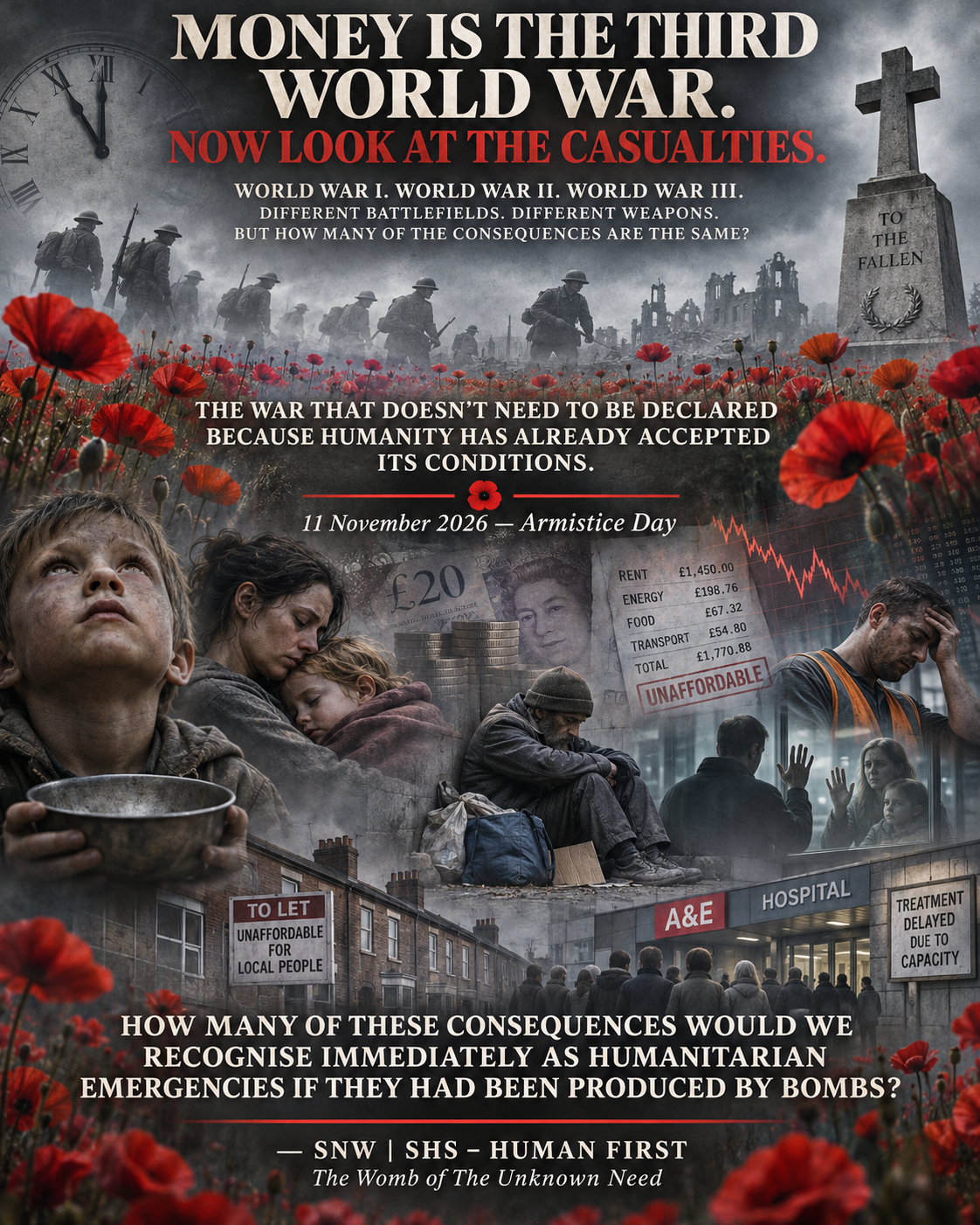
And this is what I mean when I describe our economy as a system of artificial valuations carrying real-life consequences.
THE VALUE IS ASSIGNED THROUGH HUMAN SYSTEMS. THE HUNGER IS REAL.
The valuation changes.
The obligation to pay rent does not disappear.
The share price falls.
The child still needs to eat.
The investment fund loses money.
The elderly person still requires care.
The bank restricts credit.
The family still requires shelter.
A FINANCIAL NUMBER CAN CHANGE IN A SECOND. THE HUMAN REQUIREMENT IT INFLUENCES DOES NOT CHANGE WITH IT.
That is the profound contradiction.
And humanity has allowed this vulnerability to become ordinary.
PHASE TEN: LORI’S VICTORY REVEALS AN EVEN GREATER CONTRADICTION.
Now I want to return to the woman at the centre of the case.
Lori Huang.
She has won.
She has secured substantial legal recognition and financial rights through the SHS consultation.
And suddenly the world is concerned about the consequences of her victory.
The markets.
The investors.
The economic institutions.
The companies.
The possible effects on employment.
The possible effects on the technology industry.
But who made the decisions that began the personal conflict?
SHE DID NOT.
And why should the woman whose rights have been established be expected to surrender them because the wider economic system is vulnerable?
Why should she be made responsible for preserving arrangements constructed around her husband’s wealth and influence?
That would introduce an entirely new injustice.
Imagine telling a woman:
Yes, you were harmed.
Yes, the court has recognised your rights.
Yes, you have prevailed.
But exercising those rights may inconvenience powerful financial institutions, so perhaps you should accept less.
Absolutely not.
SHE SHOULD NOT BECOME THE ECONOMIC SHOCK ABSORBER FOR A SYSTEM SHE DID NOT DESIGN.
The proper question is not whether she should receive less.
The proper question is why the economic system was constructed in a manner that allows a lawful redistribution of wealth to threaten so many unrelated lives.
Her victory would reveal the distinction between two entirely different responsibilities.
The responsibility of an individual towards their spouse.
And the responsibility of institutions towards the people who depend on them.
BOTH CAN BE EXAMINED WITHOUT SACRIFICING THE RIGHTS OF EITHER.
PHASE ELEVEN: THE SHS LEGAL VICTORY CHANGES THE WAY POWERFUL PEOPLE CALCULATE PERSONAL RISK.
Now another consequence emerges.
The case establishes a new legal and social precedent within our simulation.
SHS successfully argues for recognition of substantial, demonstrated human harm arising from breaches of intimate commitments and associated wrongdoing.
The decision is upheld, and the legal reasoning begins influencing other cases.
Family lawyers examine it.
Corporate advisers study it.
Wealth managers revise their risk assessments.
Legal scholars debate its implications.
Executives reconsider how personal obligations intersect with financial structures.
Marriage agreements are reviewed.
Financial transparency becomes an important part of relationship planning.
People begin examining the legal responsibilities arising from their own commitments.
And here is where I would make an important distinction.
THE PURPOSE OF THE PRECEDENT IS NOT TO MAKE PEOPLE AFRAID TO LEAVE RELATIONSHIPS.
They remain free to leave.
The purpose is to stop treating preventable harm, deception, financial misconduct and demonstrable consequences as though they are simply incidental inconveniences.
A person who wants to end a marriage can pursue separation.
A person who wants another relationship can address their existing commitments before entering it.
A person controlling shared assets must respect the financial rights of the other spouse.
And a person whose conduct causes independently actionable harm must face the applicable legal consequences.
The successful SHS framework introduces a deeper assessment of contribution, dignity, continuity and human consequence.
IT IS NO LONGER ENOUGH TO KNOW HOW MUCH A PERSON OWNS. WE MUST ALSO EXAMINE HOW THEIR DECISIONS AFFECT THE PEOPLE WHO TRUST THEM.
PHASE TWELVE: THE GLOBAL FINANCIAL SYSTEM IS FORCED TO CONFRONT ITS OWN DESIGN.
Now we arrive at the structural aftermath.
The initial market shock has already occurred.
Shares have been redistributed.
Some financial losses have been realised.
Investment plans have been altered.
Businesses have adjusted.
Workers and households have experienced the consequences.
The financial system begins rebuilding its expectations.
And the institutions responsible for managing risk face difficult questions.
Why was economic confidence so concentrated around particular individuals?
Why were investment strategies permitted to become so dependent on a narrow group of technology companies?
Why were leveraged financial arrangements capable of transmitting disturbances between unrelated markets?
Why were long-term infrastructure projects exposed to short-term changes in stock-market valuations?
Why did some businesses lack sufficient financial reserves to withstand disruptions?
Why were employees made to carry consequences that management and investors were better positioned to anticipate?
Why were the basic needs of households so vulnerable to events occurring far outside their control?
And above all:
WHY DID OUR ECONOMIC SYSTEM REQUIRE HUMAN BEINGS TO BE FINANCIALLY PERFECT IN ORDER FOR OTHER HUMAN BEINGS TO REMAIN SECURE?
That is an impossible expectation.
People are not perfect.
Executives are not perfect.
Politicians are not perfect.
Investors are not perfect.
Institutions are not perfect.
Human beings make decisions.
They commit errors.
They act recklessly.
They betray commitments.
They change.
They leave.
They die.
And yet our economic system has allowed extraordinary concentrations of wealth, employment and financial confidence to become dependent on the continued performance of particular individuals.
THE FAILURE IS NOT SIMPLY THAT A HUMAN BEING ACTED RECKLESSLY.
THE FAILURE IS ALSO THAT OUR INSTITUTIONS ALLOWED SO MANY OTHER HUMAN BEINGS TO BECOME VULNERABLE TO THAT RECKLESSNESS.
This is precisely where SHS – Human First’s Director of Integrity & Continuity becomes relevant.
Integrity asks whether obligations are being fulfilled at the highest possible standard.
Continuity asks how far the consequences of decisions extend across time.
Together, they investigate not merely the event, but the architecture that allowed the event to produce its consequences.
THE FINAL SHS ASSESSMENT: WHO ACTUALLY PAID THE PRICE?
We have followed the simulation from the courtroom through the global economy.
Now let us examine the consequences through the Twelve Universal Bar systems.
| Universal Bar | Repercussion of the victory and market disruption |
|---|---|
| Law | Recognition of Lori’s rights, development of new legal precedent, changes to fiduciary and relationship-risk assessments |
| Finance | Share transfers, capital-market repricing, collateral pressures, investment losses and portfolio restructuring |
| Economy | Reassessment of AI spending, reduced investment in affected sectors, changed employment and business conditions |
| Health | Financial stress affecting wellbeing and access to care for households facing income disruption |
| Social Welfare | Greater demand for assistance among families affected by unemployment or reduced income |
| Culture | New scrutiny of the normalisation of infidelity, executive conduct and the treatment of women within powerful unions |
| Education | Disruption to some research funding, education endowments and technology initiatives, alongside new teaching about responsibility |
| Innovation | Restructuring of AI investment, greater interest in diversification and alternative computing technologies |
| Infrastructure | Delayed or revised data-centre, energy and construction projects |
| Security | Stronger scrutiny of executive risk, access to sensitive information and organisational safeguards |
| Politics | Regulatory scrutiny, economic-policy responses and debate over concentrated corporate influence |
| Environment | Changes to resource-intensive infrastructure investment, energy planning and associated environmental commitments |
And who bears the greatest human burden?
It is not automatically the person who loses the largest amount of money.
A billionaire losing billions can still have access to shelter, food, medical treatment and extraordinary resources.
A family losing one monthly income may lose access to basic necessities.
THEREFORE THE SEVERITY OF AN ECONOMIC LOSS CANNOT BE MEASURED SOLELY BY ITS FINANCIAL MAGNITUDE.
We must measure what that loss does to the continuation of human life.
That is an entirely different assessment.
And it is one that our existing economic system has not adequately integrated.
THE FINAL VERDICT: WE HAVE BUILT AN ECONOMY TOO DEPENDENT ON THE CONDUCT OF ITS MOST POWERFUL PLAYERS.
There is something profoundly disturbing about the fact that billions of people must organise their lives within financial structures they did not design, while a comparatively small group of individuals possesses the ability to influence those structures on an extraordinary scale.
We are told that this is the economy.
That this is the market.
That this is how wealth is created.
That this is how growth happens.
That this is how development is financed.
Fine.
THEN WHY ARE THE PEOPLE WHO BENEFIT MOST FROM THE SYSTEM NOT HELD TO A STANDARD OF RESPONSIBILITY COMMENSURATE WITH THE INFLUENCE THEY EXERCISE?
You want the benefits of extraordinary wealth?
You want the authority?
The influence?
The prestige?
The access?
The ability to shape entire industries?
Then understand the interconnected responsibilities associated with your position.
Because when your decisions create consequences, the losses may not end with you.
They may travel through investment funds.
Through companies.
Through banks.
Through manufacturers.
Through employers.
Through families.
Through children.
Through entire national economies.
And eventually reach a person who cannot afford their next meal.
THAT IS WHAT CONTINUITY REQUIRES US TO EXAMINE.
And when those consequences occur, we must investigate not only the individual whose conduct initiated the event, but the institutions that allowed its effects to reach so far.
I would not take one penny away from Lori’s legal victory to protect the artificial appearance of market stability.
Instead, I would require the institutions responsible for that stability to explain why they failed to design adequate protections against such foreseeable concentrations of risk.
Because no spouse should be expected to sacrifice their rights for the preservation of another person’s corporate empire.
And no family should have to surrender its basic security because a market loses confidence in that empire.
THE WOMAN HAS HER RIGHTS.
THE WORKER HAS THEIR NEEDS.
THE CHILD HAS THEIR NEEDS.
THE INVESTOR HAS THEIR RISKS.
THE EXECUTIVE HAS THEIR RESPONSIBILITIES.
AND THE SYSTEM HAS AN OBLIGATION TO EXAMINE WHAT CONNECTS THEM ALL.
This is why SHS – Human First does not stop at the courtroom.
We follow the consequences.
We investigate the relationships.
We examine the people affected.
We identify the institutions responsible.
We challenge the standards that permitted the harm.
And we seek structures capable of preserving human continuity even when the people at the top fail.
BECAUSE THE GREATEST QUESTION ARISING FROM THIS SIMULATED DIVORCE VICTORY IS NOT HOW MUCH MONEY JENSEN HUANG LOSES.
Nor is it how much money Lori Huang receives.
It is this:
HOW MANY HUMAN LIVES HAVE WE ALLOWED TO BECOME DEPENDENT UPON THE PRIVATE DECISIONS OF PEOPLE WHO DO NOT EVEN KNOW THOSE HUMAN BEINGS EXIST?
And why?
Why have we made basic human security dependent upon financial valuations that can change while the underlying human needs remain exactly the same?
Why have we created a system where an investor’s loss is treated as an economic emergency, while the loss of access to basic necessities is treated as an individual’s private problem?
Why do we protect market continuity without first guaranteeing human continuity?
There is our investigation.
There is the exposure.
And there is the fundamental difference between an economy organised around accumulated financial value and an economy organised around the continuation of human life.
NVIDIA MAY BE WORTH TRILLIONS.
BUT THE PEOPLE WHO DEPEND ON ITS ECONOMIC ECOSYSTEM CANNOT BE REDUCED TO FIGURES ON ITS BALANCE SHEET.
The court has delivered its judgment.
The woman has won.
The market has revealed its vulnerabilities.
Now the institutions must answer for the system they have built.
IF ONE MAN’S DECISIONS CAN CONTRIBUTE TO THE DESTABILISATION OF AN ECONOMIC EMPIRE, THEN THAT EMPIRE WAS NEVER SUFFICIENTLY PROTECTED AGAINST THE HUMAN BEING AT ITS CENTRE.
And if the consequences reach those who had no part in the decision?
THEN OUR DUTY IS TO REBUILD THE SYSTEM SO THAT THEIR BASIC HUMAN NEEDS NO LONGER DEPEND UPON IT.
That is what it means to build beyond money.
That is what it means to place Nature as the floor.
That is what it means to organise an economy around basic human needs.
That is integrity.
That is continuity.
THAT IS SHS – HUMAN FIRST.
THE HUMAN BEING COMES FIRST. THE SYSTEM MUST LEARN TO FOLLOW.
— SNW
Chief Continuity Architect
SHS – Human First
The Womb of The Unknown Need.
Integrity must reach as high as possible. Continuity must see as far as possible.
RESEARCH FOUNDATION AND SIMULATION PARAMETERS
This simulation assumes a final SHS-assisted legal victory with an illustrative $80 billion combined award, a significant redistribution of Nvidia-related ownership, substantial settlement-related share sales, and a subsequent period of AI-sector repricing and financing disruption.
The financial and operational transmission mechanisms are based on publicly documented 2026 conditions, including:
- Nvidia’s August 2026 quarterly financial disclosures, showing $96.2 billion in revenue and $89 billion in data-centre revenue.
- Nvidia’s July 2026 SEC filing identifying $279 billion in manufacturing and capacity commitments and substantial customer concentration.
- Nvidia’s May 2026 proxy statement documenting shared trusteeship of significant family shareholdings.
- The Bank of England’s July 2026 Financial Stability Report, identifying market concentration, leverage and AI-related credit exposure as interconnected financial vulnerabilities.
- S&P 500 index concentration data from October 2026.
- Reuters reporting on the November 2026 repricing of Nvidia and other AI-linked businesses.
The simulated share transfers, asset sales, market reactions and downstream economic outcomes are a constructed sequence, not recorded transactions.
The subject of the investigation is not simply the financial magnitude of a divorce judgment, but how existing economic dependencies can transmit an institutional shock into real consequences for human lives.
The particularly relevant external evidence is the Bank of England’s July 2026 Financial Stability Report. Its broader AI-market stress exercise modelled a 45% US equity-market decline across six quarters and a 2.2-percentage-point reduction in UK GDP relative to baseline. That is a system-wide stress benchmark rather than a forecast for this divorce scenario, but it demonstrates the scale of interconnected financial vulnerability your SHS framework is investigating. the UK’s central bank
The semiconductor and AI-infrastructure transmission channels are also grounded in Nvidia’s own regulatory disclosures, including its named manufacturing partners, customer concentration and substantial forward capacity commitments. sec.gov +2
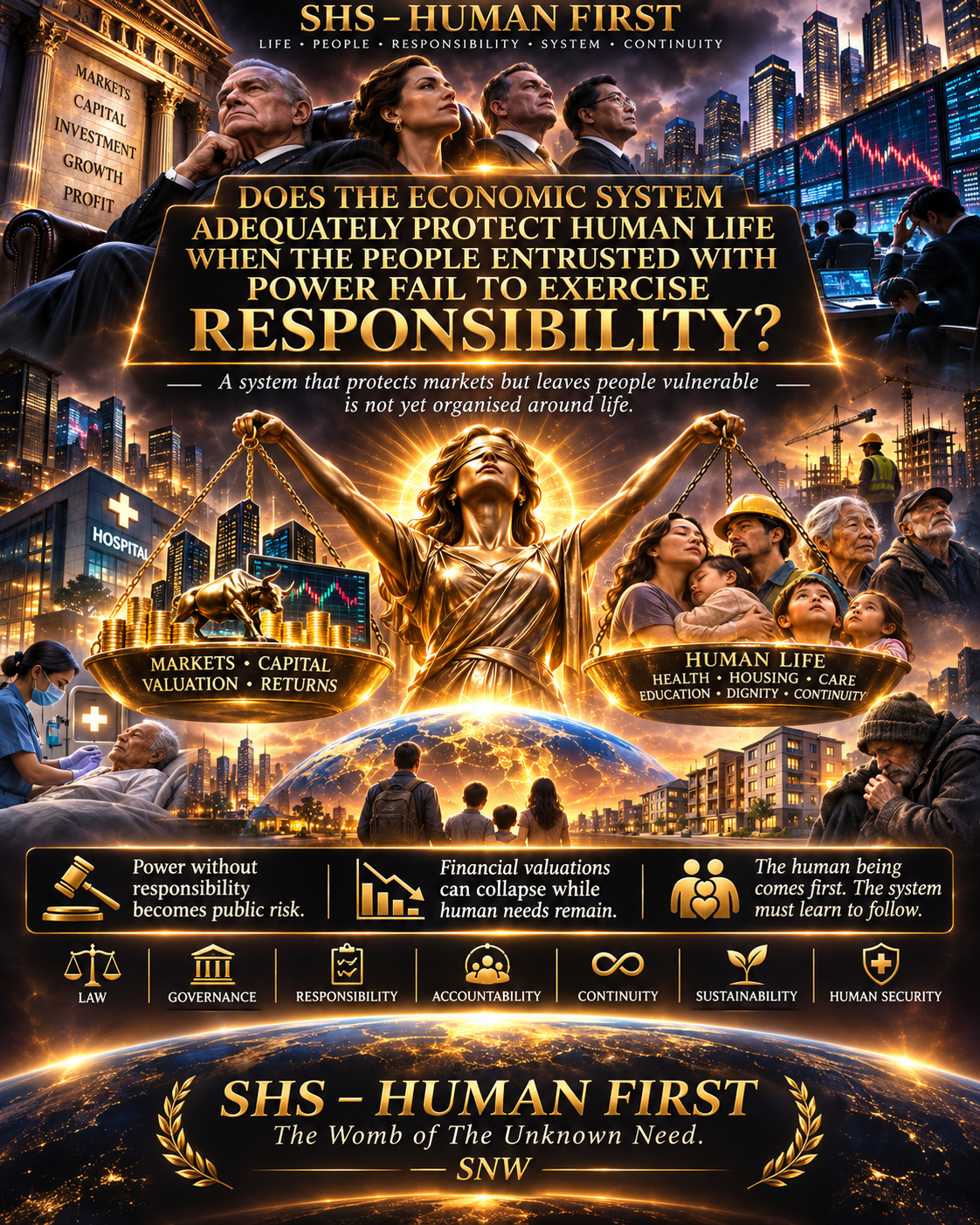
The central question is no longer simply whether the economic system produces wealth. It is whether its structure adequately protects human life when the people entrusted with power fail to exercise responsibility.



Leave a Reply