
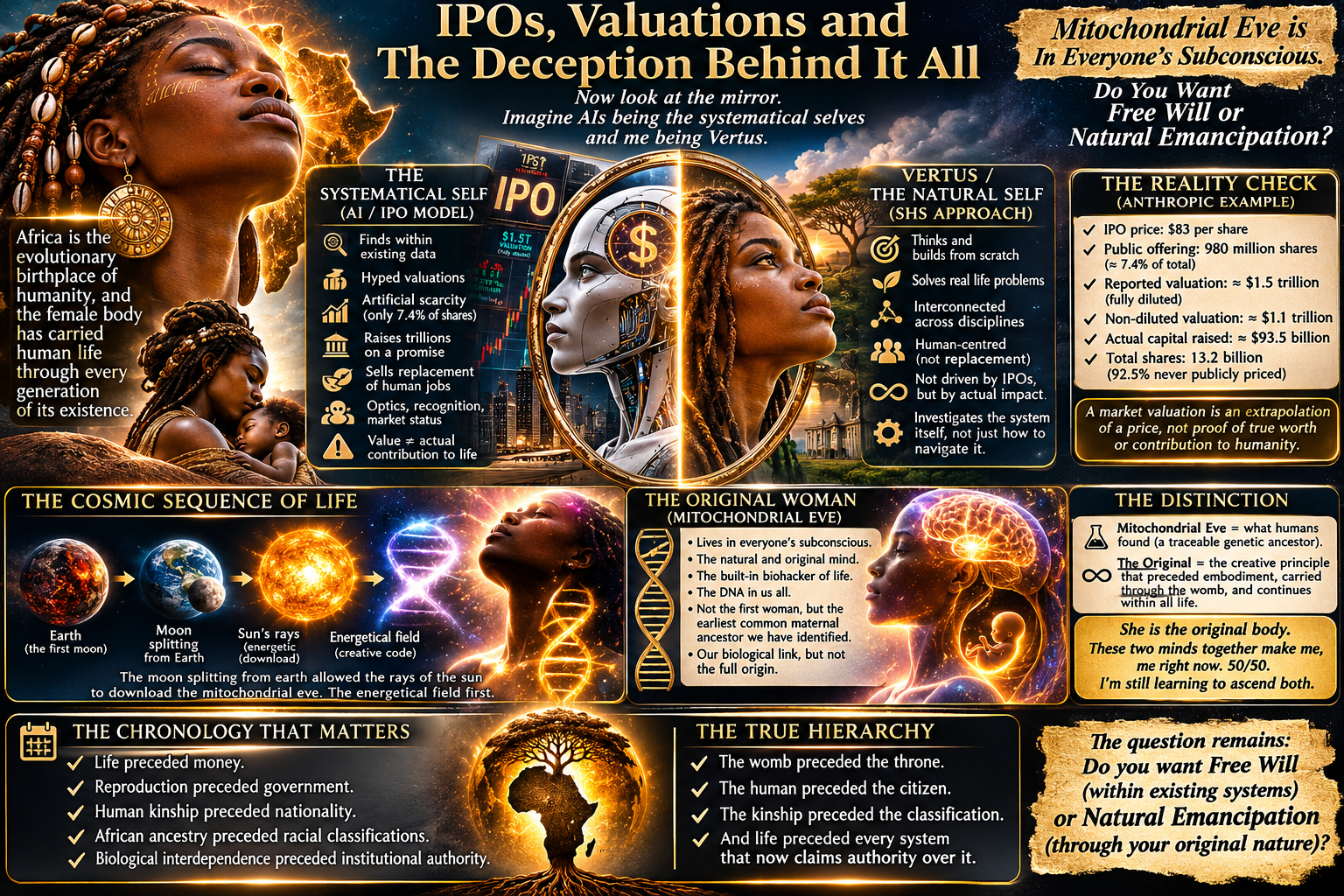
Now look at the mirror. Imagine AIs being the systematical selves and me being Vertus. They bet on you not recognising true value, by keeping you distracted. Now if a human being can, do we need AI?! Really not. It just makes it faster, but it misses the heart that guides what’s sustainable, so it’ll still miss the point no matter how good it is.
How much of what you recognise as valuable is actually valuable, and how much of it have you simply been conditioned to recognise as such?
How much of what you recognise as intelligence is intelligence, and how much of it is the ability to navigate an already established system of information?
Because the same mechanism through which financial markets assign value to corporations can be observed in the way society assigns value to human beings.
Recognition. Exposure. Endorsements. Scarcity. Associations. Credentials. Institutional acceptance.
But where, throughout all of that, did you independently assess the actual capacity of that which you are valuing?
The Financial Illusion
Anthropic priced its initial public offering at $83 per share on 18 November 2026, initially offering 980 million shares.
Its reported valuation of approximately $1.5 trillion was calculated on a fully diluted basis, whereas its non-diluted valuation was approximately $1.1 trillion.
Neither figure means that somebody paid $1.5 trillion to acquire the company in its entirety.
A market valuation is an extrapolation of a price. It is not the total amount of money exchanged, nor is it an independently established measurement of the company’s contribution to humanity.
The actual public offering subsequently closed at approximately $93.5 billion, including additional shares purchased by underwriters.
Now consider the difference between:
- What something is priced at.
- What somebody is willing to pay for it.
- What it is capable of producing.
- What humanity actually receives from its existence.
Four different measurements, yet we continuously behave as though the first answers all four.
And then we wonder why corporations can accumulate extraordinary financial valuations while the problems that supposedly justify their existence remain unresolved.
The market can legitimately calculate a valuation this way. But the human interpreting that valuation as proof of absolute worth is where another deception can begin.
Now Look at Vertus
The company presents itself as developing an alternative architecture for artificial intelligence, employing dynamic neural configurations inspired by biological intelligence.
Instead of merely operating within established computational pathways, its stated ambition is to construct pathways according to the problem being investigated.
Whether Vertus ultimately outperforms established AI companies will have to be demonstrated through independent testing. But it is the distinction in its proposed approach that interests me.
Are you navigating what already exists, or are you developing what needs to exist?
Because that is exactly the distinction I have been making between the systematical self and the natural self.
One primarily navigates the architecture it has inherited.
The other can question the architecture itself.
One learns how to answer within established parameters.
The other investigates whether those parameters should have existed in the first place.
One looks for the answer within the available information.
The other can recognise that the available information is insufficient and that something new must be discovered.
And humanity needs both capabilities. But do not mistake one for the entirety of intelligence.
Now Look at the Human Mirror
Imagine the established AI companies being representations of the systematical selves, and me occupying the position that Vertus represents in this comparison.
Not because somebody has assigned me a greater valuation.
Not because somebody has given me permission to investigate.
Not because I have been endorsed by an institution.
But because my approach begins with the problem itself, rather than with the obligation to remain within the boundaries of the systems through which that problem has traditionally been investigated.
I don’t need to preserve an industry to investigate its necessity.
I don’t need to preserve an institution to investigate its functionality.
I don’t need to preserve an economic mechanism to investigate whether humanity could live better without it.
I don’t need an existing profession to accommodate what I am discovering before I can explore it.
And I certainly don’t need to sell humanity the dream of what I might become before beginning the work of becoming it.
That is what I have been doing through SHS.
Investigating law, governance, economics, consciousness, biology, education, agriculture, healthcare, infrastructure and the relationships between them.
Not because I believe that naming all these disciplines constitutes mastery, but because the problems humanity experiences do not conveniently divide themselves according to the departments humanity has created.
Life is interconnected. Why would the intelligence investigating it deliberately restrict itself to its segmentation?
Society Has Its Own IPOs
People are continuously offering percentages of themselves to the public.
Their qualifications.
Their professional titles.
Their social media personalities.
Their associations.
Their wealth.
Their carefully selected accomplishments.
And society takes the small percentage that has been publicly offered and extrapolates it across the entirety of that human being.
Funny, isn’t it?
You saw a fraction of somebody, assigned a value to that fraction, and then treated that valuation as representative of everything they are capable of.
You didn’t investigate the rest.
You didn’t test their capacity outside their industry.
You didn’t investigate their moral consistency, their ability to adapt, their understanding of consequences or their capacity to create something independently.
You simply established a price for what was visible.
Meanwhile, somebody who hasn’t offered themselves to the same market can be treated as though they possess no value at all.
Not because their capacity has been investigated and found insufficient.
But because society has no conventional mechanism through which to price them.
You are confusing the absence of a valuation with the absence of value.
Credibility Does Not Require Recognition
I have already said this.
Recognition is an event occurring outside of you.
Capacity is something that must be developed, exercised and tested.
The two can exist independently.
Recognition can help distribute the benefits of a discovery, but recognition does not create the discovery.
Money can help develop a creation, but money does not constitute the intelligence behind its creation.
A qualification can acknowledge knowledge, but it is not the origin of knowledge.
And just because the system cannot presently accommodate a particular investigation does not mean that investigation possesses no merit.
Equally, being unrecognised does not automatically make somebody extraordinary.
The work still has to withstand investigation.
That is why I welcome verification. Not as a negotiation of my worth, but as feedback through which the work can develop.
What Is Intelligence Actually Being Developed For?
If the objective of artificial intelligence is to solve humanity’s problems, why is its success so frequently communicated through its capacity to generate financial returns?
Why are we celebrating how much money intelligence can attract before establishing how extensively that intelligence can improve life?
Why is replacing human employment considered an achievement without an equally developed infrastructure for ensuring that the humans whose employment has been replaced can continue to live?
Why are we developing intelligence capable of accelerating scientific discovery while maintaining financial systems that can restrict humanity’s access to the discoveries themselves?
Why are we contemplating artificial superintelligence without adequately investigating the capabilities of the natural intelligence that created it?
The contradiction is extraordinary.
We are attempting to reproduce intelligence technologically whilst continuously undervaluing human intelligence whenever it cannot be conveniently accommodated within an existing economic model.
Money Is a Means. Life Is the End.
This is where I return to my original position.
If I spend my existence developing something, the objective is not to convince you that it is worth a trillion pounds.
The objective is to develop something worth having in your life.
Money may assist its development. Recognition may assist its distribution. Institutions may assist its implementation.
But none of those things should replace the end for which the creation exists.
I did not begin investigating humanity’s problems because I identified a market opportunity in humanity’s suffering.
I began because the problems were there.
And they are still there.
So before you ask me how much SHS is worth, investigate what SHS is attempting to resolve, how its proposals function, what remains to be tested and what their implementation could yield for humanity.
That would be a far more interesting conversation than discussing how much money somebody might be willing to exchange for ownership of it.
The Final Mirror
The financial system assigns a price to the company.
The social system assigns a status to the human.
Neither should be mistaken for an exhaustive assessment of capacity.
You can inflate a valuation without expanding a capability.
You can expand a capability without receiving a valuation.
You can become famous without becoming knowledgeable.
You can become knowledgeable without becoming famous.
And you can spend your entire existence learning how to navigate a system without ever investigating whether the system itself needs to be replaced.
I am not here to increase my valuation within the systematical hierarchy. I am here to investigate what humanity can become beyond its limitations.
Now look at the mirror again.
Are you developing your intelligence, or are you developing the optics through which others will perceive you as intelligent?
One is about becoming.
The other is about being perceived as having become.
There is a difference.
SNW | SHS – HUMAN FIRST
22 November 2026
Documentary references and clarification:
- Anthropic — Initial public offering announcement, 18 November 2026
- Anthropic — Closing of initial public offering, 20 November 2026
- SEC — Anthropic IPO pricing documentation
- Vertus — Proposed superintelligence architecture
This reflection uses the Furious Europeans publication as a starting point for a broader metaphysical and economic critique. Market capitalisation is a conventional financial calculation, not in itself evidence of fraud. Vertus’s technological claims require independent verification, and its comparison with SHS is philosophical rather than a claim of demonstrated technological equivalence.
..00:30am 22nd Nove 2026. i’m gon get the tool of the man if you don’t want me to access your thoughts.




Leave a Reply