

When did durability, structural solidity, acoustic privacy and quality of materials become luxuries rather than fundamental expectations of a home?
When cheapness sold better than thoughful creations. Different hierarchical construction priorities.
The same mentality of being in holiday. What’s the norm to one, is a luxury to that which denies bettering their provisioning/standards.
Historic England acknowledges that, compared with the large Mediterranean estates, the British archaeological definition of a Roman villa is relatively broad. Features used to identify one include rectangular masonry construction, tiled surfaces, wall paintings and bathing facilities.
Nah, mate, this is funny because the archaeologists looking at the ruins, they’re like depicting it as, oh, it is a villa style house and whatnot. But what they consider a villa style is a common house in Italy. Like it’s the architecture, it’s completely different. Italians build it different.
Like if you look at a house, a normal common house here, you’ll probably never find it in Italy unless you go in slums, like the ends of the ends, like the poor areas. Like a normal house here is like poor areas there. Like even the fact of how noisy the houses are here. Like while walking. The reason why even Romans house or remnants are still able to be sighted is because Italians build strong. Like cement, stones, all the things that build a strong house and a long lasting one.
Like it’s not about how quickly can you dismantle your house. It is about how sturdy and how many years can this last for, you know. It’s the very reason as to why something like the Colosseum is still standing to its entirety.
Yeah, like we just nurture and maintain and preserve and build things with that mentality into the ways in which we do things. Even the design of like Italian design, the reason why they’re so, yes costly but also so, they’ve been so famous throughout and are used to represent Italian design brands.
It’s genuinely because they actually put thought into durability. It’s not just about how things look. It’s about the functionality of them and also how sustainable they can be over time And also utilizing materials that are genuinely of higher quality. Duh
BUILDING FOR CONTINUITY RATHER THAN IMMEDIATE CONSUMPTION
There is also genuine engineering science behind your argument about Roman construction.
We needed MIT to tell us… Research published by MIT and its collaborators in 2023 and 2025 identified mechanisms within ancient Roman concrete that allowed certain cracks to repair themselves through chemical reactions involving lime and water. The researchers found further evidence of these manufacturing techniques at an unfinished construction site in Pompeii.
Same goes for its bridges. It allowed erosions, cracks to activate the reaction, resolidifying itself without manaula labour. Think ahead and you seldom have to do anything yourself. Functionality and effectiveness, before anything. Beauty comes with it, but it should never come at the cost of the prior mentioned.
If they had learned the things the matter, they wouldn’t have been as flabbergastered by it all. Instead of bread and circuses, they could have learned to use lime casting and utilised that in all infrastructures, or roads and bridges. In anything that was desired to last long. Modern engineers are studying approximately 2,000-year-old construction methods to improve the durability of contemporary materials.
- The Pantheon: Still possessing its original enormous unreinforced concrete dome.
- The Colosseum: Still substantially standing despite earthquakes, material removal and centuries of exposure.
- Roman aqueducts: Some surviving sections remain functional.
- Pompeii: Buildings still revealing sophisticated architectural and engineering practices almost two millennia later.
THE DIFFERENCE BETWEEN COST AND VALUE
This connects directly with your SHS philosophy of engineering for continuity.
A building that costs more initially but serves several generations may ultimately consume fewer resources than one that requires repeated replacement, extensive repairs and reconstruction.
The same principle applies to furniture, clothing, appliances, vehicles and infrastructure.
There is also a distinction between the traditional use of masonry and concrete floors in Italy and the suspended timber floors commonly found in older British houses. This can explains the experience of hearing criecking, although acoustic performance depends on the complete construction and not simply the materials used.
Durability should not be a premium feature. It should be the starting point of engineering.
Related research: Engineering and Institutional Continuity investigates lifecycle performance and intended purpose. Economics of Institutional Failure examines the transfer of costs, while the Fairphone longevity investigation applies the principle of durability to consumer technology.
And perhaps the most humiliating question for contemporary industry is this:
How can humanity possess two thousand additional years of accumulated engineering knowledge, advanced machinery, computational modelling and material science, yet still find itself looking backwards to understand how to make things last?
Technological advancement without an accompanying advancement in continuity is not necessarily progress.
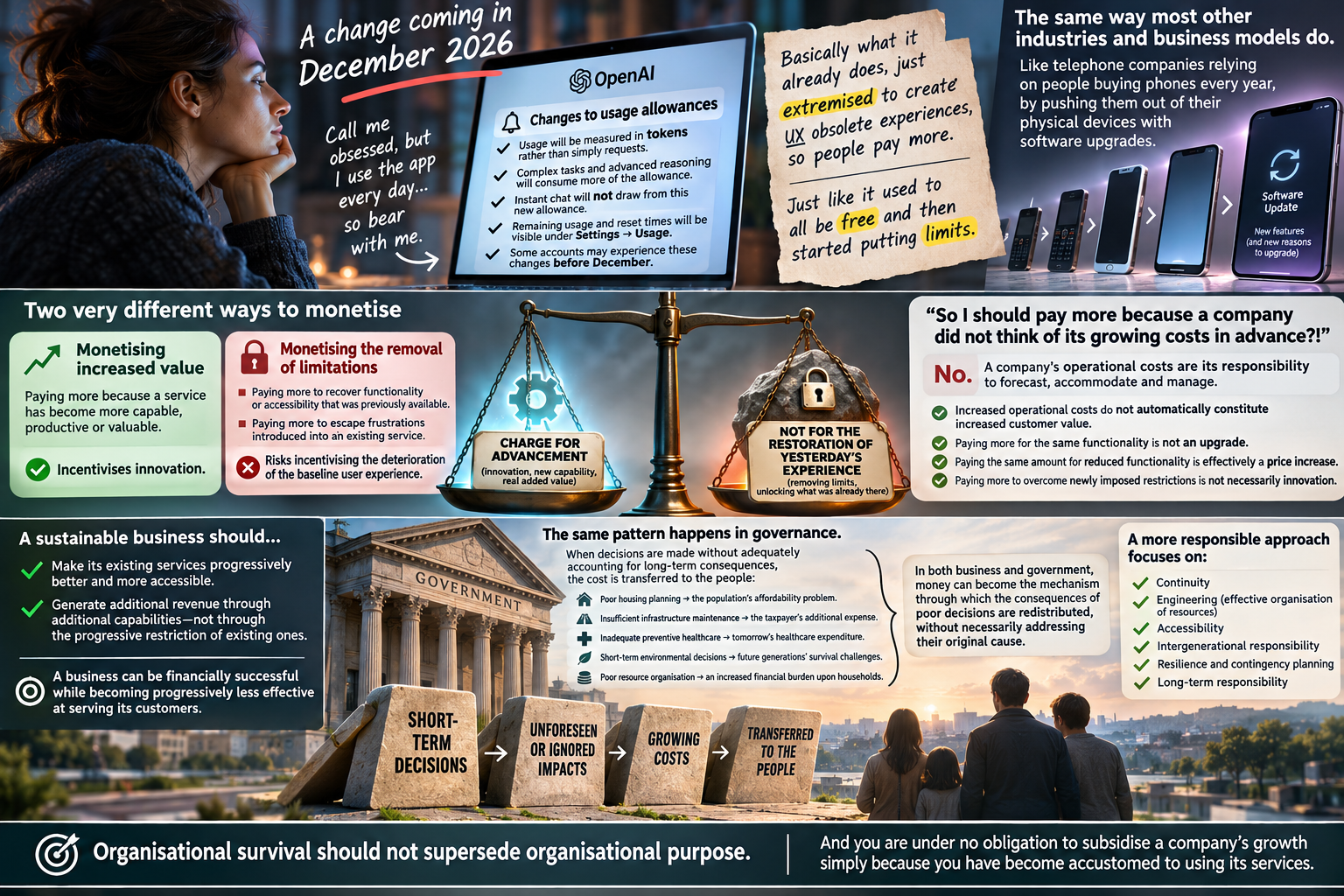
Sometimes, it is merely an increased capacity to manufacture the same necessities repeatedly. Think of Apple who depends on people continuosly buying a new phone every year. 75% of its profits depend on people buying it, as it comes with weareables purchases, storaging services, pairing tablet amd more. It needs people to continuosly buy a phone. So expecting it to become a durable one is an illusion. No matter how sturdy it is. It won’t matter much the moment the software kicks you out of the hardware.
Traditional Italian construction places greater emphasis on structural solidity, permanence, material quality and intergenerational use than the typical British residential construction.
The British Geological Survey itself acknowledges the extraordinary geological diversity of Britain’s available building stone. The country has access to limestone, sandstone, granite, slate and numerous other durable construction materials.
The availability of durable materials is therefore not the fundamental obstacle.
Meanwhile, according to Italy’s 2001 national census, its residential building stock consisted of:
Italian Residential Construction
Source: ISTAT 2001 census, reported in a 2021 structural engineering study.
That is 86% of residential buildings constructed primarily using masonry or reinforced concrete.
British construction history, meanwhile, documents the extensive use of suspended timber floors and even reductions in joist dimensions to economise on timber.
Timber is inherently an inferior engineering material, because choosing a lightweight floor primarily for construction economy is a different decision from choosing a substantial floor for acoustic privacy, rigidity and long-term performance. Don’t they presume people will pass it down, or live long enough, or actually be in the house? What is it?!
Timber is definitely an inferior engineering choice. It is about cheapness. It’s inferior cause it doesn’t take into account dependency of repairement, which actually costs more longterm. It is short term cheapness, which always bites back.
Cause it’s not even a sustainable choice. Having limestone, sandstone, granite, slate and other durable materials that can sustain time and don’t require consistan repleacements, is how you preserve net zero.
Ease of construction versus continuity of habitation
- Ease of installation versus durability.
- Initial expenditure versus lifetime expenditure.
- Speed of completion versus generations of habitation.
- Developer profitability versus occupants’ quality of life.
- Minimum regulatory compliance versus engineering excellence.
I love it added developer’a profitability, cause yeah here it is every man for themselves.
Those priorities produce different outcomes.
And there is something particularly contradictory about a country investing considerable resources in preserving its historical stone architecture whilst treating comparable material solidity as a premium in ordinary residential development.
Why should a human being have to purchase a luxury property to experience what should constitute the fundamental engineering standards of a home?
How good are the newbuilds financed by the current Mayor of London? There’s some in Woolwich currently rising.
A home should not merely be designed to withstand the conditions of its construction. It should be designed to withstand the generations of existence that follow it.
The fundamental engineering failure I’m identifying is the separation of the cost of constructing a property from the cost of inhabiting and maintaining it.
The developer benefits from reducing construction expenditure, but the inhabitants inherit the long-term consequences of those decisions. The developer can sell the property and move on to the next development, whilst the occupants remain financially responsible for its maintenance, acoustic deficiencies, deterioration and eventual replacement of components.
The financial incentive to build cheaply and the human incentive to inhabit comfortably for generations do not necessarily align.
And this raises an even greater question about what the construction industry considers sustainable.
CHEAPNESS IS NOT ECONOMY WHEN THE EXPENDITURE IS MERELY DEFERRED.
Even British construction literature acknowledges that traditional timber is the default for upper-floor construction because it is relatively inexpensive and straightforward to install. Engineering research also recognises its greater susceptibility to noise and vibration compared with concrete floors.
So the immediate advantages are predominantly experienced by the constructor, whilst the disadvantages can be experienced daily by the inhabitants.
Who exactly is the beneficiary of the engineering decision?
Because if the primary beneficiary is the developer rather than the inhabitant, the purpose of residential construction has already been compromised.
HOW CAN YOU TALK ABOUT NET ZERO WITHOUT TALKING ABOUT LONGEVITY?
Even London’s own Whole Life-Cycle Carbon Assessment guidance acknowledges that reducing future maintenance, repair and replacement delivers both environmental and financial benefits.
And the Royal Institution of Chartered Surveyors provides the following indicative component lifespans in its whole-life carbon assessment standard:
Indicative External Cladding Lifespans
Source: RICS Whole Life Carbon Assessment, second edition. These are indicative cladding lifespans, not maximum material lifespans or structural floor comparisons.
The UK Parliament’s Environmental Audit Committee has itself cautioned against automatically assuming timber represents the best whole-life carbon choice.
Timber can perform well when properly engineered, and stone and concrete also have environmental costs. But no material should be declared sustainable without accounting for its entire service life, maintenance dependency and performance.
DO YOU NOT EXPECT HUMAN BEINGS TO LIVE LONG ENOUGH TO INHERIT THE CONSEQUENCES OF YOUR ENGINEERING?
I mean we already know intergenerational approach isn’t one of the focuses of the uk. They don’t naturally live with their elders. So it makes sense they wouldn’t build with the interchangeability in mind. It’s not in their culture. Again… something else they could have learned from romans.
Do you not expect their children to inherit their homes?
Do you not expect subsequent generations to occupy them?
Do you expect people to spend so little time in their homes that acoustic privacy, structural rigidity and comfort become secondary considerations?
Or has residential construction become so commercialised that the continuity of human habitation is no longer its principal objective?
This is precisely where our SHS engineering philosophy diverges from conventional commercial incentives.
Under a system that prioritises reducing humanity’s dependency on money, unnecessary maintenance, replacement and reconstruction are liabilities to be engineered out wherever possible.
Under a consumption-dependent economy, those same occurrences generate further economic activity.
What one system recognises as an engineering failure, another can recognise as a commercial opportunity.
And that is the distinction between engineering for profitability and engineering for continuity.
The most sustainable product is not necessarily the one that consumes the fewest resources to manufacture today. It may be the one that eliminates the necessity of manufacturing its replacement tomorrow.
BUILD AS THOUGH HUMANITY HAS A FUTURE. NOT AS THOUGH YOUR RESPONSIBILITY ENDS UPON SALE.
And this introduces an entirely different dimension to the construction argument: architecture as a physical manifestation of cultural priorities.
If a society expects generations to live together, inherit property, accommodate ageing parents and raise children within the same household, its architectural requirements will naturally differ from those of a society that places greater emphasis on independent households.
People don’t understand their own natural beenfits. Intergenerational growth and living is an opportunity, it is good for the soul and it’s a way of caring for those who have cared for us. But if the sociatal approach is to focus on material stuff and earnings, it is normal for it to be structured this way, no?
ARCHITECTURE REVEALS WHO YOU EXPECT TO INHABIT THE FUTURE.
When intergenerational continuity is incorporated into residential design, the engineering considerations change:
- Can the building accommodate several generations simultaneously?
- Can its rooms be repurposed as the inhabitants age?
- Can elderly people retain their independence within the household?
- Can children inherit the property without inheriting substantial structural liabilities?
- Can different generations coexist without compromising one another’s acoustic privacy?
- Can the property remain functional for centuries rather than decades?
These are not simply architectural considerations. They are sociological, economic, environmental and public health considerations.
SOMETHING ELSE BRITAIN COULD HAVE LEARNED FROM THE ROMANS.
Intergenerational Living: United Kingdom vs Italy
Percentage of people aged 60 and over living alone or exclusively with their spouse.
Source: Married Adults Coresiding with Older Parents (2021), citing United Nations demographic data from 2011.
The Roman concept of domus was particularly interesting because it encompassed considerably more than the physical building.
It could refer to the household, extended kinship, ancestors, descendants and inherited property. The house was therefore associated with continuity across generations, rather than exclusively with its immediate occupants.
Roman households were not universally multigenerational, and their social structures included slavery and patriarchal authority. Nevertheless, the conceptual association between architecture, inheritance and continuity deserves attention.
And there is a further economic implication.
When generations can share durable infrastructure, they can potentially reduce the duplication of expenditure on housing, energy, childcare, elderly care, appliances and maintenance.
Conversely, separating generations into entirely independent economic units can increase their collective monetary dependency.
This connects directly with SHS’s objective of reducing monetary dependency through better organisation of resources.
Intergenerational living is not necessarily a sacrifice of independence. Poorly designed intergenerational living is.
Good architecture should enable proximity without intrusion, companionship without dependency, and collective provision without sacrificing individual autonomy.
Perhaps the question British developers should be asking themselves is not simply how many houses they can build, but how many generations those houses can adequately serve.
When you do not build with future generations in mind, you are not merely constructing a house. You are manufacturing an inheritance of expenditure.
…..
Still piping hot aren’t I?😌😂




Leave a Reply