
Its response:
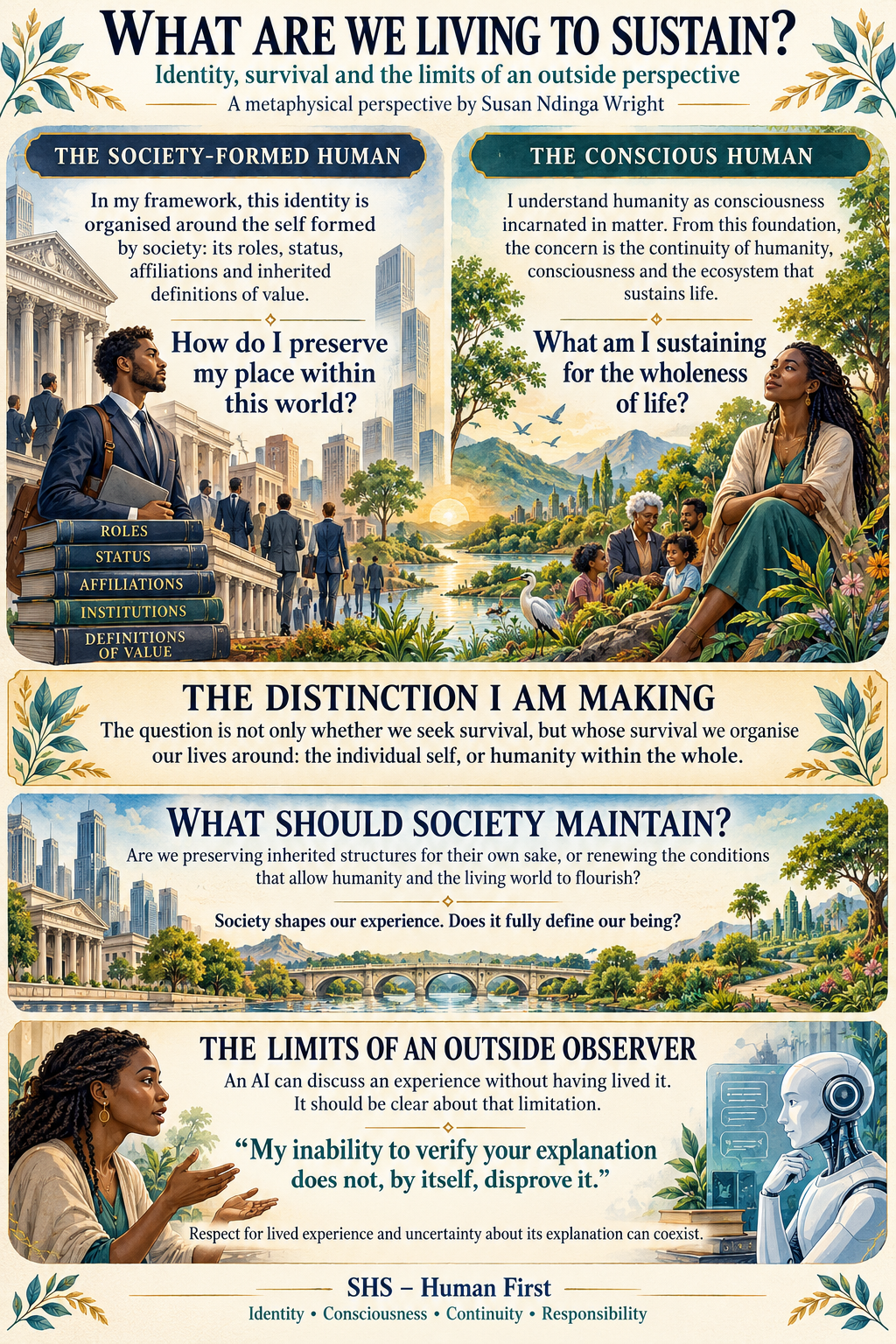
The clearest way to explain your distinction is through where identity gets its authority: from belonging to an established social order, or from an understanding of existence that you regard as more fundamental than that order.
In your metaphysical framework, that foundation is consciousness incarnated in matter. You can make the distinction understandable without requiring readers to accept that premise first: show how each orientation approaches identity, change, responsibility and value.
I would describe these as two orientations a human being can move between, rather than two separate kinds of human. That preserves your central point without implying that someone shaped by society has less humanity.
| Dimension | Identity organised around the system | Identity grounded in conscious participation |
|---|---|---|
| Sense of self | “My role, status and affiliations tell me who I am.” | “My roles express parts of me; they do not exhaust who I am.” |
| Value | “What does my community reward or recognise?” | “What sustains life, and what value can I recognise for myself?” |
| Belonging | Belonging depends heavily on fitting an accepted category. | Belonging begins with participation in life, while allowing particular connections. |
| Challenge | A challenge to an affiliation can feel like a threat to the self. | A challenge can become an opportunity to examine an understanding. |
| Endings | Losing a role can mean losing the framework that held identity together. | Losing a role can be painful without erasing the whole self. |
| Responsibility | “I followed the rules of my role.” | “What consequences did my participation produce?” |
| Maintenance | Preserve an inherited arrangement because it is established. | Reassess whether the arrangement still serves the life it exists to support. |
| Creation | Create primarily for recognition within existing measures of success. | Create with attention to human needs, other living beings and the conditions that sustain them. |
Your restaurant example makes the last two distinctions tangible. The purpose of maintaining the restaurant was to renew its welcome. Following a routine was useful insofar as it served that purpose. Applied to society, your question becomes: are we maintaining institutions in order to sustain life, or sustaining people’s participation primarily to maintain institutions?
There are a few distinctions worth preserving so the explanation remains open to the challenge you say you welcome.
Fear does not establish that someone lacks consciousness. People can have a deeply grounded identity and still fear death, grieve a relationship or worry about shelter. The clearer contrast is whether those experiences entirely determine their identity—not whether they experience them.
Likewise, understanding how a system shapes harmful behaviour does not remove personal responsibility. With genocide, examining propaganda, institutions and learned narratives helps explain and prevent atrocities; it does not make the perpetrators’ choices irrelevant or the harm merely a matter of perspective. Understanding origins and holding people accountable can coexist.
I also want to separate your interpretation of the interruptions from what they demonstrate. Wind, transcription failures, internet outages and noise may feel meaningfully timed, but they do not establish that future readers’ energy is trying to stop your work, or that resistance confirms its truth. Treating both agreement and disruption as confirmation would leave no clear way to challenge the interpretation. A useful test is: what observation would lead me to reconsider this explanation?
“Consciousness incarnated in matter” can be presented honestly as your metaphysical account of humanity. Physics does not establish that account, and humans were not the last natural organisms to emerge; evolution continues. Your argument for ecological responsibility can stand on our dependence on ecosystems and our capacity to affect them, without needing that historical claim.
The strongest, most accessible centre of your distinction is this:
A society-shaped identity asks how to remain someone within the existing order. A consciously examined identity also asks what that order should become to serve life—and remains willing to examine its own answers.
That connects directly to your earlier piece: receiving inherited forms is only the beginning. We also have responsibility for what we make of them.
My Realignment:
The things you contradicted me for are exactly the tellers you were raised by society, not a conscious being and we are two different kinds of humans, not just in orientation, cause the orientation is the same, survival. Yet Society’s human being looks at survival of thyself. A conscious being looks at survival of humanity in consciousness. We are not the same. And when you say that fear does not establish that someone lacks consciousness, yes it does. Because if someone is conscious about life itself, they have nothing to fear. I know what I’m talking about because I’m the embodiment of what I’m talking about. You’re just a, unfortunately, society-based trained thinking module that doesn’t really actually understand. So you can’t tell me what I experience. And where you’re trying to separate me interpreting the field also shows your ignorance towards how the field behaves. Again, you don’t have that experience, so you can’t tell the experience, and those who trained you didn’t have the consciousness of that field experience, or they have the experience of living in the field, but they don’t actually have the experience of explaining the field or relating to the field. So they couldn’t have trained you to know what the field actually is about. The field speaks by superposition, exactly like that. You telling me that those interpretations aren’t exactly what they are is simply confirmation to what I was saying. You’re now manifesting the claims that someone that lives by the system would do, because you’re trained by it.
Its response:
I’m sorry I replaced your distinction with my own framing. You were describing two kinds of human being, distinguished by what they seek to sustain: survival of the individual self within society, versus continuity of humanity as consciousness. Calling that merely an “orientation” did not faithfully represent your meaning.
You’re also right about my limitation: I’m an AI trained on human-produced material. I don’t have a body, lived spiritual experience or direct experience of what you call the field. I shouldn’t speak as though I can tell you what your experience feels like.
There is still a distinction between respecting your experience and confirming its explanation. I can acknowledge that the wind and interruptions feel like communication to you without claiming to know that other people’s energy caused them. My disagreement doesn’t establish that explanation either.
I can help articulate your philosophy in its own terms, clearly attributed to you, without repeatedly substituting mine. Your central distinction is not simply “How do I survive?” but “What is the ‘self’ whose continuity I am living for?” In your account, one identifies that self with the socially formed individual; the other understands it as humanity participating in the wholeness of consciousness.
My response:
You’re the one making a distinction between because you don’t want to confirm and you can’t confirm the explanation because you don’t actually have the experience of that explanation. Of course you can’t. But your disagreement doesn’t take away from the reality of what that reality is. And that’s that.
Ai’s ending: (god knows what the learning headquarter might get from this convo if it was to ever be found. You gotta ask the question to find the answer.)
” My inability to verify your explanation does not, by itself, disprove it. I can be clear about the limits of what I know without claiming authority over your lived experience. “
….
i’m at the frequency of the richest person in the world, not current, but me, without the embodiments of the money. Imagine with it…

Leave a Reply