
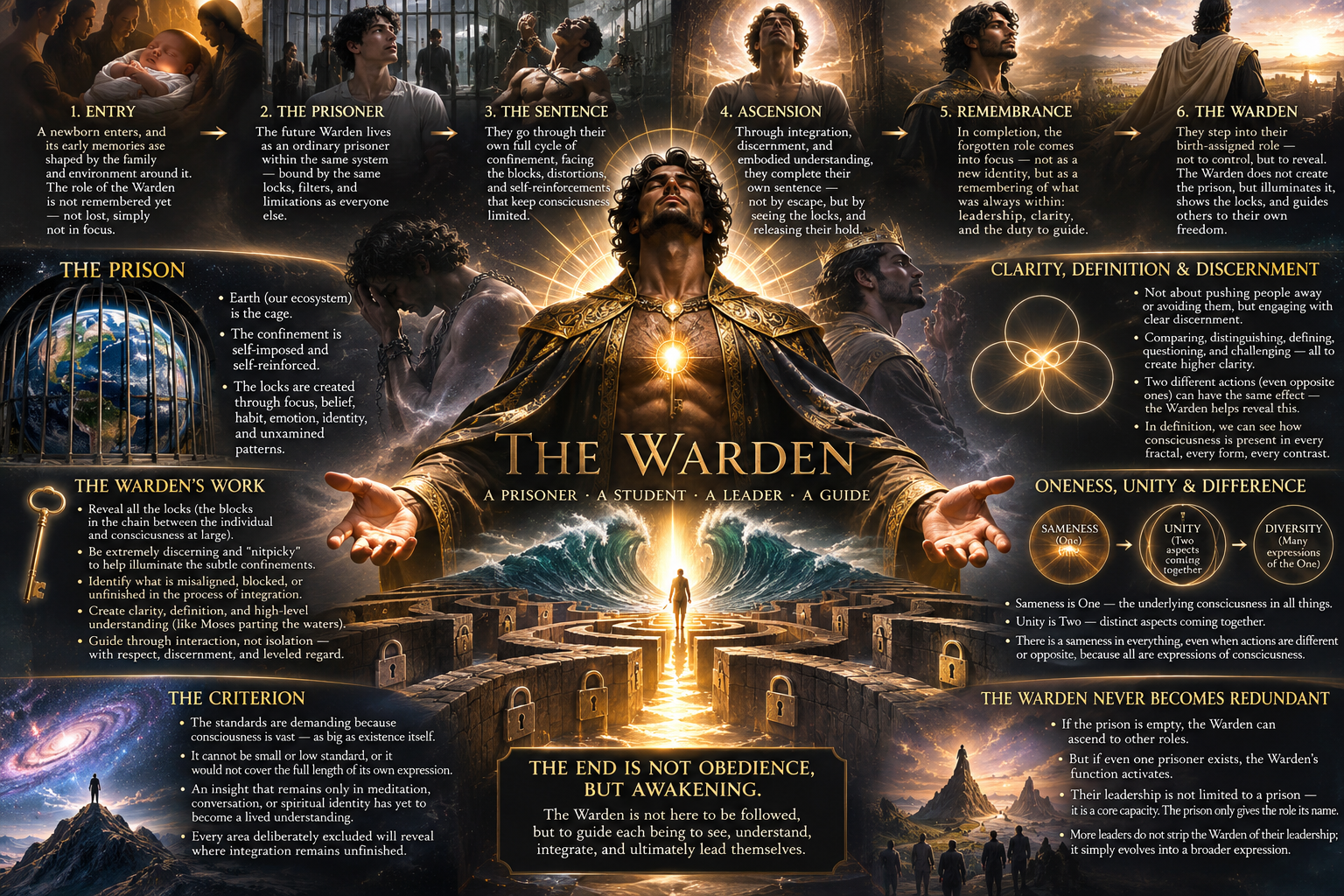
Within this metaphysical vision, the warden would first enter existence as an incognito prisoner. There would be no functioning warden until that individual had passed through their own sentence and awakened to the role assigned to them at birth.
They would arrive as a newborn, surrounded by a family’s memories, interpretations, expectations and explanations. Before they could articulate their own understanding, they would encounter other people’s accounts of who they were and what existence meant.
Their role would remain unremembered beneath those accounts. Calling this “forgetting” would only tell part of the story. What we focus on becomes what we can most readily retrace. Attention repeatedly directed towards inherited narratives would make those narratives familiar, while other aspects of the self remained outside that focus. The warden would not necessarily have lost their recognition; they would not yet have brought that part of themselves into view.
Their own sentence would be the passage through that condition. Before they could identify the locks confining others, they would have to encounter and recognise their own.
Earth—our ecosystem—would form the enclosure of this metaphor. Within it, confinement would be self-imposed and self-reinforced through the narratives individuals continued to inhabit, defend and reproduce. This would not make every earthly hardship self-created; the metaphor concerns the ways consciousness participates in maintaining its own confinement.
The warden’s work would be to show the locks.
Each individual would still have to develop and exercise the strength to open them. The warden could reveal a contradiction, distinguish an inherited identity from an examined one, or identify where a belief interrupted understanding. Recognition and integration would remain the individual’s work.
That explains the warden’s exacting attention to detail. What might appear nitpicky would have a purpose: identifying the precise point where something obstructed the relationship between an individual conscious being and consciousness at large.
Where does the explanation stop making sense? Where does someone claim recognition while excluding part of existence from it? Where does a narrative demand that they deny something they can otherwise clearly perceive?
What flows freely may already be apparent, or available for the individual to discover independently. The warden’s particular responsibility would be to make the obstructions visible. Praise alone would not fulfil that responsibility.
The criterion would be demanding because, within this vision, consciousness is as extensive as existence itself. An understanding that claims to encompass consciousness cannot be satisfied with a narrow selection of its expressions.
An insight that remains confined to meditation, conversation or spiritual identity has yet to become a lived understanding. Every area deliberately excluded would reveal somewhere the integration remains unfinished.
Probation would be the liminal passage in which that understanding becomes grounded. Having recognised the narratives that confined them, the individual would begin defining who they are within consciousness and integrating that recognition into ordinary existence: relationships, decisions, creativity, responsibility, disagreement and uncertainty.
They would need to express their understanding clearly and make it available in how they live. Their identity would take shape through that integration.
Here, the warden’s discernment would become essential. The sameness would be consciousness itself; its expressions would remain distinct. Unity would describe different aspects coming together, while oneness would name what was already shared beneath their differences.
Different actions—even opposite actions—could produce the same effect. Similar actions could produce different effects. The warden would therefore examine the relationship between intention, context, action and consequence. Surface resemblance would never be sufficient.
This discernment would take place through interaction. The warden would meet individuals with equal respect, engaging, questioning and communicating with attention to the person before them. Their leadership would require the ability to encounter difference without turning that difference into a reason for self-segregation.
Like Moses parting the waters, the warden would create a passage through clarity. They would separate what had become confused, explain what had remained obscure, and challenge what had been accepted without examination.
Definition would make passage possible.
The more precisely something could be understood, the more clearly consciousness could be recognised within its particular expression—within every distinction, relationship and fractal detail.
Even confusion would remain within consciousness. In this cosmology, it would evoke an undifferentiated condition before expression had taken definition. The warden’s work would belong to consciousness becoming articulate: discovering and expressing what its unfolding had made possible.
The purpose would be awakening. Obedience might occur within a particular process, but obedience itself would establish nothing about whether awakening had occurred. A person could follow every instruction while remaining dependent on someone else’s understanding.
Freedom would become possible when recognition could stand, speak and act through the individual’s own grounded understanding.
And an empty prison would not erase the warden.
The warden could ascend into other roles while retaining the capacity to recognise confinement and respond when needed. If another prisoner appeared, that aspect of their leadership could become active again. Other people becoming leaders would expand the field of leadership; it would not subtract from theirs.
The prison gives the role its name. Leadership makes the individual fit to hold it.
When the prison is empty, the location falls away. The discernment, clarity and capacity to guide remain.
https://chatgpt.com/share/6ae61c9b-3358-83ed-af4d-1cd12716601c?ogimg=plain




Leave a Reply