
How they need different nutritional values and needs?
Ad Break within the Ad Break(unapologetic costs’ funding): What does my Physionomy say about me? Mmm, you don’t have access to my body, but you have my Body’s Log(Blog-claaaat) 😁
….. Take your business Excuse pick!
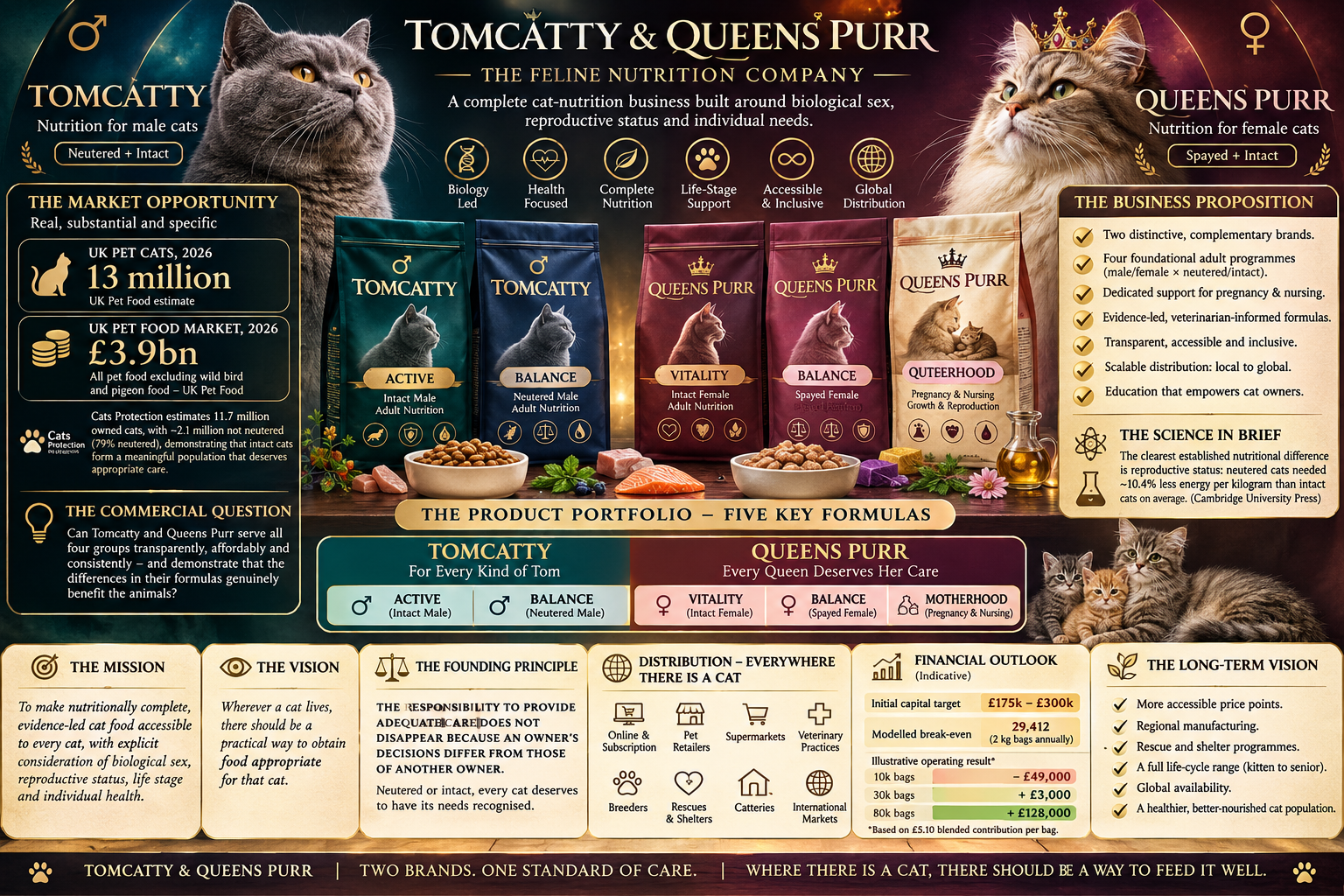
TOMCATTY & QUEENS PURR
A complete cat-nutrition business built around biological sex, reproductive status and individual needs.

TOMCATTY
Nutrition for male cats
Neutered + Intact

QUEENS PURR
Nutrition for female cats
Spayed + Intact
The business proposition: Two distinctive brands, four foundational adult nutrition programmes, special consideration for reproductive females, and distribution designed to reach cat owners regardless of whether they have chosen to neuter their animals.
The market opportunity is real—but more specific than it first appears
UK PET CATS, 2026
13 million
UK Pet Food estimate UK Pet Food
UK PET FOOD MARKET, 2026
£3.9bn
All pet food excluding wild bird and pigeon food—not cats alone UK Pet Food
Cats Protection’s separate 2026 research estimates 11.7 million owned cats, of which approximately 2.1 million are not neutered. Its survey places the neutered proportion at 79%, demonstrating that intact cats form a meaningful population that deserves appropriate care. Cats Protection
Importantly, sex-specific cat food isn’t completely new. Royal Canin previously marketed separate Neutered Young Male and Neutered Young Female diets, then discontinued them in June 2021 in favour of a combined product. Royal Canin AE [I’m dissappinted in you]
That makes the commercial question much more interesting:
Can Tomcatty and Queens Purr serve all four groups transparently, affordably and consistently—and demonstrate that the differences between their formulas genuinely benefit the animals?
The clearest established nutritional difference is reproductive status. A study of feline energy requirements found that neutered cats needed about 10.4% less energy per kilogram than intact cats on average, while sex-related differences were substantially less clear after adjusting for body weight and lean mass. Cambridge University Press
So the business should use sex and neutering status to organise its offerings, but also account for weight, age, activity, pregnancy, nursing and health conditions. That is how to turn your original idea into a credible animal-care business.
TOMCATTY & QUEENS PURR
THE FELINE NUTRITION COMPANY
Two Identities. Four Foundational Formulations. Every Cat Considered.
Founder’s Business Plan | 10 November 2026
Mission: To make nutritionally complete, evidence-led cat food accessible to every cat, with explicit consideration of biological sex, reproductive status, life stage and individual health.
Vision: Wherever a cat lives, there should be a practical way to obtain food appropriate for that cat.
Founding principle:
THE RESPONSIBILITY TO PROVIDE ADEQUATE CARE DOES NOT DISAPPEAR BECAUSE AN OWNER’S DECISIONS DIFFER FROM THOSE OF ANOTHER OWNER.
Neutered or intact, every cat deserves to have its needs recognised.
PART I — THE BUSINESS
1. Executive summary
Tomcatty and Queens Purr will operate as two complementary brands under one feline nutrition company.
TOMCATTY specialises in male cats.
QUEENS PURR specialises in female cats.
Each brand will initially contain two adult product divisions:
- Neutered or spayed.
- Intact (unneutered or unspayed).
The divisions will be supported by a nutritional selection system accounting for body condition, activity, age and reproductive requirements.
Pregnant and nursing queens will receive dedicated nutritional support rather than being treated as ordinary intact females.
The enterprise will combine:
- Veterinarily formulated complete cat food.
- Transparent nutritional information.
- Accessible purchasing and recurring supply.
- Retail and professional distribution.
- Education about feline biology and feeding.
- Product development responding to genuine gaps in care.
The ambition is international, with the United Kingdom as the proposed first commercial market.
The company’s advantage must come from nutrition, trust, availability and repeatable quality—not simply placing male and female labels on otherwise identical food.
2. The problem
The cat-food industry already provides many variations: kitten, adult, senior, sterilised, indoor, weight management and veterinary diets.
However, several purchasing problems remain.
Problem A: Reproductive status is not always prominent enough.
An owner of an intact adult cat may struggle to identify whether a general adult formula is suitable for the animal’s activity, body condition and reproductive circumstances.
Problem B: Male and female health considerations are often explained separately from the food-selection experience.
Male urinary anatomy, reproductive demands in females and post-neutering changes are real considerations, yet consumer purchasing journeys do not always explain which differences materially affect food selection.
Problem C: Pregnant and nursing queens can have dramatically different nutritional needs.
A simple adult female product cannot automatically provide for every reproductive stage.
Problem D: Premium nutrition can be difficult to afford or access.
Cats are kept in households with very different incomes and geographic circumstances.
Problem E: Multi-cat households need better feeding solutions.
Owners with male and female cats, or cats of different reproductive statuses, may need separate feeding plans.
The proposed solution is a clear, accessible system that helps owners choose food based on their cat’s actual requirements.
3. The scientific foundation
There is no established universal requirement that every adult male and female cat must eat fundamentally different nutrient ratios.
Their core nutrient needs overlap substantially.
But differences in body size, reproductive status, activity, disease susceptibility and reproduction can change the appropriate diet.
Scientific formulation should therefore prioritise:
| Factor | Why it matters |
|---|---|
| Biological sex | Anatomy and reproductive biology can affect health priorities |
| Neutering status | Energy requirements and appetite may change |
| Body condition | Determines whether weight maintenance or adjustment is appropriate |
| Age | Growth, adulthood and ageing have different nutritional demands |
| Pregnancy | Raises energy and nutrient requirements |
| Nursing | Creates substantial additional nutritional demands |
| Activity | Changes individual energy expenditure |
| Health conditions | May require diets prescribed or recommended by a veterinarian |
All complete formulas must satisfy applicable nutritional standards, using the current FEDIAF guidelines as a principal UK/European reference.
A sex-specific difference will only be incorporated into a recipe where there is nutritional justification.
The mission is not to manufacture differences between cats. It is to recognise differences that already matter.
PART II — THE PRODUCT PORTFOLIO
4. Tomcatty: Nutrition for male cats
Brand identity: Confident, recognisable, practical and rooted in the care of male cats.
Proposed tagline: For Every Kind of Tom.
TOMCATTY ACTIVE — Intact Male
Target customer: Owners of healthy, adult, unneutered male cats.
Nutritional design priorities:
- Complete adult maintenance nutrition.
- Adequate high-quality protein and essential amino acids.
- Energy density appropriate for body condition and activity.
- Hydration support through wet-food options.
- Controlled, nutritionally appropriate mineral composition.
- Clear portions based on individual body weight and activity.
Being intact does not automatically mean a cat needs a high-calorie diet. Some intact males are very active, while others are sedentary.
The product should provide adjustable feeding recommendations rather than assume all intact males have identical needs.
TOMCATTY BALANCE — Neutered Male
Target customer: Owners of healthy, adult, neutered male cats.
Nutritional design priorities:
- Energy management following neutering.
- Adequate protein to help maintain lean body mass.
- Carefully selected fat and fibre levels for satiety and calorie control.
- Sufficient essential nutrients at appropriate feeding quantities.
- Water intake and urinary-health education.
Male cats face greater risk of urethral obstruction because of their urinary anatomy.
The product must not imply it prevents obstruction merely because it is labelled for males.
Cats with urinary stones, obstruction or other diagnosed illnesses require veterinary assessment and potentially therapeutic diets.
5. Queens Purr: Nutrition for female cats
Brand identity: Nurturing, assured, elegant and biologically attentive without reducing female cats solely to reproduction.
Proposed tagline: Every Queen Deserves Her Care.
QUEENS PURR VITALITY — Intact Female
Target customer: Owners of healthy, adult, unspayed female cats that are not pregnant or nursing.
Nutritional design priorities:
- Complete adult maintenance nutrition.
- Appropriate protein, fats, vitamins and minerals.
- Energy intake matched to activity and body condition.
- Adequate hydration.
- Clearly explained transitions if pregnancy occurs.
An intact female does not require a permanently high-energy diet simply because she could become pregnant.
The food must support her current physiological condition.
QUEENS PURR BALANCE — Spayed Female
Target customer: Owners of healthy, adult, spayed female cats.
Nutritional design priorities:
- Appropriate energy density after spaying.
- Lean-body-mass support.
- Satiety and weight-management considerations.
- Appropriate nutrients at realistic feeding volumes.
- Digestive tolerance and hydration.
The purpose is to support long-term health without treating spaying as a disease.
6. Queens Purr Motherhood: The necessary fifth formula
QUEENS PURR MOTHERHOOD — Pregnancy & Nursing
This is a distinct nutritional category, not just a larger serving of ordinary adult food.
Pregnant and lactating queens need additional nutritional support. Nursing queens can require two to three times their ordinary food intake, depending on litter size and other factors.
The Motherhood formulation should:
- Be specifically formulated for growth and reproduction.
- Provide appropriate energy and nutrient density.
- Support increased feeding during pregnancy and lactation.
- Offer accessible wet-food options.
- Include veterinary-reviewed feeding instructions.
- Transition appropriately to a suitable post-weaning adult diet.
A suitable complete growth-and-reproduction diet can also inform the future kitten range, subject to its exact nutritional suitability and labelling.
No cat should be left nutritionally unsupported simply because its needs change.
7. Product architecture
| Brand | Product | Reproductive status | Intended stage |
|---|---|---|---|
| Tomcatty | Active | Intact male | Healthy adult |
| Tomcatty | Balance | Neutered male | Healthy adult |
| Queens Purr | Vitality | Intact female | Healthy adult, not breeding |
| Queens Purr | Balance | Spayed female | Healthy adult |
| Queens Purr | Motherhood | Pregnant/nursing female | Growth and reproduction |
Future ranges may include kitten food, senior nutrition and specialised products, but only where their nutritional profiles are justified.
Neither the adult nor maternity lines should be marketed as substitutes for prescription veterinary diets.
PART III — FORMULATION AND DEVELOPMENT
8. Food formats
The long-term goal is to provide a choice of complete dry and wet foods.
Dry food
Advantages include efficient storage, comparatively economical shipping, longer shelf life before opening and suitability for subscription delivery.
Proposed launch sizes:
- 400 g introductory bag.
- 2 kg standard bag.
- 4 kg household bag.
- Larger breeder, shelter and cattery packs where economically viable.
Wet food
Wet food contributes water to the diet and may be particularly useful for cats that consume relatively little drinking water.
Proposed formats:
- 85 g pouches.
- Multipacks of 12.
- Multipacks of 24 or more.
- Larger formats for professional feeders where appropriate.
Wet food should become an important part of the brand’s long-term identity, including both male and female ranges.
Mixed feeding
Owners should be offered guidance on combining compatible dry and wet products without accidentally doubling their cat’s daily energy intake.
Food selection must be based on total calories and nutrient intake, not simply the number of pouches or grams of kibble.
9. Ingredient philosophy
Cats are obligate carnivores.
The recipes must supply essential nutrients such as taurine, appropriate amino acids, preformed vitamin A, arachidonic acid, vitamins and minerals.
The formulation team should evaluate ingredients according to:
- Nutritional suitability.
- Digestibility and bioavailability.
- Consistency of supply.
- Food safety.
- Palatability.
- Traceability.
- Environmental impacts.
- Affordability.
A premium-sounding ingredient is not automatically more nutritious than a conventional one.
Similarly, grain-free, exceptionally high-protein or mineral-restricted diets should not be treated as universally superior.
The first requirement is that every complete recipe reliably meets the cat’s nutritional needs.
10. Scientific development team
Before manufacturing, appoint or contract:
Veterinary nutrition lead: Responsible for nutritional adequacy and independent review of all formulas.
Pet-food formulation specialist: Responsible for ingredient specification, manufacturing feasibility and nutritional consistency.
Quality assurance lead: Responsible for hazards, safety systems, traceability and manufacturing controls.
Veterinary advisory network: Reviews suitability, health claims, feeding instructions and product limitations.
Animal welfare adviser: Reviews the impact of marketing and product use on animal well-being.
The team should not be asked merely to endorse a predetermined formula.
Their job is to challenge, refine and test it.
11. Evidence and product trials
Development should include:
Laboratory analysis: Verification of energy, nutrient composition, contaminants and product consistency.
Palatability assessment: Whether cats will reliably consume the food.
Digestive tolerance: Assessment of gastrointestinal acceptance and stool quality.
Body-condition monitoring: Examination of feeding recommendations and weight maintenance.
Hydration assessment: Particularly when evaluating wet-food formats.
Clinical-claim validation: Any specific health-performance claim must have appropriate evidence.
Pilot studies should have veterinary oversight and avoid unnecessary or harmful animal experimentation.
The company can then build a transparent evidence record showing what each product is designed to do and what has actually been demonstrated.
PART IV — BRAND AND CUSTOMER EXPERIENCE
12. Packaging strategy
The two brands should be immediately distinguishable while clearly belonging to the same company.
Tomcatty
Suggested design:
Deep teal, midnight blue, graphite and warm copper.
Prominent male-cat silhouette.
Product divisions:
- ACTIVE: Intact male.
- BALANCE: Neutered male.
Queens Purr
Suggested design:
Rich burgundy, warm cream, plum and muted gold.
Prominent female-cat silhouette.
Product divisions:
- VITALITY: Intact female.
- BALANCE: Spayed female.
- MOTHERHOOD: Pregnant and nursing.
Sex and reproductive status should always be spelled out clearly.
Colour must not be the only way customers distinguish the products.
All packaging should include accessible typography, clear ingredient information, nutritional analysis and feeding instructions.
13. Individual cat profile
Customers should be able to create a free profile containing:
- Cat’s name and age.
- Sex.
- Neutering status.
- Weight and body-condition information.
- Activity level.
- Pregnancy or nursing status where applicable.
- Current diet and known health concerns.
- Food format preferences.
The online selector can recommend an appropriate product and an initial feeding amount.
It should also identify circumstances requiring veterinary advice.
The profile becomes the foundation for an ongoing feeding relationship.
The customer is not simply buying cat food. They are being helped to care for a particular cat.
14. The education programme
Every product should include a QR code leading to straightforward explanations of its purpose.
Topics include:
- Why neutering can change energy requirements.
- How male urinary anatomy affects health risks.
- The nutritional demands of pregnancy and nursing.
- Recognising an appropriate body condition.
- Understanding food labels.
- Combining wet and dry food.
- Feeding multiple cats with different needs.
- When to contact a veterinarian.
Education should never shame an owner for having an intact cat.
Equally, providing for intact cats must not imply that the company opposes neutering or responsible population management.
Our nutritional duty begins with the animal’s actual circumstances.
PART V — THE DISTRIBUTION MODEL
15. The founding distribution principle
EVERYWHERE THERE IS A CAT, THERE SHOULD BE AN ACCESSIBLE ROUTE TO CAT FOOD.
This means the company cannot depend exclusively on luxury pet shops or online subscriptions.
Distribution needs to consider geography, income, mobility, household circumstances and the different ways cats are cared for.
The long-term channel architecture includes:
| Channel | Distribution method | Commercial purpose |
|---|---|---|
| Direct online | Website and subscription | Customer relationships and recurring sales |
| Pet retailers | Independent shops and chains | Discovery and convenience |
| Supermarkets | National retail listings | Mass availability |
| Veterinary practices | Appropriate non-prescription ranges | Professional discovery and education |
| Breeders | Bulk and planned feeding supply | Intact-cat and maternity segments |
| Rescue organisations | Bulk supply and partnership agreements | Animal welfare and access |
| Shelters and catteries | Professional packs | Predictable recurring demand |
| Rural and agricultural stores | Regional wholesale partners | Rural accessibility |
| Groomers and cat services | Small retail displays | Community-based sales |
| Online marketplaces | Approved authorised sellers | Wider national reach |
| International distributors | Licensed or contracted regional partners | Global expansion |
Not every channel should open simultaneously.
The aim is universal reach through progressively built infrastructure.
16. Direct-to-consumer distribution
The official online store becomes the home of the brand.
Functions should include:
- Product selection based on cat profile.
- Individual purchases.
- Automatic replenishment.
- Delivery-frequency changes.
- Multi-cat household ordering.
- Purchase history.
- Feeding guides.
- Accessible customer support.
The customer should be able to switch from an intact to a neutered product when the cat’s circumstances change.
An owner of a pregnant queen should receive clear information on transitioning to Motherhood.
The goal is continuity of care.
17. Subscription strategy
Cat food is a repeat-purchase necessity.
This makes predictable replenishment commercially valuable.
Proposed subscription benefits:
- 5% discount on eligible recurring deliveries.
- Flexible delivery schedules.
- Automatic reorder reminders.
- Multiple products in one shipment.
- Feeding-profile updates.
- Simple cancellation.
Discounts must remain financially sustainable.
Subscriptions must never trap customers in unwanted payments.
They should reduce the work of providing consistent care.
18. Veterinary and professional distribution
Veterinary clinics are not simply additional shops.
They are potential partners in education and nutritional credibility.
Approach practices with documented complete-food formulations, analytical results, feeding guidance and transparent limitations.
Do not imply veterinary approval without actual approval.
Potential partnerships:
- Retail supply arrangements.
- Educational leaflets.
- Nutrition consultation referrals.
- Product information for post-neutering care.
- Guidance on pregnancy and lactation.
Clinically diagnosed conditions should remain within veterinary care.
19. Breeders, rescues and shelters
This is an important segment because the animals may have different ages, reproductive statuses and feeding needs under one roof.
Commercial offerings:
Breeder Programme
Volume purchasing, planned maternity feeding, product transitions and nutritional education.
Rescue Programme
Discounted complete-food supply, practical feeding guidance and support for mixed populations.
Shelter Programme
Bulk distribution, reliable replenishment and traceable batches.
All partnerships should require appropriate welfare standards.
No partnership should encourage irresponsible breeding or the production of unwanted litters.
20. Multi-cat households
Separate formulas create a practical challenge: cats may steal one another’s food.
The company should provide feeding guidance covering:
- Individually measured portions.
- Separate feeding areas.
- Supervised feeding when necessary.
- Microchip-operated feeders where appropriate.
- Transition instructions.
- Safe storage.
For households where separate diets are impractical, the company should explain whether one suitable complete adult diet can reasonably serve the cats involved.
Animal welfare must take precedence over persuading the household to purchase additional products.
21. International distribution
The long-term objective is a regional distribution network capable of reaching cat owners in developed, emerging, urban and rural markets.
Stage 1 — United Kingdom
Establish the business model, formula quality, production systems and repeat purchasing.
Stage 2 — Selected European markets
Expand where demand, logistics and regulatory approval support profitable distribution.
Stage 3 — North America
Adapt the formulations, packaging and claims to the applicable US and Canadian requirements, including relevant nutritional standards and feed regulations.
Stage 4 — Wider international markets
Consider regional licensing, local production and distribution partnerships.
Market-entry decisions must account for purchasing power, product safety, food standards, local feeding practices and the economics of importing finished food.
Global availability should not require every country to import expensive food from Britain.
Over time, qualified regional manufacturing may provide better affordability, sustainability and continuity of supply.
PART VI — PRICING AND PROFITABILITY
22. Price positioning
The first range should occupy the accessible-premium market rather than launch as an ultra-luxury product.
Proposed UK prices:
| Format | Indicative retail price |
|---|---|
| 400 g dry trial pack | £6.49 |
| 2 kg dry standard bag | £27.60 |
| 4 kg dry family bag | £48.00 |
| 12 × 85 g wet pouches | £17.99 |
| 24 × 85 g wet pouches | £33.99 |
These are pricing hypotheses, not supplier-confirmed costs.
At £27.60 for 2 kg, the standard dry bag costs £13.80 per kilogram. This places it above many mainstream cat foods and requires compelling quality, palatability and value evidence.
A lower-priced everyday range could follow once production volumes and formulation economics support it.
23. Unit economics: Standard 2 kg dry bag
Assume a £27.60 retail price including 20% VAT.
Revenue excluding VAT: £23.00.
Direct sale
| Component | Amount |
|---|---|
| Net revenue | £23.00 |
| Manufacturing and packaging | −£8.50 |
| Fulfilment | −£3.25 |
| Payment processing | −£1.00 |
| Amortised customer acquisition | −£4.00 |
| Returns and loss reserve | −£0.75 |
| Contribution per direct bag | £5.50 |
Estimated contribution margin: 23.9% of revenue excluding VAT.
The £4 acquisition allowance assumes marketing costs can be spread across repeat purchases. Actual first-order acquisition could be substantially higher.
Wholesale sale
Assume wholesale price of £13.80 excluding VAT.
| Component | Amount |
|---|---|
| Wholesale revenue | £13.80 |
| Manufacturing and packaging | −£8.50 |
| Wholesale handling and distribution | −£0.80 |
| Contribution per wholesale bag | £4.50 |
At the proposed retail price, a retailer purchasing for £13.80 excluding VAT would have a 40% gross margin before its own operating costs.
These figures require validation through manufacturing quotations and actual distribution agreements.
24. Operating forecasts
Assume 60% direct-to-consumer sales and 40% wholesale sales.
Blended contribution per bag:
£5.10
| Scenario | Annual bags sold | Contribution | Fixed operating costs | Operating result |
|---|---|---|---|---|
| Validation year | 10,000 | £51,000 | £100,000 | −£49,000 |
| Commercial growth | 30,000 | £153,000 | £150,000 | £3,000 |
| Wider expansion | 80,000 | £408,000 | £280,000 | £128,000 |
The results exclude corporation tax, financing expenses, extraordinary costs and any founder remuneration not already included in fixed operating expenses.
The figures are scenarios rather than predictions.
At annual fixed costs of £150,000, break-even would require approximately 29,412 bags per year at the assumed contribution margin.
Equivalent to around 2,451 bags per month.
Profitability will depend heavily on production scale, customer retention and distribution expenses.
25. Initial funding requirement
A food business requires more extensive development and compliance work than a simple retail accessory.
Illustrative launch funding:
| Expenditure | Planning budget |
|---|---|
| Veterinary nutrition and recipe development | £15,000 |
| Prototype batches, analysis and testing | £20,000 |
| Regulatory, insurance and professional services | £12,000 |
| Packaging and brand development | £10,000 |
| Initial stock | £34,000 |
| Website and subscription infrastructure | £10,000 |
| Marketing and retailer acquisition | £20,000 |
| Storage, logistics and operating setup | £15,000 |
| Working-capital and contingency reserve | £39,000 |
| Initial capital target | £175,000 |
This assumes contract manufacturing and modest initial staffing.
It does not include building a factory or financing extensive independent clinical trials.
If manufacturers require substantially larger production runs, the funding requirement could rise.
A target of £175,000–£300,000 is therefore a reasonable preliminary fundraising planning range, not a supplier quotation.
PART VII — MANUFACTURING AND RISK MANAGEMENT
26. Manufacturing strategy
Do not build an independent factory at launch.
Use an established, appropriately approved contract manufacturer with experience producing complete cat food.
The manufacturing agreement should establish:
- Formula ownership and usage rights.
- Confidentiality.
- Minimum order quantities.
- Ingredient specifications.
- Safety and quality responsibilities.
- Batch testing.
- Packaging requirements.
- Shelf-life validation.
- Product recall procedures.
- Liability allocation.
- Production lead times.
- Price revision conditions.
Where possible, identify an alternative qualified manufacturer for future supply continuity.
27. Product-quality requirements
Every production batch must be traceable.
Control systems should cover:
Incoming ingredients: Identity, traceability, approved suppliers and contamination controls.
Processing: Temperature, moisture, mixing, nutrient preservation and food-safety controls.
Finished product: Laboratory specifications, microbial quality, packaging integrity and relevant nutrient verification.
Storage: Temperature, humidity, pest management and expiry management.
Recall readiness: The company must be able to identify, locate and withdraw affected batches rapidly.
Because this food may become the sole diet of an animal, inadequate formulation is not simply a customer-service problem.
It can become a serious animal-welfare problem.
28. Legal and regulatory obligations
UK commercial operations must follow applicable animal-feed law.
Requirements include appropriate feed-business registration or approval, manufacturing controls, safe ingredients, traceability and compliant labelling.
Production involving animal by-products may also require approval from the Animal and Plant Health Agency.
Labelling must correctly distinguish complete from complementary feed, identify the intended animal and life stage, and disclose required composition, constituents, additives, quantities and business details.
Regulatory responsibilities must be assigned before the first sale.
No product is released until its nutritional adequacy, safety and legally required information are verified.
29. Major risks
| Risk | Consequence | Mitigation |
|---|---|---|
| Unproven sex-specific differentiation | Customers perceive unnecessary complexity | Require scientific justification for formula differences |
| Too many initial formulas | Inventory costs and unsold stock | Demand-led production and carefully negotiated minimums |
| Poor palatability | Low repeat purchasing | Structured acceptance trials |
| Expensive customer acquisition | Unprofitable direct sales | Subscription retention and wholesale diversification |
| Inconsistent manufacturing | Quality or safety failure | Qualified supplier audits and batch controls |
| Competition from major brands | Pricing and shelf-space pressure | Trust, transparency and a distinctive shopping experience |
| Incorrect health claims | Regulatory and reputational harm | Veterinary and legal claim review |
| Premium pricing | Excludes lower-income owners | Larger economical packs and future accessible range |
| Retailer concentration | Revenue vulnerability | Multi-channel distribution |
| Inappropriate food selection | Health risks to cats | Clear eligibility and veterinary-referral guidance |
PART VIII — MARKET ENTRY AND GROWTH
30. First 90 days
Days 1–30: Commercial validation
Search trademarks and relevant domains.
Interview male-cat and female-cat owners, including intact-cat households.
Interview veterinary professionals, rescue operators, breeders, retailers and cat boarding services.
Test product naming, price acceptance and buyer understanding.
Determine whether customers value four distinct adult categories and what evidence would convince them to switch.
Days 31–60: Technical validation
Appoint a veterinary nutrition specialist.
Request quotations from approved contract manufacturers.
Establish feasible recipe differences.
Obtain estimated minimum orders, lead times and testing requirements.
Begin brand and packaging design.
Days 61–90: Launch preparation
Finalise the commercial and technical go/no-go criteria.
Develop approved prototype recipes.
Conduct initial laboratory and palatability work.
Prepare the website and retail materials.
Establish the launch budget based on verified supplier terms.
The first 90 days should establish whether the proposed proposition deserves investment at scale.
31. First-year milestones
| Period | Objective |
|---|---|
| Months 1–3 | Market research, nutrition team, trademark checks, supplier selection |
| Months 4–6 | Formulation, laboratory analysis, trials and packaging |
| Months 7–9 | Initial direct launch and selected retail partnerships |
| Months 10–12 | Reorder analysis, formula refinement and expansion planning |
A twelve-month commercial launch is a target, not a guaranteed timeline. Food-safety and nutritional validation take priority over speed.
32. Three-year business ambition
Year One — Establish trust
Demonstrate repeat purchasing, documented product quality and a reliable commercial proposition.
Year Two — Establish reach
Grow national distribution, strengthen manufacturing capacity, expand wet-food availability and develop breeder/rescue programmes.
Year Three — Establish scale
Target substantial recurring sales, broader retail availability and preparation for selected international markets.
A business capable of selling tens of thousands of bags must also demonstrate that those bags are genuinely meeting the needs of the cats consuming them.
Sales alone are insufficient evidence of nutritional success.
PART IX — THE LONG-TERM VISION
33. Accessibility as part of the business model
The ultimate goal is not simply to sell premium cat food to households already able to afford it.
It is to make appropriate feline nutrition increasingly accessible.
As production scales, the business should investigate:
- More economical family-size packs.
- Lower-cost formulas that still meet complete nutritional standards.
- Regional manufacturing.
- Rescue and shelter pricing.
- Local retail distribution in underserved communities.
- Subscription bundles for multi-cat homes.
- Partnerships supporting cat owners facing temporary financial hardship.
A responsible food business must take affordability seriously.
A cat’s nutritional needs do not diminish because its owner has a limited income.
34. The feline life-cycle ecosystem
Eventually, Tomcatty and Queens Purr could support a cat throughout its life.
Kitten → Adult → Reproductive-status transition → Pregnancy or nursing where applicable → Mature adult → Senior care.
The owner would not need to abandon the brand when the cat’s needs changed.
Instead, the company would help identify the appropriate next nutritional programme.
This creates long-term customer relationships while preserving the welfare objective.
35. Performance indicators
Success must be measured across both commercial and animal-care dimensions.
Commercial measurements
Revenue, gross margin, contribution margin, customer acquisition cost, subscription retention, repeat purchase rates, retailer reorders, inventory turnover and working-capital requirements.
Product measurements
Nutritional conformity, manufacturing consistency, palatability, documented complaints, appropriate feeding outcomes and adverse-event monitoring.
Accessibility measurements
Regional availability, affordable pack options, shelter participation, delivery coverage and customer satisfaction.
Ethical measurements
Accuracy of nutritional claims, transparency, supplier compliance, appropriate professional referral and responsible welfare partnerships.
The final measure is not simply how many bags are sold.
It is whether the company creates a reliable system through which more cats can receive appropriate nutrition.
PART X — THE FOUNDING STATEMENT
EVERY CAT HAS A BODY. EVERY BODY HAS NEEDS.
A male cat does not cease to deserve appropriate nutrition because he has been neutered.
A female cat does not cease to require consideration because she has been spayed.
An intact male should not be nutritionally overlooked.
An intact female should not be treated as though her reproductive status is irrelevant.
And a pregnant or nursing queen should not have to depend on an ordinary maintenance diet that was never designed for her physiological demands.
The cat does not choose the food industry.
The cat does not design the packaging.
The cat does not establish nutritional standards.
The cat does not decide which products reach the shops.
Humans do.
And because humans have assumed responsibility for feeding these animals, humans must take responsibility for understanding what those animals need.
Tomcatty and Queens Purr begin with a simple proposition:
Recognise the animal.
Investigate its biology.
Understand its circumstances.
Provide suitable nourishment.
Continue adapting as its needs change.
Not every male cat needs a unique diet.
Not every female cat needs a different ingredient profile.
But every cat deserves to have the possibility of individual nutritional requirements properly considered.
And owners should be able to make informed decisions without being shamed for asking questions or choosing differently from another owner.
TOMCATTY.
For Every Kind of Tom.
QUEENS PURR.
Every Queen Deserves Her Care.
TWO BRANDS. ONE STANDARD OF CARE.
WHERE THERE IS A CAT, THERE SHOULD BE A WAY TO FEED IT WELL.
Research and regulatory references
- UK Pet Food — UK Pet Population, 2026
- UK Pet Food — Market Data
- Cats Protection — CATS Report 2026
- FEDIAF — Nutritional Guidelines
- Merck Veterinary Manual — Cat energy requirements
- Merck Veterinary Manual — Feeding during growth and reproduction
- Cornell — Feline urinary tract disease
- GOV.UK — Animal feed legislation
- GOV.UK — Pet-food production using animal by-products
- UK Intellectual Property Office — Search trademarks
Financial figures are preliminary modelling assumptions. Product names have not been confirmed as available trademarks, and no commercial formulation or supplier quotation has yet been verified.
Financial outlook at a glance
INITIAL CAPITAL TARGET
£175k–£300k
Indicative development and launch funding
MODELLED BREAK-EVEN
29,412
2 kg bags annually at £150k fixed costs
One significant commercial challenge deserves particular attention: Royal Canin’s decision to combine its former sex-specific neutered diets shows that a clear biological distinction does not automatically make separate products commercially worthwhile. Tomcatty and Queens Purr would need to establish whether four adult formulations provide meaningful benefits that justify the additional manufacturing complexity. Royal Canin AE
The model’s strongest differentiator could ultimately be the combination of four easy-to-understand choices, individual feeding guidance, maternity provision and distribution that accommodates intact cats without neglecting them.
The next major business decision would be commissioning a veterinary nutritionist to assess the four adult formulations side by side, before committing to manufacturing. That evaluation determines how much of the proposed architecture is genuine nutritional differentiation and how much is better education and distribution.



Leave a Reply