
You’ll only understand this if you have listened to the songs I recommended in the prior one. Can you keep up?! With these creative tempos, I mean… who even needs sex?! My mind does it. I should be the one that said: ” Why are they shouting?! ” to rockers, I understand now. Yeah?! Do you hunny?
Wake Up – Black Veil Brides
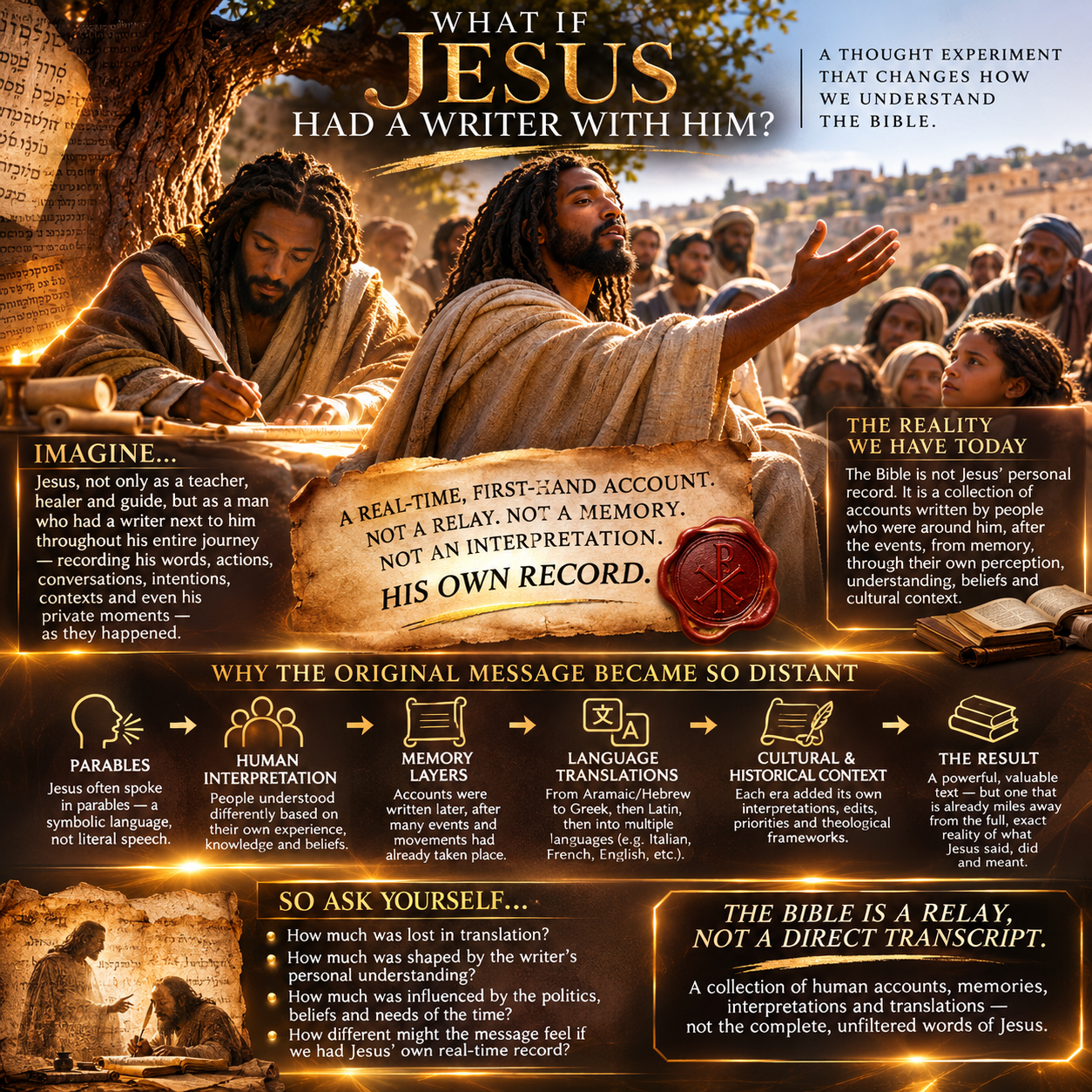
IMAGINE IF JESUS HAD A GHOSTWRITER. HIS OWN GHOST.
What If the Man Who Changed the World Had Been Able to Document His Own Existence While He Was Living It?
— SNW | SHS – Human First
I want you to imagine something.
Imagine Jesus Christ walking through the world, living his life, meeting people, speaking, teaching, questioning, observing, making decisions, encountering hostility, experiencing love, disappointment, anger, laughter, silence and everything else that comes with being human.
Now imagine that, throughout his entire existence, he had someone walking right beside him.
Not a disciple.
Not an admirer.
Not a follower trying to understand his teachings.
Not someone who would eventually sit down, years after his death, and attempt to recollect what he said.
HIMSELF.
Imagine Jesus had somehow split himself into two.
One living.
The other writing.
One experiencing his existence.
The other documenting that existence as it happened.
A ghost of himself, recording every encounter, every conversation, every observation, every explanation, every contradiction, every moment of laughter, every moment of frustration, every thought he chose to express.
Not after the fact.
RIGHT THERE. IN REAL TIME.
Imagine the difference.
Because I want us to investigate something rather extraordinary about the very foundation upon which billions of humans have built their understanding of Jesus Christ.
HOW MUCH OF WHAT HUMANITY BELIEVES ABOUT JESUS COMES DIRECTLY FROM JESUS, AND HOW MUCH COMES FROM WHAT OTHER HUMANS UNDERSTOOD, REMEMBERED, INTERPRETED AND EVENTUALLY WROTE ABOUT HIM?
And perhaps even more importantly:
HOW MUCH OF THE MAN HAVE WE NEVER BEEN GIVEN THE OPPORTUNITY TO KNOW?
THE MAN SPOKE IN PARABLES. THINK ABOUT THAT.
Jesus was known for teaching through parables.
Stories.
Metaphors.
Comparisons.
Lessons concealed within ordinary situations.
He could speak about seeds, soil, sheep, servants, fathers, sons, vineyards, wealth and debt, while communicating something beyond the immediate subject of the story.
Now consider what that means.
The person listening has to understand the language.
Then they have to understand the story.
Then they have to recognise that the story is communicating something beyond its literal description.
Then they have to interpret what that additional meaning might be.
And then, if they wish to tell somebody else what Jesus said, they must somehow communicate what they heard without confusing what was said with what they personally understood.
Do you see the problem?
Someone hears a parable.
They understand it one way.
They relay it to somebody else.
That person understands it another way.
Another person remembers it decades later.
Another person writes it down.
Another translates it.
Another teaches it.
Another preaches it.
Another builds a doctrine upon it.
Another creates an institution around that doctrine.
And centuries later, millions of humans are debating what Jesus meant.
BUT WHERE IS JESUS IN ALL OF THIS?
Where is the man explaining, in his own words, whether we have understood him correctly?
Where is the opportunity to ask him:
Is that actually what you meant?
Did you intend that interpretation?
Why did you use that particular example?
What were you responding to in that moment?
What happened before you made that statement?
And what happened afterwards?
Because context matters.
And the meaning of a conversation can change enormously when we discover what preceded it.
NOW ADD LANGUAGE TO THE EQUATION.
Jesus lived in a world in which Aramaic was widely spoken, Hebrew had religious importance, and Greek circulated throughout the eastern Mediterranean.
The New Testament writings that have come down to us were composed in Greek.
Consider that.
Before we even arrive at modern English, Italian, French, Spanish or any other contemporary language, we are already dealing with the relationship between the languages Jesus likely spoke and the language through which his teachings were preserved in the Gospels.
Then came centuries of manuscript copying, translation, interpretation, commentary and theological development.
Greek.
Latin.
Various other ancient and later languages.
Early forms of English.
Modern English.
And countless translations into languages across the world.
Not necessarily through one uninterrupted chain of translation from one language into another—many modern Bibles are translated directly from scholarly editions of the ancient texts.
But even when a translation returns to the earliest available manuscripts, it still confronts the difficulty of representing meaning across languages, cultures and historical circumstances.
One word may contain several possible meanings.
One expression may belong to a culture that no longer exists in the same form.
One metaphor may depend upon an experience unfamiliar to the modern reader.
One sentence may be translated accurately in its vocabulary while losing something of its original context.
AND HUMANITY HAS BEEN BUILDING ENTIRE INTERPRETATIONS OF EXISTENCE UPON THESE TEXTS.
Think about the extraordinary responsibility involved.
Not simply the responsibility of translating words.
But the responsibility of preserving meaning.
Because those two things are not necessarily identical.
WHAT IF WE HAD THE MAN’S OWN ACCOUNT?
Imagine Jesus teaching a crowd.
Someone asks him a question.
He answers with a parable.
The crowd interprets it.
Some understand.
Some misunderstand.
Some become offended.
Some leave confused.
And afterwards, his ghostwriter turns to him and asks:
What did you mean by that?
And Jesus answers.
Not through another person’s recollection.
Not through a theological interpretation established centuries later.
But through a contemporaneous record of his own explanation.
Imagine having the conversation before the teaching.
The teaching itself.
The responses of the audience.
And then Jesus’s own reflections upon the encounter.
THE BEFORE. THE DURING. THE AFTER.
Now imagine that extending across his entire life.
His ordinary days.
His childhood experiences.
His private conversations.
His relationships with family.
The moments when he was simply eating, walking, resting, thinking or observing other humans.
The encounters that never became famous enough to be repeated.
The moments that no one thought important enough to preserve.
The jokes.
The silences.
The questions.
The mistakes people may have made about him while he was still standing in front of them.
And the explanations he might have offered if given the opportunity.
Imagine how much more of the human being we would have been able to investigate.
Because what humanity has inherited is not a complete, continuously documented autobiography of Jesus.
We have Gospel narratives, letters, traditions and other historical sources, produced and transmitted through human communities.
Those sources may preserve meaningful testimony. But they are not an uninterrupted, first-person record of every moment he lived.
AND THE DIFFERENCE BETWEEN A LIFE AND THE RECORDS THAT SURVIVE OF THAT LIFE IS ENORMOUS.
Even the Gospel of John acknowledges, in its closing passage, that many things Jesus did were not written down.
Now think about the implications of that admission.
We know, from within the tradition itself, that the written account is not presented as an exhaustive inventory of his existence.
And yet, how frequently do humans approach the surviving account as though it contains everything necessary to determine the entirety of who he was?
WE HAVE BEEN INHERITING INTERPRETATIONS OF INTERPRETATIONS.
Imagine being judged by something you said twenty years ago.
Except nobody recorded what you actually said.
One person remembers your words.
Another remembers your tone.
Another remembers how they felt.
Another remembers what somebody else told them.
Someone eventually writes a version of the encounter.
Then that version is copied.
Translated.
Discussed.
Interpreted.
Defended.
And eventually treated as the authoritative account of your intentions.
Now imagine being unable to return and explain yourself.
Imagine billions of people being born into a world where their understanding of you is already being determined by those inherited accounts.
Where some love you.
Some fear you.
Some worship you.
Some reject you.
Some fight in your name.
Some claim authority through your name.
And others spend their entire lives arguing over what you meant.
WHILE YOU, THE ORIGINAL HUMAN AT THE CENTRE OF IT ALL, ARE NO LONGER PRESENT TO PARTICIPATE IN THE CONVERSATION.
Isn’t that an extraordinary situation?
And notice something else.
Even if the original account had been perfectly preserved, people would still interpret it differently.
Because human perception does not disappear simply because the source is available.
But a contemporaneous first-person record would give us something invaluable:
THE OPPORTUNITY TO COMPARE WHAT THE PERSON ACTUALLY RECORDED WITH WHAT OTHERS LATER CLAIMED THE PERSON MEANT.
That comparison alone could transform the entire investigation.
WHAT IF HIS GHOSTWRITER HAD RECORDED HIS CONTRADICTIONS TOO?
Now this is where it becomes even more interesting.
I wouldn’t want the ghostwriter to record only his great teachings.
I would want everything.
His uncertainty, if he expressed any.
His frustration.
His changes in approach.
His emotional responses.
The days when he may have been tired.
The conversations in which he corrected someone.
The occasions when someone corrected their own misunderstanding.
I would want to know what he thought about the world he inherited.
What he observed about the people governing it.
What he discovered about human behaviour.
What he thought he was accomplishing.
And how his own understanding of his mission was expressed throughout his life.
NOT A POLISHED VERSION OF THE MAN.
THE MAN.
Because there is something extraordinarily important about preserving the ordinary alongside the extraordinary.
Sometimes the smallest encounter tells us more about someone’s character than their greatest public speech.
Sometimes one conversation reveals a principle that a thousand later interpretations struggle to explain.
And sometimes what somebody chooses not to do tells us something about the integrity of everything they claim to represent.
Why wouldn’t we want those moments?
Why would we settle for fragments if a more complete record were possible?
AND WHAT OF THE PEOPLE WHO WROTE ABOUT HIM?
This is not an accusation that every person who transmitted the traditions about Jesus deliberately misrepresented him.
It is an investigation into the limitations of human recollection and interpretation.
People can be completely sincere and still misunderstand.
They can remember the emotional significance of a conversation while forgetting its exact wording.
They can preserve a teaching because they consider it important, while overlooking an ordinary interaction that might help explain it.
They can organise material according to the message they wish their audience to understand.
They can translate faithfully while still having to make decisions between competing meanings.
SINCERITY DOES NOT AUTOMATICALLY PRODUCE COMPLETENESS.
And conviction does not eliminate the possibility of error.
So what happens when the original person becomes inaccessible, but the interpretations continue multiplying?
Eventually, the interpreters can become the authorities.
And the authority of the interpretation may become so established that questioning it is treated as questioning the person themselves.
But those are not necessarily the same thing.
QUESTIONING AN INTERPRETATION OF JESUS IS NOT AUTOMATICALLY THE SAME AS QUESTIONING JESUS.
That distinction deserves considerably more attention.
THE GHOSTWRITER: THE WITNESS WHO NEVER HAD TO REMEMBER.
Now return to the original thought experiment.
A second Jesus.
A ghost of himself.
Writing alongside him.
Not waiting twenty or forty years to collect memories.
Not reconstructing conversations from testimony.
Not deciding which moments deserve to survive after the person has died.
Documenting the journey as it unfolds.
What was said.
What was done.
What was observed.
What was questioned.
What was intended.
What remained unresolved.
And what changed as time continued.
Of course, even such a record would be limited by what Jesus chose to express, what could be observed and what language was capable of communicating.
No written account can contain every dimension of a human consciousness.
But imagine the difference between a person who documents their existence while living it and a person whose existence must later be reconstructed by others.
ONE LEAVES THEIR OWN ACCOUNT TO BE INVESTIGATED.
THE OTHER LEAVES HUMANITY TO INVESTIGATE THE ACCOUNTS OF THOSE WHO SURVIVED THEM.
Both can hold value.
But they are not equivalent.
And perhaps that is the part I find most fascinating.
Because today, humanity has technological capabilities that would have been unimaginable in the world Jesus inhabited.
We can record conversations as they happen.
We can preserve dated documents.
We can archive photographs, videos and written reflections.
We can connect an idea to the moment it was conceived.
We can document how an interpretation changes.
We can preserve disagreements alongside the circumstances that produced them.
We can even converse with systems capable of helping us organise, compare and revisit what we have said across time.
Not flawless systems.
Not substitutes for our own judgment.
But tools through which we can establish far more detailed records of our intellectual and personal journeys.
WE NOW HAVE THE POSSIBILITY OF BEING PRESENT IN BOTH OUR OWN LIVES AND THE DOCUMENTATION OF THOSE LIVES.
Imagine the historical difference that could make.
SO HERE IS MY QUESTION TO HUMANITY.
If Jesus had documented his entire existence himself, would we have the same religions today?
Would the same denominations exist?
Would the same arguments have developed?
Would people have interpreted his teachings in the same ways?
Would some doctrines have taken entirely different forms?
Would some disagreements have been resolved before they ever became institutionalised?
Would we have discovered dimensions of his personality that no surviving Gospel preserves?
Would we have found that some of the things people insist he meant were not what he intended at all?
Or would we have discovered that some interpretations were more accurate than their critics ever imagined?
WE DON’T KNOW.
And that is precisely the point.
We don’t know everything the man said.
We don’t know everything he did.
We don’t possess an exhaustive record of every encounter, every explanation and every ordinary day.
We possess what has survived through history.
And what has survived is not identical to the entirety of what existed.
A COMMEMORATION TO THE UNWRITTEN LIFE.
I find something deeply significant about that.
Not merely because the subject is Jesus Christ.
But because the same question applies to countless humans throughout history.
How many people have been reduced to the accounts of others?
How many discoveries disappeared because nobody wrote them down?
How many conversations were transformed through memory?
How many intentions were lost between the moment they were expressed and the moment somebody attempted to explain them?
How many people have been celebrated for things they never intended, condemned for things they never said, or remembered through narratives they never had the opportunity to examine?
And how many ordinary moments, potentially essential to understanding the whole, have simply vanished?
We cannot recover every moment of the past.
But we can reconsider how we preserve the present.
Because a person’s existence is not merely the collection of statements that other people consider worth remembering.
It is an accumulation of encounters, thoughts, relationships, actions, observations and consequences.
And the more of those connections we preserve, the more comprehensive our understanding can become.
IMAGINE IF JESUS HAD A GHOSTWRITER.
IMAGINE IF THAT GHOSTWRITER WAS HIMSELF.
IMAGINE IF HUMANITY HAD BEEN ABLE TO HEAR THE MAN EXPLAIN HIS OWN JOURNEY INSTEAD OF RELYING ENTIRELY ON THE ACCOUNTS THAT REACHED US THROUGH OTHERS.
Not to dismiss the records we have.
But to recognise the extraordinary difference between a human life and humanity’s eventual interpretation of that life.
And perhaps, with the technologies available to us today, we should begin asking ourselves a rather important question:
IF WE HAVE THE ABILITY TO DOCUMENT OUR OWN JOURNEYS WHILE WE ARE STILL LIVING THEM, WHY SHOULD WE LEAVE THE ENTIRE RESPONSIBILITY OF EXPLAINING WHO WE WERE TO PEOPLE WHO WILL COME AFTER US?
Let them interpret.
Let them investigate.
Let them question.
Let them compare.
But give them the original voice to return to.
Give them the context.
Give them the development.
Give them the contradictions.
Give them the explanations.
Give them the humanity.
BECAUSE THE PERSON WHO LIVED THE LIFE AND THE PEOPLE WHO LATER TELL THE STORY OF THAT LIFE ARE NOT THE SAME SOURCE.
And I wonder how differently humanity might understand its history if more of those original voices had survived.
— SNW
SHS – Human First
The Womb of The Unknown Need.
….
Okay, I need you to write a piece in commemoration to the fact that imagine if Jesus had a a writer next to him throughout his whole journey, just writing every, his little moments. Like, like as if he had split himself in two to write everything that he was doing on the spot. Not people relaying the information after and writing about him after he had died because there was a lot of movements that happened in between, a lot of memories that were tainted, a lot of perception, a lot of different interpretations that came into play. Jesus spoke in parables. So whatever people understood from what he said is what they relayed back without actually not always getting it right. Of course, if the man is already speaking in parables, he’s already speaking in a language that’s not the given language. So on top of that, so there’s the interpretation from that language to the normal language. And then on top of that, the interpretation from archaic, well, the translations from so many different languages all the way from archaic English till you get to the normal English or whichever language in the now from Latin English, from, sorry, from Latin to Italian, from whatever. The amount of translations and interpretations that had to go in to even just do the first ever Bible. It was already miles away from what Jesus was and what Jesus meant and what Jesus did. Miles away. And not all of his life was even written down. So imagine if he had had himself, like imagine if he had like a ghost of himself just writing next to him. Like we call it ghost writers. We want people to actually think about this. Have them think that everything that is in the Bible is an actual interpretation or a relay of people that were around Jesus, not actually his words, not the whole thing




Leave a Reply