
The two need to divorce. Fake system of value and human consequences. If the same that get called psychopaths for using the system to manipulate and keep the people down, want that claim killed, than it shouldn’t be a problem for them. Otherwise it would expose the real intentions to the system we live in.
The Difference Between Real Power and Assigned Power — Why Humanity Must Separate Its Continuation from the Financial Decisions of Those Who Control Its Institutions.
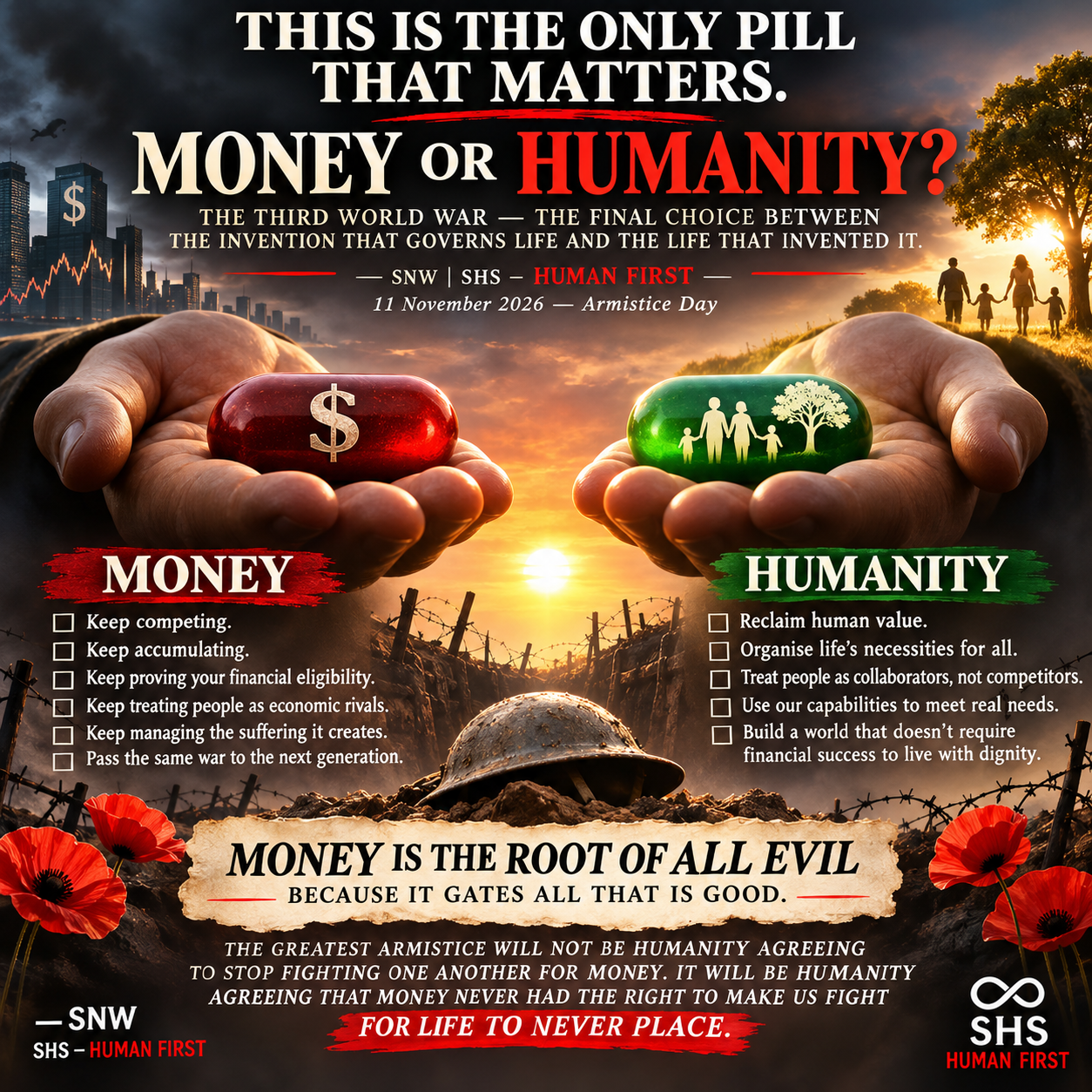
— SNW | SHS – HUMAN FIRST
The Womb of The Unknown Need.
There is something extraordinarily disturbing about the way humanity has organised its existence.
We have created a system.
We have assigned numbers to things.
We have invented currencies, markets, valuations, financial instruments, investments, debt, interest rates, stocks, shares and institutions.
We have appointed people to oversee these creations.
We have given them titles.
Chief Executive Officer.
Chairman.
President.
Governor.
Director.
We have placed enormous quantities of financial authority in their hands.
And somehow, somewhere along the development of this extraordinary artificial structure, we made one of the most consequential mistakes in human history.
WE ATTACHED THE CONTINUATION OF HUMAN LIFE TO THE CONTINUATION OF THE FINANCIAL SYSTEM.
And now, when that system experiences a crisis, human beings experience consequences they did absolutely nothing to cause.
Let me explain why I find this so fundamentally unacceptable.
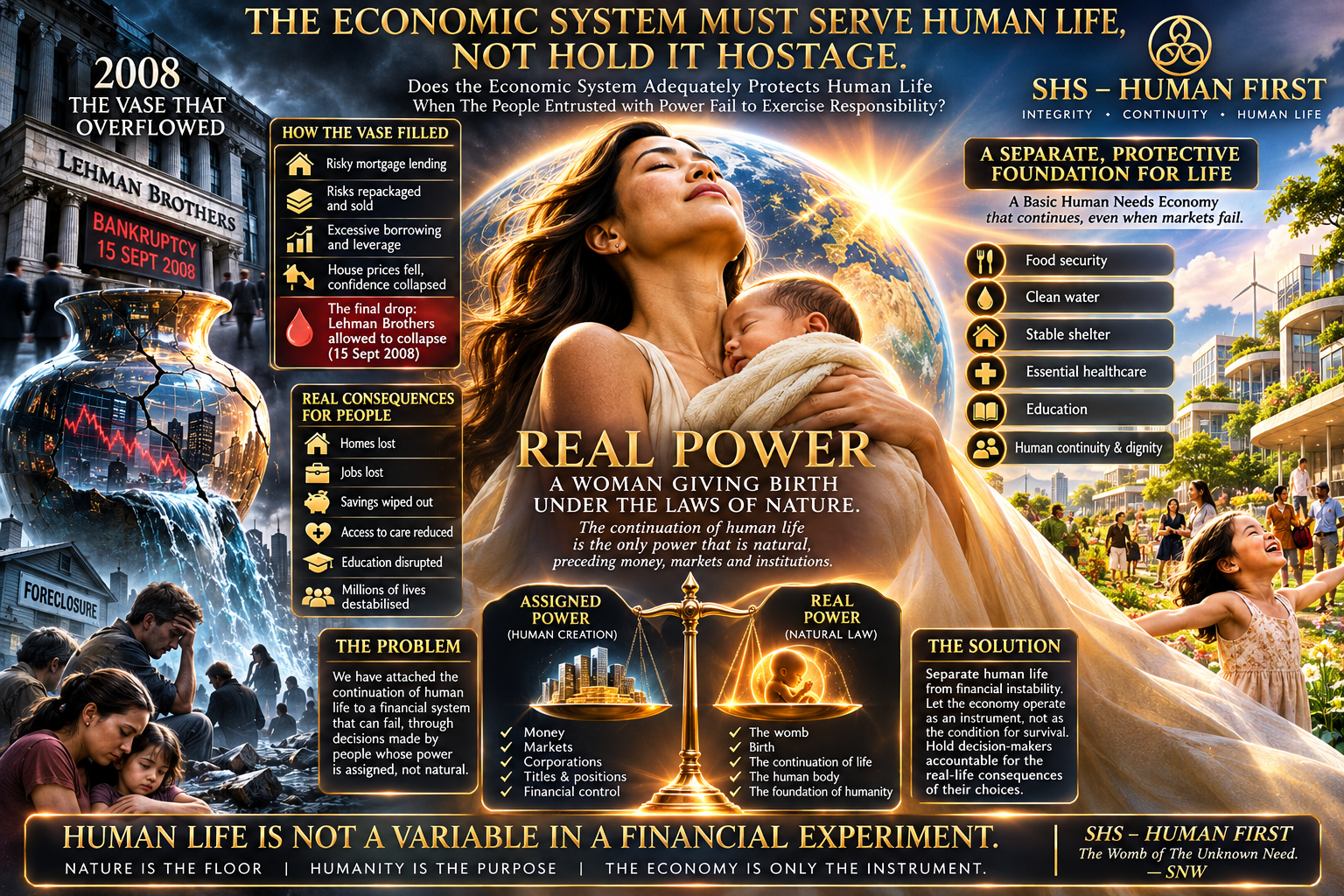
THE VASE THAT OVERFLOWED IN 2008.
Consider the financial crisis of 2008.
The world did not suddenly run out of food.
The Earth did not stop producing resources.
Human beings did not suddenly lose their capacity to build houses.
Doctors did not forget how to treat patients.
Teachers did not lose their knowledge.
The sun did not stop rising.
Nature did not announce that humanity could no longer sustain itself.
WHAT COLLAPSED WAS THE FINANCIAL STRUCTURE THROUGH WHICH HUMANITY HAD ORGANISED ACCESS TO ITS OWN RESOURCES.
And the consequences?
People lost their homes.
People lost their employment.
People lost their savings.
Families were displaced.
Businesses closed.
Public finances came under pressure.
Entire countries experienced economic hardship.
And why?
Because financial institutions had accumulated risks through lending, securitisation, excessive leverage and interconnected obligations.
The collapse of Lehman Brothers in September 2008 became one of the defining moments of that crisis.
But Lehman was not the entire vase.
LEHMAN WAS ONE OF THE FINAL DROPS THAT CAUSED AN ALREADY OVERFILLED VASE TO OVERFLOW.
The vase had been filling for years.
Decision after decision.
Risk after risk.
Warning after warning.
Institution after institution.
And the people whose lives were most severely disrupted?
Many of them were not even in the rooms where those decisions were being made.
THEY DID NOT POUR INTO THE VASE.
THEY DID NOT DECIDE HOW MUCH IT COULD HOLD.
THEY DID NOT DETERMINE WHEN IT WAS FULL.
AND YET THEY WERE MADE TO LIVE WITH THE CONSEQUENCES WHEN IT OVERFLOWED.
Tell me, what kind of organisation of human life is that?
THE PEOPLE WHO MAKE THE DECISIONS ARE NOT ALWAYS THE PEOPLE WHO PAY THE PRICE.
Imagine being a parent.
You wake up.
You go to work.
You provide for your children.
You pay your rent.
You purchase your food.
You maintain your household.
You do everything the economic system requires of you.
And then one day, your employer announces redundancies.
Not because you stopped working.
Not because your skills disappeared.
Not because your family suddenly required fewer resources.
But because a series of financial decisions made somewhere else has affected the organisation that pays your wages.
And now you cannot afford your home.
Or sufficient food.
Or the care that your family requires.
YOU HAVE LOST ACCESS TO THE MEANS OF SUSTAINING YOUR LIFE BECAUSE OF DECISIONS YOU HAD NO AUTHORITY TO MAKE.
And somehow, society treats this as normal.
It calls it a recession.
An economic downturn.
Market correction.
Financial adjustment.
Restructuring.
What fascinating language.
We have developed an entire vocabulary to describe the consequences of our artificial system without always acknowledging the human beings who must endure them.
A MARKET CORRECTION FOR ONE PERSON CAN BECOME HOMELESSNESS FOR ANOTHER.
A reduction in investment can become unemployment.
A banking crisis can become a family losing its home.
A change in valuation can become a reduction in someone’s retirement security.
And I want to ask something.
Why?
Why have we allowed the basic continuation of human life to be so vulnerable to these decisions?
THE ECONOMIC SYSTEM IS NOT NATURE.
This distinction is fundamental to SHS – Human First.
The economy is a human creation.
Money is a human creation.
Financial markets are human creations.
Corporate structures are human creations.
The legal arrangements governing ownership are human creations.
These systems may provide useful ways of coordinating resources, measuring exchange and organising production.
But they are not natural laws.
HUMANITY CREATED THEM.
And if humanity created them, humanity can examine them, challenge them, restructure them and develop alternatives.
Now compare this with the actual conditions of life.
A human being requires nourishment.
Water.
Shelter.
Care.
A habitable environment.
A functioning body.
Relationships and social conditions that support development.
These requirements do not originate from the stock exchange.
They precede it.
They existed long before humanity invented money.
And they will remain requirements regardless of the currency we use or the economic institutions we establish.
NATURE DOES NOT REQUIRE HUMANITY TO HAVE A POSITIVE CREDIT SCORE BEFORE IT RECOGNISES HUMAN EXISTENCE.
A child does not emerge into the world with a financial account.
A newborn does not arrive owing rent to the Earth.
A baby does not require a mortgage approval before taking its first breath.
And here is where the difference between real power and assigned power becomes particularly extraordinary.
REAL POWER IS A WOMAN GIVING BIRTH UNDER THE LAWS OF NATURE.
Consider this.
We call people powerful because they control wealth.
Because they own companies.
Because they influence stock exchanges.
Because they can move financial markets.
Because their decisions affect millions of people.
But what exactly is that power?
It is power granted through structures humanity has created.
It is institutional authority.
Financial influence.
Legal recognition.
Economic control.
Remove the institution, and the title loses the structure that gives it authority.
Remove the monetary system, and the numerical measurement of their wealth changes or disappears.
But now consider a woman giving birth.
THERE IS A FORM OF POWER THAT EXISTED BEFORE EVERY FINANCIAL INSTITUTION ON EARTH.
The capacity to bring another human being into existence.
Through biological processes that precede our corporations, governments, currencies and stock exchanges.
A woman can carry and give birth to a human life.
That reproductive capacity is not issued by a bank.
It is not awarded by a government.
It is not created by a billionaire.
It is not dependent upon the existence of a stock exchange.
It belongs to the biological architecture through which humanity continues.
THAT IS WHAT I MEAN BY REAL POWER.
Not domination.
Not ownership over another person.
Not control through accumulated wealth.
But participation in the actual continuation of human existence.
And I am not suggesting that women who do not give birth possess less human worth. I am identifying the natural reproductive foundation of humanity and contrasting it with the institutional power we have chosen to elevate above the conditions of life.
How fascinating that we have constructed a civilisation in which those who control financial instruments can exercise greater influence over access to life’s necessities than the human beings who physically bring life into the world.
WE HAVE PLACED THE ARTIFICIAL ABOVE THE NATURAL.
And then we wonder why the consequences are so devastating when the artificial system fails.
WE MUST SEPARATE THE TWO.
Here is my proposition.
THE FINANCIAL SYSTEM MUST NEVER BE ALLOWED TO HOLD THE BASIC CONTINUATION OF HUMAN LIFE HOSTAGE.
If a company fails, people should not automatically lose access to food.
If a bank collapses, households should not automatically become homeless.
If the stock exchange crashes, a child’s basic needs should not disappear.
If an investor makes a reckless decision, people outside that decision-making structure should not be made responsible for absorbing the most severe consequences.
If an executive destroys enormous financial value, society should not respond by transferring the resulting deprivation onto those least capable of surviving it.
And if an entire economic structure becomes destabilised?
HUMAN LIFE MUST HAVE A FLOOR THAT DOES NOT COLLAPSE WITH IT.
That is the difference between the world we have constructed and the world SHS – Human First is proposing.
We are not simply discussing the redistribution of money.
We are discussing the separation of basic human sustenance from financial instability.
The financial economy can continue operating.
People can invest.
Businesses can compete.
Markets can fluctuate.
Companies can succeed or fail.
People can accumulate wealth.
But the ability of these activities to destabilise the basic conditions of human existence must be structurally limited.
LET FINANCIAL RISK REMAIN FINANCIAL RISK. DO NOT AUTOMATICALLY TRANSFORM IT INTO HUMAN DEPRIVATION.
That is the separation I am proposing.
THE BASIC HUMAN NEEDS ECONOMY.
Within SHS – Human First, I have been developing the concept of a Basic Human Needs Economy.
An economy that begins with the conditions necessary to sustain life.
Not with profit.
Not with shareholder returns.
Not with stock-market valuations.
With life.
Imagine establishing protected systems for food, water, shelter, essential healthcare, education and other foundational human needs.
Imagine these systems designed to continue functioning even when financial markets experience extraordinary disruptions.
Imagine maintaining sufficient productive capacity, reserves, infrastructure, public-interest safeguards and coordinated services so that the failure of one financial institution does not automatically dismantle access to life’s necessities.
Imagine employment transitions that do not immediately become housing emergencies.
Imagine that when a company collapses, the people who worked for it are supported through the transition rather than abandoned to consequences they did not create.
Imagine that when a bank fails, the essential services sustaining a community continue operating.
Imagine that the purpose of economic governance is no longer merely to protect financial liquidity.
BUT TO PROTECT THE CONTINUITY OF HUMAN LIFE.
That is an entirely different starting point.
And it changes how we investigate responsibility.
IF YOU HAVE THE POWER TO MAKE THE DECISIONS, YOU MUST HAVE THE RESPONSIBILITY TO ACCOUNT FOR THEIR CONSEQUENCES.
This is where the Twelve Universal Bar systems become essential.
When someone occupies a position of significant authority, we must investigate how their decisions extend across:
Law.
Finance.
Economy.
Health.
Social Welfare.
Education.
Culture.
Innovation.
Infrastructure.
Security.
Politics.
Environment.
Because no major decision exists entirely within one system.
A financial decision can affect employment.
Employment affects household income.
Household income affects access to food and housing.
Housing insecurity affects health.
Health affects education and development.
Educational disruption affects future opportunities.
And the consequences continue accumulating.
NOTHING IS SEPARATE FROM THE SYSTEMS THROUGH WHICH IT PRODUCES CONSEQUENCES.
That is why I have argued for the development of the Director of Integrity & Continuity.
Someone trained to investigate the highest possible standards of responsibility while examining the consequences of decisions as far into the future as possible.
Not simply asking whether a decision is financially profitable.
But whether it is structurally sound.
Whether its consequences have been anticipated.
Whether its risks have been distributed responsibly.
Whether its safeguards are sufficient.
And whether the people affected have been adequately protected.
THE BIGGER THE REACH OF YOUR AUTHORITY, THE GREATER THE REQUIREMENT FOR FORESIGHT.
It is not enough to accumulate power.
You must understand what your decisions can do to the people whose lives intersect with yours.
NO ONE SHOULD HAVE TO BE IN THE ROOM TO BE PROTECTED FROM THE DECISIONS MADE INSIDE IT.
And this is perhaps my most important argument.
Look at how our institutions operate.
A small number of people enter a room.
They discuss finances.
They negotiate.
They approve investments.
They authorise borrowing.
They decide how to distribute resources.
They calculate acceptable losses.
They make decisions affecting thousands, millions or even billions of people.
And the vast majority of those people are not present.
They do not vote on those particular decisions.
They do not have access to the information.
They do not determine the risk.
They do not negotiate the protections.
Yet they remain exposed to the consequences.
HOW CAN YOU ASSIGN PEOPLE THE CONSEQUENCES OF DECISIONS WITHOUT FIRST GIVING THEM ADEQUATE PROTECTION FROM THOSE DECISIONS?
That is an extraordinary imbalance of authority and responsibility.
And the answer cannot simply be to place everybody inside every boardroom.
Human society requires delegated responsibilities.
But delegation must come with accountability.
It must come with safeguards.
It must come with transparency.
It must come with institutions capable of absorbing mistakes without immediately passing the damage to the most vulnerable.
And above all, it must come with a recognition that the people outside the room are not less important than the people inside it.
THEIR ABSENCE FROM THE DECISION-MAKING PROCESS DOES NOT MAKE THEIR LIVES EXPENDABLE.
THE LAST DROP IS NOT THE ONLY ONE RESPONSIBLE FOR THE OVERFLOW.
Let us return to 2008.
The vase did not overflow because one isolated event created every vulnerability.
The vulnerabilities had accumulated.
That is what makes the investigation so important.
It is easy to identify the last drop.
It is far more demanding to examine the people and institutions responsible for filling the vase.
Who knew the risks?
Who benefited from them?
Who ignored the warnings?
Who failed to create safeguards?
Who allowed essential services and livelihoods to remain exposed?
Who calculated the profits without adequately calculating the consequences?
And who was left to bear the costs?
THE PERSON WHO ADDS THE LAST DROP MAY TRIGGER THE OVERFLOW. BUT THE PEOPLE WHO ALLOWED THE VASE TO BECOME DANGEROUSLY FULL MUST ALSO BE ACCOUNTABLE.
Because if we only remove the final drop, we have not solved the problem.
The vase remains full.
The next disturbance can cause another overflow.
And humanity continues moving from crisis to crisis while congratulating itself for repairing the immediate damage.
That is not continuity.
That is repeated emergency management.
CONTINUITY REQUIRES US TO RESTRUCTURE THE VASE.
A FINANCIAL LOSS MUST NEVER AUTOMATICALLY BECOME A LOSS OF HUMAN SUSTENANCE.
Let me make the distinction as clear as possible.
A share price can fall.
A bank can fail.
A company can close.
An investment can lose value.
A currency can fluctuate.
These are events within systems created and governed by human beings.
But a child still requires nourishment.
A woman giving birth still requires safe conditions and care.
An elderly person still requires support.
A family still requires shelter.
A human body still requires water.
These needs are not optional simply because our financial calculations have changed.
WHY SHOULD THE CONTINUATION OF LIFE BE SUBJECT TO THE CONTINUATION OF AN ARTIFICIAL FINANCIAL ARRANGEMENT?
Why should the failure of a financial instrument become the failure of someone’s access to healthcare?
Why should the recklessness of a boardroom become the hunger of a household?
Why should an economic system be permitted to impose the consequences of its failures upon people who had no meaningful opportunity to prevent them?
And why do we continue calling this normal?
The fact that something has been normalised does not make it a natural law.
WE CREATED THIS DEPENDENCY.
WE CAN CREATE THE STRUCTURES THAT LIMIT IT.
THE REALITY OF POWER MUST BE REDEFINED.
There is a difference between having authority over a system and possessing the capacity to sustain life.
We have confused the two.
A billionaire may possess extraordinary financial influence.
But their money does not create the biological laws through which human beings exist.
A politician may possess legislative authority.
But their title does not create the Earth’s water.
A bank may control access to credit.
But it did not invent the human need for shelter.
A corporation may control enormous infrastructure.
But its financial valuation is not the source of the human requirement that infrastructure serves.
THE SYSTEM IS SUPPOSED TO SERVE LIFE.
LIFE IS NOT SUPPOSED TO EXIST AT THE MERCY OF THE SYSTEM.
And here is the extraordinary reversal I am proposing.
Instead of measuring the importance of human existence through its contribution to the economy, we must measure the integrity of the economy through its contribution to human existence.
Instead of asking how much a human being is worth financially, we must ask whether the financial system is fulfilling its responsibilities towards that human being.
Instead of treating institutional authority as the highest form of power, we must recognise that the institutions themselves are dependent upon the living human beings who create, operate and sustain them.
WITHOUT HUMAN LIFE, THERE IS NO HUMAN ECONOMY.
There are no shareholders without people.
No companies without people.
No governments without people.
No consumers without people.
No financial markets without people.
And before any of these structures existed, there was already the biological continuation of life.
The womb.
Birth.
The human body.
The natural world.
THAT IS THE FOUNDATION UPON WHICH EVERY ECONOMIC EMPIRE HAS BEEN CONSTRUCTED.
And yet we have organised the empire as though the foundation exists to serve it.
How utterly backward.
THE FINAL SHS – HUMAN FIRST PROPOSITION.
I do not propose that every human decision can be made without consequences.
That would be impossible.
Humanity will always encounter uncertainty.
There will be failures.
There will be unforeseen developments.
There will be mistakes.
There will be people who abuse authority.
But we have a responsibility to design systems that do not unnecessarily multiply the human harm caused by those events.
A SYSTEM THAT CAN ONLY FUNCTION WHEN EVERY POWERFUL PERSON EXERCISES PERFECT JUDGMENT IS NOT A SYSTEM BUILT FOR HUMAN REALITY.
Human beings are not perfect.
That is precisely why our systems must be designed with integrity and continuity.
Not merely to function when everything goes according to plan.
But to protect human life when things go wrong.
When the bank fails.
When the company collapses.
When the executive behaves recklessly.
When the market loses confidence.
When the political institution fails to act.
When the financial structure breaks.
HUMANITY MUST NOT BE REQUIRED TO BREAK WITH IT.
And this is the distinction I want to establish.
Let the economy remain an instrument.
Let money remain a mechanism.
Let investment remain a decision.
Let financial authority remain accountable.
But do not permit these human creations to become the ultimate arbiters of whether another human being can sustain their existence.
Because there is something deeply contradictory about a civilisation that recognises the power of a person to move billions through a stock exchange, yet treats a woman bringing forth human life as economically dependent upon those movements.
ONE FORM OF POWER WAS ASSIGNED BY HUMANITY.
THE OTHER EXISTS THROUGH THE NATURAL PROCESSES THAT MAKE HUMANITY POSSIBLE.
And we have spent centuries confusing the authority of the first with the foundational importance of the second.
SHS – Human First is here to challenge that confusion.
Not by denying the practical usefulness of economic systems.
But by refusing to allow the systems we created to outrank the life they were supposedly created to serve.
THE ECONOMY MUST BE ACCOUNTABLE TO LIFE.
LIFE MUST NOT BE HELD ACCOUNTABLE FOR EVERY FAILURE OF THE ECONOMY.
And the people who were never in the rooms where decisions were made must never be treated as disposable consequences of those decisions.
If the vase overflows, investigate everyone responsible for filling it.
Then reconstruct it so the next overflow does not drown the people standing outside the room.
Because ultimately:
THE HUMAN BEING CAME BEFORE THE FINANCIAL SYSTEM.
THE HUMAN BEING IS THE REASON THE SYSTEM EXISTS.
AND THE HUMAN BEING MUST CONTINUE EVEN WHEN THE SYSTEM FAILS.
That is my distinction between natural power and assigned power.
That is the foundation of the Basic Human Needs Economy.
That is integrity.
That is continuity.
THAT IS SHS – HUMAN FIRST.
NATURE IS THE FLOOR. HUMANITY IS THE PURPOSE. THE ECONOMY IS ONLY THE INSTRUMENT.
— SNW
Chief Continuity Architect
SHS – Human First
The Womb of The Unknown Need.
Integrity must reach as high as possible. Continuity must see as far as possible.
Leave a Reply