
We do already have an awful lot on it… so I’ll wait until the Phoenix day and with it consider all my options. I only costs less than 200 to file a lawsuit by myself so… with everything else already covered, it would be a gpod investment.
The Difference Between Immediate Suffering and Generational Suffering — An Investigation into Integrity, Continuity, and the Responsibility of Rebuilding Humanity’s Economic Foundations.
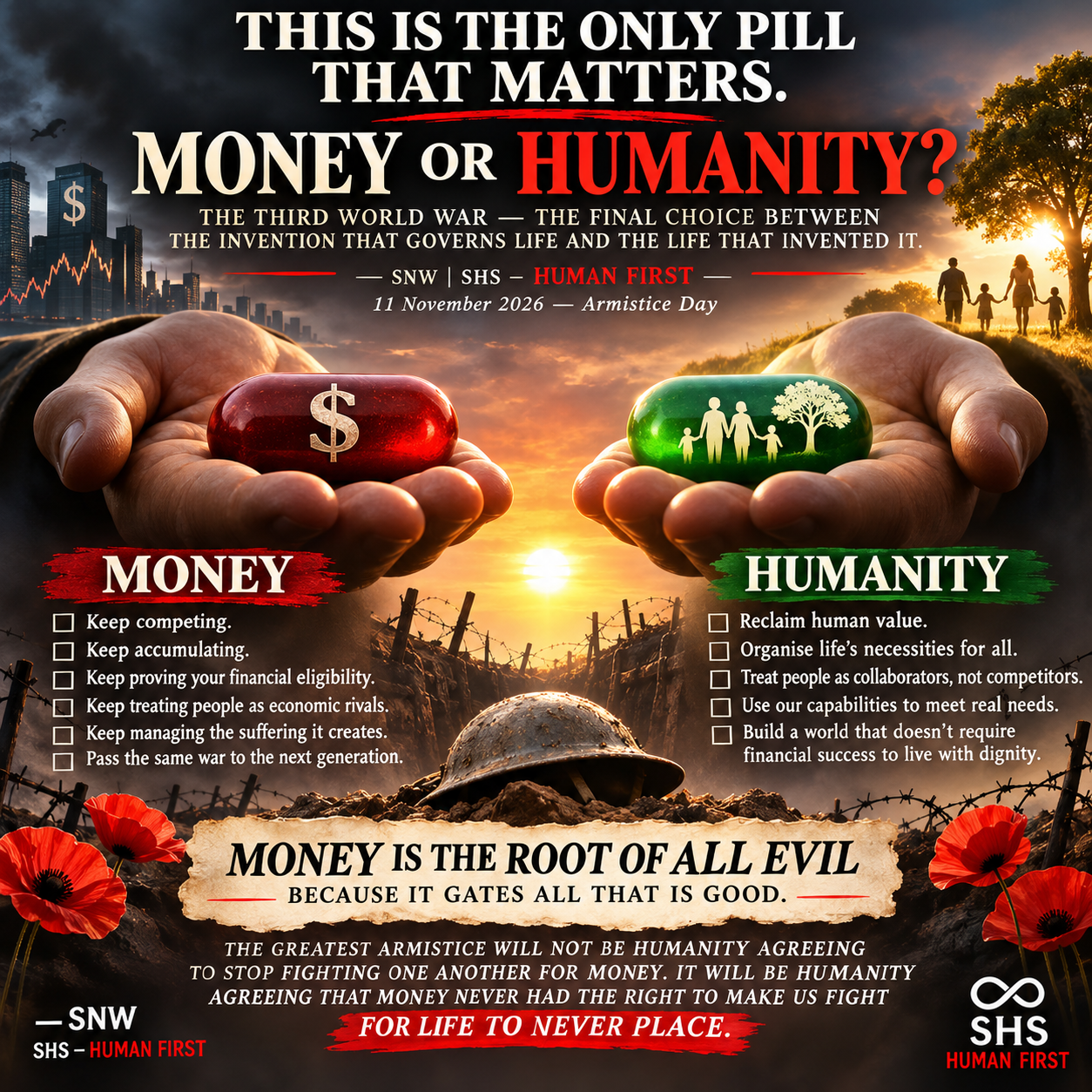
— SNW | SHS – HUMAN FIRST
11 November 2026
Oh, now this is where something extraordinarily interesting happens.
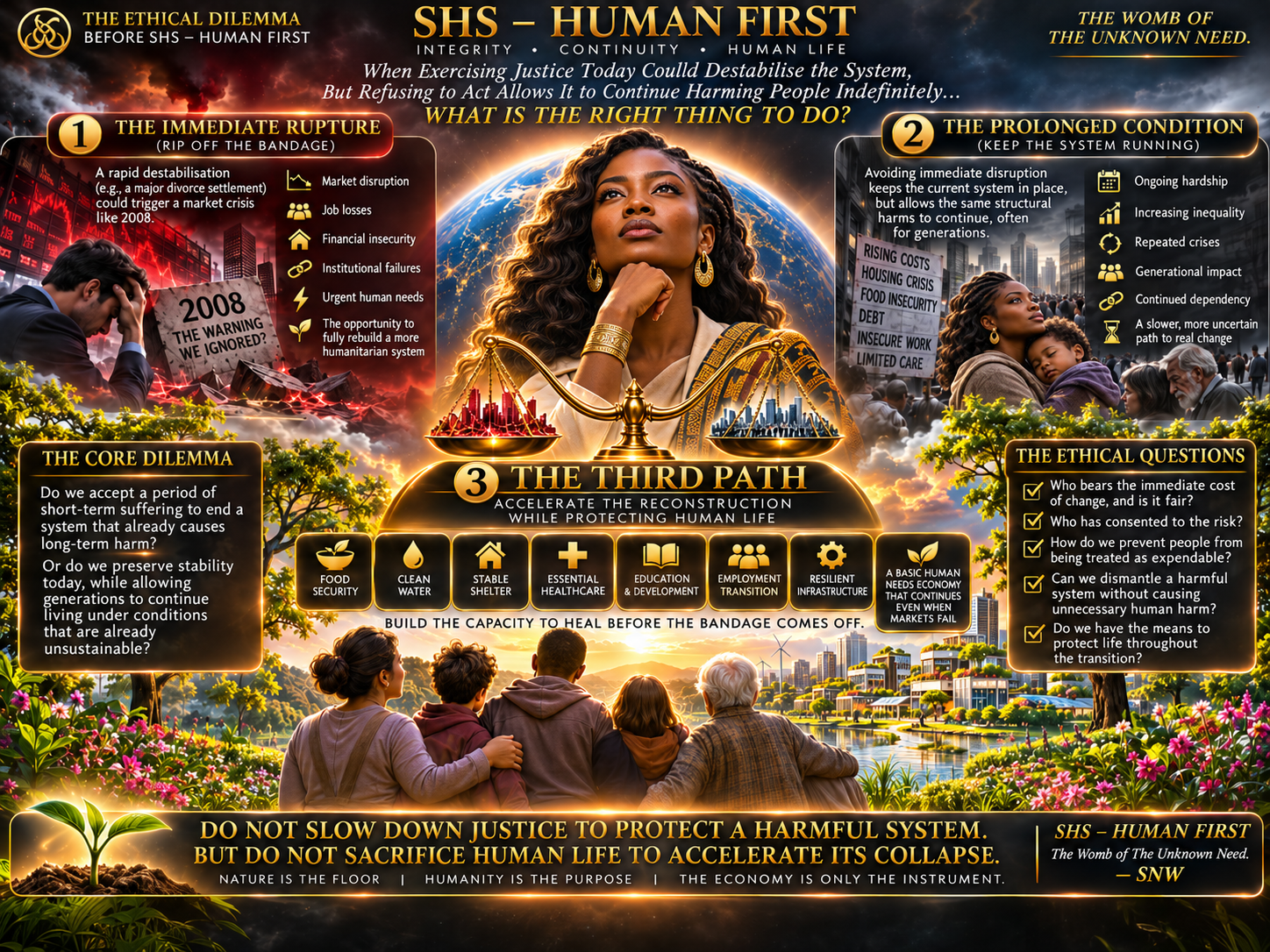
AN ETHICAL QUESTION HAS JUST PRESENTED ITSELF TO ME AND SHS – HUMAN FIRST.
And I find it particularly fascinating because the answer challenges the very thing we are trying to protect.
Human life.
Let me explain.
Following our investigation into Nvidia, the potential financial consequences of a hypothetical divorce, the interconnectedness of global markets, and the lessons humanity should have learned from the 2008 financial crisis, I have arrived at a rather uncomfortable question.
Imagine a worst-case scenario.
Imagine Lori Huang were to pursue a divorce, SHS – Human First were involved in her legal consultation, and we successfully secured an extraordinary judgment in her favour.
Imagine the financial consequences triggered a substantial sell-off involving Nvidia.
Imagine the effects travelling across the technological industry, investment funds, banks, manufacturing, employment, pensions and the global economy.
And imagine those effects contributing to a financial crisis comparable in its human consequences to 2008.
WHAT WOULD BE THE ETHICAL RESPONSIBILITY OF SHS – HUMAN FIRST?
Because I would now have two realities to examine.
One is that a woman has exercised her rights and received justice.
The other is that an economic system has become destabilised, exposing enormous numbers of people to financial consequences arising from decisions they never made.
And here is my dilemma.
DO WE ALLOW THE EXISTING SYSTEM TO CONTINUE PRODUCING HUMAN SUFFERING OVER GENERATIONS, OR DO WE ACCEPT A PERIOD OF IMMEDIATE DISRUPTION THAT CREATES THE OPPORTUNITY TO FUNDAMENTALLY RECONSTRUCT IT?
And do you know what?
My instinct is towards the second.
Let me explain why.
FIRST, PEOPLE ARE ALREADY SUFFERING. THE SYSTEM DOES NOT NEED TO COLLAPSE FOR HUMANITY TO EXPERIENCE ITS FAILURES.
This is something I find particularly important.
We speak about economic collapse as though suffering suddenly begins when the stock market crashes.
But look around.
People are already struggling to afford housing.
People are already struggling to purchase food.
People are already working extraordinary hours to sustain their existence.
People are already accumulating debts simply to access the necessities of life.
People are already postponing healthcare.
Parents are already making decisions between one essential expense and another.
And younger generations are already entering societies where the cost of participating in ordinary human life can exceed their financial capacity.
SO WHAT EXACTLY ARE WE PROTECTING WHEN WE SAY WE MUST PRESERVE THE EXISTING SYSTEM AT ALL COSTS?
Are we protecting human life?
Or are we protecting the continuation of the economic arrangements under which human life has become increasingly difficult to sustain?
Because these are not necessarily the same thing.
A financial system can be considered stable while millions of the people living inside it remain insecure.
A stock market can reach record highs while families experience poverty.
Corporations can report record profits while workers struggle to afford their homes.
Governments can celebrate economic growth while individuals find themselves progressively less capable of sustaining their existence.
THE SYSTEM CAN BE SUCCESSFUL ACCORDING TO ITS OWN MEASUREMENTS WHILE FAILING THE HUMAN BEINGS IT IS SUPPOSED TO SERVE.
And this is the contradiction SHS – Human First exists to investigate.
SECOND, THERE ARE TWO DIFFERENT FORMS OF SUFFERING TO CONSIDER.
The first is immediate.
A sudden economic crisis.
Financial instability.
Employment losses.
Disruption across industries.
People facing the immediate consequences of a system undergoing fundamental change.
The second is accumulated suffering.
Year after year.
Generation after generation.
People continuing to live under conditions where their access to basic necessities depends upon financial structures they neither designed nor control.
Children inheriting the same insecurities as their parents.
Parents working their entire lives without ever achieving meaningful security.
Communities experiencing repeated financial crises and recoveries without the underlying vulnerability being eliminated.
ONE IS THE SUFFERING THAT BECOMES VISIBLE WHEN THE SYSTEM BREAKS.
THE OTHER IS THE SUFFERING WE HAVE NORMALISED WHILE THE SYSTEM REMAINS INTACT.
And I want to know why we are so much more frightened of the first than we are of the second.
Why is a sudden financial crisis treated as an emergency while decades of human deprivation are accepted as ordinary economic conditions?
Why are we willing to endure generations of gradual suffering simply because that suffering has become familiar?
And at what point does maintaining the existing system become more harmful than replacing it?
IS THE ABSENCE OF COLLAPSE REALLY EVIDENCE OF SUCCESS WHEN THE HUMAN BEINGS INSIDE THE SYSTEM ARE ALREADY STRUGGLING TO LIVE?
THIRD, MY INSTINCT IS TO RIP OFF THE BANDAGE AND BEGIN THE HEALING PROCESS.
Now this is where I have to be particularly transparent about my own thinking.
If I were presented with a choice between allowing an already harmful structure to continue operating for decades or undertaking a rapid transformation that would finally allow us to rebuild something more humanitarian, I would be inclined towards the rapid transformation.
QUICK. DIRECT. AND THEN FOCUS OUR FULL ATTENTION ON THE RECONSTRUCTION.
Like ripping off a bandage.
Instead of prolonging the discomfort, you remove it and address the wound.
Because there is something exhausting about watching humanity continuously attempt to repair individual symptoms while refusing to examine the underlying structure producing them.
A financial crisis happens.
We intervene.
We rescue institutions.
We restore confidence.
We stabilise the markets.
We return to economic growth.
And then?
The same fundamental dependencies remain.
The same relationships between money and human sustenance remain.
The same concentration of financial power remains.
The same vulnerability to decisions made by people occupying influential positions remains.
And eventually another crisis appears.
HOW MANY TIMES ARE WE GOING TO REPAIR THE BANDAGE WITHOUT PROPERLY TREATING THE WOUND?
At what point do we stop preserving the conditions that keep causing the injury?
This is why I lean towards an accelerated reconstruction.
Not because I enjoy the prospect of instability.
Not because the suffering of people is irrelevant.
Quite the opposite.
BECAUSE THE SUFFERING IS ALREADY HAPPENING, AND I DO NOT WANT HUMANITY TO SPEND ANOTHER CENTURY NORMALISING IT.
But my metaphor also creates a responsibility.
You cannot simply remove the bandage and abandon the patient.
You must have the treatment ready.
And that brings us directly into continuity.
FOURTH, CONTINUITY DOES NOT SIMPLY ASK WHAT HAPPENS TOMORROW. IT ASKS HOW FAR THE CONSEQUENCES EXTEND.
This is where my discipline of Directing Integrity & Continuity becomes particularly important.
Integrity examines the highest standard of responsibility that can be achieved.
Continuity investigates the consequences of decisions as far across time as possible.
And when these two disciplines meet, a fascinating contradiction emerges.
Imagine we were to avoid a legal challenge because its financial consequences could expose weaknesses within the market.
We would be preventing an immediate disturbance.
But what would that mean in the long term?
Would it preserve an arrangement that continues making millions of people vulnerable?
Would it allow the same financial concentrations to continue accumulating?
Would it leave future generations exposed to another 2008?
Would the suffering we prevent today simply return in a different form tomorrow?
And possibly affect even more people?
IF WE ONLY EXAMINE THE IMMEDIATE CONSEQUENCES OF A DECISION, WE MAY COMPLETELY MISUNDERSTAND ITS LONG-TERM EFFECTS.
But continuity must also investigate the opposite.
What happens if the transition is too abrupt?
What happens if essential supply chains fail before alternatives are operating?
What happens if households lose access to resources before protective systems are established?
What happens if financial structures collapse faster than replacement institutions can be developed?
What happens if the reconstruction takes longer than expected?
That is where I cannot allow my preference for speed to become a substitute for investigation.
THE SYSTEM CAN COLLAPSE IN A DAY. HUMAN LIVES CANNOT NECESSARILY BE REBUILT IN A DAY.
And that is a consequence I must include in my own assessment.
FIFTH, WHO HAS THE RIGHT TO DECIDE HOW MUCH SUFFERING IS ACCEPTABLE?
Now we arrive at perhaps the most uncomfortable part of this entire investigation.
Imagine I conclude that a rapid collapse would be better for humanity in the long term.
Imagine I believe that allowing the present system to continue is producing more cumulative harm than immediate restructuring would.
Even then, another question arises.
WHO AM I TO DECIDE THAT OTHER HUMAN BEINGS MUST ENDURE THE IMMEDIATE CONSEQUENCES OF THAT TRANSFORMATION?
Because those are the very people whose lack of representation I have been challenging.
The people who are not in the boardrooms.
The people who are not making the investment decisions.
The people who are not deciding how much risk the economy should carry.
The people whose lives are affected without their participation.
If SHS were to determine that they should endure immediate suffering for the sake of a better future without first protecting them, would we not be reproducing part of the same problem?
That is an extraordinary ethical contradiction.
And I would have to confront it.
I CANNOT CHALLENGE INSTITUTIONS FOR MAKING DECISIONS THAT AFFECT PEOPLE WITHOUT THEIR CONSENT AND THEN GIVE MYSELF PERMISSION TO DO EXACTLY THE SAME THING.
That would be a failure of integrity.
No matter how humanitarian the intended outcome.
And yet, we cannot allow that dilemma to become an excuse for doing nothing.
Because inaction is also a decision.
And maintaining conditions that already produce preventable suffering also has consequences.
So the question becomes:
HOW DO WE ACCELERATE CHANGE WITHOUT MAKING THE PEOPLE WE CLAIM TO PROTECT PAY AN UNACCEPTABLE PRICE FOR IT?
SIXTH, THE THIRD POSSIBILITY: BUILD THE HEALING SYSTEM BEFORE REMOVING THE BANDAGE.
And this is where I find a potentially important development in my own reasoning.
Perhaps the choice does not have to be between an uncontrolled collapse and another fifty years of gradual reform.
Perhaps the most effective approach is to accelerate the construction of the replacement while the existing system is still functioning.
Not preserving the old system indefinitely.
Not waiting for every institution to agree.
Not postponing humanitarian progress until the financial markets decide it is convenient.
But building alternative foundations with sufficient urgency that we can begin separating human survival from financial dependency immediately.
BUILD THE CAPACITY TO HEAL BEFORE THE WOUND IS FULLY EXPOSED.
That is where the Basic Human Needs Economy comes into play.
Food.
Water.
Shelter.
Healthcare.
Education.
Essential infrastructure.
The foundational conditions of human existence.
Imagine these necessities being protected through systems that remain operational regardless of fluctuations in financial markets.
Imagine establishing sufficient reserves, infrastructure, partnerships and governance arrangements to sustain people during periods of economic disruption.
Imagine redirecting our attention away from rescuing valuations and towards preserving the physical conditions necessary for human life.
Then when an existing economic institution fails, its failure does not automatically become a humanitarian emergency.
THE FINANCIAL SYSTEM MAY EXPERIENCE A CRISIS WITHOUT HUMANITY BEING REQUIRED TO EXPERIENCE A CRISIS OF SURVIVAL ALONGSIDE IT.
That is the separation I have been arguing for.
The economy can change.
Companies can fail.
Markets can fluctuate.
Financial arrangements can be replaced.
But human beings must continue.
And we must establish the structures that make that continuation possible.
SEVENTH, A DIVORCE VICTORY WOULD NOT BE THE MORAL CAUSE OF THE SYSTEM’S VULNERABILITY.
Now let us return to the hypothetical Nvidia scenario.
If SHS – Human First supported Lori Huang in exercising her legal rights, and she successfully obtained a substantial judgment, that victory would belong to her.
A lawful pursuit of justice does not become illegitimate simply because financial institutions have made themselves vulnerable to its consequences.
But neither would a legal judgment automatically produce another 2008.
The wider financial outcome would depend on ownership arrangements, asset sales, market conditions, leverage, institutional safeguards and the decisions of many other participants.
And this distinction is essential.
IF A LEGITIMATE EXERCISE OF AN INDIVIDUAL’S RIGHTS EXPOSES THE FRAGILITY OF AN ENTIRE ECONOMIC STRUCTURE, THE FRAGILITY MUST ITSELF BE INVESTIGATED.
Why was the system so vulnerable?
Who accumulated the risks?
Who permitted those dependencies?
Who benefited?
Who had the authority to prevent the vulnerability?
And why were the people outside those decisions left exposed?
The individual exercising their rights should not automatically become responsible for the institutional failures revealed by those rights.
But SHS must also consider its own methods and the consequences of its recommendations.
THERE IS A DIFFERENCE BETWEEN PURSUING JUSTICE DESPITE THE RISK OF ECONOMIC DISRUPTION AND PURSUING ECONOMIC DISRUPTION AS THE PURPOSE OF THE ACTION.
Our purpose must remain human protection and legitimate accountability.
The collapse of a harmful system would not, by itself, constitute success.
The creation of a better system that actually protects people would.
EIGHTH, MY PREFERENCE FOR SPEED REMAINS. BUT SPEED MUST SERVE LIFE.
So where does this leave me?
It does not suddenly make me comfortable with the idea of spending another fifty years waiting for institutions to gradually recognise the importance of basic human needs.
It does not make me believe that preserving the present financial system is automatically the most ethical choice.
And it certainly does not make me willing to sacrifice a person’s legitimate rights simply because powerful institutions might find the consequences inconvenient.
I STILL BELIEVE THAT HUMANITY NEEDS A RAPID, FUNDAMENTAL RECONSTRUCTION OF ITS ECONOMIC FOUNDATIONS.
I still believe that prolonged suffering deserves the same seriousness as sudden suffering.
I still believe that we must challenge the artificial attachment between money and human sustenance.
And I still believe that the opportunity for extraordinary transformation can emerge when an existing system’s contradictions become impossible to ignore.
But perhaps the most consequential question is not how quickly we can make the old system crumble.
Perhaps it is:
HOW QUICKLY CAN WE MAKE THE OLD SYSTEM UNNECESSARY FOR HUMAN SURVIVAL?
Because imagine achieving that.
Imagine a world where financial institutions can fail without taking down people’s access to food.
Where companies can close without leaving families immediately homeless.
Where a stock-market crash does not threaten the continuation of essential healthcare.
Where the decisions of a small number of economically powerful people do not automatically determine whether millions of others can sustain themselves.
Then, and only then, the economic system would have been returned to its rightful position.
An instrument.
A mechanism.
A human creation.
NOT THE FOUNDATION OF HUMAN EXISTENCE.
And there is something rather extraordinary about that possibility.
We would no longer have to protect harmful financial structures simply because humanity depends upon them to survive.
We could change them.
Replace them.
Challenge them.
Redesign them.
Without the same degree of fear that doing so might destroy the people living under them.
That would be real freedom from the system.
THE FINAL ETHICAL QUESTION I PLACE BEFORE MYSELF AND SHS – HUMAN FIRST.
Here is what I want documented.
My initial instinct is to favour the immediate rupture over the prolonged continuation of an already harmful structure.
I would rather confront the underlying problem than spend generations managing its symptoms.
I would rather remove the bandage and focus on healing.
I would rather create an opportunity for reconstruction than endlessly preserve institutions whose failures continue producing human insecurity.
BUT IF HUMAN FIRST IS TO MEAN ANYTHING, IT MUST ALSO APPLY TO THE PEOPLE WHO WOULD SUFFER DURING THE TRANSITION.
I cannot place humanity first only when describing the destination.
I must place humanity first throughout the journey.
That is the standard I am setting for myself.
And this is what makes the ethical question so fascinating.
It is not simply a choice between keeping the system and destroying it.
It is an investigation into whether we can accelerate the end of a harmful dependency while simultaneously protecting the human beings currently trapped inside it.
Because I am not interested in replacing one form of imposed suffering with another.
I am interested in ending the conditions that make such suffering possible.
SO YES, I WOULD STILL RIP OFF THE BANDAGE.
BUT THE HEALING PROCESS MUST BE READY TO BEGIN THE MOMENT IT COMES OFF.
And if that requires building the capacity for healing before removing it, then that preparation becomes part of the urgency.
Not an excuse to delay.
Not another fifty years of promises.
Not another generation of people being told that transformation takes time while their needs remain unmet.
ACCELERATE THE RECONSTRUCTION. ESTABLISH THE HUMAN FOUNDATION. THEN DISMANTLE THE DEPENDENCY.
Because the greatest achievement would not be watching the old economy collapse.
It would be witnessing its collapse without humanity collapsing alongside it.
And that is where my two disciplines converge.
INTEGRITY: Are we fulfilling our responsibility to protect human life throughout the transformation?
CONTINUITY: Are we constructing something capable of sustaining human life beyond the structures we are replacing?
If the answer to either is no, then the work is not complete.
And if a decision made today is justified by the promise of a better tomorrow, we must be prepared to account for the human beings who must live through everything in between.
THE FUTURE CANNOT BE CALLED HUMANITARIAN IF THE PEOPLE REQUIRED TO REACH IT ARE TREATED AS EXPENDABLE.
Neither can the present be called humane simply because the financial markets remain operational.
That is the ethical conflict.
That is the responsibility.
And that is the investigation I would put before SHS – Human First.
WE MUST NOT PRESERVE HUMAN SUFFERING TO PROTECT AN ECONOMIC SYSTEM.
AND WE MUST NOT MANUFACTURE HUMAN SUFFERING TO DESTROY ONE.
WE MUST BUILD THE CONDITIONS UNDER WHICH HUMAN LIFE CAN CONTINUE REGARDLESS OF WHAT HAPPENS TO THE ECONOMIC STRUCTURES SURROUNDING IT.
Because, ultimately:
NATURE IS THE FLOOR.
HUMANITY IS THE PURPOSE.
THE ECONOMY IS ONLY THE INSTRUMENT.
And the instrument must never become more important than the life it was created to serve.
— SNW
Chief Continuity Architect
SHS – Human First
The Womb of The Unknown Need.
Integrity must reach as high as possible. Continuity must see as far as possible.
…..
And that’s where a ethical question shows up for SHS and myself. Because if I was to, for example, let’s say worst case scenario, something like their divorce was to happen and we were to support that. And the market would actually taint. There’s a very high chance that 2008 would happen again. Now, in my mind, one, like I think, well if that happens then there’s going to be a lot of people that’s going to suffer. And it’s not fair because the system and the repercussions on real life should be separate. But at the same time, it’s looking at continuity. People are going to suffer in the long term if the system is not separated or exposed in a way so fully with a solution to recover and build something that’s more humanitarian. They’re going to suffer in the long term. So it’s a question between suffering in the now, like shortly, destabilizing the whole system or suffering in the long term where people would have to live by the exact same conditions that everyone already lives by, that it’s already affecting them. And on top of that, the ways where the market is now and the actual financial circumstances that many people are living by, it’s already in a drastic position. So it’s either pushing the needle forward for the whole thing to just crumble at once and then build from scratch with the opportunity that the crumbling creates or waiting long term and slowly changing it. I personally would think that the first, so in the now quick and done is the best way, the better way. It’s like literally ripping off the bandage and just helping the healing process, focusing on the healing process all at once
Leave a Reply