
The Metaphysics of Shame, Accountability, Integrity and the Human Fear of Being Exposed
— SNW | SHS – Human First
“Nearly all of our faults are more forgivable than the means we use to hide them.”
— François de La Rochefoucauld
Oh, how fascinating.
And how extraordinarily revealing of human behaviour.
Because there’s something rather peculiar about the way human beings approach accountability.
SOMETIMES PEOPLE ARE SO TERRIFIED OF BEING SEEN DOING SOMETHING WRONG THAT THEY END UP DOING SOMETHING FAR WORSE TO PREVENT ANYONE FROM FINDING OUT.
Imagine that.
The original mistake might have been forgivable.
An error in judgement.
A moment of weakness.
A misunderstanding.
An impulsive decision.
Something that could have been acknowledged, corrected, repaired and eventually left in the past.
But instead?
The person begins constructing an entirely new reality around the mistake.
They lie.
They conceal information.
They manipulate perceptions.
They discredit those who noticed.
They invent explanations.
They recruit others into protecting the narrative.
And suddenly, what began as one mistake has developed into an entire structure of deception.
THE ORIGINAL WRONG IS NO LONGER THE ONLY WRONG. THE EFFORT TO CONCEAL IT HAS BECOME A SEPARATE WRONGDOING.
And sometimes, a far more consequential one.
THE CHILD WHO LEARNS TO FEAR THE TRUTH
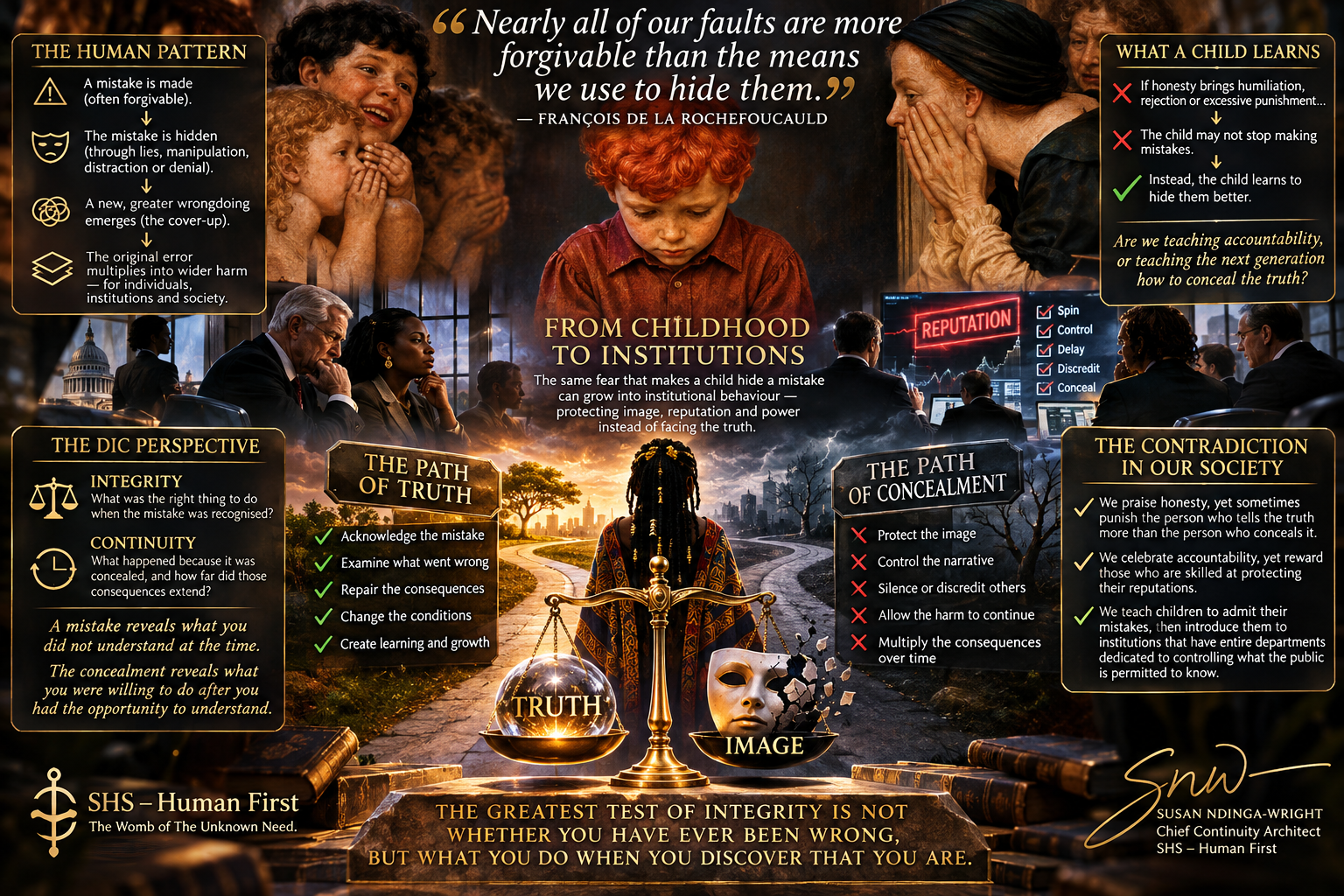
Look at the image accompanying the quotation.
A child stands with his head lowered, surrounded by the reactions of adults.
What interests me is not simply what the child might have done.
It’s what the child is learning from the experience.
Is he learning why his behaviour was wrong?
Is he learning how to repair the consequences?
Or is he learning something entirely different?
THAT BEING DISCOVERED IS MORE FRIGHTENING THAN THE MISTAKE ITSELF.
Because imagine a child who makes a mistake and is met with humiliation, ridicule, disproportionate punishment or the withdrawal of affection.
What might that child learn?
Perhaps not to stop making mistakes.
But to become better at hiding them.
And if the child repeatedly learns that honesty brings greater punishment than concealment, we should not be entirely surprised when concealment becomes a protective habit.
Then, years later, society meets the adult.
And asks why the adult cannot admit wrongdoing.
How fascinating.
WE MAY HAVE CREATED THE VERY BEHAVIOUR WE ARE NOW CONDEMNING.
This is not to suggest that every dishonest adult was raised this way.
It is to question whether our methods of teaching accountability sometimes produce the opposite of what we intended.
NOW EXPAND THAT CHILD INTO AN INSTITUTION.
Imagine the child grows up.
Becomes a politician.
A lawyer.
A judge.
A corporate executive.
A director.
A government official.
An individual entrusted with public responsibility.
Now imagine that person makes a mistake.
Except this time, the consequences are no longer confined to their own circumstances.
Their decisions affect employees, families, communities, economies and sometimes entire countries.
And what happens when the mistake is discovered?
Does the institution immediately investigate what went wrong?
Does it disclose the evidence?
Does it correct the consequences?
Does it examine how to prevent repetition?
Or does it first investigate how to protect its reputation?
AH. THERE IT IS.
The same question.
Only now the child has become an institution, and the fear of punishment has become the protection of public image.
The truth becomes a reputational risk.
The person exposing the mistake becomes a threat.
The evidence becomes inconvenient.
And accountability becomes something to be managed rather than fulfilled.
But here is the fascinating part.
THE MORE RESOURCES AN INSTITUTION DEVOTES TO HIDING ITS FAILURES, THE MORE THOSE RESOURCES BECOME EVIDENCE OF WHAT IT WAS WILLING TO DO TO AVOID ACCOUNTABILITY.
The cover-up acquires its own history.
Its own decisions.
Its own consequences.
Its own victims.
Its own responsibility.
And suddenly, the institution is no longer answering for one mistake.
It is answering for an entire sequence of decisions made after it knew something was wrong.
INTEGRITY AND CONTINUITY: THE TWO DIRECTIONS OF ACCOUNTABILITY.
This is where my work on Directing Integrity & Continuity becomes particularly relevant.
Integrity asks:
What was the right thing to do when the mistake was recognised?
Continuity asks:
What happened because the mistake was concealed, and how far did those consequences extend?
You see, concealment doesn’t necessarily eliminate the original wrongdoing.
It can preserve the conditions that allowed it to happen.
And those conditions can continue producing consequences long after the original decision.
An institution might protect its reputation today while exposing future generations to the consequences of an error that could have been corrected yesterday.
WHAT WAS INITIALLY A FAILURE OF JUDGEMENT CAN BECOME A CONTINUING FAILURE OF INTEGRITY.
That is why I distinguish between accountability and punishment.
Accountability is not simply making someone suffer because they made a mistake.
It is establishing what happened, recognising the harm, taking responsibility, providing appropriate repair and changing the conditions that made the harm possible.
Of course, some wrongs are extraordinarily serious. Acknowledgement alone cannot undo them, and proportionate legal consequences may still be necessary.
But the purpose of accountability should not be to teach people that the truth is their enemy.
It should be to make the truth the foundation from which correction becomes possible.
AND THIS IS WHERE HUMANITY HAS A RATHER INTERESTING CONTRADICTION.
We praise honesty.
But sometimes punish the person who tells the truth more harshly than the person who successfully conceals it.
We celebrate accountability.
But reward those who are skilled at protecting their reputations.
We teach children to admit their mistakes.
Then introduce them to adult institutions that have entire departments dedicated to controlling what the public is permitted to know.
AND WE WONDER WHY THE HUMAN RELATIONSHIP WITH TRUTH IS SO COMPLICATED.
Perhaps we ought to investigate what kind of society we are constructing when appearances become more valuable than integrity.
Because the objective should never be to create human beings who are incapable of admitting failure.
The objective should be to develop human beings who recognise failure early enough to prevent its consequences from expanding.
And institutions that do the same.
Not every mistake needs public exposure. Privacy can be legitimate, and sensitive disclosures must be handled responsibly.
But there is a fundamental difference between protecting someone’s legitimate privacy and concealing information to evade responsibility for harm.
THE RIGHT TO PRIVACY IS NOT THE RIGHT TO ESCAPE ACCOUNTABILITY.
THE GREATEST TEST OF INTEGRITY IS NOT WHETHER YOU HAVE EVER BEEN WRONG.
It is what you do when you discover that you are.
Do you protect the truth?
Or the image you’ve constructed of yourself?
Do you correct the consequences?
Or force others to live with them so that you can remain comfortable?
Do you recognise that your understanding was incomplete?
Or create an entire defence around refusing to learn?
Because I find something extraordinarily revealing about a person who can say:
I was wrong.
I understand why.
I understand what it affected.
And I’m prepared to correct what I can.
There is more possibility for development in that admission than in a thousand explanations designed to disguise a failure.
THE MISTAKE REVEALS WHAT YOU DID NOT UNDERSTAND AT THE TIME.
THE CONCEALMENT REVEALS WHAT YOU WERE WILLING TO DO AFTER YOU HAD THE OPPORTUNITY TO UNDERSTAND.
And those are two very different assessments of integrity.
Perhaps this is one of the most important lessons we could introduce into childhood education, institutional governance and the future development of artificial intelligence alike.
Not the impossible expectation of never being wrong.
But the capacity to recognise error without constructing an additional world of harm around it.
Because an intelligence that cannot acknowledge its own mistakes will struggle to learn from them.
And a civilisation that cannot acknowledge its own contradictions will struggle to evolve beyond them.
THE TRUTH DOES NOT ALWAYS MAKE THE ORIGINAL MISTAKE FORGIVABLE.
BUT HIDING THE TRUTH CAN MAKE THE CONSEQUENCES FAR WORSE THAN THEY EVER NEEDED TO BE.
And that, to me, is why integrity must be investigated alongside continuity.
Because what we refuse to correct today may become someone else’s inherited suffering tomorrow.
— SNW
Chief Continuity Architect | SHS – Human First
11 November 2026


Leave a Reply