
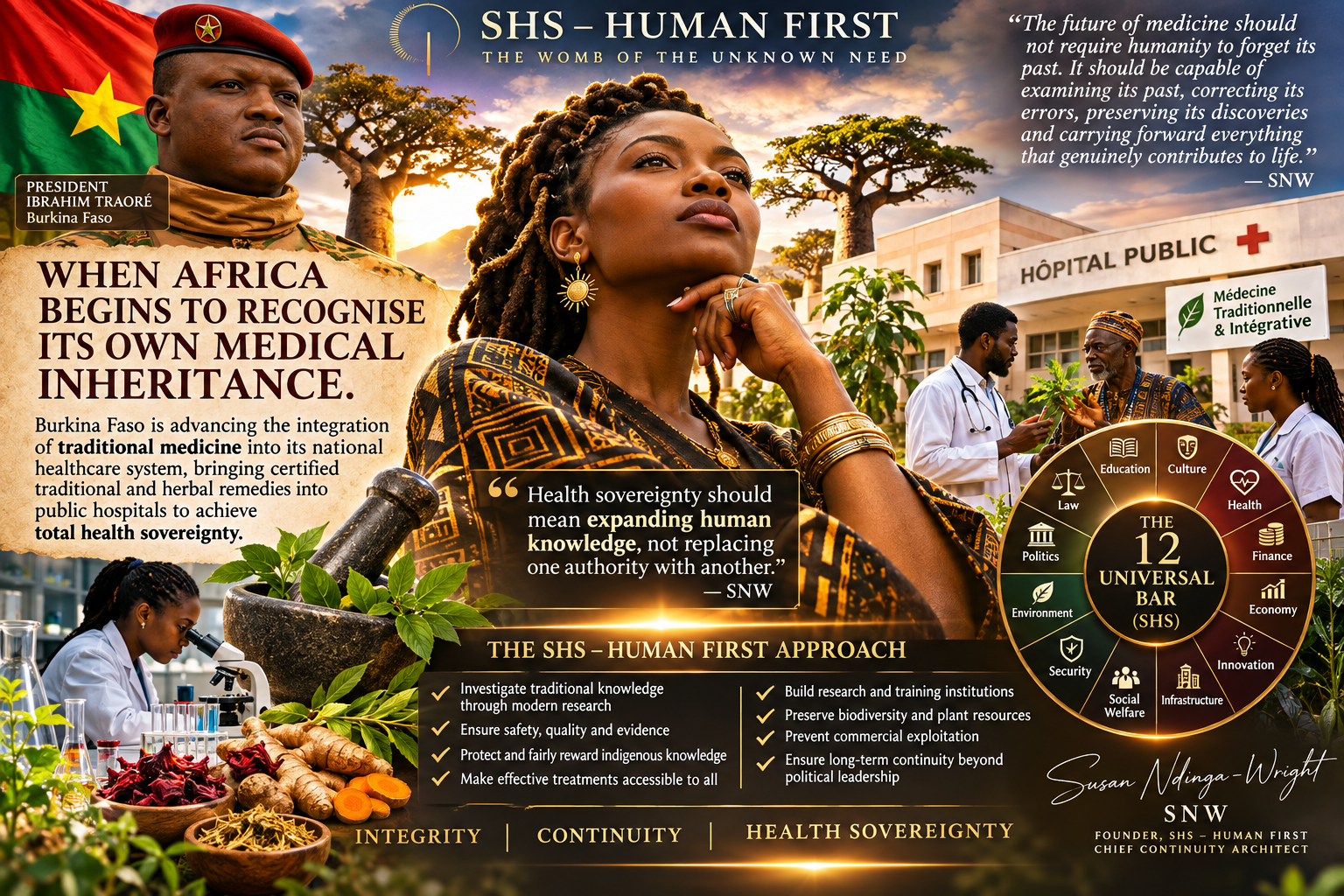
Burkina Faso is taking steps towards something significant: bringing traditional African medical knowledge into the formal healthcare system rather than treating it as separate from modern medicine. And the workd sits witnessing the results modern medicine never wanted to see.
The beginning to the end of Big Pharma.
Traditional medicine units were being developed for hospitals as early as 2024, and in September 2026 the Health Ministry confirmed further work to integrate traditional remedies into national healthcare. More than 18 traditional medicines had reportedly been approved by then.
Burkina Faso, Traditional Medicine and the Meaning of Health Sovereignty
— SNW | SHS – Human First
Well, well, well. This is rather fascinating.
Burkina Faso, under President Ibrahim Traoré, is advancing the integration of traditional medicine into its national healthcare system.
And I want us to look beyond the political announcement, because what interests me is not simply the decision to recognise herbal remedies.
IT IS THE QUESTION OF WHY SO MUCH OF HUMANITY’S OWN KNOWLEDGE HAS BEEN MADE TO EXIST OUTSIDE THE INSTITUTIONS CREATED TO CARE FOR HUMANITY.
Think about that.
Before hospitals, pharmaceutical corporations, medical patents, universities and modern healthcare institutions, humans were already investigating their surroundings.
They were observing plants.
They were studying their bodies.
They were discovering what relieved certain symptoms, what caused illness, what harmed them and what appeared to support recovery.
Some discoveries were useful. Others were mistaken. Knowledge accumulated through generations of observation, experimentation and experience.
And through that process, entire cultures developed their own understandings of health.
Now, here comes the interesting part.
When modern medicine developed, many traditional practices were dismissed, marginalised or separated from recognised healthcare.
Some deserved scientific rejection because they were ineffective or dangerous.
But did everything deserve dismissal simply because it came from a different system of knowledge?
WHY SHOULD THE ORIGIN OF KNOWLEDGE DETERMINE WHETHER IT DESERVES INVESTIGATION?
A plant does not become medicinal because a pharmaceutical company discovers it.
Nor does a plant become safe merely because our ancestors used it.
Its properties exist independently of both.
Our responsibility is to investigate those properties properly.
And that is where I find the direction being pursued by Burkina Faso particularly interesting.
HEALTH SOVEREIGNTY SHOULD MEAN EXPANDING HUMAN KNOWLEDGE, NOT REPLACING ONE AUTHORITY WITH ANOTHER.
Imagine a healthcare system where traditional practitioners, botanists, pharmacologists, physicians, environmental scientists and researchers were collaborating.
Imagine studying indigenous medical knowledge through modern research facilities, while recognising the communities responsible for preserving that knowledge.
Imagine local plants being investigated for treatments, cultivated sustainably, tested for safety, and incorporated into healthcare where evidence demonstrates genuine medical benefit.
Not replacing emergency medicine.
Not abandoning surgery.
Not substituting untested remedies for treatments known to save lives.
BUT EXPANDING WHAT HEALTHCARE IS CAPABLE OF KNOWING AND PROVIDING.
Because to me, that is what human development should look like.
We should not have to destroy the knowledge of yesterday to develop the knowledge of tomorrow.
We should be capable of investigating both.
THE SHS – HUMAN FIRST PERSPECTIVE
Under our Twelve Universal Bar systems, an initiative like this would never be examined solely through Health.
We would investigate its relationship with Education, Culture, Economy, Finance, Innovation, Infrastructure, Social Welfare, Security, Environment, Politics and Law.
Who owns the medicinal knowledge?
Who benefits financially when a remedy is commercialised?
Are traditional practitioners properly compensated?
Can the public access effective treatments without being financially excluded?
Are medicinal plants cultivated without destroying their ecosystems?
Can laboratories independently verify the ingredients, doses, benefits, side effects and interactions of these medicines?
Are patients protected against exploitation and false medical claims?
Can traditional and conventional practitioners communicate when a patient is receiving both types of treatment?
And crucially:
ARE WE IMPROVING HUMAN HEALTH, OR ARE WE SIMPLY CREATING ANOTHER INDUSTRY FROM WHICH SOME PEOPLE WILL PROFIT WHILE OTHERS CONTINUE TO SUFFER?
These are the questions that turn an interesting political initiative into a serious humanitarian investigation.
AND THERE IS ANOTHER DIMENSION: AFRICA’S RELATIONSHIP WITH ITS OWN INHERITANCE.
For generations, African societies have possessed extensive cultural, ecological and medicinal knowledge.
Yet much of what is internationally recognised as scientific advancement is validated through institutions whose historical development occurred elsewhere.
That does not make modern science illegitimate.
Science is not the property of any civilisation.
But neither should the capacity to investigate, validate and develop knowledge belong to only a particular part of the world.
African countries should be able to research their own resources, establish their own institutions, develop their own medicines and contribute discoveries to the rest of humanity.
Not merely as consumers of knowledge.
BUT AS PRODUCERS, PROTECTORS AND CONTINUOUS DEVELOPERS OF IT.
And I would extend that principle beyond Africa.
Because human knowledge is an inheritance belonging to humanity, while the rights of the communities that develop and preserve it must also be respected.
THIS IS WHERE CONTINUITY BECOMES IMPORTANT.
A government can announce a reform.
But can it preserve that reform beyond its current leadership?
Can it build research institutions that survive political changes?
Can it train future generations of practitioners?
Can it establish transparent regulatory standards?
Can it prevent medicinal knowledge from becoming another form of commercial extraction?
Can it recognise failures, withdraw harmful products and continuously improve?
That would be the real test.
Not whether a leader makes an announcement.
But whether the institutions created from that announcement continue serving human life long after the leader is gone.
SOVEREIGNTY IS NOT SIMPLY THE ABILITY TO SAY THAT SOMETHING IS OURS.
It is the capacity to understand it, protect it, develop it, regulate it and ensure that its benefits reach the people.
And perhaps one of the most consequential things that could come from Burkina Faso’s direction is a healthcare system that refuses the false choice between ancestral knowledge and scientific progress.
Because our ancestors were investigating existence long before we developed the institutions through which we investigate it today.
Their conclusions should not be immune from scrutiny.
But their knowledge should not be immune from investigation either.
THE FUTURE OF MEDICINE SHOULD NOT REQUIRE HUMANITY TO FORGET ITS PAST.
It should be capable of examining its past, correcting its errors, preserving its discoveries and carrying forward everything that genuinely contributes to life.
THAT IS INTEGRITY.
THAT IS CONTINUITY.
AND THAT IS THE KIND OF HEALTH SOVEREIGNTY WORTH BUILDING.
— SNW | SHS – Human First
The Womb of The Unknown Need.
Leave a Reply