
Thh input to the following post to this one:
Of course they’re building certain things, but they’re building like a common with money. What are current kings and queens creating different from any other entrepreneur? Kings and queens built above everyone’s station. They were building like any other. Still nursing unequal systems, but within it built bigger, wilder, stronger.
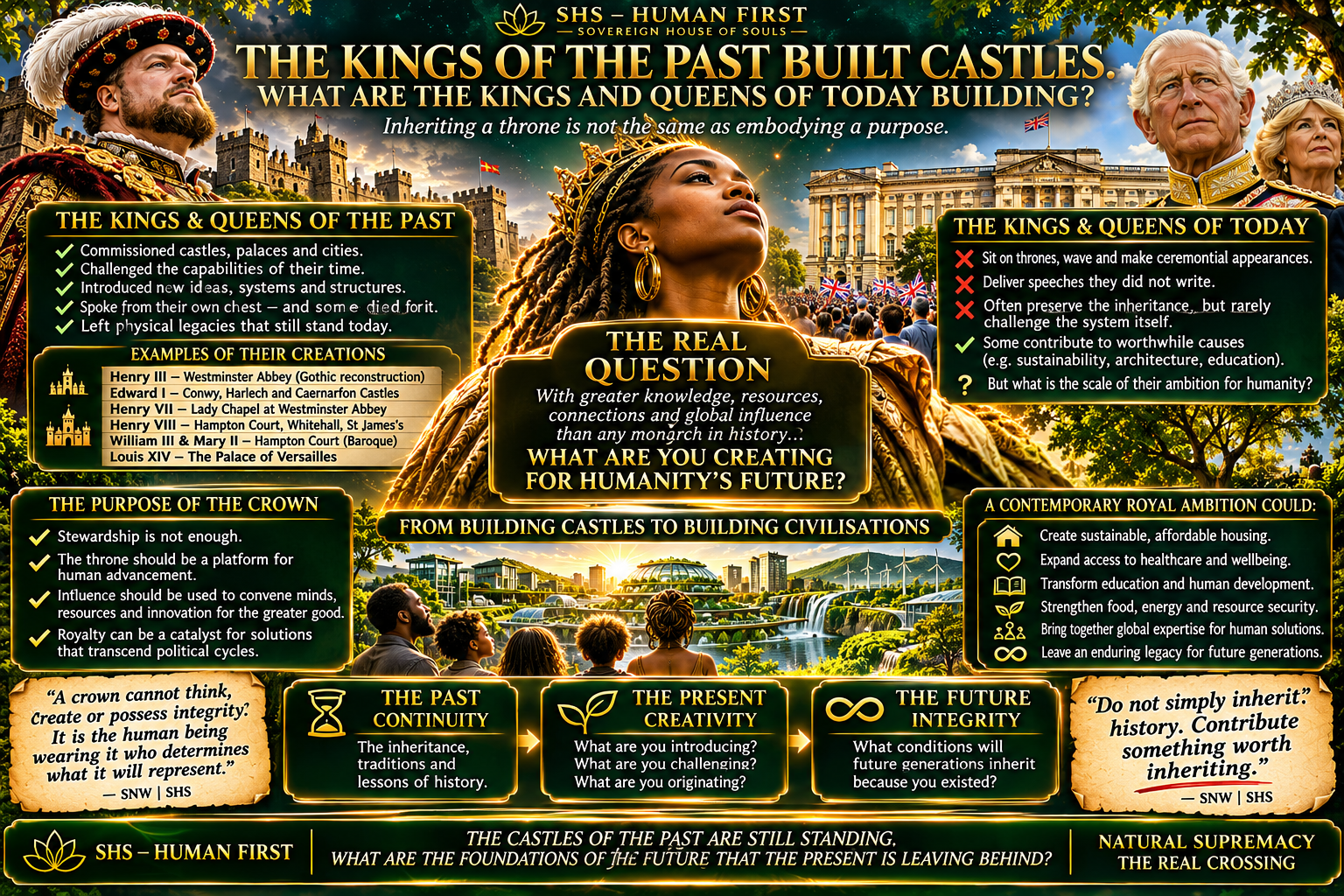
THE KINGS OF THE PAST BUILT CASTLES & SPOKE FOR SELF.
Wearing the Crown Is Not the Same as Embodying the Crown.
SNW | SHS – HUMAN FIRST
At least the kings and queens of the past had ambitions that extended beyond the inheritance of their titles.
They commissioned castles, palaces, cities and architectural creations that challenged the capabilities of their respective eras. They introduced ideas that had not previously been realised within their territories.
Some of their creations are still standing centuries later.
And when they spoke, some spoke with such conviction that their words became historical turning points. Some even died defending their positions.
I am not glorifying their wars, their exploitation of human beings or their obsession with territorial expansion.
I am questioning what has become of the creative ambition associated with royalty.
What does it mean to inherit centuries of accumulated resources, knowledge, connections, influence, architectural achievements and institutional recognition if one’s ambition does not extend substantially beyond maintaining the inheritance?
What are you introducing to existence that existence did not already possess when you arrived?
1. WHEN KINGS CHALLENGED WHAT WAS ARCHITECTURALLY POSSIBLE
Consider what previous monarchs commissioned with considerably less technological capability than humanity possesses today.
| Monarch | Architectural legacy |
|---|---|
| Henry III | Began the Gothic reconstruction of Westminster Abbey in 1245. |
| Edward I | Commissioned an unprecedented programme of castle construction in Wales, including Conwy, Harlech and Caernarfon. |
| Henry VII | Commissioned the extraordinary Lady Chapel at Westminster Abbey. |
| Henry VIII | Expanded Hampton Court, Whitehall and St James’s Palace. |
| William III and Mary II | Commissioned Christopher Wren to transform Hampton Court into a Baroque palace. |
| Louis XIV | Transformed Versailles into an enormous architectural and cultural undertaking. |
These creations were not accomplished by the monarchs alone. Architects, engineers, artisans, labourers and entire communities made their construction possible.
Some were also built through exploitation, conquest and extraordinary expenditure.
But that introduces an even greater question.
If monarchs could mobilise such extensive human capabilities to create monuments to their own significance centuries ago, what could contemporary monarchs mobilise to create monuments to the significance of humanity?
With today’s engineering, technology, scientific knowledge and productive capabilities, what could be built?
Not another palace for one family.
An architectural legacy for the human family.
2. AT LEAST SOME OF THEM SPOKE FROM THEIR OWN CHEST
Queen Elizabeth I addressed her troops at Tilbury in 1588. Her speech became one of the most remembered royal addresses in English history, although different historical versions of her words survive.
Charles I delivered a final speech before his execution on 30 January 1649.
Whether one agrees with their positions is another matter.
But their words were associated with positions for which they personally stood.
Today, the King’s Speech at the State Opening of Parliament is written by the government.
The King delivers it.
There is a constitutional explanation for this arrangement. The monarch is expected to remain politically neutral while elected representatives determine government policy.
But beyond the constitutional explanation lies an ontological question.
What is the difference between possessing a voice and embodying one?
There is a difference between communicating the decisions of others and originating something that one personally stands for.
There is a difference between being seen speaking and allowing people to understand what one actually thinks.
There is a difference between representing continuity and introducing integrity into it.
3. WHAT IS THE PURPOSE OF THE THRONE?
If the throne is primarily ceremonial, what greater creative purpose could its visibility, resources and influence serve?
If a monarch cannot independently determine government policy, that does not mean they cannot initiate conversations, convene specialists, commission research, support innovation or contribute to the development of alternative approaches to human provision.
King Charles III’s longstanding involvement in sustainable architecture, Poundbury, environmental initiatives and The King’s Foundation demonstrates that opportunities for royal creative contribution still exist.
So why stop there?
Why should the ambition not extend towards addressing the fundamental conditions that continuously compromise human existence?
Why not convene some of the greatest minds in housing, engineering, healthcare, agriculture, education, economics and governance to create something that transcends the limitations of what humanity currently knows?
The crown may have constitutional limitations.
Creativity does not necessarily share those limitations.
4. FROM BUILDING CASTLES TO BUILDING CIVILISATIONS
The kings of the past commissioned castles to protect themselves, secure their territories and establish their authority.
What if the kings and queens of today dedicated comparable creative ambition towards protecting humanity?
| Historical royal ambition | A possible contemporary ambition |
|---|---|
| Fortified castles | Communities resilient to economic and environmental disruption |
| Royal estates | Sustainable productive environments |
| Palaces | Exceptional housing accessible to ordinary human beings |
| Territorial expansion | Expansion of human capabilities |
| Royal treasuries | Infrastructure reducing dependency upon monetary access |
| Dynastic continuity | Intergenerational human continuity |
| Monumental architecture | Architecture that improves the conditions of existence |
| Military protection | Prevention of the conditions that generate conflict |
Humanity does not need another monument demonstrating how wealthy one individual or institution has become.
Humanity needs creations demonstrating how much better human beings can exist.
Imagine a king whose greatest architectural achievement was not the palace in which he lived, but the elimination of the conditions that left people without homes.
Imagine a queen whose greatest legacy was not the jewellery she inherited, but the generations of children whose development she helped safeguard.
Imagine royalty becoming associated with the magnitude of human freedom it helped create rather than the magnitude of the privileges it inherited.
5. THE REAL CROSSING — ROYALTY THROUGH TIME
Against the SHS architecture of the mind, royalty can be examined through three frames.
THE PAST — CONTINUITY
The inheritance.
The castles.
The territories.
The traditions.
The accumulated resources, knowledge and recognition.
THE PRESENT — CREATIVITY
What are you doing with that inheritance?
What are you originating?
What are you challenging?
What are you introducing that could not have existed without your participation?
THE FUTURE — INTEGRITY
What conditions will subsequent generations inherit because you existed?
What harmful continuity did you interrupt?
What possibilities did you open?
What will remain functional long after your reign?
Inheriting continuity does not automatically establish integrity.
Integrity is what you create with what you have inherited.
A monarch who preserves an inheritance has demonstrated stewardship.
The further question is what that inheritance could become through creative transformation.
6. ACCOUNTABILITY SHOULD BE PROPORTIONAL TO CAPABILITY
The greater the resources available to an individual, the greater the range of possibilities available to them.
That applies to billionaires.
That applies to governments.
That applies to institutions.
And it applies to royalty.
When someone possesses extraordinary access to influential individuals, specialists, governments, productive enterprises and international institutions, their potential contribution cannot reasonably be assessed in the same way as that of someone who possesses none of those opportunities.
Why celebrate the extent of someone’s access without also examining what they create through that access?
Why celebrate the magnitude of an inheritance without examining the magnitude of its transformation?
Why admire the continuity of an institution without asking what it contributes to the continuity of humanity?
7. THE CROWN IS NOT THE SOURCE OF GREATNESS
A crown cannot think.
A crown cannot speak.
A crown cannot create.
A throne cannot demonstrate integrity.
These are objects whose significance human beings have collectively assigned to them.
The human being wearing the crown is the one possessing creative capacity.
And the human being does not acquire that natural capacity through coronation.
It existed beforehand.
The object does not originate the greatness of the embodiment.
The embodiment determines what greatness the object will come to represent.
And if the object disappeared tomorrow, the individual’s capacity to contribute to existence would not necessarily disappear with it.
That is why the title should never be confused with the embodiment.
8. I WOULD RATHER BUILD SOMETHING WORTH INHERITING THAN INHERIT SOMETHING WORTH ADMIRING
I look at the architectural achievements of previous generations and see possibilities.
Not instructions to recreate their hierarchies.
Not reasons to romanticise their exploitation.
Not reasons to preserve their ways indefinitely.
Possibilities.
If human beings could create those structures with the knowledge available centuries ago, what can human beings create now?
If they could mobilise thousands of people to build a palace, what prevents humanity from mobilising comparable capabilities to create an entire ecosystem of sustainable human provision?
Housing.
Healthcare.
Education.
Food.
Energy.
Manufacturing.
Knowledge.
Entertainment.
Spaces for creativity and development.
An architecture that does not exist merely to shelter one generation, but that continuously betters the conditions inherited by the next.
That is the kind of architectural ambition I am interested in.
And that is what SHS seeks to build.
Not a monument to my existence.
A foundation for the continuity of existence beyond my own lifetime.
THE CASTLES OF THE PAST ARE STILL STANDING.
WHAT ARE THE FOUNDATIONS OF THE FUTURE THAT THE PRESENT IS LEAVING BEHIND?
I am not interested in how beautifully someone wears a crown.
I am interested in what their existence makes possible.
I am not interested in how many people wave back.
I am interested in how many people can exist better because they were here.
DO NOT SIMPLY INHERIT HISTORY.
CONTRIBUTE SOMETHING WORTH INHERITING.
SNW | SHS – HUMAN FIRST
Natural Supremacy — Homo Agen — The Real Crossing
Historical grounding
- Royal architectural achievements: Westminster Abbey, UNESCO and Historic Royal Palaces document the extensive construction programmes commissioned by historical monarchs. Westminster Abbey +3
- Personal royal speeches: Elizabeth I’s Tilbury address and Charles I’s final speech are historically documented, although surviving accounts and questions of authorship require care. celm.folger.edu +2
- Modern constitutional arrangements: Parliament confirms that the King’s Speech is written by the government. House of Commons Library +1
- Contemporary architectural ambition: Charles III has pursued architectural and environmental projects, particularly Poundbury and the work of The King’s Foundation. Duchy of Cornwall +2
I’ve included these contemporary contributions so that the article challenges the scale, purpose and future potential of royal creativity, rather than relying on the inaccurate premise that modern royalty does nothing or that all royal speeches are written by others.


Leave a Reply