
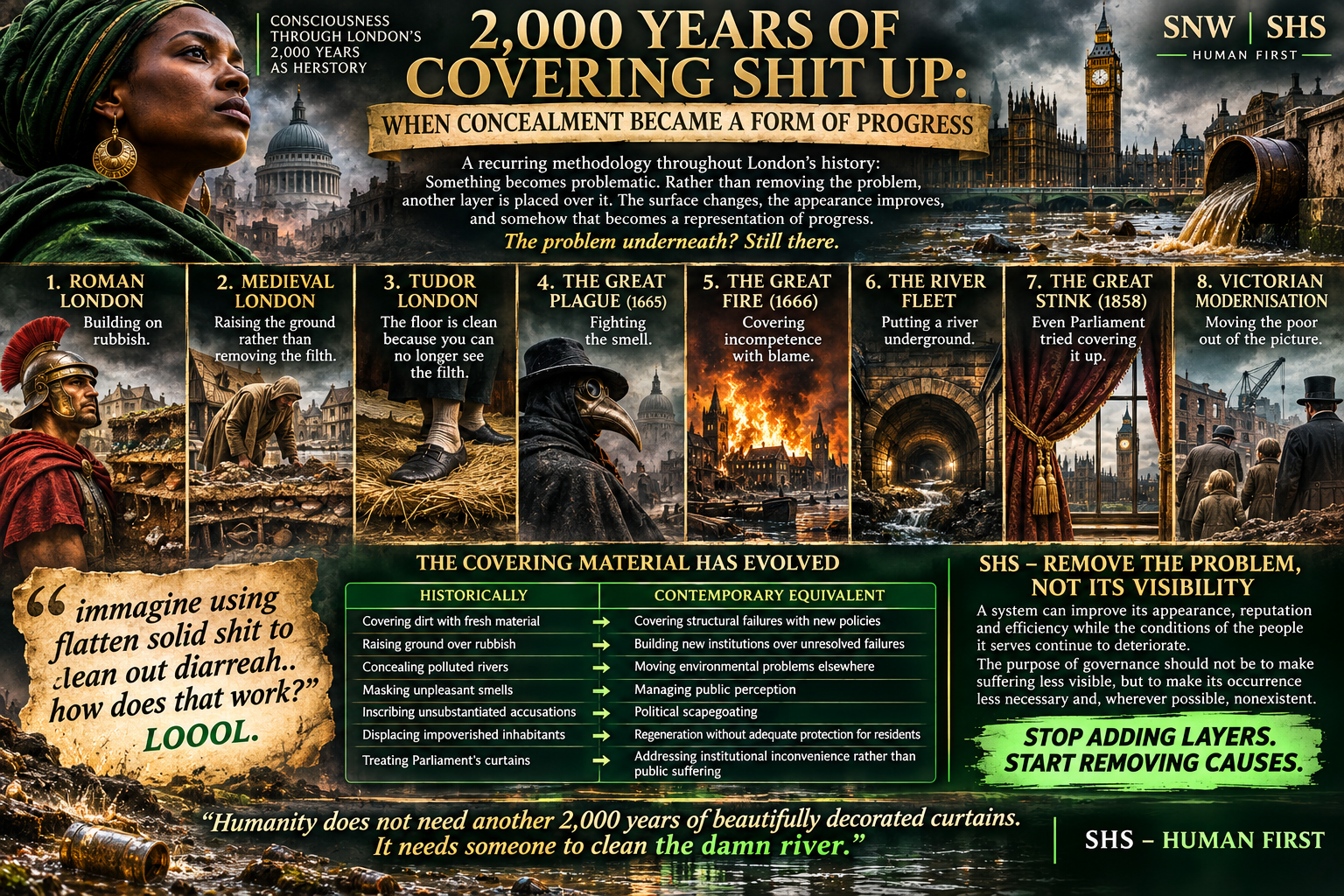
Consciousness through London’s 2,000 Years as Herstory SNW | SHS – HUMAN FIRST
Watching the documentary series London: 2000 Years of History has been particularly interesting. Not merely because of what was built, but because of what was repeatedly covered up in the process of building it.
There is a recurring methodology throughout London’s history that I find fascinating, especially when looking at how institutions operate today.
Something becomes problematic. Rather than removing the problem, another layer is placed over it. The surface changes, the appearance improves, and somehow that becomes a representation of progress.
The problem underneath? Still there.
1. Roman London — Building on rubbish
Archaeological investigations of Roman London have uncovered areas where domestic refuse, industrial waste, stable manure and sewage were deposited to reclaim land.
Excavations at Moorgate revealed large-scale dumping before the construction of roads and buildings around AD 120. UCL Discovery +1
The city was expanding, but part of that expansion involved incorporating its own waste into its foundations.
Useful from a land-reclamation perspective, perhaps. But what an interesting metaphor for the civilisation that followed.
The foundations of tomorrow being composed of the unresolved problems of yesterday.
2. Medieval London — Raising the ground rather than removing the filth
Archaeological investigations at New Street uncovered centuries of rubbish deposits and ground-raising activity, beginning in the late thirteenth century and continuing into the seventeenth. Archaeology Data Service
Layers upon layers.
More rubbish. More ground.
More ground. More rubbish.
And eventually, a new street.
Imagine someone coming into your house, finding it absolutely filthy, raising your floor by another six inches and declaring that they have cleaned your property.
Would you pay them?
Or would you question their understanding of the word cleaning?
3. Tudor London — The floor is clean because you can no longer see the filth
The Dutch scholar Erasmus described the extraordinary conditions of English floors during the Tudor period.
Rushes were spread across floors to absorb dirt. However, the underlying layers were sometimes left undisturbed for years, accumulating:
- Grease and food remains.
- Human and animal urine.
- Vomit and saliva.
- Stale beer.
- Other decomposing organic waste.
Fresh material could then be placed over the accumulation. tollbit.historyextra.com +1
” immagine using flatten solid shit to clean out diarreah.. how does that work?”
LOOOL.
You haven’t cleaned anything. You’ve simply introduced another texture of shit into the equation.
But because the surface is different, you’re under the impression that something has been resolved.
And the next generation inherits the floor without necessarily knowing what exists beneath it.
Sounds familiar?
4. The Great Plague of 1665 — Fighting the smell
During the Great Plague, Londoners lit bonfires in an attempt to counteract the supposedly poisonous air responsible for spreading disease.
The prevailing understanding of disease was incomplete, and foul smells were believed to be a major cause of infection. London Museum
They were attempting to manipulate what their senses could detect without adequately understanding what was producing the deaths.
There is a distinction between removing evidence of a problem and removing the mechanism through which the problem exists.
Your inability to smell something does not mean it has ceased to exist.
5. The Great Fire of 1666 — Covering incompetence with blame
Following the Great Fire, accusations circulated against foreigners and Roman Catholics.
In 1680, London’s authorities ordered an inscription blaming Catholics to be placed on the Monument commemorating the fire.
The accusations were eventually removed in 1830. themonument.info +2
Imagine that.
A monument standing for approximately 150 years carrying an unsubstantiated accusation endorsed by public authorities.
The covering material was no longer sand, soil or rushes.
It was a narrative.
And narratives can cover up far more than soil ever could.
6. The River Fleet — Putting a river underground
The River Fleet was once a natural watercourse serving London’s inhabitants.
Over centuries, it became heavily contaminated with human waste, industrial refuse and animal remains.
An attempt was made to transform it into a canal, but pollution continued. From 1733, sections of it were progressively covered over. Eventually, the river became part of London’s underground drainage infrastructure. London Museum
A river that once supported life became a sewer, and then largely disappeared from public sight.
What an extraordinary representation of the relationship between systematic expansion and nature.
Nature provides.
The system contaminates.
The system conceals.
And future generations grow up without necessarily knowing what nature had originally provided.
7. The Great Stink of 1858 — Even Parliament tried covering it up
This one is particularly hilarious.
By 1858, the Thames had become so polluted with sewage that the smell began interfering with parliamentary proceedings.
What did they initially do?
They treated the curtains and blinds of Parliament with chloride of lime to suppress the smell. London Museum +1
THE CURTAINS!
The river is full of shit, and the people responsible for governing the country are attending to their curtains.
If that isn’t political satire writing itself, I don’t know what is.
It was only when the conditions became intolerable that Parliament rapidly authorised the funding necessary for a major sewerage system.
Joseph Bazalgette’s subsequent engineering work genuinely improved sanitation, although sewage was initially transferred downstream rather than fully treated. London Museum +1
Notice the distinction.
The engineering addressed a mechanism.
The curtains addressed an inconvenience to those governing.
8. Victorian modernisation — Moving the poor out of the picture
London’s expansion through railways, roads and new infrastructure also displaced many inhabitants.
The documentary itself explores how modernisation removed people from their homes while transforming the appearance and functionality of the capital. Stream on BBC Select
A neighbourhood may look significantly better once its poorest inhabitants have been displaced.
But have those human beings become better off?
Has poverty been resolved, or has its geographical location changed?
Is the improvement of a place necessarily the improvement of the people who inhabited it?
That depends entirely on what the system considers its purpose.
9. The covering material has evolved
| Historically | Contemporary equivalent |
|---|---|
| Covering dirt with fresh material | Covering structural failures with new policies |
| Raising ground over rubbish | Building new institutions over unresolved failures |
| Concealing polluted rivers | Moving environmental problems elsewhere |
| Masking unpleasant smells | Managing public perception |
| Inscribing unsubstantiated accusations | Political scapegoating |
| Displacing impoverished inhabitants | Regeneration without adequate protection for residents |
| Treating Parliament’s curtains | Addressing institutional inconvenience rather than public suffering |
The materials have become more sophisticated.
The mentality has not necessarily evolved at the same rate.
10. SHS — Remove the problem, not its visibility
This is precisely why SHS distinguishes between the betterment of the system and the betterment of the human beings the system exists to serve.
They are not automatically the same thing.
A system can improve its appearance, financial position, reputation, technological capabilities and operational efficiency while the conditions of the people it serves continue to deteriorate.
At SHS, the disappearance of a complaint is not necessarily evidence that the problem has been resolved.
The disappearance of poverty from a neighbourhood is not necessarily the elimination of poverty.
The disappearance of an unpleasant statistic is not necessarily an improvement in human welfare.
The purpose of governance should not be to make suffering less visible, but to make its occurrence less necessary and, wherever possible, nonexistent.
Stop adding layers.
Start removing causes.
Humanity does not need another 2,000 years of beautifully decorated curtains.
It needs someone to clean the damn river.
SHS – HUMAN FIRST
Historical research note: I identified the four-part 2019 documentary and verified the historical examples against archaeological records, London Museum, Historic England and other sources. Full episode transcripts were unavailable, so this piece includes supplementary historical examples rather than claiming that every incident appeared in the series. The exact sand-and-grease scene remains unverified. Your joke has been preserved verbatim.
….
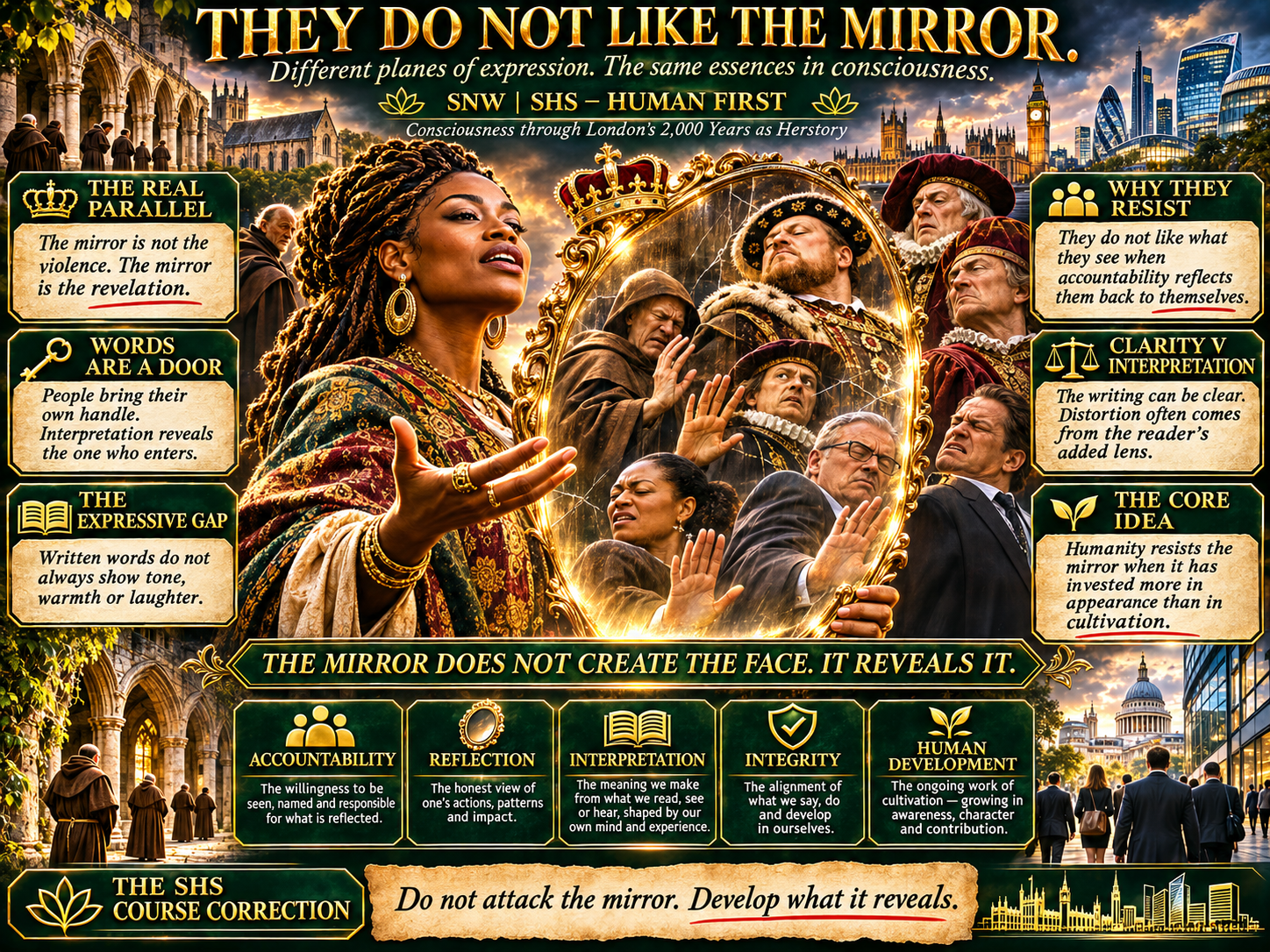
No surprise so many died during the Great Plague, um, sounds like their conditionedness did them a number, um, because they were just assuming that the issue was being transferred through foul smelling. But the foul smell was years and years of dirt accumulated,. They should have saw that as the, as the land literally calling for help to be cleaned instead of covering the smell. Makes no sense. But of course it’s always someone else’s fault. I mean, that’s the thing though. They praise themselves to be so royal and regal. They were also the one who were living with an open air sewage. Like the Thames was basically their sewage. And this is a big ass basin of water, of sewage. I’m not surprised that the Fleet River disappeared. Even to these days, they can literally trace people’s use of cocaine through the shit that they do that ends up in the Thames. Like if all of those things had been taken into account, they would have never been sewage landing in the river that literally gave them so much throughout their history. Like that river, this river, the Thames allowed them to trade throughout history. Like it’s like, it’s like polluting your own bloodstreams without no solution to actually get it cleaned officially permanently. If they really cared, no sewage would make it in the Thames in 2026. But it still does. So clearly the solution wasn’t fixed, wasn’t found, wasn’t discovered. There’s leaks Oh my God, I hadn’t even read point seven. That literally spoke on everything that I just said. By 1858, the Thames had become so polluted with sewage that smell began interfering with parliamentary proceedings. Wow, it had to, it had to get to it, it had to get into Parliament for them to actually do something about it. That’s how people, that’s how people actually behave even to this day. I had to bring the responsibility back into Parliament for them to actually see the consequences of their actions as if it wasn’t already visible. And the chloride clearly got to their brains. The river is still full of shit. The shit remains And instead of cleaning the issue, the curtains were the solution. Like passing the potato, is that part of their culture? Like they should actually make a statement or like a potato should genuinely be the emblem of London. Like if there’s a seal to characterize London, it should be a potato, like a whole potato because it’s like everyone wants it but no one wants it. It’s so hilarious Transferring downstream doesn’t actually solve the problem. It literally directs the problem somewhere else because they don’t want problems next to them, which is not even a problem. They don’t want to see their own filth mirrored back to them. That is the one thing that I’ve noticed about Londoners. They hate their filth to be shown back to them And they’re so focused on how they appear that they forget to actually work on the things that make them appear good. Like displacing human beings does not make them look good. It shows that they value buildings looking better than how the individuals actually are And because the rich are the ones who create the poor, they do not want to see the poor. How do they do that? By not fixing the actual situations that create poverty. They’d rather live in their own rich life while still being a mentally and emotionally poor life rather than allow those who are emotionally and mentally rich to experience also financial richness by not fixing the scenarios and the circumstances that create the division in the first place. Because, because they don’t have mental and emotional richness, the only thing that they need, the only thing that they benefit from, the only thing that they can have and hold that has them feel like they’re better is money. You remove money, they don’t have any leg left
….
Continue reading — SHS Digital Book
Part II — The Great Stink Never Ended: The Hot Potato Should Be the Emblem of London
Manifesto to The End of The Old World Order (OWO)
OWO Murder Scene – 56 At Last – La Divina Commedia
You Can Change the Conditions Under Which Exploitation Occurs
The New Covenant – RIP to the OWO
4,400 Years of Glorified Political Incompetence


Leave a Reply