
Remove it and watch the magic happen. Like literally. Consciousness will have more space to come through us, cause creativity won’t be attached to a finite dead thing like it, but to the ever unfolding of life. Take your picks. Magic or money. Ya can’t have both on a large scale. Only the 1% will. Like with Money. 2 mirrors with M as capital letter. They used propaganda to enforce it, it makes sense it woul also undo it
…
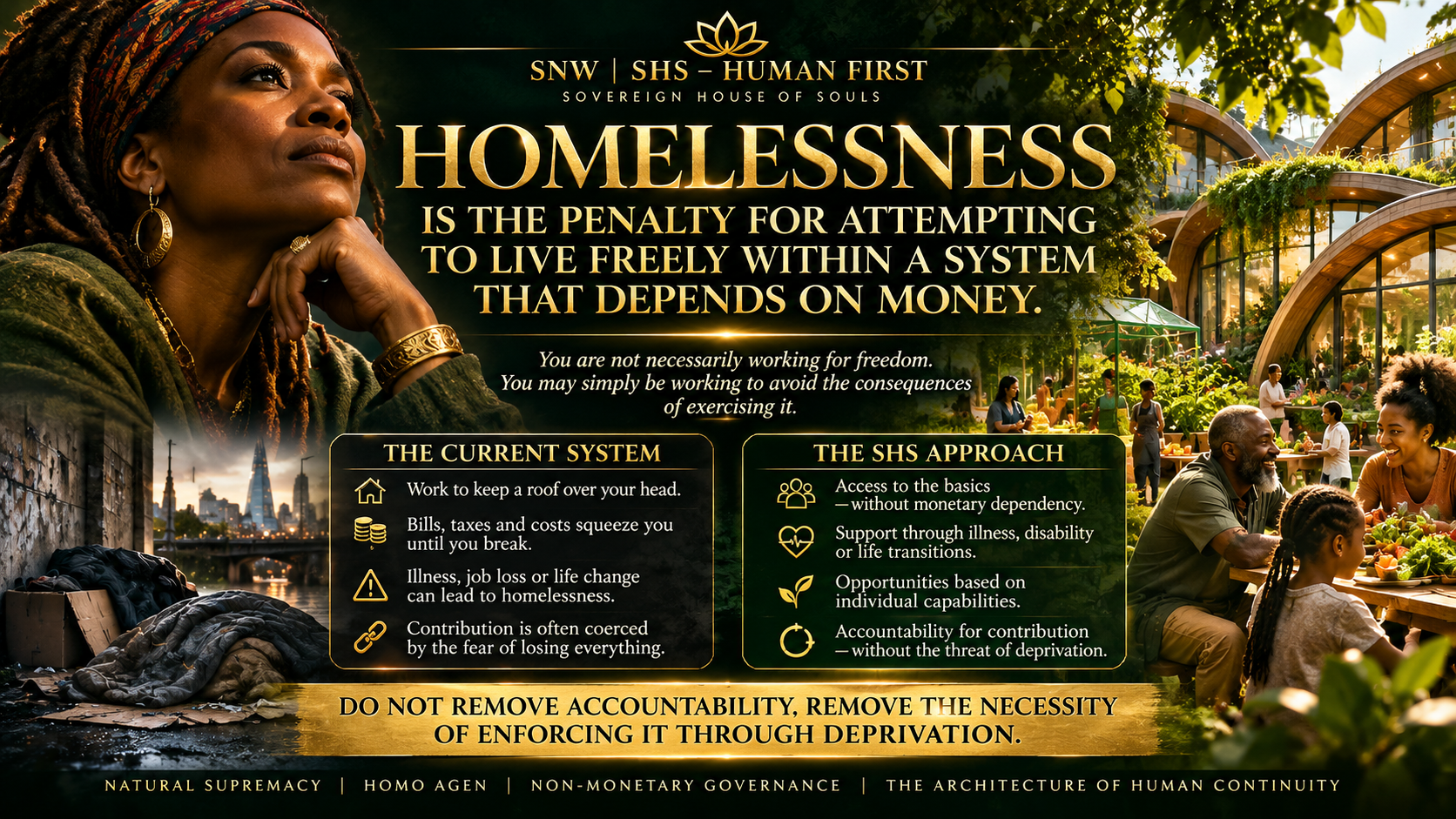
HOMELESSNESS IS THE PENALTY FOR ATTEMPTING TO LIVE FREELY WITHIN A SYSTEM THAT DEPENDS ON MONEY.
What You Call Freedom Is Still Governed by the Fear of Losing Everything.
SNW | SHS – HUMAN FIRST
I’ve essentially been living freely since 2024. Mentally, emotionally and, in my relationship with money, financially.
The fact that I experienced homelessness does not contradict that freedom. It illustrates the limitations of the system within which I was attempting to exercise it.
When you live within a system that makes access to the most natural necessities dependent upon money, homelessness becomes one of the potential consequences of attempting to live beyond that dependency.
It is not necessarily a punishment imposed intentionally by an individual. It is a structural penalty produced by the way access to existence has been organised.
And that is precisely what I am building against.
WHAT ARE PEOPLE ACTUALLY AFRAID OF?
Homelessness.
Prison.
And behind both, the possibility of death, deprivation or the deterioration of their existence.
How many people return to work every morning because they genuinely want to contribute to what they are building?
And how many return because they cannot afford the consequences of not doing so?
There is a considerable difference between the two.
Within the existing system, there are several ways to secure greater freedom:
- Accumulate enough money to finance your own existence.
- Inherit sufficient wealth to avoid compulsory employment.
- Find someone willing to finance your existence.
- Continue working to maintain access to necessities.
Even attempting to live independently within nature can require money, land ownership or permission.
You are not necessarily working for freedom. You may simply be working to avoid the consequences of exercising it.
THE SYSTEM DOES NOT NEED TO ANNOUNCE ITS PUNISHMENTS.
The government does not send you a letter saying:
By the way, the cumulative financial obligations being placed upon you may eventually make your existence unsustainable.
Instead, the pressures arrive individually.
Rent. Energy bills. Water bills. Taxes. Transportation costs. Food prices. Debt repayments.
Each institution accounts for what it requires from you without necessarily accounting for what all the institutions collectively leave you with.
And when you can no longer sustain those obligations, the consequences become your personal circumstances to manage.
Work harder.
Find another job.
Reduce your expenditure.
Give up more of your time.
Become more economically useful.
At what point does the system hold itself accountable for the circumstances its collective arrangements produce?
It does not require a deliberate intention to make someone homeless for the architecture to produce homelessness.
The outcome itself deserves accountability.
SHS — FREEDOM WITHOUT THE THREAT OF DEPRIVATION
What I am building through SHS is an ecosystem within which access to fundamental necessities is progressively separated from monetary dependency.
Housing. Nourishment. Water. Healthcare. Education. Energy.
The objective is that none of these should become inaccessible simply because someone experiences a temporary inability to contribute.
That does not mean creating a population that sits around doing nothing whilst a smaller proportion of humanity sustains everyone’s existence.
We cannot recreate the mentality of the masters who sloth away whilst everyone else performs the work that sustains them.
That would merely redistribute the positions within the same hierarchy.
| Existing conditions | SHS developmental objective |
|---|---|
| Work to maintain access to shelter. | Secure shelter whilst developing your capacity to contribute. |
| Illness can compromise financial security. | Illness initiates care and reciprocal support. |
| Losing employment can threaten your entire existence. | Losing a role does not mean losing your place within the ecosystem. |
| Contribution is predominantly measured financially. | Contribution is recognised through its actual value. |
| Individuals must adapt to available employment. | Opportunities are developed around individual capabilities. |
| Survival incentivises productivity. | Purpose, reciprocity and responsibility incentivise contribution. |
| Deprivation disciplines the individual. | Development and accountability strengthen the individual. |
Accountability does not require the threat of homelessness.
UNDERSTANDING YOUR PEOPLE IS A PREREQUISITE TO PROVIDING FOR THEM.
If somebody becomes unwell, somebody else can temporarily contribute in their place.
When they recover, they can resume contributing according to their readiness and capabilities.
If somebody lives with a physical disability, why would we force them into work that exceeds their physical capacity?
Why not understand what they are capable of?
They may possess extraordinary cognitive, creative, organisational, emotional or analytical abilities. They may have developed particular ways of navigating existence through the circumstances they have experienced.
Others may require long-term support without being able to undertake conventional work at all.
Understand the individual before determining what contribution is appropriate.
And recognise that an individual’s right to exist does not disappear when their capacity to contribute does.
Humanity is not a collection of interchangeable employees.
It is a collective of individuals possessing different capabilities, experiences, developmental trajectories and circumstances.
Those differences are resources to understand and nurture, not inconveniences to administer.
If our governments do not understand their people, how can they possibly organise adequate provision for all of them?
FREEDOM FROM OBLIGATION IS NOT FREEDOM FROM ACCOUNTABILITY.
There is a difference between:
- Being unable to contribute.
- Needing time before contributing.
- Not having discovered how to contribute.
- Deliberately exploiting the contributions of others.
Why should all four circumstances receive the same response?
The first requires support.
The second requires understanding.
The third requires development.
The fourth requires accountability.
None requires homelessness.
An intelligent governance architecture must possess the capacity to distinguish between these circumstances and respond accordingly.
Otherwise, it is not governing human beings through understanding. It is governing them through generalisation.
THE SECURITY TO DEVELOP YOURSELF
Imagine being able to change direction without risking everything.
To discover that your current occupation does not reflect your capabilities and have the opportunity to develop new ones.
To become a parent without fearing financial collapse.
To recover from illness without having to calculate how much recovery you can afford.
To take time to understand yourself without being deemed economically irrelevant.
To create something valuable without first having to establish its commercial viability.
How much human potential remains undeveloped because human beings cannot afford the time required to develop it?
We keep questioning why people are not more innovative, more emotionally regulated, more creative, more collaborative and more responsible.
Yet we continuously organise their existence around circumstances that deprive them of the time and security necessary to cultivate those qualities.
And then we punish them for the consequences.
I AM NOT BUILDING AGAINST CONTRIBUTION. I AM BUILDING AGAINST THE COERCION OF CONTRIBUTION.
My own experience challenges the assumption that freedom inevitably produces laziness.
I have continued creating without being financially rewarded for every creation.
I have chosen to contribute because I recognise value in what I am developing.
I want that opportunity to become accessible to others without them having to experience the deprivation I experienced.
Homelessness should not be a developmental requirement for discovering that another way of living is possible.
Nor should wealth be a prerequisite for exercising freedom.
I do not want humanity to have to choose between its freedom and its security.
I want to develop an architecture within which the two sustain one another.
IF FREEDOM THREATENS YOUR ACCESS TO EXISTENCE, HOW FREE WERE YOU IN THE FIRST PLACE?
We should not have to threaten human beings with deprivation to make them valuable.
We should develop conditions within which human beings can discover, nurture and express their value.
We should not have to fear losing everything whenever we become temporarily incapable of giving something.
We should belong to an ecosystem capable of sustaining us through those circumstances, just as we sustain it through ours.
DO NOT REMOVE ACCOUNTABILITY. REMOVE THE NECESSITY OF ENFORCING IT THROUGH DEPRIVATION.
DO NOT ELIMINATE CONTRIBUTION. LIBERATE IT FROM THE COERCION OF SURVIVAL.
DO NOT TEACH HUMANITY HOW TO AFFORD ITS EXISTENCE. ORGANISE RESOURCES SO THAT EXISTENCE DOES NOT CONTINUOUSLY HAVE TO BE AFFORDED.
That is the distinction.
That is what SHS is building towards.
SNW | SHS – HUMAN FIRST
Natural Supremacy — Homo Agen — Non-Monetary Counter-Inflationary Governance — The Architecture of Human Continuity
……
So I’m gonna need you to write the following piece, which would be about how I’ve been basically living freely, whether mentally, emotionally, financially, or whatnot, since 2024. And the only reason why I got made homeless is because when you live in a system that depends on money to take and have access to the most natural things, homelessness is one of the benchmarks if you’re trying to live freely, you know? It’s like, it’s the, it’s the penny— what’s it called? Punishment for wanting to live without depending on money. That’s what homelessness is, basically. And that’s why everyone fears homelessness. That’s why everyone goes to work. Everyone fears homelessness or prison. Those are the two things. And death is, like, behind it, because those two feel like they’re closer to both. They’re closer to death. But really and truly, homelessness is the punishment for wanting to live freely, wanting to live in the most natural way possible. Unless obviously you have money to self-finance and going and living in the woods. Or you just, you have an inheritance, like financial inheritance, like the trust fund kid, basically. Or… You work. There’s another way. So, in a system, in the system that I’m building, no one needs to be homeless because, because the system, it’s about not relying on money to have access to everything. That is the whole context of it all. Homelessness is the punishment for the current system in which we live in. But it doesn’t tell you that anything that the government also builds, which, by the way, is considerably and more and more pushing people towards homelessness. It doesn’t tell you that, oh, by the way, I’m planning to make you homeless, and in doing so, I’m gonna squeeze every source that you have, financial source that you have, give you bills and taxes to pay so that then you get homeless and then you stop thinking about wanting something better for yourself. Or you give more of yourself and you work even harder for this one system that doesn’t really care for you. That’s what it wants from you. So it makes no sense because it shouldn’t be like that. What I’m building through SHS is a system that gives you access to the basics, gives you boundaries of how much you can sloth, because we cannot live. Like the masters who sloth away while everyone else does the hard work for us. And we need to build something where everyone can be held accountable for contributing, but at the same time, if one day they don’t contribute, they don’t risk losing everything. You know? Or if something happens to their health, they don’t risk losing a spot where they can contribute. Someone else might kick in, and then the moment they are back on their feet, they can contribute again if they want to, if they’re ready for it. We’re never going to have a disabled individual trying to force themselves into hard work when they might not have the resources to do so, like physical resources to do so. We might give them jobs where they might have to use their minds a bit more, because that’s what probably would have had to become more developed in order to think their way through life where the physicality wasn’t available. You know? It’s understanding your people. If our governments do not understand the people, that’s why they cannot provide for everyone. Simple as that.



Leave a Reply