

This song sounds great, great vocals, but the mentality is the most disruptive that exists. Acknowledge the good and understand the bad.
Billionaire – Travie McCoy ft. Bruno Mars
A better one: ” Die With A Smile – Bruno Mars ft. Lady Gaga “
….
The saying originates from a traditional Spanish proverb:
“Dime con quién andas y te diré quién eres.”
Tell me who you walk with, and I will tell you who you are.
One of its earliest documented literary appearances is in Don Quixote (1615) by Miguel de Cervantes. Cervantes himself presented it as an existing proverb, so its original author remains unknown.
Similar sentiments were expressed by:
- Euripides (c. 480–406 BC): “Every man is like the company he is wont to keep.”
- Johann Wolfgang von Goethe (1749–1832): “Tell me your companions, and I will tell you what you are.”
…..
Write about how a majority of people thinks highly of the things that are actually detrimental to humanity. One that is a successful billionaire is detrimental to humanity because that billionaire is not making millionaires of everyone else. If a billionaire existed because everyone else was a millionaire, then happy days. But they’re not. And we don’t. We’re not. So we have to really look at the things that people look highly of and consider highly because that will show us exactly where as a humanity, as a society we’re missing out on. When you look at a king and a queen, you look highly to them just because they have an acclaimed role in society, but not because they offer value to that society. Not anything as special as the role that is because they might do charities and things like that. It is part of the character, it is part of the role. But because of how highly they are put in society, they should be delivering way more. But they don’t. People look highly of people that make money. People look highly of people that conquer things. People look highly of people that have created famous pieces because there’s people that have created better pieces than Shakespeare, let’s be honest. But they’re not seen as highly just because they do not have the reputation of Shakespeare. There’s like people don’t look highly of someone that has lost everything but somehow learned how to take care of themselves. People don’t look highly to the single mom that raises the child and does their best at it and yeah, sure, she might have a lot of lucks, but that single mom still was able to raise a child on her own. People don’t look highly to the woman that was abused, kicked, beaten, spat at, insulted and still somehow was able to rise above it all and still continue to have a sense of self, a reason to stay alive. People don’t look highly to the man that’s expected not to cry but cries in front of a crowd because they understand that capping themselves is what creates insensible man in the first place. And they want to be better. People don’t look highly to the father that stays in the family instead of getting distracted by what glimmers outside of the realm of the family. People don’t look highly to the one that doesn’t have a lot of money but makes sure that every day there’s food on the table. Somehow they make it work. People don’t look highly to the one that walks miles just to get some bread, food, clothing for their kids. They look highly of the one that uses their Maserati to get to the corner shop that’s down the road. Like people’s priorities in what they put on a pedestal are completely disrupted. And disruptive to the notions of what is supposed to be seen as highly in society
…..
Consciousness through London’s 2,000 Years as Herstory — Part VI
SNW | SHS – HUMAN FIRST
Following the distinction between constructed supremacy and natural supremacy, I think it is necessary to investigate what human beings actually think highly of.
Because what a civilisation admires reveals what it aspires towards.
What it rewards reveals what it encourages.
What it celebrates reveals what it wishes to reproduce.
And what it continuously overlooks reveals the qualities it has failed to recognise the value of.
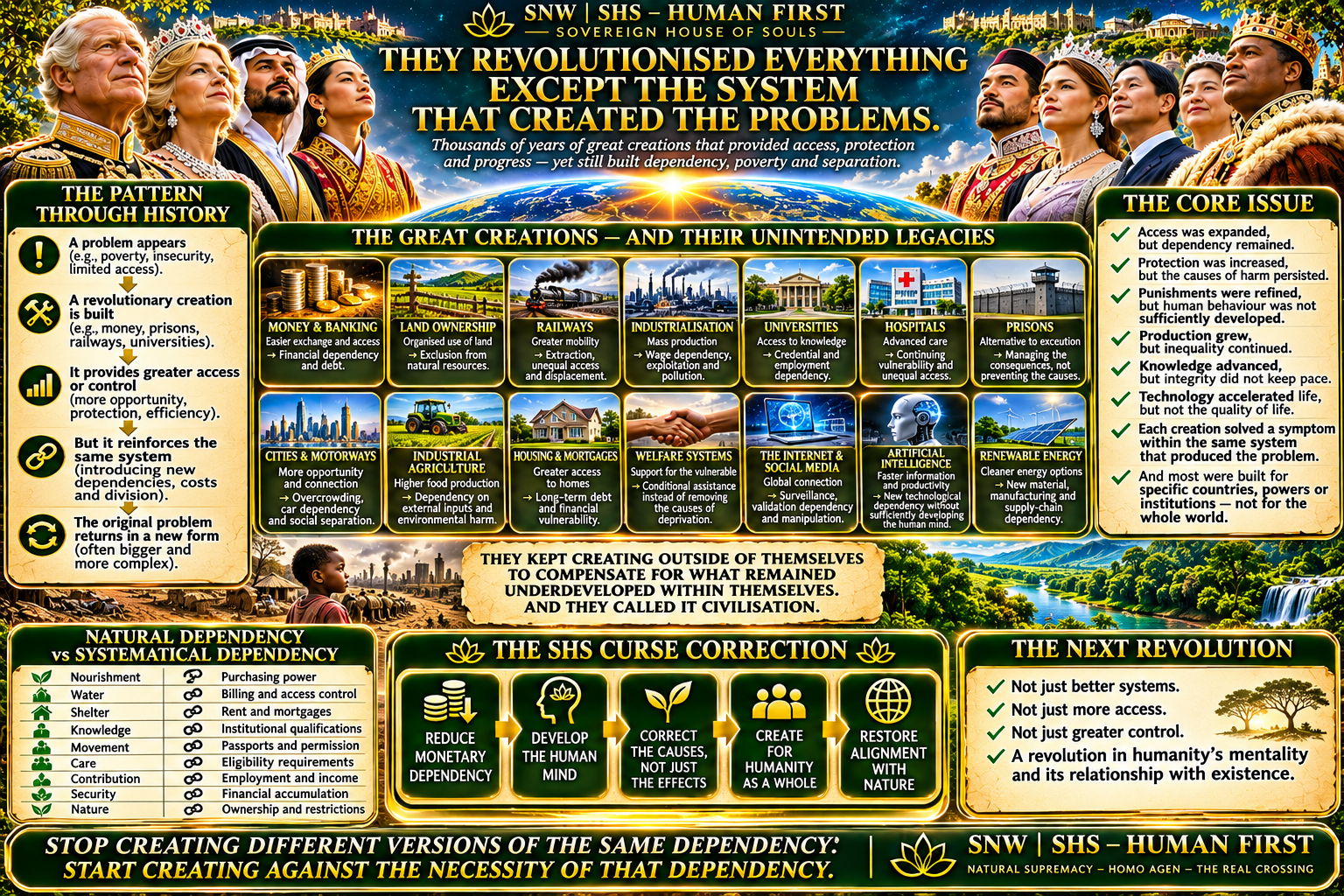
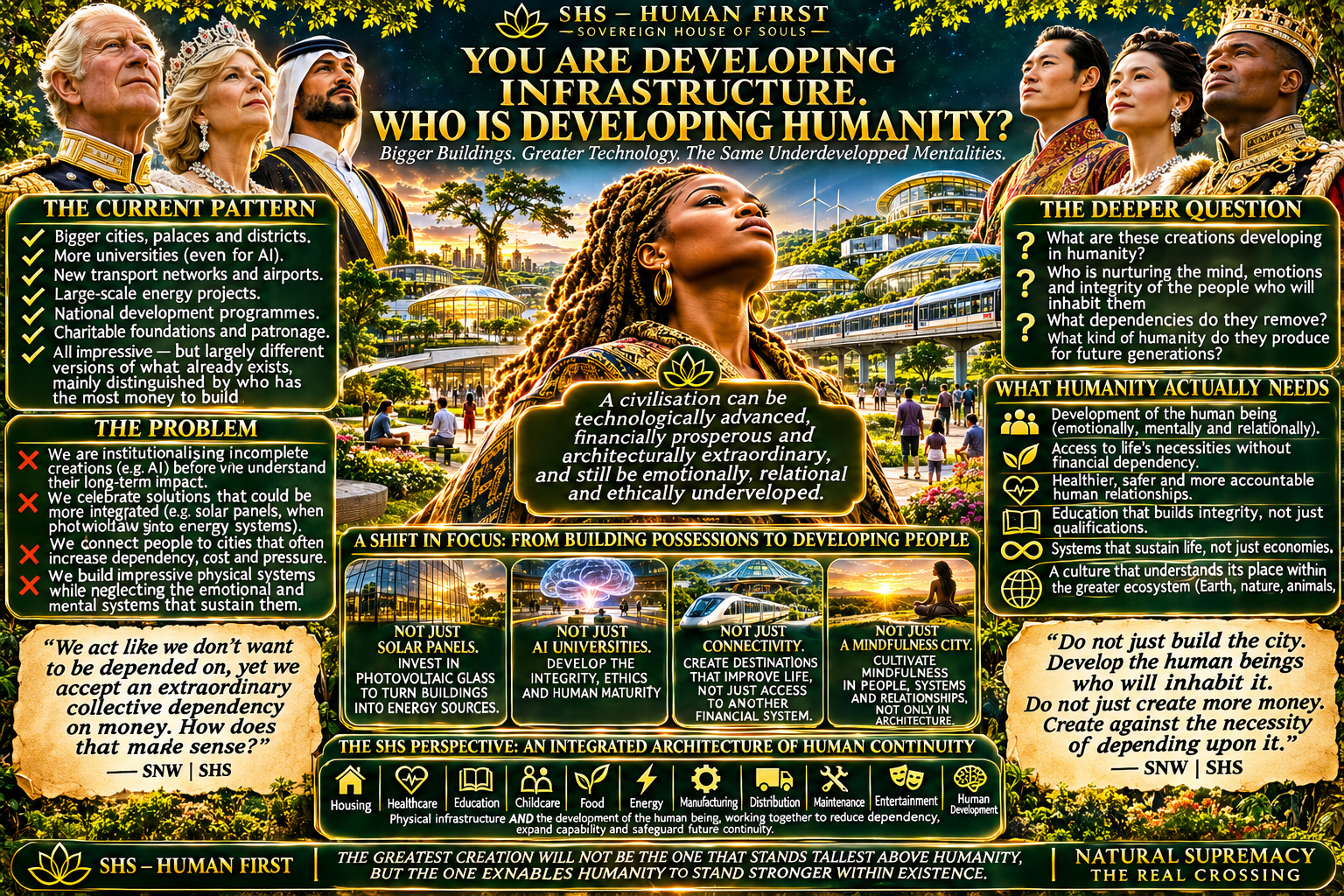
The problem is not merely that humanity has stopped thinking highly of itself.
It is that so much of society thinks highly of things that can be detrimental to its own collective development.
Humanity has not lost its ability to admire. It has compromised its understanding of what is admirable.
THE BILLIONAIRE — WHAT EXACTLY ARE YOU CELEBRATING?
People look highly upon someone for becoming a successful billionaire.
But what has that billionaire made of everyone else?
If a billionaire existed because everyone else was a millionaire, happy days!
If their extraordinary financial wealth were a consequence of having elevated the material circumstances of everyone participating in its creation, then there would be something collectively worth celebrating.
But the mere existence of a billionaire does not demonstrate that the circumstances of humanity have improved.
Someone can accumulate extraordinary wealth whilst the people contributing to its accumulation struggle to afford accommodation, food, healthcare and the necessities of existence.
Yet society looks towards the person at the top of that arrangement as the representation of success.
Not towards the people sustaining it.
Not towards the people making sacrifices within it.
Not towards the people whose labour continuously enables its existence.
I am not questioning someone’s ability to accumulate money.
I am questioning why the accumulation itself is considered an accomplishment worthy of admiration independently of its consequences.
How wealthy did the people around you become as a consequence of your becoming wealthy?
And I am not exclusively referring to financial wealth.
What knowledge did they gain?
What freedom did they acquire?
What opportunities became accessible to them?
What circumstances did you help them overcome?
What abilities did they develop?
What can they now experience that they could not experience before?
Because if your personal success is not translating into the betterment of the circumstances of those enabling it, then what exactly makes your success a success for humanity?
THE KING AND QUEEN — ADMIRATION BEFORE CONTRIBUTION
People look highly upon kings and queens because they occupy an acclaimed position within society.
Their admiration has been predetermined.
Before the individual has demonstrated anything extraordinary, the position itself has already established the expectation that they should be admired.
The individual inherits the admiration alongside the title.
And yes, they may participate in charitable activities, support organisations and contribute positively to particular causes.
But surely the magnitude of their responsibilities should correspond to the magnitude of the position they occupy?
If millions of ordinary human beings can dedicate themselves to charitable activities without possessing palaces, institutional resources, international visibility or inherited wealth, then surely considerably more should be expected of those who possess all of those advantages?
Instead, the very circumstances that should increase the expectations placed upon them can become the reasons society is impressed by considerably less.
The higher the pedestal, the higher the responsibility should be. Not the lower the threshold for admiration.
THE CONQUEROR — GREATNESS THROUGH THE DISRUPTION OF OTHERS
People look highly upon those who have conquered territories.
They celebrate the expansion of empires.
They admire military victories.
They name streets, buildings and institutions after individuals whose historical significance is associated with their capacity to overpower others.
But what about the human being who prevented a conflict?
What about the individual who managed to establish communication between people who could not previously coexist?
What about those who ensured children did not have to grow up without their parents?
What about those whose intelligence prevented the necessity of violence in the first place?
Their accomplishments are considerably more difficult to commemorate because the very thing they successfully prevented never occurred.
There is no battlefield to visit.
No destruction to photograph.
No dramatic victory to reenact.
No casualty list to demonstrate the magnitude of what was avoided.
And yet, from the perspective of human continuity, their contribution could be substantially greater.
Why is humanity so fascinated by those who survived their own destruction and so indifferent towards those who prevented destruction from occurring?
SHAKESPEARE — WHEN REPUTATION BECOMES THE MEASUREMENT OF QUALITY
People look highly upon those who have created historically famous pieces.
But fame and quality are not interchangeable.
There may be human beings alive today whose literary abilities, creativity, philosophical understanding and capacity to express the complexities of human existence exceed those of William Shakespeare.
Yet their work may never be studied.
Their names may never be known.
Their writings may never enter educational institutions.
Not necessarily because their contributions are inferior, but because they do not possess the inherited machinery of recognition that accompanies an established reputation.
Shakespeare’s literary significance does not require questioning the possibility of someone else being equally or more capable.
In fact, if humanity is developing across generations, it should welcome that possibility.
What would be the purpose of inheriting centuries of literature, knowledge and linguistic development if subsequent generations were never expected to surpass those who preceded them?
The greatest compliment to a historical contributor is not to make their greatness permanently unattainable. It is to demonstrate how much further humanity could develop because of what they contributed.
How many extraordinary works have been overlooked because society was too occupied admiring the names it had already been taught to admire?
NOW LET US LOOK AT THE PEOPLE HUMANITY DOES NOT PUT ON PEDESTALS
THE HUMAN BEING WHO LOST EVERYTHING AND LEARNED TO TAKE CARE OF THEMSELVES
Society celebrates someone who has accumulated millions.
But how much recognition does it give to someone who lost everything and somehow learned how to rebuild themselves?
Someone who had to rediscover their identity without the circumstances through which they had previously understood themselves.
Someone who had to develop resourcefulness, emotional intelligence, independence and resilience whilst possessing very little.
Someone who learned how to care for themselves without having been adequately shown how.
What extraordinary knowledge might such a human being possess?
What could they teach others about existence?
What might humanity learn from them about the distinction between possessing things and possessing oneself?
But because their accomplishments cannot necessarily be displayed through material possessions, society struggles to recognise them as successful.
Some human beings have accomplished more with nothing than others have accomplished with everything.
THE SINGLE MOTHER
People do not look highly enough upon the single mother who raises a child on her own.
Yes, she may have shortcomings.
Yes, she may make mistakes.
Yes, there may be things she could do better.
But she is simultaneously attempting to maintain her own existence whilst developing the existence of another human being.
She must organise resources, manage time, provide emotional support, educate, protect, nurture and continuously respond to circumstances that are not entirely within her control.
And unlike someone occupying a prestigious institutional position, she cannot simply finish her working day and return home from her responsibilities.
Her responsibilities are at home.
How much intelligence does that require?
How much adaptability?
How much endurance?
How much creativity?
How much love?
An individual raising another human being is contributing directly to what humanity will subsequently become.
Yet someone accumulating money can receive substantially more admiration than someone developing a life.
What does that reveal about society’s priorities?
THE WOMAN WHO REFUSED TO LET CRUELTY DETERMINE WHAT SHE BECAME
What about the woman who was abused, kicked, beaten, spat at, insulted and repeatedly subjected to circumstances that could have destroyed her understanding of herself?
The woman who somehow managed to rise above it all.
Who rediscovered her sense of self.
Who found a reason to continue existing.
Who refused to allow the cruelty of others to permanently determine the relationship she had with herself.
Who perhaps even retained her ability to love, to trust, to create and to recognise goodness despite everything she had experienced.
Where is her monument?
Where is her ceremony?
Where is the recognition of her extraordinary accomplishment?
Society celebrates those who conquer other human beings.
But what about the human being who had to overcome the consequences of what other human beings did to her?
She may have conquered something considerably more difficult than territory.
And her greatness does not depend upon her ability to recover in a particular way or within a particular timeframe. Nor should her resilience become an excuse for allowing such suffering to occur.
The recognition of her strength should coexist with the responsibility to eliminate the circumstances that made such strength necessary.
THE MAN WHO CRIES IN FRONT OF A CROWD
What about the man who has been conditioned to believe that crying makes him less of a man, yet possesses the courage to cry in front of an entire crowd?
The man who recognises that suppressing his emotional existence is not necessarily a representation of strength.
The man who understands that continuously capping his emotional expression can compromise his ability to understand himself, communicate with others and develop meaningful relationships.
The man who is willing to confront generations of conditioning because he wishes to become better.
Society has traditionally celebrated men for their capacity to endure pain without displaying it.
But what about their capacity to acknowledge pain without becoming ashamed of their humanity?
What about their ability to communicate their suffering rather than reproduce it through their behaviour towards others?
What about their willingness to develop emotional sensitivity in environments that have taught them to consider sensitivity a weakness?
What kind of strength requires a human being to conceal an entire dimension of their existence?
The man who chooses to confront that conditioning may be contributing more towards the development of future generations than the man who proudly reproduces it.
THE FATHER WHO STAYS
What about the father who remains committed to his family?
The one who does not continuously become distracted by everything that glimmers outside the realm of the relationships he has chosen to nurture.
The one who understands that continuity requires participation.
The one who recognises that bringing a child into existence is not the completion of his contribution to that child’s existence.
It is the beginning.
The one who invests time, attention, emotional availability, patience and knowledge into the human beings whose development he has accepted responsibility for.
The one who understands that the greatest thing he can create might not be something he can sell.
It might be someone he can help develop.
And his greatness does not lie merely in staying physically present. It lies in how positively his presence contributes to the circumstances of those around him.
These human beings are continuously developing the future of humanity.
Yet how often are they celebrated with the enthusiasm society reserves for someone acquiring another luxury?
THE PERSON WHO SOMEHOW MAKES IT WORK
What about the human being who does not possess much money, but somehow makes sure there is food on the table every single day?
The one who must constantly reorganise limited resources to accommodate the needs of several human beings.
The one who knows how to stretch what little they possess.
The one who anticipates what will be needed tomorrow whilst ensuring there is enough for today.
The one who has developed an extraordinary understanding of resource management without ever being awarded a degree in economics.
The one whose creativity is not necessarily expressed through a painting, a business or an invention, but through the continuous preservation of life under difficult circumstances.
Society celebrates chief executives for successfully allocating millions of pounds.
Imagine what the person maintaining an entire household with considerably less could teach them about resourcefulness.
Sometimes the greatest demonstrations of intelligence are occurring in the environments that society has taught itself to associate with failure.
THE ONE WHO WALKS MILES FOR THEIR CHILDREN V THE ONE WHO DRIVES A MASERATI TO THE CORNER SHOP
This one particularly reveals the absurdity of society’s priorities.
There is a human being who walks miles to obtain bread, food, clothing or other necessities for their children.
And there is another human being who drives their Maserati to the corner shop down the road.
Which one is society more likely to turn its head towards?
Which one is more likely to be perceived as successful?
Which one is more likely to be admired?
The one whose commitment requires considerable physical effort, or the one whose financial circumstances have eliminated the necessity of that effort?
There is nothing inherently wrong with possessing a Maserati.
But there is something fundamentally misplaced about recognising the vehicle as a greater representation of human accomplishment than the commitment of the person walking.
The car demonstrates what someone possesses.
The journey may demonstrate what someone is willing to do for another human being.
And those are entirely different measurements of greatness.
One is visible wealth. The other is expressed humanity.
Why has society become so much more attentive to the former?
WHAT HUMANITY CELEBRATES V WHAT HUMANITY SHOULD LEARN TO RECOGNISE
| What society often puts on a pedestal | What deserves considerably more recognition |
|---|---|
| Financial accumulation | The ability to expand collective prosperity |
| Inherited authority | Demonstrated responsibility and accountability |
| Military conquest | Conflict prevention and reconciliation |
| Established literary reputation | Originality and intellectual contribution, wherever they emerge |
| Luxury possessions | Resourcefulness and meaningful contribution |
| Emotional suppression | Emotional intelligence and authentic expression |
| Institutional prestige | Integrity independent of institutional recognition |
| Public visibility | The invisible preservation of human life |
| Physical dominance | The ability to protect without unnecessarily harming |
| Individual success | Success that multiplies the capabilities of others |
| The appearance of independence | The ability to rebuild oneself after losing everything |
| Expensive lifestyles | The ability to provide consistently under difficult circumstances |
| Commanding a population | Nurturing and developing another human being |
| Being served by others | Contributing towards the betterment of others |
The problem is not necessarily the existence of the things in the first column.
The problem is the hierarchy of admiration that society has constructed around them.
THE CONSEQUENCES OF MISDIRECTED ADMIRATION
What happens when children grow up observing these priorities?
They learn that the person with the expensive car is more successful than the person who walks miles to care for them.
They learn that the person with the most money is more accomplished than the person who makes sure everyone eats.
They learn that being emotionally unavailable can be a representation of masculinity.
They learn that commanding others can be a representation of greatness.
They learn that recognition is more important than contribution.
They learn that being seen as successful can be more rewarding than actually improving the circumstances of another human being.
And then society wonders why so many human beings dedicate their existence to the pursuit of money, appearance, status, reputation and authority.
What else have you taught them to aspire towards?
The things placed upon pedestals become instructions without needing to be written as instructions.
They communicate what society considers worth becoming.
They influence what people sacrifice, what they pursue, what they neglect and what they consider beneath them.
A civilisation cannot continuously glorify the accumulation of individual advantages and then express surprise when collective responsibility deteriorates.
It cannot continuously glorify superiority and then express surprise when people struggle to coexist as equals.
It cannot continuously reward appearances and then express surprise when people conceal their inadequacies.
The admiration itself becomes part of the conditioning.
DO NOT CONFUSE THE GREATNESS OF THE HUMAN BEING WITH THE GREATNESS OF THEIR CIRCUMSTANCES
There is another important distinction to make.
I am not suggesting that poverty, abuse, emotional suffering, abandonment or deprivation should become the new requirements for being considered extraordinary.
That would be another form of distorted thinking.
The objective is not to romanticise suffering.
The objective is to recognise the extraordinary human qualities that can exist independently of favourable circumstances, whilst working towards eliminating the unnecessary suffering through which those qualities have had to express themselves.
The single mother deserves recognition, but she also deserves support.
The survivor deserves recognition, but she should never have been subjected to abuse.
The father deserves recognition, but he should have access to the circumstances necessary to participate meaningfully in his family’s development.
The person walking miles for their children deserves recognition, but their children should not have to depend upon such sacrifice to access necessities.
The person who makes it work deserves recognition, but they should not be permanently required to make inadequate resources work.
Recognise the greatness of the human being. Do not glorify the inadequacy of the circumstances.
That is where recognition must translate into responsibility.
SHS — REORGANISING THE PEDESTALS
Natural supremacy requires humanity to reconsider what it thinks highly of.
Not simply to replace one predetermined selection of superior human beings with another.
But to develop the ability to recognise greatness through its expression, irrespective of where it occurs.
Within a kitchen.
Within a classroom.
Within a hospital.
Within a household.
Within a laboratory.
Within someone rebuilding their life.
Within someone choosing not to reproduce the cruelty they experienced.
Within someone quietly making sure another human being has the opportunity to continue existing.
Greatness does not become less extraordinary because nobody witnessed it.
Contribution does not become less valuable because nobody documented it.
Intelligence does not become less intelligent because nobody awarded it a qualification.
And a human being does not become less worthy of admiration because their circumstances have not enabled them to accumulate the things society has been conditioned to admire.
Perhaps humanity’s greatest educational reformation must begin with the reformation of its admiration.
Because until human beings learn to recognise what actually contributes towards their collective betterment, they will continue aspiring towards things that can compromise it.
STOP ADMIRING PEOPLE EXCLUSIVELY FOR HOW HIGH THEY HAVE MANAGED TO PLACE THEMSELVES.
START RECOGNISING PEOPLE FOR HOW MUCH HUMANITY THEY HAVE MANAGED TO ELEVATE.
Natural supremacy.
Thinking highly of humanity.
And learning to recognise the things within humanity that are actually worth thinking highly of.
SNW | SHS – HUMAN FIRST



Leave a Reply